Stop Guessing the Market
A Practical Framework for Retail Investors Who Want Clearer Buy, Hold, and Sell Decisions
Most retail investors are not short of effort. They read the news, follow market opinions, watch prices move, and try to make sensible decisions with the information in front of them. The problem is that the market rarely gives clear answers when emotions are high. Stocks often look safest after they have already risen, and they often feel most dangerous just before strength begins to return.
That is why so many investors buy too late, sell too early, hold through major weakness, or hesitate when the best opportunities are forming.
The Smart Money Framework is designed to solve that problem.
It gives retail investors a clear, disciplined way to judge what the market itself is showing - not what the headlines are saying, not what the crowd is feeling, and not what emotion is pushing them to do. The framework is built around the simple idea that every stock moves through recognisable stages. Once you understand those stages, you can make better decisions about what to buy, when to buy, when to hold, and when to step aside.
The aim is not to predict every market move. The aim is to stop guessing, remove emotion from the decision-making process, and follow a logical framework that helps you identify strength early, avoid obvious weakness, and exit before the risk becomes too great.
Stage 1
Filter Out the Noise
Most investors believe they need more information.
More news. More opinions. More forecasts. More analyst upgrades. More economic commentary. More explanations for why the market moved today.
But in reality, most investors do not suffer from a lack of information. They suffer from too much noise.
Noise is anything that distracts you from what the market itself is actually showing. It is the headline that makes you feel safe after a stock has already risen. It is the frightening news story that makes you sell just as strength is beginning to return. It is the broker recommendation that sounds convincing but arrives long after the best opportunity has passed. It is the confident market forecast that gives you certainty in a place where certainty rarely exists.
Financial news can be useful for understanding what has happened, but it is rarely useful for deciding what to do next. By the time most investors read the story, the market has usually already reacted. The price has moved. The strong hands have positioned. The opportunity, or the danger, has often started before the explanation reaches the public.
Broker and analyst advice can also be dangerous when followed blindly. Not because every analyst is wrong, but because the investor rarely knows the interests, incentives, assumptions, or timing behind the recommendation. A stock can be upgraded after a major rise, downgraded after a major fall, or promoted when the best entry point has already passed. For the retail investor, this creates a serious problem: they are often acting on second-hand opinion instead of first-hand evidence.
The Smart Money Framework starts by removing that dependency.
Instead of asking, “What are people saying?” the investor begins asking, “What is the market showing?”
Is the stock rising or falling? Is it acting stronger or weaker than the wider market? Is volume confirming demand? Is the stock building strength quietly, breaking out into a new advance, losing momentum, or entering clear weakness?
This shift changes everything.
The goal is not to know every news story. The goal is to read market action clearly enough to make better decisions. Strong stocks reveal themselves through behaviour. Weak stocks reveal themselves through behaviour. The market leaves evidence behind long before the average investor feels confident enough to act.
Filtering out the noise does not mean ignoring the world. It means refusing to let headlines, opinions, fear, hype, or hope make the decision for you.
The disciplined investor learns to position into strength, not emotion. They wait for evidence. They look for demand. They focus on stocks that are improving before the crowd fully understands why. And they avoid the trap of buying stories when the market action itself is already warning them to stay away.
This is the first principle of the Smart Money Framework:
Before you can invest intelligently, you must stop listening to the noise and start reading the market.Stage 2
Start With the Big Picture
Before looking for individual stocks to buy, the Smart Money Framework begins with the wider market.
This matters because even strong stocks can struggle when the overall market is weak. A good company, a strong story, or an attractive price does not protect an investor if the market itself is under pressure. When the wider market is falling, fear spreads quickly, money leaves risk assets, and even quality shares can be dragged lower.
The disciplined investor does not begin by asking, “What stock should I buy?”
They begin by asking, “Is this a healthy market to be buying in at all?”
The purpose of this stage is to judge the overall market climate. Is money flowing into the market or leaving it? Are more stocks rising than falling? Are leading shares acting well? Are breakouts succeeding or failing? Is volume supporting the advance, or appearing heavily on the down days? Is the market making progress, or is it struggling beneath the surface?
These questions help the investor decide whether the correct action is to buy, hold, reduce risk, or stay out.
A healthy market gives investors a tailwind.
Prices are rising, leading stocks are breaking out, demand is visible, and pullbacks are generally controlled. In this environment, investors can look for high-quality opportunities and position into strength.
A mixed market requires patience.
Some stocks may still be acting well, but the evidence is not strong enough to be aggressive. In this environment, the investor should be selective, avoid chasing, and only act when the individual stock shows exceptional strength.
A weakening market demands caution.
More stocks begin to break down, failed breakouts become common, volume appears on the sell side, and the strongest names start losing momentum. In this environment, the investor should protect capital, avoid new exposure, and review existing positions carefully.
A dangerous market is one where the evidence has clearly turned negative.
The main trend is down, weakness is spreading, and rallies are failing. In this environment, the priority is not finding bargains. The priority is avoiding damage.
The Smart Money Framework does not require the investor to predict the economy, interest rates, inflation, elections, recessions, or headlines. It asks them to judge what the market is already doing.
The market itself gives clues.
If the majority of stocks are improving, demand is broadening, and leading shares are breaking higher, the investor has permission to look for opportunities.
If fewer stocks are participating, weakness is spreading, and price action is deteriorating, the investor has a warning to become more defensive.
This is the second principle of the Smart Money Framework:
Never judge a stock in isolation. First judge the market it belongs to.Stage 3
Identify the Market Stage
Once the wider market has been assessed, the next step is to identify the stage of the individual stock.
This is one of the most important parts of the Smart Money Framework, because every stock moves through a cycle. It falls, it settles, it strengthens, it advances, it slows, it weakens, and eventually it declines again. Most retail investors only notice the move once it has already become obvious. By then, the best part of the opportunity may already be gone.
The disciplined investor looks earlier.
They are not trying to predict the future. They are trying to recognise the change in behaviour before the crowd fully sees it.
The first clue is often a stock that has stopped falling. The price is no longer making aggressive new lows. It starts to move sideways. The selling pressure begins to reduce. Volume may dry up on declines, suggesting fewer investors are rushing to sell. The stock may begin to hold above previous support areas. At this point, the stock is not yet a buy, but it may be moving out of clear weakness and into a base-building stage.
The next clue is the 30-week moving average.
In a weak stock, the 30-week average is usually falling, and price remains below it. This tells the investor that the main trend is still negative. In this stage, the stock should normally be avoided, no matter how cheap it appears.
As the stock improves, the 30-week average begins to flatten. This is an early sign that the downward pressure may be easing. The stock may start crossing above and below the average as it builds a base. This still requires patience. A flat average is not enough on its own, but it tells the investor that the character of the stock may be changing.
The stronger signal comes when price moves above the base and the 30-week average begins to turn upward. This suggests the stock is no longer simply recovering from weakness. It may be preparing to enter a new advancing stage.
Volume is the confirmation.
A move higher on weak volume is less convincing. A move higher on increasing volume suggests that demand is returning. This is where the Smart Money Framework looks for evidence that larger, more informed buyers may be accumulating shares before the move becomes widely accepted.
Relative strength adds another layer.
The stock should not only look better against its own past. It should also begin acting stronger than the wider market. If the general market is flat or weak, but the stock is holding up well or rising, that is an important clue. It suggests the stock is attracting demand while others are being ignored.
The purpose of this stage is to classify the stock correctly.
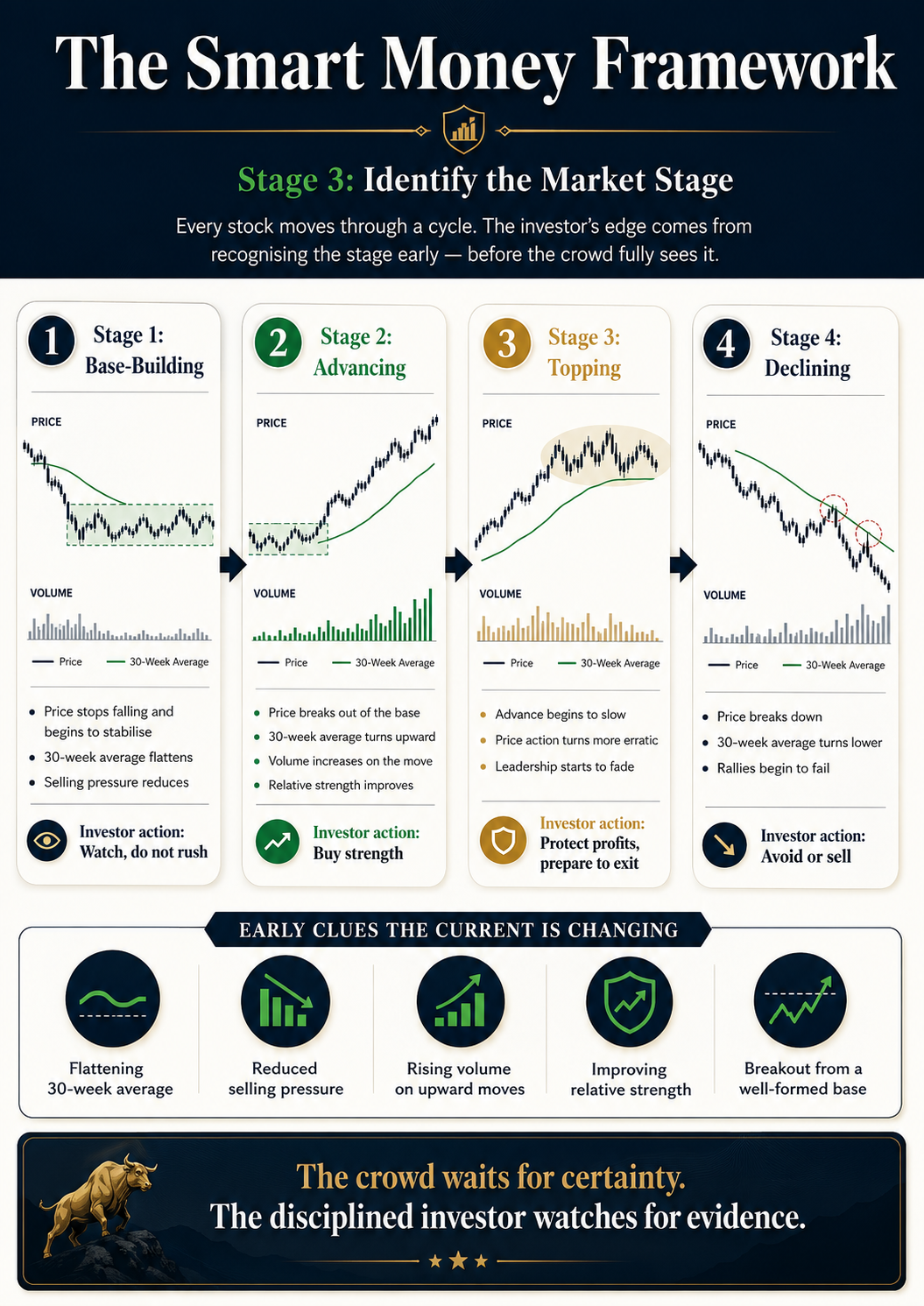
This is where the retail investor gains an advantage. They stop reacting to stories after the move has happened and start reading the early evidence of change.
The market often gives clues before the crowd has confidence. A flattening 30-week average, reduced selling pressure, improving relative strength, and rising volume on upward moves are all signs that the current may be changing.
This is the third principle of the Smart Money Framework:
Every stock has a stage. The investor’s job is to identify the stage before making the decision.Stage 4
Avoid the Falling Knife
One of the most dangerous ideas in investing is the belief that a stock must be good value simply because it has fallen in price.
Retail investors are often attracted to falling stocks because they look cheaper than they used to be. A share that was £10 and is now £5 feels like a bargain. A share that has dropped 40%, 50%, or 60% starts to look tempting because the mind naturally compares today’s price with the old high.
But the market does not care where the stock used to trade.
A falling stock is not automatically cheap. Very often, it is falling because the balance between supply and demand has changed. Sellers are in control. Buyers are not strong enough to absorb the pressure. Confidence has weakened. Institutions may be reducing exposure. The trend has turned against the investor.
This is what people mean when they talk about catching a falling knife.
The danger is not just that the stock has fallen. The danger is that there is no evidence the fall is over. A stock can look cheap, then become cheaper. It can fall 30%, then fall another 30%. It can bounce just enough to create hope, then roll over again. These temporary rallies can be especially dangerous because they make investors believe the recovery has begun when the stock is still trapped in a declining stage.
This is where the 30-week moving average becomes vital.
In the Smart Money Framework, the 30-week average acts as a simple guide to the stock’s major trend. When price is below a falling 30-week average, the message is clear: the stock is still in a weak phase. The dominant direction is down. The burden of proof is on the stock to show real improvement before it deserves attention.
A declining 30-week average tells the investor not to argue with the market.
It means the stock has not simply had a bad week or a short pullback. It means the longer-term trend has deteriorated. Each rally should be treated with caution until the evidence changes. If price keeps failing below the 30-week average, the stock is not showing strength. It is showing resistance from above. Sellers are using rebounds as opportunities to exit.
This is why buying too early in Stage 4 is so costly.
The investor sees a lower price and imagines upside. The market sees weakness and continues to punish it. The investor thinks they are being brave. In reality, they may simply be standing in front of the trend.
The Smart Money Framework teaches the opposite approach.
A falling stock must first stop falling. It must stabilise. It must build a base. The 30-week average must flatten. Selling pressure must reduce. Relative strength must improve. Then, and only then, can the investor begin to consider whether the stock is moving out of weakness and into a healthier stage.
Until that happens, the correct action is simple: avoid it, sell it, or stay out of the way.
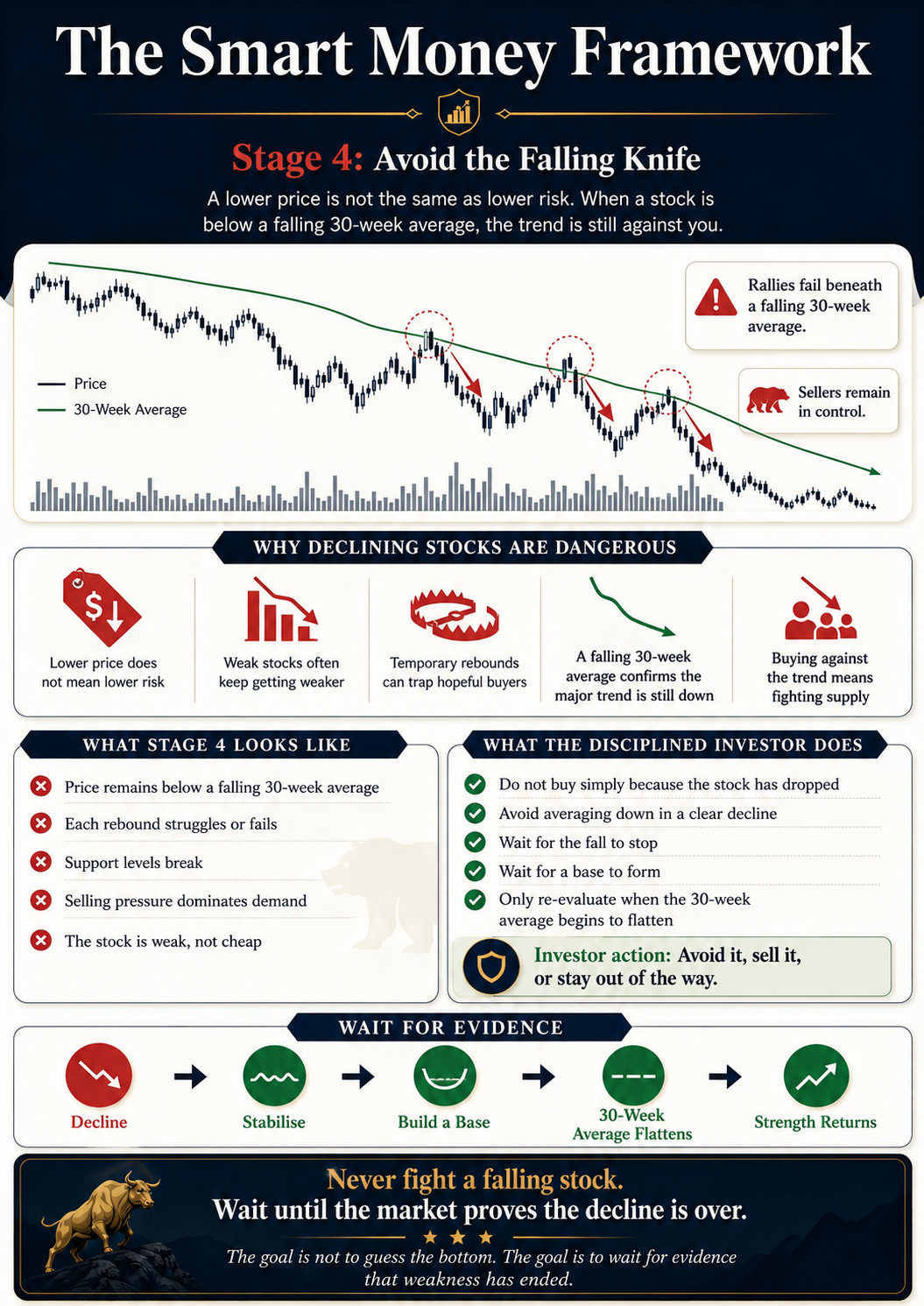
Stage 4 is not where smart investors look for easy bargains. It is where disciplined investors protect capital. They understand that the first job is not to make money. The first job is to avoid large, unnecessary losses.
A stock in decline may eventually become a great opportunity, but not while it is still declining. The opportunity comes later, when the selling has exhausted itself, the base has formed, and the market begins to show renewed demand.
This is the fourth principle of the Smart Money Framework:
Never fight a falling stock. Wait until the market proves the decline is over.Stage 5
Watch Quiet Strength Form
The best opportunities rarely begin when the story already looks perfect.
By the time everyone agrees a stock is attractive, the strongest part of the move may already be underway. The headlines have improved. The analysts are more confident. The crowd feels safer. But the market often begins turning before the public explanation becomes obvious.
This is where the disciplined investor must learn to look beneath the surface.
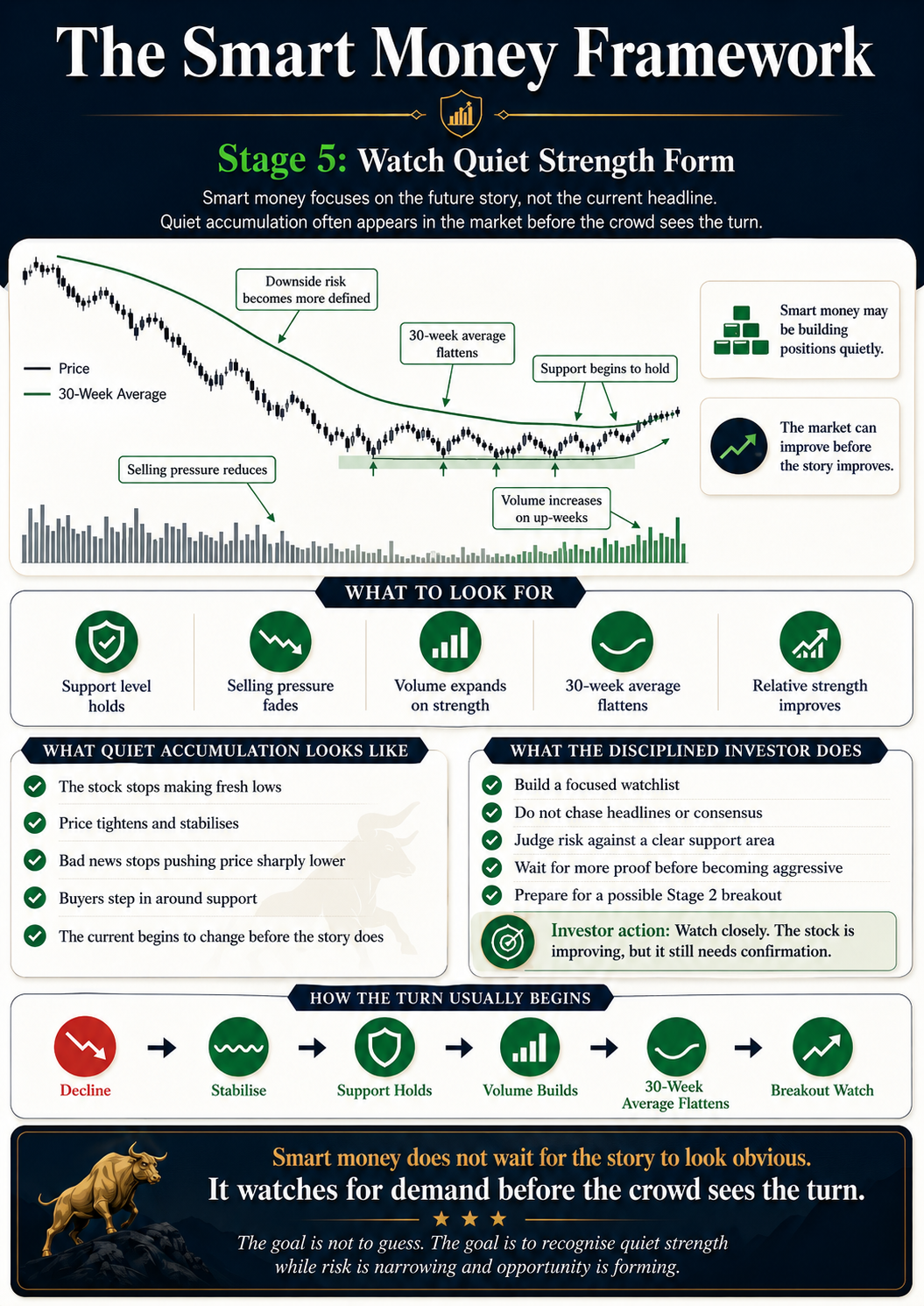
Stage 5 is about recognising quiet strength before it becomes widely accepted. It is the point where a stock has stopped falling, selling pressure has begun to ease, and signs of accumulation start to appear. The old story may still look poor. The news may still be negative. Sentiment may still be low. Most investors may have lost interest.
But smart money is not focused only on the current story.
The current story is often already priced in.
What matters is whether the future story is beginning to change.
This change does not usually announce itself through headlines first. It appears in market behaviour. The stock stops making fresh lows. It begins to hold key support areas. Declines become less aggressive. Volume starts appearing on stronger weeks. Price begins to tighten. The 30-week average starts to flatten. The stock begins acting less weak than it did before.
These are the clues that matter.
A stock that was previously falling begins to stabilise. Each attempt to push it lower attracts buyers. The price stops collapsing on bad news. Selling volume dries up. Then, on improving weeks, volume begins to expand. This suggests that demand may be returning quietly.
This is often where stronger hands begin building positions.
They are not buying because the stock feels exciting. They are buying because the downside risk may be starting to narrow while the potential reward begins to improve. The stock has already been punished. Weak holders may have already sold. The price has found an area where buyers are prepared to step in. The risk can now be judged against a clearer support level.
That support level is important.
A support area shows where demand has appeared before. If the stock repeatedly holds that area, it tells the investor that sellers are no longer able to force the price materially lower. This does not guarantee a new advance, but it does show that the balance between supply and demand may be shifting.
The 30-week moving average remains central.
At this stage, the 30-week average may still be flat or only beginning to turn. That means the investor should not become aggressive too early. The stock is improving, but it has not fully proven itself. The purpose of Stage 5 is not to rush in. The purpose is to prepare.
The disciplined investor watches for a combination of clues:
Taken together, these signs suggest that the current may be changing.
This is where the retail investor can develop a real edge. Not by guessing the bottom, and not by buying every stock that has fallen, but by learning to recognise when weakness is quietly being replaced by accumulation.
Stage 5 is not about chasing excitement.
It is about building the research list before the crowd returns.
The investor is looking for stocks where risk is becoming more defined, demand is beginning to reappear, and the market is showing early evidence that a future advance may be forming.
This is the fifth principle of the Smart Money Framework:
The best opportunities often begin quietly, while the crowd is still looking backwards.Stage 6
Wait for Confirmation
Spotting early strength is important, but it is not enough on its own.
A stock may stop falling. It may begin to stabilise. It may hold support. It may even show signs that buyers are returning. But until the market confirms that strength, the investor must remain patient.
This is where many retail investors make their next mistake.
After watching a stock decline for months, they see the first sign of improvement and rush in too early. They want to catch the bottom. They want to be ahead of the move. They convince themselves that the worst is over because the price has stopped falling.
But a stock that has stopped falling has not necessarily started advancing.
There is a difference between a stock that is improving and a stock that is ready.
The Smart Money Framework separates those two ideas.
Stage 5 identifies the stock as a candidate. Stage 6 decides whether that candidate deserves to become a buy candidate. That decision should not be based on hope, excitement, or the feeling that the stock “looks cheap.” It should be based on confirmation.
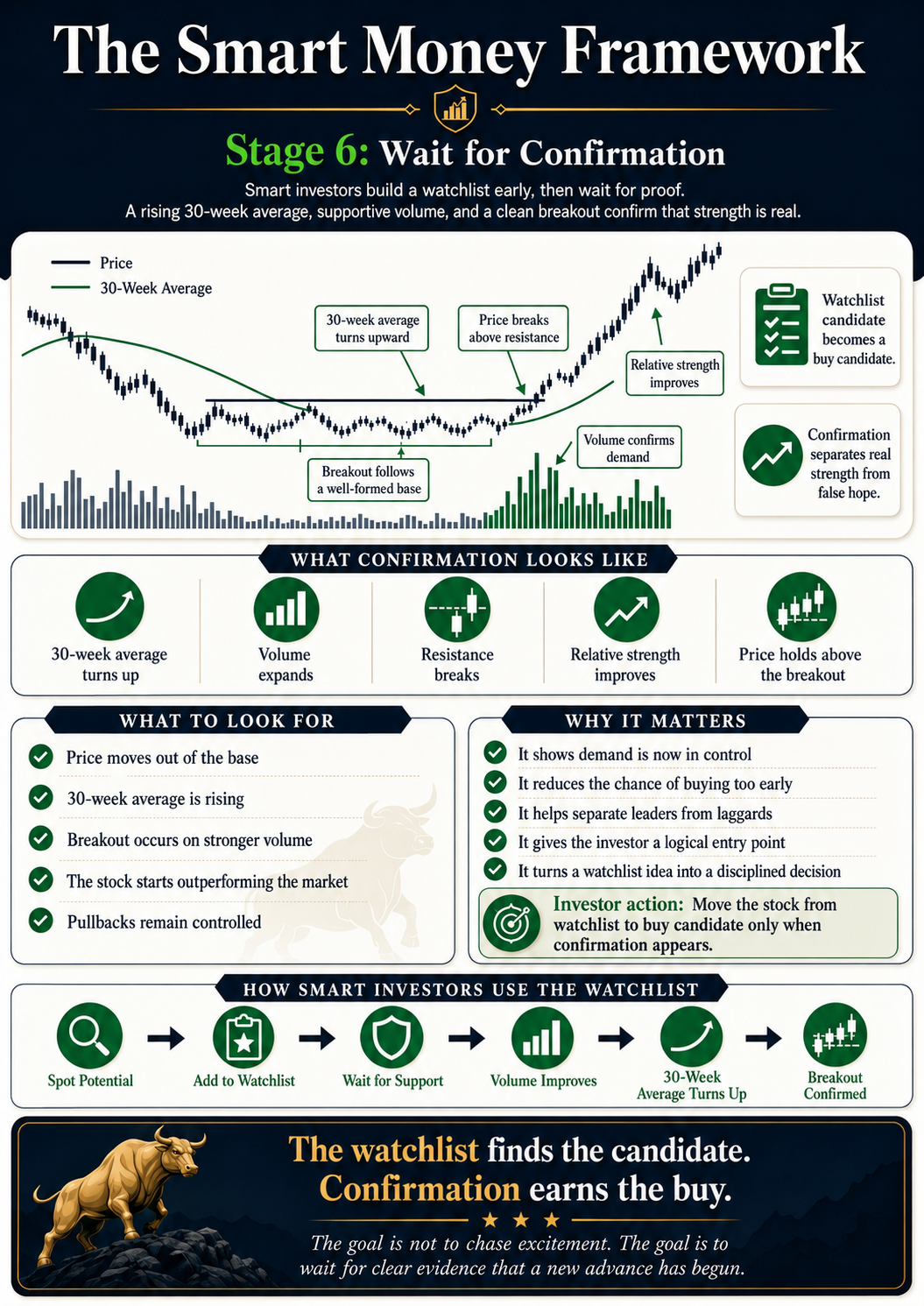
Confirmation means the market is now providing stronger evidence that demand is taking control.
The first sign is the 30-week moving average.
In a weak stock, the 30-week average is usually falling, and price struggles below it. In an improving stock, the average begins to flatten. But the stronger signal comes when the 30-week average starts to turn upward. This tells the investor that the major trend is no longer working against them. The stock is beginning to move with the current, not against it.
The second sign is the breakout.
A stock that has been building a base will often meet resistance around the same area several times. Sellers appear there. The price struggles there. The stock cannot yet push through. Confirmation begins when price finally breaks above that area and shows that demand is strong enough to overcome supply.
The third sign is volume.
A breakout on weak volume is not as convincing. It may simply be a temporary move with little real sponsorship behind it. A breakout supported by stronger volume tells a different story. It suggests buyers are stepping in with conviction. It shows that the move is not just a small bounce, but potentially the beginning of a more meaningful advance.
The fourth sign is relative strength.
The stock should not only be rising. It should be acting better than the wider market. If the overall market is mixed but this stock is pushing higher, holding gains, and showing leadership, that is important evidence. Strong stocks often reveal themselves by refusing to behave like weak ones.
The final sign is follow-through.
A stock does not need to go straight up after breaking out, but it should behave well. It should hold above the breakout area or recover quickly if it pulls back. Pullbacks should remain controlled. The stock should not immediately collapse back into the base. If it does, the breakout may have failed.
This is why confirmation matters.
It reduces the chance of buying too early. It helps the investor avoid false starts. It separates real strength from temporary hope. It turns a stock from an interesting idea into a disciplined decision.
The disciplined investor does not need to buy the exact bottom. They need to buy when the evidence has improved enough to justify the risk.
That is the purpose of the research list.
The research list is not a list of stocks to buy immediately. It is a list of stocks to monitor. The investor identifies early movers, tracks the development of the base, watches the 30-week average, observes volume, compares relative strength, and waits for the market to confirm the opportunity.
When confirmation appears, the decision becomes clearer.
The stock has moved out of its base. The 30-week average is rising. Volume supports the move. Relative strength is improving. The breakout is holding. At that point, the investor is no longer buying a falling stock or guessing at a bottom. They are positioning into emerging strength.
This is the sixth principle of the Smart Money Framework:
The research list finds the candidate. Confirmation earns the buy.Stage 7
Follow Relative Strength
Not every improving stock deserves the same attention.
Some stocks rise because the whole market is rising. Some recover because they were heavily sold and are simply bouncing. Others begin to act differently. They push higher before the wider market. They hold firm when other stocks weaken. They break out while similar companies are still struggling. They begin to lead.
This is where relative strength becomes vital.
Relative strength is not just about whether a stock is going up. It is about whether the stock is acting stronger than the market around it. A stock may rise 10%, but if its sector has risen 20%, it is not leading. Another stock may rise only slightly in a weak market, but if everything else is falling, that strength may be meaningful.
The Smart Money Framework looks for stocks that are proving themselves against both the wider market and their own sector.
This matters because the biggest future winners often begin by showing leadership early. They do not wait for every stock to recover. They start outperforming while the crowd is still uncertain. They attract demand before the story becomes obvious. They begin to separate from the pack.
A true leader shows strength in more than one way.
It holds up better during weak periods. It recovers faster after pullbacks. It breaks out from its base with stronger volume. It moves above its 30-week average while weaker stocks remain trapped below theirs. It begins outperforming the market index. It also begins outperforming other stocks in the same sector.
That sector comparison is important.
If a whole sector is improving, the investor should not automatically buy any stock within it. The better question is: which stock is acting strongest inside that improving group? Which one is breaking out first? Which one is attracting volume? Which one is holding support more cleanly? Which one has the clearest upward turn in its 30-week average?
The strongest stock in a strong sector can offer a powerful advantage.
It has two forces working in its favour: the sector is attracting money, and the individual stock is showing leadership within that sector. This is often where the most compelling opportunities develop.
The opposite is also true.
A stock that looks cheap but is underperforming its sector is not showing leadership. A stock that cannot rise when its market is rising is giving a warning. A stock that breaks down while similar stocks are holding firm may be revealing hidden weakness. Relative strength helps the investor avoid weak names disguised as bargains.
This stage is about ranking opportunity.
Once a stock has moved from research candidate to buy candidate, the investor should ask:
If the answer is yes, the stock may not just be improving. It may be emerging as a leader.
This is important because leadership often compounds. Strong stocks can continue attracting attention, capital, and confidence. As more investors recognise the move, demand can increase. What begins as quiet strength can become visible momentum.
The disciplined investor does not chase every rising stock. They look for evidence of leadership.
They want stocks where the market itself is voting clearly. They want stocks that are not simply moving with the crowd, but standing above it. They want stocks that show strength before the story becomes comfortable, and continue to show strength as the move develops.
Relative strength is the framework’s way of asking one simple question:
Why own the average stock when the market is already showing you the leaders?
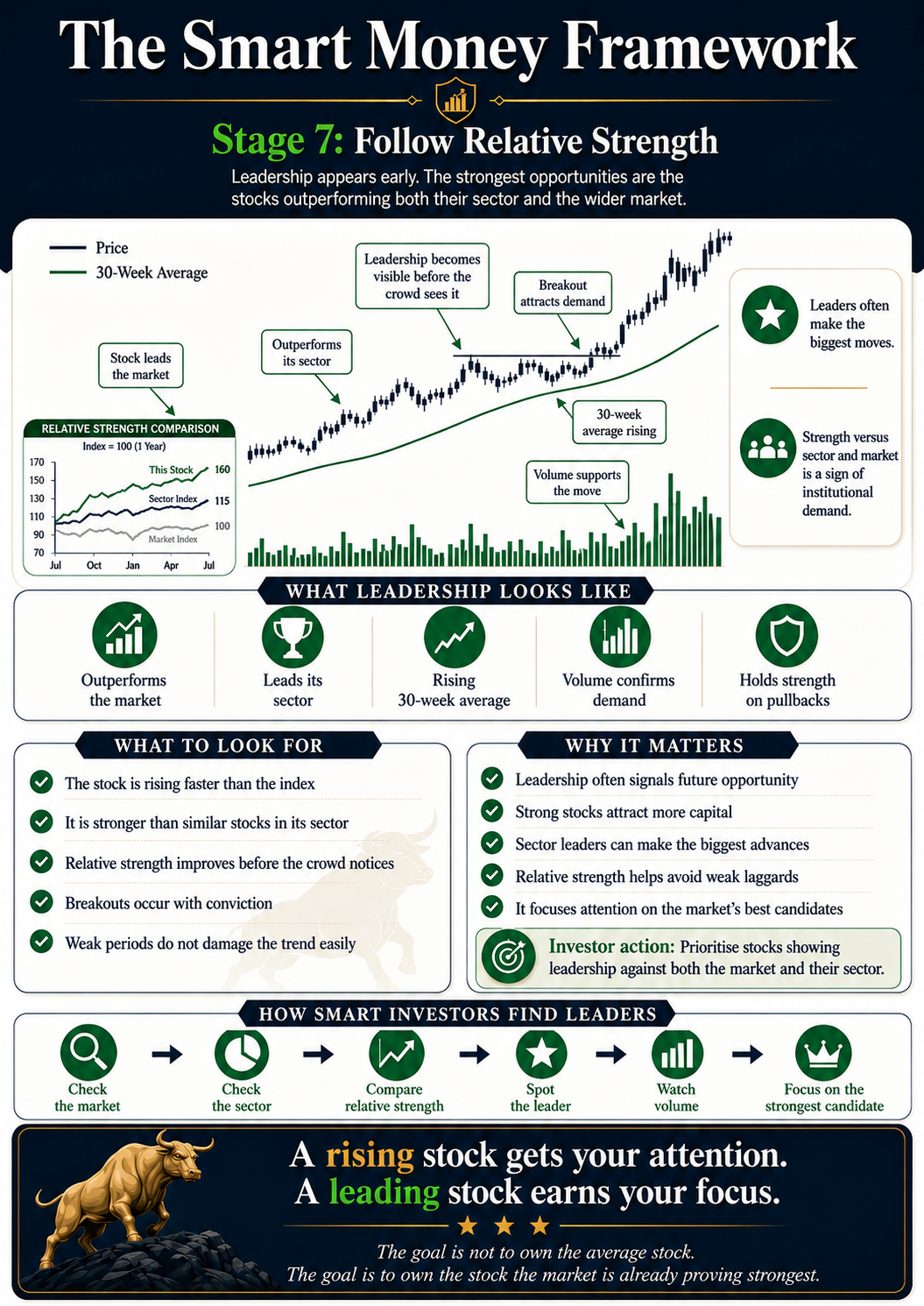
This is the seventh principle of the Smart Money Framework:
The best opportunities are not just rising. They are leading.Stage 8
Manage Risk, Then Let Strength Work
Finding a strong stock is only the beginning.
Once an investor has identified the market stage, waited for confirmation, checked relative strength, and found a genuine leader, the next job is not to predict every movement. The next job is to manage risk properly and then allow the trend enough room to develop.
This is where many retail investors struggle.
They buy a stock because it looks strong, but they do not know where the idea becomes wrong. Then, when the price pulls back, emotion takes over. A normal pullback feels like danger. A temporary pause feels like failure. They sell too early, only to watch the stock continue higher without them.
Other investors make the opposite mistake. They buy without a clear risk plan, then hold through serious weakness because they do not want to take a loss. What began as a controlled decision becomes hope. They tell themselves it will come back. They ignore the breakdown. They keep holding long after the evidence has changed.
The Smart Money Framework avoids both mistakes.
Before buying, the investor must define the risk. This means knowing where the stock should not go if the decision is correct. A logical risk point may sit below the breakout area, below the base, below a key support level, or below the rising 30-week average depending on the structure of the chart. The exact level is less important than the principle: the investor must know where the evidence has failed.
This is not about predicting the perfect price.
It is about discipline.
If the stock breaks below the level that supported the original decision, the investor has a clear signal that the idea may be wrong. That does not make the investor a failure. It means the framework is working. Small controlled losses are part of intelligent investing. Large uncontrolled losses usually come from refusing to accept that the evidence has changed.
Once risk is defined, the investor must then do something equally difficult.
They must give strength room to work.
A healthy advancing stock does not move in a straight line. It rises, pauses, pulls back, consolidates, and then continues. Normal pullbacks are not automatically sell signals. A leading stock may dip back toward support, test the breakout area, or move sideways for several weeks while the 30-week average catches up.
The disciplined investor does not sell simply because the stock has stopped rising for a moment.
They ask a better question:
If the price remains above key support, the 30-week average continues to rise, volume does not show serious distribution, relative strength remains firm, and the stock continues to behave better than the market, the main trend may still be intact. In that case, patience matters.
This is the balance Stage 8 teaches.
Risk must be controlled, but strength must not be strangled.
The investor needs a clear exit point if the evidence fails, but they also need enough patience to let a genuine leader develop. The aim is not to capture every small movement. The aim is to participate in the major advance while the stock remains in a healthy stage.
This changes the investor’s mindset.
They no longer ask, “Should I sell because the stock has pulled back?”
They ask, “Has the evidence that made this a strong stock actually changed?”
That is the difference between emotional investing and disciplined investing.
The Smart Money Framework teaches investors to respect both sides of the decision. Protect capital when the market proves the idea wrong. Stay with the position when the market continues to prove the idea right.
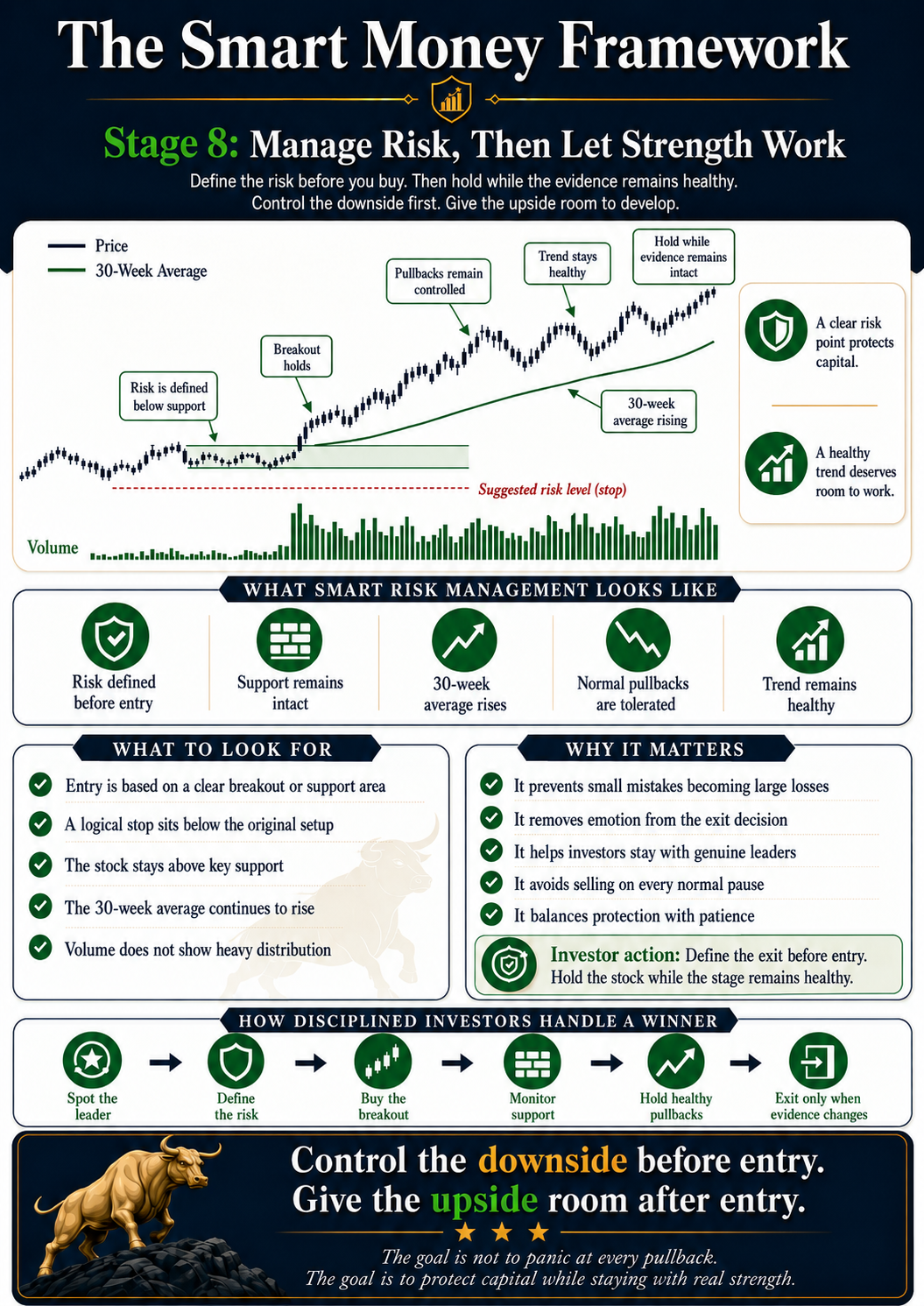
This is the eighth principle of the Smart Money Framework:
Define the risk before you buy. Hold while the stage remains healthy.Expanded framework infographic