In brief
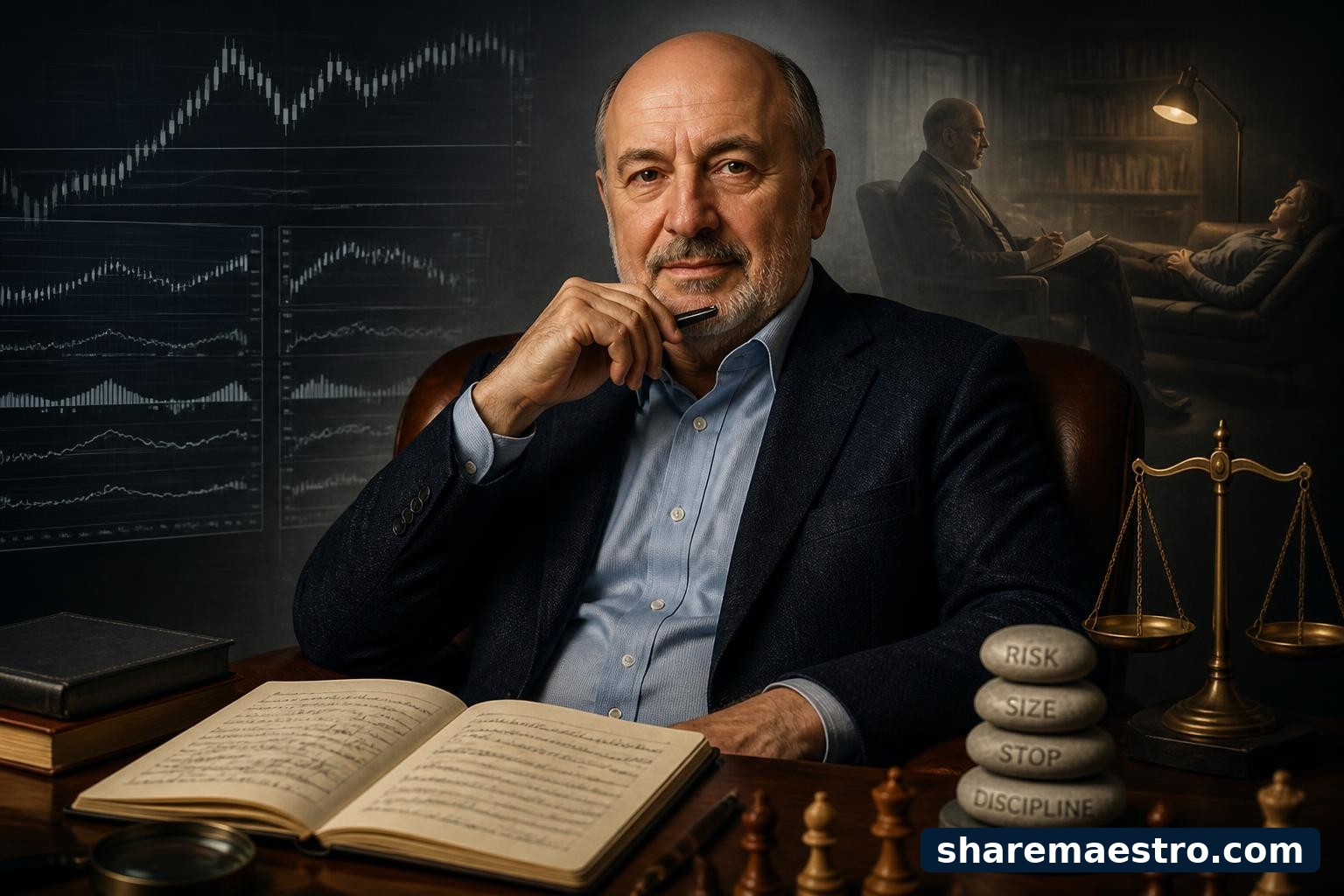
A professional profile of Dr. Alexander Elder, the psychiatrist turned trader educator whose books, Triple Screen method, Force Index, Elder-Ray, trading journals, and money management doctrine shaped modern retail trading education while leaving investors with a useful warning: discipline is not the same as easy profits.
- Dr. Elder matters less as an audited fund manager than as a system builder who gave retail traders a coherent language for psychology, technical method, and risk control.
- His best-known framework, the Triple Screen approach, tries to resolve conflicting technical signals by forcing a trade through multiple time frames before action is taken.
- His public record is primarily educational, not a continuous verified performance record, which means his influence is easier to document than his personal trading returns.
- His strongest contribution is the insistence that records, position sizing, stops, and emotional control are not accessories to trading, but the trade itself.
- The danger in his legacy is that readers may mistake an organized technical toolkit for a guaranteed edge in markets where most frequent traders lose money.
Performance and evidence
Performance markers
Visual Evidence
Charts and timelines
Risk
Timeline
Philosophy
Performance
The trader as patient
Alexander Elder's most durable idea begins before the chart. The trader, in his telling, is not a pure calculating machine hunting signals, but a human being sitting under pressure with memory, pride, fear, impatience, and a capacity for self-deception. That was the originality of his work. He did not simply add psychology to technical analysis as a decorative chapter. He treated psychology as the condition under which every indicator, stop, and rule either works or collapses.
In a trading culture that often sells certainty, Elder made a career out of making traders confront uncertainty. His language comes from the clinic as much as from the screen: diagnosis, discipline, records, self-management. The price chart may be the object, but the subject is the person pressing the button. In that sense, his market contribution sits between a technical manual and a behavioral case study.
That is why he belongs in the canon of modern trading educators. Elder did not run a famous mutual fund, build a global macro empire, or publish an audited stream of institutional returns. His importance lies elsewhere. He helped codify the private trader's workbench, combining trend, momentum, risk control, and written feedback into a process that ordinary market participants could understand, imitate, and test against themselves.
From Leningrad to the trading room
The public biography reads like the start of a Cold War novel. Elder was born in Leningrad, grew up in Estonia, entered medical school at 16, and later worked as a ship's doctor. At 23, while the ship was in Africa, he left it and received political asylum in the United States. The official accounts then move him to New York, where he worked as a psychiatrist and taught at Columbia University.
Those details matter because Elder's market persona is inseparable from the escape narrative. He came to trading not as a broker trained on a sales desk, nor as a mathematician hired into a bank, but as a physician whose first professional discipline was the observation of people under stress. His later emphasis on fear, compulsive repetition, and written records did not arrive as marketing color. It came from a trained habit of watching behavior betray intention.
In interviews, Elder has described his early market activity with disarming bluntness, saying that before he understood the game he was effectively gambling. That admission gives his curriculum much of its force. The teacher is not presented as a born winner with secret market instincts, but as someone who blew up small accounts, went back to work, saved money, and returned with better rules.
Why he matters
Elder matters because he organized the retail trader's confusion. By the early 1990s, personal computers, charting packages, discount brokerage, financial cable television, and expanding futures and options access had given individuals more market tools than most could use wisely. The problem was not a lack of indicators. It was a lack of hierarchy. Traders had signals, opinions, market stories, and tips, but not always a way to decide which one should outrank the others.
His answer was structure. In Trading for a Living, first published in 1993, he framed success around three elements that would become his signature: Mind, Method, and Money. The phrase was simple, but the editorial sequence was important. He placed self-control and risk control on the same level as market analysis, rejecting the common beginner's fantasy that the right indicator could compensate for poor temperament or reckless sizing.
The influence is visible in the durability of his books, his official education business, and the vocabulary that has migrated into trading rooms far beyond his own audience. Elder's materials are sold in many languages, his training programs continue under the Elder.com and SpikeTrade banners, and his named tools are built into charting platforms. That does not prove profitability. It does prove that his framework became part of the grammar of modern discretionary trading.
The three Ms as operating doctrine
The three Ms are often quoted so casually that their severity gets lost. Mind is not inspiration. It is the discipline to see what the market is doing rather than what the trader wants it to do. Method is not a collection of favorite indicators. It is a defined way to identify opportunity, set entries, place stops, and decide exits. Money is not an afterthought. It is the mechanism that keeps a trader solvent through inevitable losing streaks.
The elegance of the framework is that each part checks the others. A trader with discipline but no method is merely patient. A trader with a method but no risk control can be destroyed by one sequence of losses. A trader with money rules but no psychological commitment will override them when the market becomes emotionally charged. Elder's system tries to turn that triangle into a daily operating routine.
The 2014 New Trading for a Living updated the earlier classic for faster, more computerized markets, but the core remained conservative. The book's official description emphasizes calm discipline, risk management, self-management, stock-pick rating templates, trade plans, and readiness checks. That tells the reader what Elder thought was still missing after two decades of market technology: not more speed, but better restraint.
Triple Screen and the search for alignment
Elder's best-known trading architecture is the Triple Screen method. Its underlying problem is familiar to anyone who has opened more than one chart. A weekly chart can be rising while a daily oscillator looks overbought; a daily decline can be noise inside a larger uptrend; a short-term buy signal can be meaningless if the major trend is deteriorating. Elder's response was to make a trade pass sequential tests rather than rely on one favorite signal.
The method reflects a clinical logic. First, identify the larger condition. Second, look for a tactical setup within that condition. Third, time the entry with a shorter-term trigger. The result is not a mechanical guarantee but a decision tree. It forces the trader to ask whether a signal is aligned with the larger move or merely attractive in isolation. The strongest part of the idea is not the specific indicator choice. It is the discipline of asking which time frame has authority.
That structure also explains Elder's appeal to discretionary traders. He did not insist that everyone become a black-box system designer. He created a rules-based grammar for judgment. In his own writing, he acknowledged the bridge between discretionary and systematic methods: capable discretionary traders still need firm rules, while systematic traders still make judgment calls about when, where, and how to deploy systems.
Indicators as instruments, not idols
Elder's indicators are best understood as instruments on a dashboard, not predictions dressed as science. The Force Index, introduced through his work and widely documented by charting references, combines price change and volume to assess the power behind a move. Its calculation is deliberately plain: the change in closing price multiplied by volume, often smoothed with an exponential moving average. The point is not mystery. It is to connect direction, magnitude, and participation.
The Elder Impulse System, later featured in Come Into My Trading Room, combines a 13-period exponential moving average with the MACD Histogram to classify whether trend and momentum are moving together. Charting platforms color bars green, red, or neutral, but the underlying idea is again one of alignment. A trader should not treat price movement as a single dimension when trend and momentum may be saying different things.
Elder-Ray, SafeZone stops, AutoEnvelope, Market Thermometer, and related tools extended the same impulse toward measurement. His software products for platforms such as TradeStation list many of these indicators as programmed tools. Yet Elder was notably suspicious of overloading charts. In a Wiley excerpt, he warned against too many indicators and argued for a small number understood deeply. That restraint is central to his seriousness.
The journal as a mirror
If there is one Elder habit that survives changes in markets, it is record-keeping. In his world, the trading journal is not clerical housekeeping. It is the feedback system that turns experience into evidence. A trader who writes down entry, exit, rationale, emotional state, risk, and result cannot as easily rewrite the past to protect ego. The record becomes a mirror, and the mirror is often uncomfortable.
The connection to psychiatry is explicit in his interviews. Elder has compared market records to behavioral logs that reveal patterns a person would rather not see. A trader can claim to be disciplined while repeatedly chasing breakouts late, widening stops, or abandoning plans after two losses. The journal makes those claims testable. It shifts the trader from self-description to self-audit.
This is one reason Elder's work has aged better than many indicator books. Specific settings can be debated. Markets change. Commissions collapse. Platforms accelerate. But the need to compare a plan with the trader's actual behavior has not disappeared. In a market culture saturated with screenshots of wins, Elder's insistence on complete records remains a quiet rebuke.
Money management as survival technology
Elder's money management doctrine begins with a simple premise: a trader cannot learn if the account is destroyed. His interview language is memorable because it is practical rather than theoretical. He likened money management to a life jacket on a boat. One may return safely without it for a while, but repeated exposure without protection eventually reveals the flaw.
That logic is rooted in his view of markets as probabilistic. A strategy can have an edge and still produce several losing trades in a row. This is the distinction he draws between dynamic causation and statistical causation. The pencil pushed across a desk goes where it is pushed. A trade setup with favorable odds can still lose repeatedly before the edge reappears. Position size is what keeps that sequence from becoming fatal.
The lesson is austere. Risk control is not a way to avoid losses. It is a way to keep losses from becoming identity events. In Elder's books and courses, stops, trade size, account-level risk, and trade planning are joined to psychology because each rule exists for the moment when a trader least wants to obey it. The discipline is valuable precisely because it is needed under emotional stress.
A teacher's record, not a manager's record
The balanced view of Elder must start with what cannot be verified. His public profile does not resemble that of an institutional portfolio manager with audited annual returns, client letters, regulatory assets, and a benchmark history. He is described by official sources as a private trader, professional trader, teacher, author, and founder of education communities. That is a meaningful record, but it is not a performance record in the way investors use that term for funds.
This distinction is not a criticism by itself. Some market figures influence practice through portfolios; others through tools, writing, and education. Elder belongs mainly to the second category. His measurable public footprint is bibliographic and pedagogical: the 1993 publication of Trading for a Living, the 2002 Come Into My Trading Room, the later New Trading for a Living, courses, software, SpikeTrade, and continuing speaking work.
The distinction does protect readers from a common error. Influence is not the same as proof of alpha. A framework can be intelligent, a teacher can be serious, and a method can improve discipline without guaranteeing superior returns. Elder's contribution is strongest when treated as a process architecture for traders, not as evidence that private traders can reliably extract profits by copying his screens.
The hard evidence from the wider trading field
The difficulty of Elder's domain is supported by evidence far beyond his own biography. A major study by Brad Barber, Yi-Tsung Lee, Yu-Jane Liu, and Terrance Odean examined day traders in Taiwan from 1992 through 2006 and found that the vast majority lost money. The study also found that less than 1 percent of the day trader population could predictably and reliably earn positive abnormal returns net of fees.
That finding cuts in two directions. It does not say skill is impossible. In fact, the study found a small group of highly successful day traders whose future performance was meaningfully better than others. But it says the base rate is brutal. Most traders should assume that the market is not waiting to pay them for enthusiasm, screen time, or borrowed confidence.
The SEC's investor education material carries the same warning in plain regulatory language. It describes day trading as highly risky, stressful, expensive, and often dependent on leverage. It also warns that many traders suffer severe financial losses in their first months. Elder's risk doctrine looks more serious against that background. It is not a cautious footnote. It is the minimum entry requirement for participating in a field where most entrants are outmatched.
Where the method can fail
The first failure mode is indicator worship. Elder tried to prevent it, but any named system is vulnerable to simplification. Traders can take Triple Screen, Force Index, or Impulse colors and treat them as permission slips rather than questions. Once a tool becomes a shortcut around judgment, it stops serving Elder's broader purpose. A green bar is not a business plan. A divergence is not a guarantee.
The second failure mode is overconfidence disguised as discipline. A trader can keep records, use stops, and follow a checklist while still trading a weak edge. Process improves the odds of learning, but it does not manufacture liquidity, information advantage, or durable predictability. Elder's own distinction between discretionary and systematic trading recognizes this. Firm rules help, but the market does not owe them a reward.
The third failure mode is commercialization. Trading education is a market of its own, and educational authority can encourage students to believe that confidence is transferable by purchase. Elder's better writing resists that by stressing work, self-study, and the inevitability of drawdowns. Still, the reader must separate the value of a teacher's structure from the illusion that instruction can remove market uncertainty.
The organized trader
Come Into My Trading Room widened Elder's project from market analysis to work design. The official description of the book highlights the 3 Ms, market selection, a decision-making tree, time organization, and recent trade walk-throughs. That was an important shift. It moved the reader from the question, What should I buy or sell, to the question, How should a trader organize the entire act of decision-making.
The organized trader is a different character from the screen addict. He or she knows what markets are under review, what time frames matter, what setups have names, what risk is allowed, and what evidence must be recorded. Elder's later courses and camps continue that emphasis by naming psychology, technical analysis, money management, record-keeping, and the decision tree as core subjects. The repetition tells us what he believed traders kept failing to internalize.
This is one reason his curriculum has appealed to serious amateurs rather than only beginners. A beginner needs definitions. A developing trader needs constraint. Elder's work offers the second: fewer indicators, named setups, smaller risk, better records, clearer exits, and written trade plans. The promise is not market mastery. It is the possibility of becoming less chaotic.
SpikeTrade and the social turn
Elder's later work also moved trading education into community. SpikeTrade, which he co-directs with Kerry Lovvorn, is presented as a group where members share trade plans, journals, stock picks, and competition results. The format is significant because it takes a solitary activity and adds peer visibility. That can be useful when it encourages preparation and accountability. It can be dangerous when it encourages imitation.
The best version of the idea fits Elder's record-keeping philosophy. If a trader must put a plan into words before the trade, disclose the logic, and compare the result with the premise, community becomes another mirror. The worst version would be the ordinary online trap: ideas are copied without context, risk is personalized too late, and the trader confuses social proof with edge.
Elder's continuing courses suggest that he understood both sides. His official training pages still emphasize small groups, follow-up, personal consultation, money management, psychology, and self-management. That is a more demanding model than the mass distribution of tips. It treats trading as apprenticeship and practice, although it cannot escape the basic fact that the market will grade each participant individually.
A method built for discretion in an automated age
Elder's work now circulates in markets transformed by zero-commission brokerage, mobile apps, social media, algorithmic execution, crypto venues, and retail options speculation. At first glance, a framework born from weekly and daily charts may seem dated. But the deeper structure of his work is not tied to a brokerage era. It is about hierarchy, temperament, position size, and records, all of which remain relevant precisely because speed has increased.
The challenge is that modern platforms make action easier than reflection. A trader can scan, buy, sell, reverse, and broadcast faster than any 1993 reader could have imagined. Elder's method slows that sequence down. It asks which time frame is dominant, what setup is present, what risk is allowed, where the exit sits, and whether the trade belongs in the plan. That friction may be the most useful part of the system now.
At the same time, automation raises the standard of proof. A discretionary trader using technical signals competes in markets where other participants can test patterns across huge data sets and execute in milliseconds. Elder's framework can still improve conduct, but conduct and edge are not identical. The modern trader must test, adapt, and remain skeptical, especially when a visual pattern feels persuasive but lacks statistical support.
The criticism he invites
Elder's central vulnerability is the broader vulnerability of technical trading education. It can sound precise while resting on conditional, shifting, and sometimes subjective evidence. He partly disarms that criticism by warning against classical charting subjectivity and indicator overload. But he cannot remove the larger problem. A system that organizes decisions does not automatically establish that those decisions have a persistent market edge after costs, slippage, taxes, and errors.
A second criticism concerns aspiration. Trading books often attract readers who want independence, not just technique. Elder's language of freedom, travel, and self-direction can inspire, but it also sits near a dangerous fantasy. The SEC warning on day trading is a useful counterweight: this activity can be stressful, expensive, highly risky, and unsuitable for many individuals. The dream of independence can become dependence on the next trade.
The fairest assessment is that Elder's best work contains its own antidote. He tells traders to expect losses, write things down, control risk, and distrust fantasies. He frames markets as probabilistic rather than predictable. He stresses money management because even a favorable setup can fail. The danger comes when readers keep the promise of freedom and discard the discipline that was supposed to make survival possible.
What remains useful
What remains useful is not a single setting on MACD, a particular Force Index smoothing period, or a colored bar on a chart. Those can be modified, tested, or abandoned. What remains useful is Elder's insistence that every trade is a behavioral event as well as a market event. It has a thesis, a risk, a trigger, an emotional context, and an after-action record.
His most important lesson may be negative: do not let the market turn you into someone you cannot audit. Do not trade so large that you cannot think. Do not add indicators because you lack conviction. Do not call an impulse a strategy. Do not mistake a winning trade for a good trade or a losing trade for a bad one until the process has been reviewed.
That is why Elder's relevance continues even for traders who never adopt Triple Screen exactly as he wrote it. He gave the private trader a disciplined vocabulary for self-observation. In a field that rewards patience rarely and punishes arrogance quickly, that vocabulary still matters. It does not make trading easy. It makes the trader harder to fool, especially by himself.
Disclosure
Educational financial journalism and market research only. Not financial, investment, trading, tax, or legal advice.