In brief
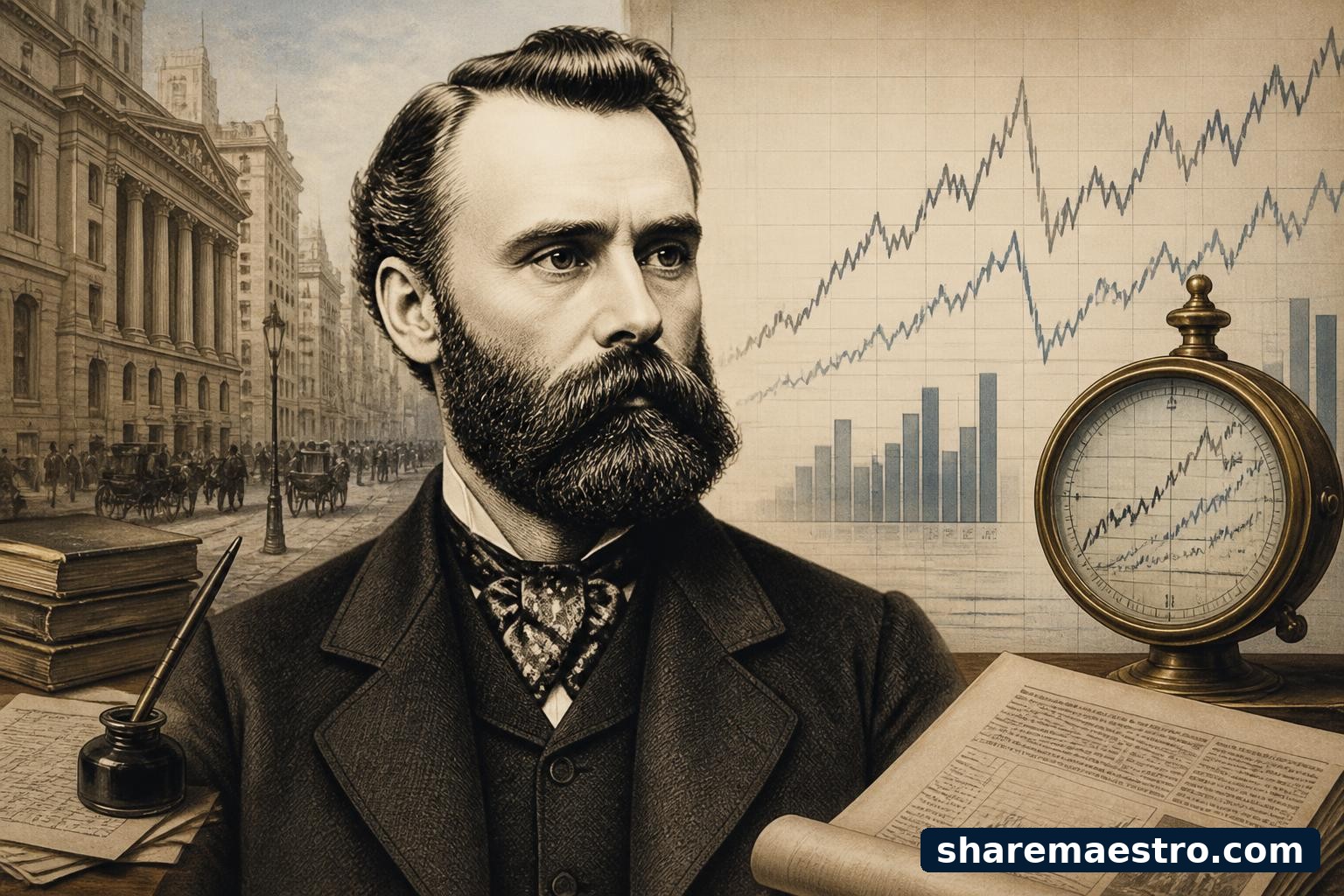
Charles Henry Dow was not a fund manager, a stock picker, or a speculator in the modern professional sense. He was a journalist who believed the market could be made intelligible if prices were organized, compared, and interpreted with discipline. As co-founder of Dow Jones & Company and The Wall Street Journal, he helped build the infrastructure of financial news. As creator of the Dow Jones averages, he gave investors a compact way to read the market as a whole. The principles later organized as Dow Theory made him a foundational figure in technical analysis, but also a more complicated one than his legend suggests: Dow did not publish a finished trading system, and later interpreters turned his editorials into doctrine. His legacy is the tension between clarity and simplification, between market observation and market prophecy.
- Dow's central innovation was not a hot stock recommendation but a market grammar: averages, confirmation, trend, and disciplined observation.
- The Dow Jones Industrial Average began on May 26, 1896, with 12 industrial stocks and a first calculated value of 40.94.
- Dow Theory was assembled after Dow's death by figures including S. A. Nelson, William Peter Hamilton, and Robert Rhea, who turned Dow's editorials into a more formal trend-following discipline.
- The strongest empirical defense of the approach concerns William Peter Hamilton's Dow Theory editorials from 1902 to 1929, which Brown, Goetzmann, and Kumar found produced positive risk-adjusted results.
- The method remains useful as a framework for patience, confirmation, and risk awareness, but dangerous when treated as a mechanical oracle or a substitute for valuation, economics, and portfolio construction.
Performance and evidence
Performance markers
Visual Evidence
Charts and timelines
Risk
Timeline
Philosophy
Performance
The afternoon Wall Street became a number
On May 26, 1896, Charles Henry Dow reduced a loud, fragmented market to a single figure. He added the prices of 12 industrial companies, divided by 12, and published the result in The Wall Street Journal. The number was 40.94. It was not presented as a grand theory of capitalism. It was practical arithmetic, done with pencil and paper, meant to give readers a way to follow the broad movement of industrial shares without drowning in individual quotations.
The simplicity was the point. Wall Street at the end of the nineteenth century was rich in rumor, telegrams, bucket shops, pools, and tips. It was poor in common reference points. Dow's average created a daily market sentence that almost any reader could understand. It said, in effect, that the market was not merely a collection of securities. It could be observed as a system, and its direction could be discussed with a shared vocabulary.
That act is why Dow belongs in a finance profile series, even though he did not resemble the portfolio managers who usually occupy the genre. He did not build a partnership around a return record or launch a hedge fund around an edge. He built an information machine. From that machine came Dow Jones & Company, The Wall Street Journal, the Dow Jones averages, and the trend principles later called Dow Theory. His career sits at the origin of market journalism, index construction, and technical analysis.
A journalist, not a Wall Street operator
Dow's authority came from reporting before it came from markets. He was born in Sterling, Connecticut, on November 6, 1851, into a farming family. His father died when Dow was still a child, and the family's circumstances limited his formal schooling. The familiar nineteenth-century finance biography often begins with capital, family connections, or a seat near the exchange. Dow's begins with a farm, a truncated education, and a desire to become a newspaper man.
In 1869 he apprenticed at the Springfield Republican under Samuel Bowles III, then moved through Providence journalism, including the Providence Star and the Providence Journal. The important bridge to markets came in 1879, when he accompanied geologists and Wall Street executives to Colorado to cover the silver boom. The assignment matters because it put Dow in contact with the capital-raising machinery behind mining and railroads, and it taught him that financial reporting required more than transcription. It required skepticism about promotion and fluency in securities.
Dow then moved to New York financial journalism, working at the New York Mail and Express and the Kiernan News Agency. There he persuaded his employer to hire Edward D. Jones, a fellow reporter he had known in Providence. The pairing is often remembered through the brand name that followed, but it began as a newsroom alliance. Both men understood that the market's appetite for timely information was becoming a business in itself.
The news service before the newspaper
Dow, Jones & Company was formed in November 1882 by Charles Dow, Edward Jones, and Charles Bergstresser. Its early product was not a glossy newspaper or a mass-market financial portal. It was a fast, specialized service for Wall Street customers who needed prices, facts, and market color before competitors received them. The firm used runners to carry brief reports to subscribers, turning speed into a commercial proposition and accuracy into a reputational asset.
In 1883 the company began publishing Customers' Afternoon Letter. In 1884 the Dow Jones averages first appeared in that letter. In 1889 the letter became The Wall Street Journal. Those dates trace a critical evolution in American finance: private market intelligence became a daily financial publication, and a publication became an institution powerful enough to define the market's closing story for generations.
Dow's most durable contribution was the union of journalism and measurement. The paper needed market data that could be printed, compared, and interpreted each day. The average gave the paper that instrument. In turn, the paper gave the average distribution, authority, and ritual. The combination made Dow less like a trader with a system and more like an architect of market publicness, a figure who helped move Wall Street information from clubby circulation toward a broader reading public.
Why the first averages mattered
Before the industrial average, Dow had already experimented with a market average dominated by railroads. That made sense. Railroads were the great listed enterprises of nineteenth-century America, capital-intensive, heavily traded, and tied to the movement of goods, people, credit, and land values. A railroad average was therefore a rough gauge of national commerce. It connected Wall Street prices to the physical economy in a way that individual stock tips did not.
The later industrial average marked a shift in the American economy itself. By 1896, industrial combinations, manufacturing companies, sugar, tobacco, gas, steel, rubber, and electrical firms were demanding investor attention. Dow's 12-stock industrial average gave that transition a visible market form. It was primitive by modern standards, but it recognized that the listed market was no longer only a railroad market. Industrial capitalism had become a tradable public fact.
The original industrial average also exposed a truth that still defines index construction. An index is never just arithmetic. It is a judgment about what deserves representation. Dow's first industrial list included companies such as American Cotton Oil, American Sugar, American Tobacco, Chicago Gas, General Electric, National Lead, and U.S. Rubber. The names feel remote today, but at the time they captured the era's productive muscle and speculative imagination.
The power and flaw of price-weighting
Dow's calculation was simple because it had to be simple. Add the component prices and divide. In 1896, that was a workable answer to a practical newsroom problem. It allowed the market to be summarized quickly and consistently. The same simplicity later became one of the Dow's most persistent weaknesses. A price-weighted index gives more influence to a high-priced stock than to a lower-priced stock, regardless of the companies' total market values.
Modern S&P Dow Jones Indices documentation explains the practical consequence. The Dow's numerator is the sum of component prices, and the divisor is adjusted to preserve continuity after stock splits, substitutions, and other corporate events. The divisor keeps the historical series from being broken by mechanical changes. What began as division by 12 eventually became a more complex continuity device, even though the index retained its price-weighted ancestry.
This is one reason Dow's creation became both iconic and controversial. It is easy to explain, easy to quote, and deeply embedded in financial culture. It is also less representative than a broad float-adjusted market-capitalization index. That tension runs through the entire Dow legacy. Dow wanted a clear barometer. Later markets demanded broader, more precise instruments. The Dow survived because it was legible, not because it was the final word in benchmark design.
From average to public barometer
The Dow did not become a public symbol immediately. In its first decades, it served mainly Wall Street professionals and financially engaged readers who wanted a practical measure of market trends. The decisive popularization came later, especially around the crash of 1929. When the index lost nearly a quarter of its value over two trading days in October 1929, a broad public needed a way to understand not just which stocks had fallen, but what had happened to the market.
That is when Dow's arithmetic became social language. Newspapers and broadcasters could report the Dow as a shorthand for collective financial pain, recovery, fear, or confidence. The index did not create those emotions, but it organized them. Investors who owned no Dow components still watched it because it had become a proxy for market climate. The average had escaped its original editorial setting and entered public consciousness.
Its continuity strengthened that role. The industrial average expanded from 12 stocks to 20 in 1916 and to 30 in 1928. Component changes reflected changing market leadership, from old industrial names to later consumer, technology, financial, and health care companies. General Electric, one of the original 1896 components, remained connected to the index until its 2018 removal. The Dow became a record not only of prices, but of economic succession.
Dow's theory before it had a name
The phrase Dow Theory can mislead. Dow did not leave behind a finished trading manual with numbered rules and backtested signals. He wrote editorials, observed market behavior, and argued that stock prices could reveal something about business conditions and investor psychology. After his death in 1902, others organized those ideas into a more formal doctrine. S. A. Nelson, William Peter Hamilton, and Robert Rhea were central in turning Dow's market essays into a tradition.
Nelson's The A B C of Stock Speculation, published in the early twentieth century, explicitly presented Dow's ideas as a body of thought. Hamilton's The Stock Market Barometer, published in 1922, framed the market averages as instruments with forecasting value. Rhea's 1932 book, The Dow Theory, attempted to define the theory's development and usefulness for speculation. The canon was therefore posthumous and cumulative, not a single text handed down by Dow.
This matters because Dow's reputation is often burdened by claims made in his name. The original Dow was less mechanical than many later summaries imply. He was concerned with broad tendencies, market phases, confirmation, and the relationship between price action and business conditions. Later interpreters converted a journalist's disciplined market reading into a system. That conversion made Dow's ideas more teachable, but also more vulnerable to overstatement.
The market as a discounting machine
At the philosophical center of Dow Theory is the claim that market averages discount the known facts that matter to investors. In modern language, that sounds adjacent to efficient-market thinking, but Dow's world was very different from the world of electronic filings and continuous news. His point was more observational: prices were the result of many informed and uninformed judgments, and the average could reveal the net effect of those judgments before any single explanation became obvious.
The second pillar is trend. Dow's successors described primary movements, secondary reactions, and minor fluctuations. The primary trend was the great tide. Secondary moves were countercurrents. Daily noise was the chop that tempted impatient traders into error. This language is one reason Dow Theory survived. It gave market participants a way to separate signal from agitation, even if the separation was always easier in retrospect than in real time.
The third pillar is confirmation. In the classic formulation, industrial and transportation averages should confirm each other because production and movement are linked. If industrial stocks break higher while transportation stocks fail to follow, the message is suspect. That idea was born in a railroad and manufacturing economy, but its deeper logic remains broader: a market move gains credibility when economically connected groups participate together rather than leaving leadership narrow and fragile.
A process built around waiting
As an investment or trading discipline, Dow Theory is less a stock-selection method than a market-timing and risk-awareness framework. It does not ask whether a company is cheap relative to earnings or whether management is allocating capital well. It asks whether the market's primary trend has turned, whether the turn is confirmed, and whether the evidence is strong enough to justify action. Its natural posture is patience.
That patience gives the method its appeal and its cost. Dow Theory is designed to avoid acting on every rally or selloff. It waits for confirmation by averages and for price action that suggests a primary move rather than a passing reaction. This reduces impulsiveness, but it also means signals arrive late. A method that demands confirmation will never buy the exact bottom or sell the exact top. It accepts lateness as the price of avoiding many false starts.
Portfolio construction under this framework is therefore stark. The core decision is exposure, not security selection. Hamilton's later editorials, which became the basis for formal empirical tests, were classified as bullish, bearish, or neutral. That is a very different discipline from concentrated value investing or modern factor allocation. It treats the market as the object of analysis and the average as the tradable idea, even before index funds made such exposure easy.
Risk management, nineteenth-century style
Dow's world was filled with leverage, margin speculation, tips, and bucket shops. Nelson's presentation of Dow's thought spends considerable energy distinguishing speculation from blind gambling and warning against overtrading. The famous maxim to cut losses short and let profits run appears in that setting as a rule of survival. It is not sophisticated portfolio theory, but it is a recognition that the market punishes ego, delay, and the refusal to admit error.
Dow Theory's risk control is embedded in its structure. It tries to keep traders aligned with the primary trend and to avoid fighting a broad market movement on the basis of hope. It also distrusts unconfirmed moves. A rally that lacks transportation confirmation, or a price advance that lacks volume support in later formulations, is not treated as strongly as a move with broader evidence behind it. The emphasis is not prediction for its own sake. It is exposure only when the evidence improves.
The failure mode is equally clear. A trend-following discipline can be whipsawed in range-bound markets, late at turning points, and overconfident when historical analogies look too neat. It may reduce certain errors while creating others. Its best use is as a brake on impulse and a reminder to respect primary market direction. Its worst use is as a rigid code that pretends complex economies speak through two averages without ambiguity.
The Hamilton evidence and the Cowles reversal
Dow himself left no audited fund record, so performance evidence for Dow Theory comes mainly through later interpreters. William Peter Hamilton, who succeeded Dow as a leading Wall Street Journal voice, supplied the most important record because his market editorials from 1902 to 1929 could be classified and tested. Alfred Cowles famously examined Hamilton's calls in the 1930s and concluded that the approach lagged a fully invested market portfolio.
The 1998 Journal of Finance paper by Stephen J. Brown, William N. Goetzmann, and Alok Kumar changed that verdict. They revisited Cowles's evidence and argued that the earlier test missed the importance of risk adjustment. Hamilton was often out of the market, so comparing his results with a fully invested benchmark without adjusting for risk understated the value of his timing. Their conclusion was that Hamilton's strategies produced high Sharpe ratios and positive alphas for 1902 to 1929.
That finding does not turn Dow Theory into an all-purpose law. It does show that the old editorials were not merely decorative market commentary. Hamilton's version of the approach had enough structure to be tested, and enough risk sensitivity to look better under modern performance measures than under raw return comparison. The evidence is strongest as a historical defense of one interpreter in one period, not as a universal guarantee for every later trader invoking Dow's name.
What the academics still argue about
Technical analysis remains one of finance's oldest arguments. The Dow tradition stands at the center of that dispute because it predates modern charting software, behavioral finance, and quantitative trend following. Critics argue that past prices should not provide easy abnormal profits in competitive markets, especially after transaction costs. Supporters answer that trends, underreaction, liquidity pressure, and investor psychology can create persistent patterns, even if those patterns are unstable.
The literature is mixed rather than triumphal. Recent surveys note that Cowles's early work was skeptical, while Brown, Goetzmann, and Kumar found positive risk-adjusted results for Hamilton. Other studies of moving averages, trading-range breaks, and technical rules have produced varying results across markets, periods, and methodologies. That lack of consensus is important. It keeps Dow Theory from being responsibly presented as a proven money machine.
The fairest conclusion is narrower and more durable. Dow's framework helped create the habit of testing price action against rules, context, and confirmation. It anticipated the trend-following instinct without the machinery of modern systematic funds. Yet its historical success, where documented, depends on interpretation, execution, costs, and market regime. Treating it as an oracle ignores both the empirical debate and Dow's own roots as a cautious observer rather than a market prophet.
The benchmark that shaped financial journalism
Dow's continuing importance is not limited to technical analysis. He helped make the benchmark a central object in financial journalism. Before an investor can ask whether a manager beat the market, the market must be represented by something. Before a newspaper can say the market rose or fell, it needs a consistent measure. Dow's averages supplied that common object, and The Wall Street Journal repeated it until the number became a habit.
This changed the relationship between markets and the public. A benchmark condenses complexity, which is both useful and dangerous. It allows a pension saver, a broker, a banker, and a politician to refer to the same daily movement. It also encourages overinterpretation of a single number. The Dow's rise taught financial media how powerful a market shorthand could be. Every later index inherited part of that lesson, even when designed to correct the Dow's flaws.
The S&P 500, created in its modern form decades later, offered broader capitalization-weighted representation. Today it is generally treated as a more complete gauge of large-cap U.S. equities. Yet the Dow remains culturally potent because it is older, easier to narrate, and deeply tied to market memory. Dow's genius was to understand that investors needed not only facts, but a frame in which facts could be read together.
The limits of a 30-stock memory machine
The Dow's endurance should not be confused with completeness. A 30-stock, price-weighted index cannot fully represent the U.S. equity market. Its component selection is intentionally judgmental, focused on large, well-known companies with reputation, investor interest, growth history, and sector balance. Transportation and utilities are excluded because separate Dow Jones averages cover those groups. This makes the industrial average coherent, but not comprehensive.
Price-weighting also produces awkward distortions. A company with a higher share price can matter more to the Dow than a much larger company with a lower share price. Stock splits can alter index influence without changing business value, requiring divisor adjustments to maintain continuity. Extremely high-priced stocks may be unsuitable because they would dominate the average. These are not small technicalities. They shape what the Dow says and what it cannot say.
The component history makes the point visually. The index began with smoke-stack and raw-material companies, expanded to 20, then to 30, and changed repeatedly as the economy changed. Kodak gave way to Intel, and Intel later gave way to Nvidia in the index's more recent stewardship. Averages are historical artifacts as well as measurement tools. They preserve continuity by changing just enough to remain recognizable.
Dow's influence on modern market process
Modern investors live in a world Dow could not have imagined: exchange-traded funds, factor models, high-frequency data, electronic market centers, automated portfolio analytics, and global multi-asset allocation. Yet several habits in that world bear his imprint. Investors still ask what the market is doing before asking why. They still compare related groups for confirmation. They still separate primary trend from temporary reaction, even when using statistical language rather than tide metaphors.
Dow's influence also reaches professional humility. His approach begins with observation rather than explanation. The market moves first; the analyst interprets afterward. That order is a useful corrective to narrative confidence. It reminds investors that prices can register information, liquidity, fear, and positioning before commentary catches up. The risk is that price becomes idolized, as if every tick carried wisdom. Dow's better legacy is not worship of price, but disciplined attention to it.
For financial journalism, the lesson is just as strong. Dow showed that the act of measurement can shape the story being told. A market average is not a neutral ornament placed beside an article. It becomes the grammar through which readers understand boom, panic, recovery, and stagnation. The best market journalism still follows Dow's underlying demand: organize facts clearly enough that readers can see the market's structure without mistaking clarity for certainty.
What remains useful, and what remains dangerous
What remains useful in Charles Dow is his insistence on confirmation, context, and restraint. He offered a way to resist the tyranny of the latest quote. The market's primary movement mattered more than the day's noise. Related averages mattered more than one isolated breakout. The broad tape mattered more than a tip. Those ideas still have value because they address recurring human errors: impatience, overconfidence, selective evidence, and the urge to force meaning onto every fluctuation.
What remains dangerous is the temptation to turn Dow into a mechanical authority. Markets have changed, sector relationships have changed, and the industrial-transportation link is less comprehensive than it was in a railroad economy. A method born from observation can become brittle when converted into slogans. Confirmation can become paralysis. Trend respect can become late capitulation. The average can become a substitute for understanding the businesses, valuations, credit conditions, and policy forces beneath it.
Dow's career is best understood as the beginning of a discipline, not the end of one. He made Wall Street more readable by combining reporting, arithmetic, and market judgment. His successors turned that work into theory, traders turned it into signals, and index providers turned his average into a governed benchmark with global recognition. The strongest tribute is not to treat the Dow as sacred. It is to remember why it mattered: it gave investors a common language for uncertainty.
Disclosure
Educational financial journalism and market research only. Not financial, investment, trading, tax, or legal advice.