In brief
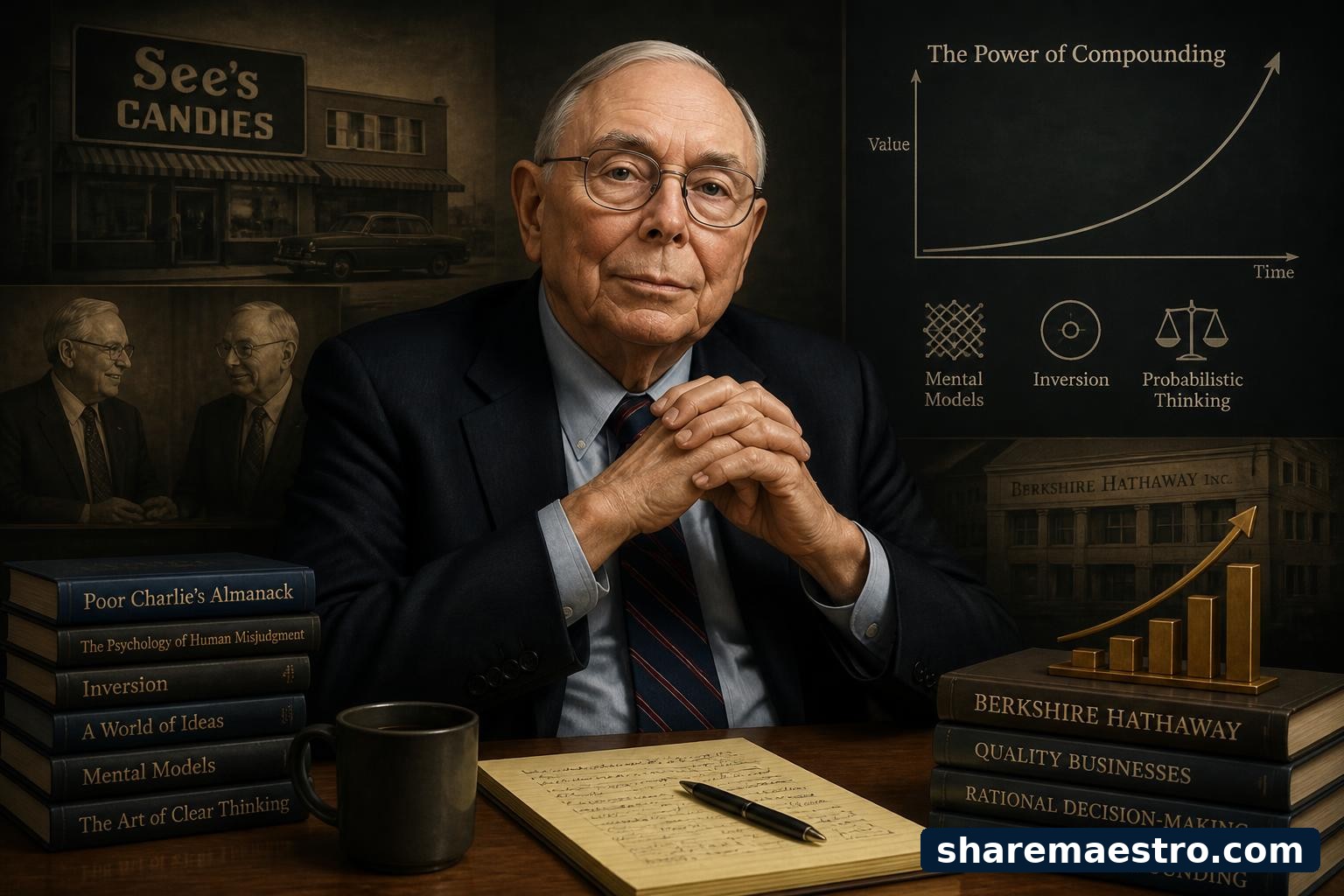
Charles T. Munger was more than Warren Buffett's blunt partner at Berkshire Hathaway. He was the intellectual force behind a decisive change in modern value investing: away from merely cheap assets and toward exceptional businesses that could compound capital for decades. His record included a volatile but outstanding investment partnership, the See's Candies lesson that reshaped Berkshire, and a long public campaign for rational decision-making. His method also had costs: concentration created deep drawdowns, patience could shade into inaction, and his late-career China and Daily Journal bets exposed the limits of even a disciplined mind. His continuing relevance lies not in quotable aphorisms, but in a demanding system for judging businesses, incentives, human error, and permanent loss.
- Munger's central contribution was to push Berkshire away from Graham-style bargain hunting at scale and toward durable businesses bought at sensible prices.
- His own investment partnership compounded at 19.8% annually from 1962 through 1975 on an overall basis, but it also suffered steep losses in 1973 and 1974.
- See's Candies became the proof case for paying up for a business with pricing power, low incremental capital needs, and a brand that could finance future acquisitions.
- Munger's public philosophy joined business analysis with psychology, incentives, inversion, and multidisciplinary mental models.
- His record is inseparable from limits and criticism, including concentrated drawdowns, errors of omission, the Alibaba episode, and the controversial UCSB dorm design tied to his philanthropy.
Performance and evidence
Performance markers
Visual Evidence
Charts and timelines
Risk
Timeline
Philosophy
Performance
The architect in the chair beside Buffett
Charlie Munger's most influential work was often done from the second chair. For decades, the Berkshire Hathaway annual meeting presented him as the terse counterweight to Warren Buffett: the man who waited, listened, and then reduced a complicated business question to a sentence that sounded less like analysis than judgment. That stage persona was entertaining, but it also disguised the scale of his contribution. Munger was not simply an ornament to Buffett's success. He supplied the philosophical correction that made Berkshire a different kind of institution.
That correction can be stated simply, though it was difficult to practice. Munger pushed Berkshire away from the hunting of statistically cheap securities and toward the ownership of superior businesses that could redeploy capital at high returns or disgorge cash for better uses. The move was not cosmetic. It changed the opportunity set, the expected holding period, the kinds of managers Berkshire wanted, and the culture it offered to sellers. It also helped create a corporate structure that could absorb enormous amounts of capital without behaving like a transaction machine.
Buffett later called Munger the architect of modern Berkshire, with himself cast as the general contractor. The metaphor is useful because Munger's genius was structural. He cared about what a system would reward, what it would punish, and what kinds of errors it would invite over time. His investing legacy begins there: not with a single stock pick, but with a framework for compounding that treated temperament, incentives, and business quality as hard financial variables.
Why Munger matters beyond the Buffett partnership
Munger matters because he made value investing less mechanical and more demanding. Benjamin Graham had given investors a grammar of margin of safety, liquidation value, statistical cheapness, and emotional independence. Munger did not reject that foundation. He changed its center of gravity. At small scale, bargain hunting could work. At Berkshire's scale, it could trap capital in low-return enterprises where a cheap purchase price became a consolation prize rather than a source of compounding.
The result was a broader definition of value. In Munger's world, value was not only the gap between price and appraised assets. It was the durability of a business model, the discipline of management, the ability to raise prices without losing customers, the absence of unnecessary capital requirements, and the likelihood that time would help rather than hurt the owner. This sounds obvious now because his influence has been absorbed into mainstream investing language. It was not obvious when balance-sheet bargains and low multiples dominated the value canon.
His importance also lies in his refusal to separate investing from cognition. Munger treated envy, incentives, social proof, overconfidence, and authority bias as practical risks. He saw markets not as elegant machines but as arenas where human weakness periodically created opportunity and ruin. That made his philosophy unusually portable. It could explain a candy company, an insurance float model, a legal publisher's investment portfolio, and the way a smart person could still make a mistake after decades of warning others against obvious traps.
From Omaha to Los Angeles, by way of the law
Charles Thomas Munger was born in Omaha, Nebraska, on January 1, 1924. The biographical symmetry with Buffett has always been irresistible: two Omaha boys, separated by age and circumstance, eventually building one of the great compounding records in corporate history. But Munger's path was less direct. He served in the Army Air Corps, studied mathematics and meteorology, graduated from Harvard Law School, and built a career in Los Angeles rather than remaining inside the Nebraska orbit.
Law mattered to his investing because it trained him to read incentives and adversarial structures. He became a founding partner of the Los Angeles law firm now known as Munger, Tolles & Olson, and left the firm in 1965 to focus on investments. That timing is important. Munger did not become an investor because he failed at another profession. He walked away from a successful legal path because capital allocation offered a larger canvas for the same habits of mind: evidence, incentives, probabilistic judgment, and the suspicion that complicated arrangements often benefit the arranger.
By the late 1970s, Munger's overlapping roles had become part of a distinctive network. He was associated with Berkshire, Wesco Financial, Daily Journal, Costco, and a circle of investors influenced by the West Coast strain of value investing. Yet he kept the lawyer's skepticism. He believed in contracts, structure, reputation, and the avoidance of people who could not be trusted. That moral vocabulary was not decorative. For Munger, a bad person in a good business could still make a bad investment.
The partnership record that proved the temperament
Before he became known as Buffett's partner, Munger had a record of his own. In 1962, he began managing money through an investment partnership associated with Wheeler, Munger & Co. The results were exceptional by any standard, but they were also volatile in a way that reveals much about the man. Columbia Business School's version of Buffett's essay, The Superinvestors of Graham-and-Doddsville, identifies Munger's portfolio as concentrated in relatively few securities and marked by larger peaks and valleys than more diversified approaches.
From 1962 through 1975, Munger's overall partnership return compounded at 19.8% annually, versus 5.0% for the Dow in the same table. Limited partners earned 13.7% annually after the partnership economics. The annual numbers show the price of concentration. The partnership gained 71.1% overall in 1963 and 56.2% in 1967. It then fell 31.9% in 1973 and 31.5% in 1974 before rebounding 73.2% in 1975.
That record complicates the later image of Munger as simply cautious. He was cautious about stupidity, leverage, bad incentives, and permanent impairment. He was not cautious about owning a few things he believed he understood. His version of risk was not annual volatility. It was being wrong about the business, the people, or the odds of survival. The partnership years established the core tension in his method: patience and rationality could coexist with portfolio concentration severe enough to test any client base.
The Berkshire mistake that became the Berkshire system
The founding irony of Berkshire Hathaway is that Buffett's purchase of control was, by his own later assessment, a mistake. The textile business was cheap, but the economics were poor. That was precisely the kind of situation Graham-trained investors could find tempting: a modest price below a conservative estimate of value, with the promise that a favorable turn might allow an exit. Munger's objection was not that the arithmetic was wrong. It was that the category was wrong.
In the 1989 Berkshire letter, Buffett described the cigar-butt approach and the deeper lesson that time favors wonderful businesses and works against mediocre ones. In the 2023 annual report, he credited Munger with telling him in 1965 to stop buying businesses like Berkshire and instead add wonderful businesses purchased at fair prices. That sentence became the hinge in Berkshire's evolution. It was not a rejection of value. It was a redefinition of what deserved to be valued.
The system that followed combined decentralized operations, permanent capital, insurance float, disciplined acquisition criteria, and an unusual indifference to Wall Street activity. Berkshire did not need a busy headquarters to justify itself. It needed a culture in which managers could run their businesses, excess cash could move to better opportunities, and the parent company could wait without institutional embarrassment. Munger's contribution was to see that a corporation could be designed to protect rationality from the usual pressures of corporate life.
See's Candies and the proof of quality
If Berkshire has a creation story for quality investing, it is See's Candies. In 1972, Blue Chip Stamps, in which Buffett, Munger, and Berkshire had stakes, bought the West Coast chocolate company for $25 million. At the time, See's was earning about $4 million before tax while using only about $8 million of net tangible assets. It also possessed an asset that accounting could not properly capture: a brand with pricing power.
The numbers became a business-school case before Berkshire became a business-school institution. In the 2014 annual report, Buffett wrote that See's had earned $1.9 billion before tax while requiring only $40 million of added investment. The important point was not merely the return on the original purchase price. It was the cash that See's sent elsewhere. A business that could grow earnings without consuming much capital became a funding source for other acquisitions and a practical education in intangible value.
Munger's insight was that quality could be underpriced even when it looked optically expensive against tangible book value. Paying three times net tangible assets made Buffett uncomfortable, but Munger understood that the asset worth owning was not the inventory or the fixtures. It was customer habit, brand memory, and the ability to raise prices in small increments over long periods. See's taught Berkshire that a superior business can be cheap in economic terms even when it is not cheap in accounting terms.
A philosophy built on inversion and worldly wisdom
Munger's public language could sound severe, but the machinery beneath it was curious and eclectic. He admired Benjamin Franklin, read across disciplines, and argued that important problems should be attacked with a latticework of mental models rather than with a single academic tool. The official Poor Charlie's Almanack framed this habit as the collection of his talks, lectures, and public commentary on business, investing, and life. Its popularity reflects the fact that Munger offered investors a way to think before they reached for a spreadsheet.
Inversion was the most famous of his mental habits. Instead of asking only how to succeed, ask how to fail, and then avoid those routes. That idea sounds simple until it is applied seriously. In investing, it means asking what could destroy the thesis, what incentives could distort reported results, what industry structure could erode margins, and what personal emotion could turn a good idea into an oversized mistake. It also means refusing to let activity masquerade as progress.
The mental-model language sometimes invited superficial imitation. Lists of biases are easier to quote than to internalize. Munger's own use was harder. He wanted a mind trained to recognize when several forces were operating at once: social proof, incentives, scarcity, envy, authority, and commitment. In markets, such combinations can produce bubbles, bad acquisitions, fads, and panics. His edge was not that he knew every model. It was that he kept asking which model applied and which one he might be missing.
Process: wait, read, concentrate, and say no
The Munger process did not resemble the industrial research machine of a modern multi-manager fund. It placed a premium on reading, solitude, and selectivity. In his 2014 note on Berkshire's past and future, Munger described a chairman who would reserve time for quiet reading and thinking, choose managers, deploy excess cash, and avoid unnecessary headquarters bureaucracy. The point was not lifestyle preference. It was to create conditions under which judgment could improve rather than decay under meetings, incentives, and forced transactions.
Portfolio construction followed from the same logic. If great opportunities are rare, the investor should be ready to act when one appears and content to do little when none is available. That approach rewards patience, but it also demands psychological toughness. It can look lazy in rising markets, reckless when a concentrated position falls, and outdated when speculative assets dominate returns. Munger accepted those reputational costs because the alternative was to imitate crowds he believed were being paid for motion rather than results.
This process also explains Berkshire's acquisition culture. Munger disliked deal machinery that needed deals to justify itself. Berkshire could buy companies without promising synergies, without replacing every manager, and without using stock casually as currency. That restraint was a competitive advantage when sellers cared about permanence and autonomy. It was also a filter. Berkshire would miss many things, but it would avoid the corporate habit of using optimistic projections to dignify a bad purchase.
Risk control as a negative art
Munger's risk management began with avoiding obvious ways to get killed. In later interviews, he reduced much of his life strategy to avoiding standard paths of failure, including leverage and destructive personal habits. That was not folk wisdom tacked onto a financial career. It was central to how he and Buffett ran Berkshire. They accepted mark-to-market volatility, public criticism, and long periods of underactivity. They were far less willing to accept financing structures that could force action at the wrong time.
Berkshire's own language makes the point. The company repeatedly emphasized permanent loss of capital rather than temporary quotation declines. In 2014, Buffett compared cash to oxygen and said Berkshire kept at least $20 billion in cash equivalents, specifically U.S. Treasury bills, because liquidity substitutes often disappear when needed. He also wrote that Berkshire would avoid practices that could create sudden demands for large sums, including major short-term debt maturities and collateral calls.
This caution had an opportunity cost. Munger acknowledged that more leverage could have produced higher returns for Berkshire, at least in hindsight. But the firm was not designed to maximize a back-tested return on equity. It was designed to survive panics, protect shareholders who trusted it with savings, and be a buyer when others were constrained. Munger's risk control was therefore negative art: eliminate fragility, avoid bad people, keep liquidity real, and leave room for rare opportunity.
The evidence of compounding at scale
The full Berkshire record cannot be assigned to Munger alone, and any fair account should resist doing so. Buffett made the capital allocation decisions, built the insurance base, negotiated many of the defining investments, and wrote the shareholder letters that educated generations of investors. Yet the record that emerged is inseparable from the Munger shift in philosophy. From 1965 through 2023, Berkshire's per-share market value compounded at 19.8% annually, compared with 10.2% for the S&P 500 including dividends.
The overall gain numbers are almost absurd to read: 4,384,748% for Berkshire from 1964 through 2023, versus 31,223% for the S&P 500 with dividends. Such figures are not a promise and not a clean measure of Munger's personal skill. They are evidence that a particular system, applied early enough, with exceptional operators and favorable American capitalism behind it, produced one of the great corporate compounding records.
Munger was unusually candid about the limits of replication. In his 2014 vice-chairman's essay, he argued that Berkshire's outcome was so large that even a younger Buffett with the same intelligence would not be likely to recreate it from a small base under later conditions. That humility matters. The Berkshire record is useful as evidence, but dangerous as mythology. It shows what quality, float, patience, tax efficiency, and discipline can do. It does not show that every admirer can repeat it.
Daily Journal and the costs of concentration
Daily Journal offered a smaller, stranger laboratory for Munger's later investing. The company was historically tied to legal publishing and later legal software, but its balance sheet came to be dominated by marketable securities. In its 2023 Form 10-K, Daily Journal reported marketable securities worth about $303.1 million as of September 30, 2023, with pre-tax unrealized gains of about $137.7 million. It also disclosed that the holdings were concentrated in just eight companies.
The same filing was unusually direct about Munger's role and absence. It described him as the longtime manager of the company's marketable securities portfolio and said it would be impossible to replace him. It also warned that, after his death, the company did not expect the portfolio's future financial performance to rival its past performance. That is both tribute and risk disclosure. A public company had become partly dependent on the judgment of one elderly investor.
Daily Journal also reveals the discomforts in Munger's method. Concentration can be rational when insight is real, but it creates visible volatility and succession risk. The company reported a $75 million margin loan balance at fiscal year-end 2023, a detail that sits uneasily beside Munger's lifelong warnings about leverage, even if the financing was at the corporate portfolio level and not a simple speculative margin account in the retail sense. The lesson is not hypocrisy. It is that even disciplined investors can live with tensions their admirers prefer to smooth away.
Mistakes, omissions, and the Alibaba admission
Munger's errors are essential to his profile because he made them public. At Berkshire, he and Buffett often emphasized errors of omission: the great businesses they understood or nearly understood but failed to buy. In the 2014 annual report, Munger wrote that Berkshire's net worth would have been at least $50 billion higher if it had seized several opportunities it was not quite smart enough to recognize as virtually certain. That is a remarkable admission because it treats missed opportunity as a real cost, not a harmless absence.
The late-career Alibaba episode became the most discussed example of Munger's fallibility. Daily Journal's filings did not name each holding in the annual report, but they disclosed a concentrated portfolio, exposure to one Hong Kong dollar-denominated security, large unrealized swings, and the risks of marketable securities dominating reported results. Public remarks around Daily Journal meetings made clear that Munger had reassessed his thinking on Alibaba, particularly the competitive realities of online retailing in China.
What made the episode important was not simply that the stock disappointed. It challenged some of the habits associated with Munger's reputation: staying within a circle of competence, avoiding overenthusiasm, and respecting competitive intensity. China also added governance, geopolitical, currency, and regulatory layers that could not be solved by admiration for a business model. For investors who treated Munger as a source of certainty, Alibaba was a useful antidote. His philosophy was a discipline for reducing error, not a guarantee against it.
The blunt critic of speculation
Munger's public criticism of speculation became sharper as markets grew more casino-like. He disliked cryptocurrencies, promotional finance, excessive trading, and the culture of cleverness that profits from customer activity more than customer success. His language could be abrasive, but the underlying concern was consistent: systems with bad incentives attract bad behavior, and bad behavior eventually finds vulnerable buyers. He had little patience for the argument that novelty by itself deserved respect.
This made him a hero to some long-term investors and an irritant to others. Critics saw an old investor dismissing innovations he did not fully appreciate. Admirers saw a rare billionaire willing to say that much of modern finance is designed to stimulate action rather than judgment. The fairest reading is that Munger was strongest when identifying incentive problems and weakest when his disdain for a category risked flattening distinctions within it.
His critique remains relevant because the machinery of speculation has only become more accessible. Commission-free trading, social media narratives, derivatives, private markets, tokenized assets, and financial influencers all increase the need for Munger's old question: who benefits if I act? That question does not settle every debate. It does, however, slow the investor down long enough to inspect the sales pitch, the fee stream, and the psychological hook.
The philanthropy problem: judgment outside the circle
Munger's confidence traveled beyond markets. He was a major philanthropist, especially in education, libraries, and residential projects. Some of that giving reflected the same productive obsession that shaped his investing: he wanted environments that would encourage learning, multidisciplinary exchange, and self-improvement. But the most controversial part of his philanthropy showed the danger of carrying one's judgment too far outside the domain where it has been tested.
The proposed Munger Hall at UC Santa Barbara became a national flashpoint. A consulting architect on the university's design review committee resigned in protest over an 11-story, 1.68-million-square-foot residence hall planned for up to 4,500 students, with most small single-occupancy bedrooms lacking windows. The project was tied to a $200 million Munger donation conditioned on following his design. Defenders stressed housing needs, common spaces, ventilation, and student privacy. Critics called it a social and psychological experiment with unknown consequences.
This controversy belongs in any serious assessment of Munger because it complicates the clean narrative of rationality. He prized evidence, incentives, and humility before reality, yet in architecture he could appear stubbornly certain. The issue was not whether a donor should care about design. It was whether wealth and intelligence in one field should override professional judgment in another. Munger taught investors to respect circles of competence. The dorm controversy showed how difficult that respect can be when conviction is joined to capital.
Influence on investors and institutions
Munger's influence runs through many channels. It is visible in the language of quality value investing, in the spread of mental-model checklists, in the admiration for Costco-like business models, in the reverence for decentralized corporate cultures, and in the idea that a great investor should be a learning machine rather than a narrow securities analyst. For many professionals, he made it respectable to study psychology, biology, history, engineering, and law as part of investment preparation.
His influence also shaped the behavior of capital allocators who never met him. Fund managers adopted concentrated, long-term language. Corporate leaders borrowed Berkshire's vocabulary of autonomy and trust. Individual investors learned to ask whether a business could raise prices, whether growth required too much capital, and whether incentives lined up with owners. The risk is that the vocabulary became easier to copy than the discipline. Many portfolios described as Munger-like are simply concentrated; fewer show his patience, skepticism, or aversion to ruin.
The deeper institutional lesson is about design. Munger believed that systems produce behavior. Berkshire's tiny headquarters, limited bureaucracy, permanent capital, reluctance to issue stock, and owner-oriented communication were not quirks. They were defenses against predictable human failure. That insight may be more important than any investment slogan attached to his name. The investor's job is not only to find good businesses. It is to build habits and structures that make bad decisions less likely.
What remains useful, and what remains dangerous
The useful Munger is not the dispenser of sharp one-liners. It is the investor who asks whether a business will be helped or hurt by time, whether management deserves trust, whether incentives are clean, whether the downside is survivable, and whether a decision is being driven by envy, boredom, or social proof. Those questions age well. They are especially valuable in markets that reward speed, novelty, and constant explanation.
The dangerous Munger is the simplified version. Buy wonderful businesses at fair prices can become an excuse to overpay for fashionable compounders. Concentration can become bravado. Long-term ownership can become refusal to update evidence. Mental models can become intellectual decoration rather than a check on bias. Even admiration for Berkshire can become backward-looking if it ignores the scale, timing, tax, insurance, and cultural advantages that made the record possible.
Munger's continuing relevance lies in the balance. He widened value investing without dissolving its discipline. He made psychology practical without making it soft. He praised patience while admitting omission errors. He warned against leverage while operating in institutions that sometimes used financial tools in complex ways. He was rational enough to become a legend and human enough to remain instructive. That is why his work endures: it is not a formula for brilliance, but a lifelong campaign against avoidable stupidity.
Disclosure
Educational financial journalism and market research only. Not financial, investment, trading, tax, or legal advice.