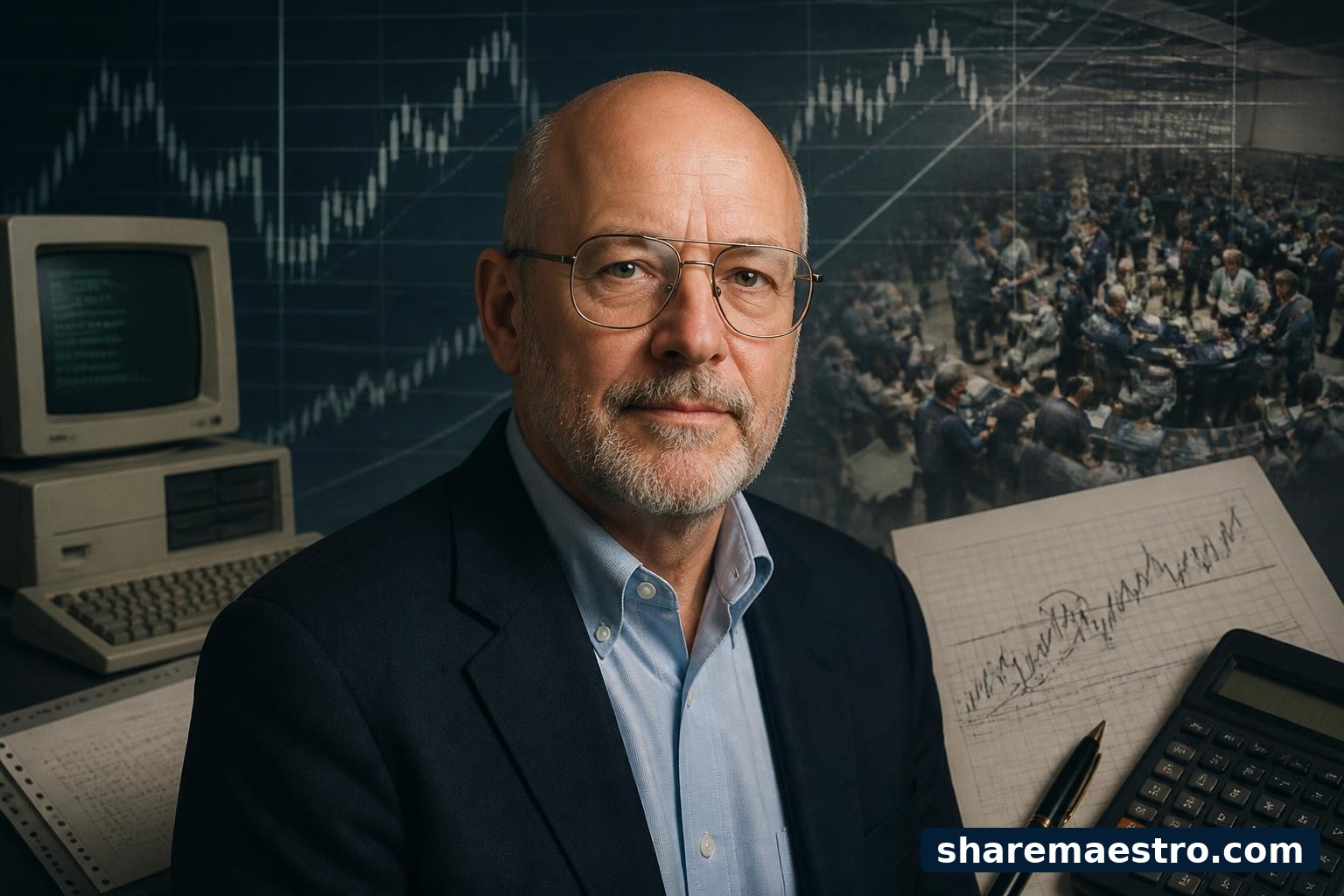
In brief
This Sharemaestro profile examines Ed Seykota's role as an early architect of computerized futures trend following, his record as presented in Market Wizards and Stocks & Commodities, his emphasis on risk and trader psychology, the Trading Tribe, and the limits of a method that can look simple until drawdowns, whipsaws, and human behavior arrive.
- Seykota mattered because he brought engineering discipline, mainframe testing, and rules-based execution to futures trading before systematic trading became a mainstream institutional language.
- His public legend rests heavily on the Market Wizards account and the 1992 Stocks & Commodities interview, which described a model customer account that began with $5,000 in 1972 and had earned more than a 250,000% gain.
- His method is less a secret indicator than a structure: trade with trends, diversify, use stops, size positions by risk, test systems, and accept that the trader's psychology is part of the system.
- Seykota's greatest warning is also his appeal: the same leverage and pyramiding that allow extraordinary compounding can turn normal trend-following pain into ruin if heat, liquidity, and drawdown tolerance are misjudged.
- His continuing relevance lies in the fusion of code and behavior. Modern systematic traders have better data and faster machines, but they still face the old problem of whether they can follow the rules they claim to believe.
Performance and evidence
Performance markers
Visual Evidence
Charts and timelines
Risk
Timeline
Philosophy
Performance
The engineer who made the market mechanical
Long before systematic trading became a polished institutional category, Ed Seykota was testing commodity prices on machines that made the work feel more like industrial engineering than Wall Street romance. He was not building a story stock portfolio, courting corporate managements, or trying to outguess next quarter's earnings. He was asking whether price behavior could be reduced to rules, whether those rules could be tested, and whether a person could keep following them when the market made the rules look foolish.
That last condition is why Seykota remains more than a historical curiosity. His career sits at the crossing of three revolutions that now define modern trading: computers, diversification across liquid futures, and the codification of risk. He belongs to the same broad era that produced the great macro and managed futures traders, but his signature was different. He turned the idea of trend following into an executable routine, then spent decades arguing that the routine was only as strong as the human being operating it.
The public record of Seykota is thinner than that of many hedge fund founders because he avoided the large public firm model and rarely sought celebrity. Yet the pieces that exist are unusually concentrated. Market Wizards made him a cult figure. Stocks & Commodities captured him explaining the early mechanics of his work. His own Trading Tribe writings reveal a trader who came to believe that stops, bet size, and feelings were not separate subjects but one operating system. That fusion is the real Seykota story.
Why Seykota matters
Seykota matters because he helped establish that a trader could build a durable edge without forecasting in the conventional sense. The premise was radical in a market culture that rewarded confident opinions. The trend follower did not need to know why gold, currencies, bonds, grains, or stock indexes were moving. The trend follower needed a way to detect that they were moving, a method for getting aboard, and a risk plan for surviving all the times the move failed.
This sounds almost obvious now because quantitative and rules-based investing have become common. In the early 1970s it was not obvious. Computing time was expensive, data had to be assembled with labor, and most market participants still lived by broker talk, chart books, economic narratives, and instinct. Seykota's account of buying computer time, punching cards from The Wall Street Journal, and running tests in FORTRAN on a brokerage mainframe belongs to a period when the infrastructure itself was part of the edge.
His influence also lies in the way he stripped trend following of mystique. The core principles in his later public writings are blunt: trade in the direction of the trend, use stops, manage risk, and design position size before the order goes in. The sophistication is not hidden in an exotic formula. It is hidden in the patience to test simple ideas, the humility to accept small losses, and the willingness to look foolish while waiting for the rare move that pays for the rest.
That is why Seykota remains cited by traders who have no intention of copying his exact systems. He represents a way of thinking. Markets are uncertain, but behavior can be specified. Losses are unavoidable, but exposure can be controlled. The future cannot be known, but the rules for meeting it can be written in advance.
From radios and wave forms to price signals
Seykota's origin story reads less like a Wall Street apprenticeship than a technician's education in feedback. In a 1992 Stocks & Commodities interview, he described a childhood filled with radios, test equipment, oscilloscopes, and a fascination with wave forms. His father introduced him early to a simple breakout idea: buy when price breaks out of the top of a box and sell when it breaks out of the bottom. The image is almost too neat, but it foreshadows the career that followed.
At MIT, Seykota studied servo theory, the study of self-controlling mechanisms such as thermostats, governors, and process controllers. The key lesson was feedback. A system observes a state, compares it with a reference, and acts. That intellectual frame matters because Seykota later approached markets less as a series of narratives than as a set of adaptive signals. Price moves, the system responds, risk changes, and the trader adjusts exposure.
The decisive bridge came through Richard Donchian. Seykota recalled reading Donchian's work on diversified moving-average systems and being struck by the idea of an automatic mechanical moneymaking machine. He bought computer time, entered price data manually, and tested variations. Longer-term smoothing seemed to hold up better than short-term systems once transaction costs were considered. That observation would become a recurring theme in trend following: a system must be simple enough to survive costs, noise, and human interference.
Seykota was not the first trend follower, and he did not invent moving averages or breakouts. His contribution was to combine inherited technical ideas with the discipline of computing. He was part of the generation that turned what had been chart reading into mechanical testing. The market was still uncertain, but the trader no longer had to depend only on memory and conviction.
The wire house lesson
Seykota's early professional episode at a wire house is one of the clearest windows into his later distrust of incentives that are not aligned with performance. In the early 1970s, he used the firm's IBM 360/65 accounting mainframe on weekends to run tests. The work was slow. He later said he tested four types of systems on about 50 parameter sets across eight commodities going back roughly a decade, a project that took half a year.
Management saw a product. Seykota saw a system that should make money for customers. The distinction mattered. In his telling, his boss could not follow the system and his boss's boss was more interested in modifying it to generate commissions. Seykota left, disgusted by a structure that rewarded activity over client results. The episode has become part of his legend because it framed systematic trading not merely as technology, but as an ethical stance against churn.
At 23, he went out on his own with a small group of accounts. A few years later, he said, the wire house had hundreds of sales agents raising money for its version of the system, while he had more assets under management through internal growth from the original accounts. The lesson was blunt: compounding from a disciplined method could beat distribution from a compromised one.
The story also explains Seykota's later insistence on compatibility between trader and system. Rules are not self-executing simply because they are printed or coded. A firm can package a method and still fail if its incentives, clients, or operators cannot tolerate its behavior. For Seykota, technology solved only part of the problem. The deeper question was whether the people around the system could live with it.
The record that made the legend
The performance claim most associated with Seykota is extraordinary and should be stated carefully. Stocks & Commodities wrote in 1992 that according to Market Wizards, Seykota's model account, described as an actual customer account, began with $5,000 in 1972 and by that time had earned more than a 250,000% gain. Wiley's page for Market Wizards likewise describes an MIT-trained electrical engineer whose computerized trading earned 250,000% over 16 years and lists the Seykota chapter as Everybody Gets What They Want.
Such numbers made Seykota one of the most arresting figures in Jack Schwager's interview canon. They also create a challenge for any sober profile. The account was not a mutual fund with daily public net asset values, a modern audited hedge fund database entry, or a public company record. The claim survives because it was published in highly influential trading literature and repeated in a respected technical trading magazine, not because the full account history is publicly reproducible.
That distinction does not make the record irrelevant. It changes how it should be read. The numbers signal what aggressive trend following can do under favorable conditions when a trader catches large futures trends, sizes effectively, and compounds. They do not prove that the same return profile is broadly available, easily scalable, or psychologically tolerable. Seykota's own work on heat later made that caveat explicit: higher expected return may arrive with drawdowns that few investors can endure.
The legend, then, is not just that a small account became enormous. It is that the route was systematic rather than promotional. Seykota became famous for doing the opposite of what market entertainers usually do. He had no grand economic thesis to sell. He had rules, code, stops, and a temperament that treated spectacular gains as the consequence of repeated obedience to a process.
What the system was, and what it was not
Seykota's style is commonly described as computerized trend following, but that phrase can make it sound more mysterious than it was. The raw ingredients were familiar: moving averages, support and resistance, long and short signals, and diversification across futures markets. In his public comments, he repeatedly emphasized that the exact indicator is less magical than the trader's ability to follow a chosen formula when it becomes uncomfortable.
The process begins with a definition of trend. That definition can be a moving-average crossover, a breakout from a range, a support and resistance corridor, or another smoothing method. Seykota's point was that there is no single sacred trend. The trader chooses a definition, tests it, examines how it behaves across markets and regimes, and then builds risk controls around its weaknesses. What matters is not that the rule feels clever on a chart, but that it can be executed through whipsaws.
Trend following also reverses a common trading instinct. It buys strength and sells weakness. It does not wait for comforting pullbacks if the system says the trend is already in force. It can enter after several false starts, then lose again, then enter again. That repeated willingness to pay small losses for the right to catch a large move is psychologically punishing, which is why Seykota made loss cutting central rather than incidental.
The system was never pure automation in the fantasy sense. Seykota argued that mechanical traders still use judgment in selecting markets, changing bet size, rolling contracts, and deciding how to live with the system. Even a coded rule is embedded in human choices. That observation has aged well. Modern algorithmic trading often hides discretion at the design level, but the discretion has not disappeared.
Position sizing as the true engine
If the entry signal is the visible part of Seykota's method, position sizing is the engine. His writings return again and again to the idea that risk must be set before the trade is entered. Once the trade is live, much of the real risk decision has already been made. The stop defines the point at which the premise has failed. The distance to that stop, combined with the equity at risk, determines size.
Seykota used the term heat to describe equity-normalized trade risk. In one example from his FAQ aggregation, a $1,000,000 account with 1% heat has a $10,000 risk budget for the next trade. If the risk to the stop is $2,000 per contract, the position is five contracts. The arithmetic is simple, but the consequence is profound. Volatility and stop distance automatically change size. The trader does not get to use conviction as an excuse to overbet.
His later guidance was often more conservative than the mythology around his returns might suggest. In 2023, he wrote that professional commodity traders generally keep individual position entry risk between one tenth of one percent and one half of one percent, and generally keep total entry risk below 10%, while acknowledging that some successful traders may exceed those guidelines. Elsewhere, the FAQ aggregation frames 1% heat as aggressive and 5% as maniacal.
The gap between the spectacular record and the conservative language is not a contradiction. It is the paradox of leveraged trend following. The method can generate extraordinary results only because futures allow meaningful exposure across many markets, but the same leverage turns sizing errors into existential errors. Seykota's career is often summarized by trend, but his lasting technical contribution is the insistence that trade size, not prediction, determines survival.
Stops, whipsaws, and the price of admission
Seykota's world has no escape from whipsaws. False breakouts are not evidence that the method is broken. They are the cost of waiting for the few moves that matter. In the official Whipsaw Song, his trading principles are almost comic in their simplicity: ride winners, cut losses, manage risk, use stops, stick to the system, and ignore hot news. The song works because it turns an austere philosophy into a folk refrain.
Stops are central, but Seykota never treated them as magic. A stop placed too close invites ordinary noise to take the trader out. A stop placed too far reduces position size or increases loss. A stop that exists only in the trader's imagination is not risk control. In his public answers, Seykota stressed that stop placement and position sizing must be tested together inside the trader's drawdown tolerance envelope.
His language around news is equally revealing. Trend followers do not need to argue with every headline because the system already treats price as the final integrating mechanism. That does not mean news never matters. It means the trader does not use late public explanations to override a rule. By the time a narrative feels obvious, the price move may already be mature. Seykota's technical insight and psychological insight meet at that point: the urge to explain can become the urge to interfere.
This is also where many traders misunderstand the method. Trend following is not a promise to be right more often. It may lose frequently and still work if losses are small and winners are allowed to grow. The trader must accept a business model that can feel like repeated failure interrupted by occasional vindication. Seykota's genius was to state that discomfort plainly rather than dress it up as certainty.
Heat, ruin, and the uncomfortable math
In 1993, Seykota and Dave Druz published Determining Optimal Risk in Stocks & Commodities, an article that captures the harder mathematical side of his thinking. The paper begins with a simple trader's dilemma: risk too little and returns are small; risk too much and ruin arrives. It uses the term heat for distributed portfolio bet size and argues that heat is bound up not only with system characteristics but also with personality preference.
The article's coin-toss example is famous among Seykota readers. In a stylized game where heads wins two and tails loses one, the optimal fixed bet is 25% of stake. Push beyond that and the final total begins to suffer as drawdowns dominate. The example is not a recommendation for normal trading size. It is an illustration of why the best mathematical growth point may still be psychologically or practically unacceptable.
The article's actual system simulation made the point even more sharply. It showed optimal performance at heat around 140%, about 28% for each of five instruments, with a return near 55% per annum, average drawdown around 40% per annum, and maximum drawdown over 90%. The authors immediately noted that few investors would have the stomach for such an optimum, and that most would prefer less drawdown and less gain.
That is one of the most important Seykota lessons. A system can be mathematically attractive and commercially impossible. It can maximize one measure while destroying client confidence, trader sleep, or operational stability. For modern investors raised on Sharpe ratios and backtests, the point remains urgent. Optimization is not the same as investability.
The psychology was not decoration
Seykota's most quoted psychological line is that everyone gets what they want out of the market. The phrase can sound mystical or harsh, but his broader work gives it a practical meaning. Traders often say they want profits while arranging their behavior to obtain excitement, validation, punishment, drama, or proof of intelligence. The account statement reveals not only the system's performance but the trader's hidden incentives.
This is why he moved from systems into the Trading Tribe. In the early 1990s, according to his official biography, he formed a group of traders committed to excellence and to helping each other align their trading systems with personal psychology. The group later evolved into a broader support network. The premise was unusual for a systems pioneer: the trader's emotional life was not a soft topic to be outsourced to motivation. It was part of execution.
The Trading Tribe Process asks participants to notice feelings rather than suppress them, with group members listening, mirroring, and encouraging the sender to experience what is present. Seykota's own page describes traders as self-reliant and often committed to doing it themselves, then argues that inner work is difficult alone because people avoid the very feelings that drive recurring dramas. That language is far from conventional finance, but the trading application is direct.
A trader who cannot feel fear may overtrade. A trader who cannot tolerate regret may move stops. A trader who cannot bear missing out may chase every breakout. A trader who needs to be right may refuse a small loss. Seykota's psychological work is controversial in tone, but its market implication is hard to dismiss: system failure often enters through behavior.
The Trading Tribe as an extension of the system
The Trading Tribe is easy to caricature because it does not sound like the usual language of finance. It uses terms such as Fred, the conscious mind, the hot seat, feelings, forms, and the Rocks Process. Yet underneath the idiosyncratic vocabulary is a consistent extension of Seykota's trading philosophy. If a trading system is a set of rules for price uncertainty, the Tribe is a set of practices for emotional uncertainty.
The official TTP page frames the process as an educational technology for personal growth. Its member philosophy includes following trends, not trying to figure out markets, letting winners ride, cutting losses, managing risk, and celebrating feelings. That list is important because it shows that Seykota did not separate trading mechanics from self-observation. The same person who can define a breakout must also notice the urge to sabotage it.
TTP Extensions, published in 2013, shows Seykota revising the process after observing that some participants used earlier practices medicinally, to make uncomfortable feelings disappear without addressing recurring patterns. That willingness to modify the psychological framework mirrors his approach to systems. The process evolves empirically, by trial and error, through experience rather than doctrine.
For critics, the Tribe can look too inward, too personal, or too eccentric for serious finance. The criticism has weight if the work is treated as a substitute for robust testing, liquidity awareness, and operational discipline. But as a supplement to systematic trading, it addresses a problem that spreadsheets rarely solve. The rules are useless if the trader cannot live with the feelings the rules produce.
Criticism and limits
The first limit is evidence. Seykota's public record is legendary, but it is not documented in the way a modern institutional allocator would require. The famous model account is reported through Market Wizards and Stocks & Commodities, not through a complete public audit trail. That does not erase the achievement, but it does require restraint. A profile can recognize the record's importance without pretending it is the same as a regulated fund's full performance history.
The second limit is scalability. A small account trading futures can compound at rates that larger capital cannot easily replicate. Liquidity, market impact, diversification capacity, margin demands, and investor withdrawals all change with size. Seykota's own early success was tied to a small number of accounts and internal growth, not to gathering vast assets. That may have preserved flexibility, but it also means his record should not be generalized casually to large pools of capital.
The third limit is the method itself. Trend following can spend long periods bleeding through false signals. It can lag at turning points, suffer in range-bound markets, and deliver its best returns in concentrated bursts. The AQR study of long-run trend following is supportive, finding positive average returns in each decade since 1880 and strong performance in many large 60/40 crisis periods, but it is not a guarantee. It also acknowledges the importance of implementation and the possibility that fees, crowding, and correlations can affect future returns.
The fourth limit is psychological overreach. Seykota's insistence that emotions matter is valuable, but it can become too totalizing if every loss is interpreted as a hidden desire or every drawdown as a personal drama. Markets are noisy. Systems fail. Execution costs change. A balanced reading of Seykota keeps both truths in view: the trader's behavior matters, and the market remains capable of defeating a well-behaved trader.
How his method changed the trading conversation
Seykota did not create the managed futures industry, but he helped define its grammar. The modern commodity trading advisor world is built around many of the ideas that he brought into sharp focus: systematic signals, diversified futures, long and short exposure, risk budgets, drawdown tolerance, and a clear separation between prediction and response. The CFTC's CTA framework became part of the formal regulatory architecture, while traders like Seykota shaped the practical language of how such programs were understood.
The shift was cultural as much as technical. Seykota's generation helped make it respectable to say that price was enough. A trader could ignore fundamental narratives not out of ignorance, but because the system's job was to respond to market action. That idea now appears across quantitative futures, time-series momentum research, managed futures funds, and even retail trend systems. The old brokerage culture of tips and stories lost ground to rules and testing.
He also influenced the way traders talk about risk. Many market participants discuss risk as volatility after the fact. Seykota discussed it as a decision before entry. Heat, stop distance, position size, and total exposure became the language of intention. That vocabulary is now common in systematic trading, but its importance is still underestimated by traders who spend months tuning entries and minutes deciding how much to bet.
Perhaps his deepest influence is the union of rule and temperament. The market does not reward a system in abstraction. It rewards a trader or organization that can execute the system under stress. This idea runs through later managed futures firms, systematic macro programs, and independent traders who discovered that backtests are the easy part. Seykota made the uncomfortable part central.
What remains useful today
The most useful part of Seykota's legacy is not a particular moving average length or breakout window. It is the architecture. Define the signal. Test it across markets. Size positions from risk. Place stops. Diversify. Keep losses small enough to continue. Let rare winners become meaningful. Review whether the system matches the trader's emotional and financial tolerance. None of that is obsolete.
The long-run evidence for trend following supports the broad intuition that price trends have persisted across asset classes and regimes. The AQR century study found positive average returns in each decade since 1880 and strong results in eight of the ten largest crisis periods for a 60/40 portfolio. That matters because it places Seykota's approach inside a broader empirical tradition rather than treating it only as a personal legend.
Yet the danger has also increased. Software makes it easy to overfit. Data is abundant, but clean historical futures data remains complex. Execution is faster, but competition is deeper. Retail traders can automate signals without understanding margin, slippage, contract rolls, or correlation spikes. The fact that a rule can be coded does not mean it is robust. Seykota's warning that complexity often comes from emotions, not markets, is still a useful antidote to ornamental systems.
The safest modern reading is humble. Trend following can diversify portfolios, but it can disappoint for years. Stops can control ordinary losses, but not all gap or liquidity risk. Position sizing can reduce ruin risk, but it cannot make uncertainty disappear. The system can be simple, but living with it is not. Seykota's relevance lies in that distinction.
The continuing lesson of Ed Seykota
Ed Seykota's career is a reminder that the future of finance often begins in ungainly tools. Punch cards, weekend mainframes, hand-entered data, and simple moving averages helped create a model of trading that now sits behind sophisticated quantitative programs. The technology has changed beyond recognition. The underlying bargain has not. A trend follower pays for the right tail with small losses, patience, and the humility to be wrong often.
He is also a reminder that great trading records can be both inspiring and dangerous. The 250,000% figure made the legend, but the risk work explains the legend's cost. Heat can compound capital or destroy it. The trader's job is not to find the hottest possible setting in a simulation. It is to find the level of exposure that can survive markets, clients, margin, sleep, and self-deception.
Seykota's unusual combination of engineer and psychological provocateur is what gives him staying power. Many traders learn the first half of his message and miss the second. They want the code, the breakout, the parameter, the song lyric. His harder point is that the real system includes the person who must execute it. A trader can automate entries and still manually sabotage exits. A fund can optimize risk and still misjudge investor fear.
That is why Seykota remains a market legend rather than merely an early systems trader. He helped put futures trading on the path toward rules and computers, then insisted that discipline was not in the machine. It was in the trader's willingness to accept what the machine required. In an era of faster data, cheaper automation, and endless signals, that lesson has become more valuable, not less.
Disclosure
Educational financial journalism and market research only. Not financial, investment, trading, tax, or legal advice.