In brief
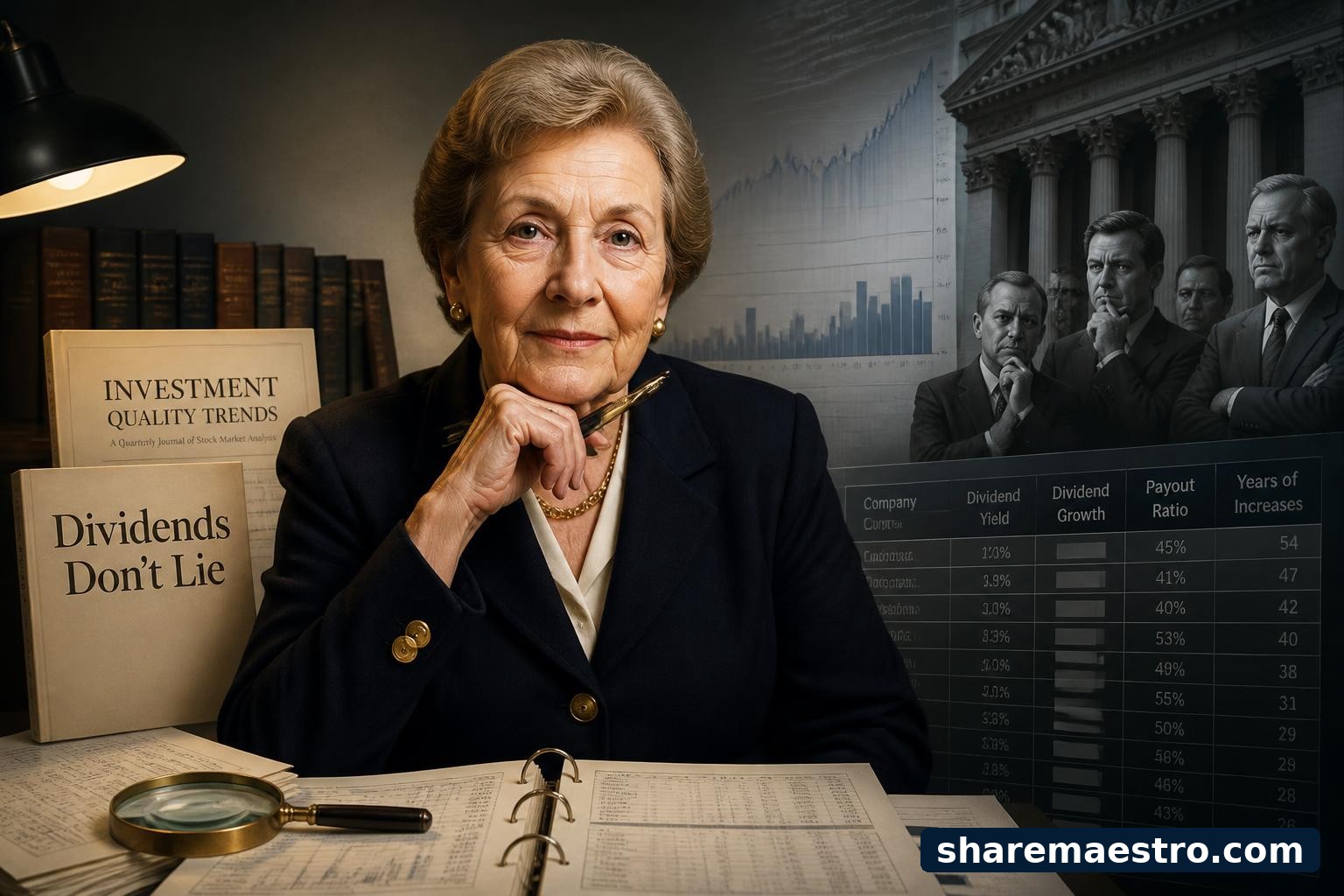
Geraldine Weiss turned dividend-yield value investing into a disciplined advisory business, using high-quality dividend payers, historical yield ranges, and a strict sell discipline to challenge both Wall Street's gender biases and its appetite for accounting stories. Her record showed resilience across difficult markets, though her approach also faced real limits in growth-led periods and in cases where high yield signaled distress rather than value.
- Weiss co-founded Investment Quality Trends in 1966 and used the byline G. Weiss for years because financial readers were more willing to trust a gender-neutral adviser than an openly female one.
- Her central idea was that a high-quality company's own historical dividend yield could identify undervaluation and overvaluation more clearly than earnings narratives alone.
- The method began with quality screens, including long dividend histories, earnings improvement, liquidity, institutional sponsorship, and S&P quality rankings, before price or yield was considered actionable.
- Independent and industry performance references credited the newsletter with competitive long-term returns and strong risk-adjusted results, though the figures differ by period and portfolio.
- The approach remains influential in dividend growth investing, income screens, and index products, but it can mislead investors who chase high yield without testing payout safety, debt, and business durability.
Performance and evidence
Performance markers
Visual Evidence
Charts and timelines
Risk
Timeline
Philosophy
Performance
The panic that turned into a method
In October 1962, with the Cuban missile crisis pushing the world toward a nuclear standoff and stock prices lower, Geraldine Weiss saw something different from panic. She was a Navy officer's wife in San Diego, a mother of four, and not yet a recognized market voice. The selling looked less like the end of capitalism than a chance to buy shares in sound companies at better prices. When the crisis passed and the stocks she had bought rose, the episode gave her more than a profit. It gave her a vocation.
That origin story matters because it contains the outlines of the investor she became. Weiss was not a Wall Street trader trying to exploit an information edge by the minute. She was a student of market behavior who came to believe that broad fear could temporarily misprice durable businesses, and that investors needed a simple, repeatable way to distinguish a bargain from a broken company. Her answer would be the dividend, not as ornament or income alone, but as evidence.
The phrase most attached to her career, Dividends Don't Lie, was more than a book title. It was a protest against the investment culture of estimates, promotional earnings, and fashionable stories. Weiss argued that cash distributions, voted by directors and paid to shareholders, carried a truth that accounting figures could blur. She did not claim every dividend payer was safe. She built a system around the harder question of which dividend payers were high quality, and when their yields showed value rather than danger.
That combination made Weiss a rare figure in modern investing: a market pioneer whose method was conservative but whose career was radical. She entered a profession that did not want women in analytical roles, built one of the most durable independent stock advisory newsletters in the United States, and developed a valuation discipline that still echoes through dividend growth screens, income portfolios, and quality-value products.
A San Francisco childhood and a Berkeley education
Geraldine Sylvia Schmulowitz was born in San Francisco on March 16, 1926. Her father worked in residential real estate, and the family later changed its name to Small in response to anti-Semitism. Market talk was part of the household atmosphere. Both parents dabbled in stocks, and the nightly conversation gave the future adviser an early familiarity with prices, risk, and the emotional vocabulary of investing. She grew up at a time when the stock market still carried the memory of the crash and Depression, yet it remained a subject of aspiration in many American homes.
At the University of California, Berkeley, Weiss studied economics and business rather than law, despite an earlier ambition to become a lawyer. She met Richard A. Weiss, a young Navy officer, while in college. They married in February 1946, beginning a life that moved with the Navy across Japan, the Philippines, Hawaii, and California. The mobility of military family life did not resemble the standard apprenticeship path into finance, but it gave her long hours of self-directed study once her children were older.
Her entry into investing was therefore both delayed and self-made. She read widely in the San Diego public libraries, consuming investment books with the urgency of someone who had discovered a late calling. The opening she sought from the brokerage industry did not come. Firms that might have hired a man with curiosity and drive offered her secretarial work. In an industry that claimed to respect numbers, the numbers were not yet enough when attached to a woman.
The byline that hid the woman
Weiss's practical answer to exclusion was to create her own platform. In 1966, she began publishing Investment Quality Trends, a stock advisory newsletter that would become the center of her professional life. The publication operated far from Wall Street's physical and cultural center, out of La Jolla, California, yet its ambitions were national. It served investors who wanted disciplined stock selection, not market gossip, and it focused on high-quality companies with dividend records that could be measured across cycles.
The first issue appeared on April 1, 1966, according to the firm's own history. For years, readers knew the editor as G. Weiss. The initial was not a branding flourish. It was camouflage. Weiss understood that many subscribers and prospects would be more receptive to a market letter if they could imagine the author as Gerald or George. The decision was an indictment of the profession, but it was also a shrewd commercial adaptation by someone determined to be judged on performance.
The concealment ended in the 1970s when Weiss appeared on Wall Street Week with Louis Rukeyser. By then the record had attracted attention strong enough to reduce the perceived risk of revelation. The moment worked because it reversed the usual power relationship. Subscribers who might have dismissed a female adviser before seeing results now had to decide whether gender mattered after the newsletter had already made its case in the market. Weiss's answer, delivered through returns rather than argument, was that the market had never cared.
Why the dividend became her truth test
Weiss's essential proposition was elegantly narrow. A company's stock price may swing with fashion, fear, and estimates, but its dividend history records a long series of corporate decisions. A board must declare a cash dividend. A company must have the means, or at least the willingness, to pay it. A rising dividend over many years does not prove excellence, yet it imposes a discipline on management and leaves a trail that investors can examine. To Weiss, that trail was often more revealing than headline earnings.
The method did not treat yield as a generic ranking tool. It compared a stock's current yield with its own historical yield ranges. When a high-quality company's yield rose to a historically high level, the share price was often depressed relative to the dividend stream. That created a potential undervalue area. When the same company's yield fell to a historically low level, the price had often advanced to an overvalue area. The investor's work was to wait for these recurring zones, not to guess each quarterly earnings surprise.
This was value investing, but not Graham's net-net liquidation arithmetic. It was also technical analysis, but not chart reading detached from business quality. Investment Quality Trends described the approach as a fundamental approach to technical analysis: quality determined what could be bought, while dividend-yield profiles helped determine when to buy, sell, or hold. That fusion explains the durability of the method. It gave conservative investors a chart, but the chart was built from cash distributions rather than price momentum alone.
Quality came before yield
The most common misunderstanding of Weiss's work is to reduce it to high-yield stock picking. Her own framework was more restrictive. The newsletter's Select Blue Chip criteria required a company to pass at least five of six tests to earn the designation and allowed it to remain with four. The tests included dividend increases in five of the last 12 years, an S&P quality ranking in the A category, at least 5 million shares outstanding, at least 80 institutional investors, at least 25 years of uninterrupted dividends, and earnings improvement in seven of the last 12 years.
The 12-year tests were not arbitrary decoration. Investment Quality Trends later explained that the period was meant to cover roughly three business or economic cycles, enough time for recessions, industry shocks, tax changes, and management errors to show themselves. A company that could improve earnings and dividends across that span had displayed something more durable than a single product cycle. Weiss wanted the evidence of competence before the evidence of cheapness.
That is why her blue-chip definition differed from the casual use of the term. A large household-name stock was not automatically a Weiss blue chip. A famous company without a sufficiently reliable dividend record could fall outside the investable universe. The method's first act was exclusion. In one explanation, the firm said its criteria eliminated about 98 percent of the domestic publicly traded universe, leaving a few hundred stocks for further dividend-yield profiling. The narrowness was a feature, not a bug.
The machinery of undervalue and overvalue
Once a company passed the quality gate, the Weiss system mapped its valuation through yield. Investment Quality Trends grouped Select Blue Chips into four categories: Undervalued, Rising Trend, Overvalued, and Declining Trend. An undervalued stock had reached a historically repetitive low-price and high-yield area. A rising-trend stock had advanced at least 10 percent from its undervalue base. An overvalued stock had reached a historically repetitive high-price and low-yield area. A declining-trend stock had fallen at least 10 percent from its overvalue peak.
The data tables were not designed for casual inspiration. They showed price, dividend, yield, points down to undervalue, percent down, undervalue low price, historical high yield, points up to overvalue, percent up, overvalue high price, historical low yield, quality rankings, book value, trailing earnings, price-earnings ratio, payout ratio, debt, and dividend danger flags. The point was to remove as much improvisation as possible. A subscriber could see whether a security met the quality standard, whether the dividend was covered, and how far the price was from the relevant yield zone.
The charts were distinctive because they overlaid undervalue and overvalue dividend-yield areas on price history in a stair-step fashion. That visual grammar reflected the core belief that dividends change in steps while prices swing daily. A rising dividend could lift the undervalue and overvalue price lines over time. In practical terms, Weiss was teaching investors to watch for a stock's price to move against a slowly improving income stream, then to use that tension as a valuation signal.
A sell discipline hidden inside an income strategy
Weiss's reputation as the Grande Dame of Dividends can obscure how active her discipline was. The goal was not simply to collect distributions forever from any company with a familiar name. The newsletter's framework called for buying when high-quality dividend payers reached historically attractive yield levels, holding through the move toward fairer value, and selling when the yield fell into the overvalue zone. Income was part of the return, but the process also harvested capital gains when prices advanced too far relative to the dividend.
That sell discipline separated the method from a purely passive dividend growth approach. It acknowledged that even excellent companies can become too expensive. A low yield might reflect years of price appreciation that had already capitalized the good news. For an investor concerned with future returns, the moment of maximum admiration could be the moment of maximum risk. Weiss's system forced a hard question: if the dividend no longer offered adequate value relative to the stock's history, why keep treating the shares as a bargain?
Risk controls were embedded in the same tables. A payout ratio at or above 100 percent of trailing earnings triggered a Dividend in Danger flag. For industrial companies, the newsletter generally preferred payout ratios between 30 percent and 60 percent, with higher tolerance for utilities because of their different capital structures. Debt mattered as well. Liquidity, institutional sponsorship, and quality rankings were not afterthoughts. They were guardrails against confusing a stock made cheap by fear with one made cheap by deteriorating fundamentals.
The record that made the argument harder to dismiss
The first test of Weiss's credibility was survival. Investment Quality Trends launched in 1966, just as the United States entered a long and difficult period for equities. The firm's own retrospective says the S&P 500 lost more than 45 percent during the 1966 to 1975 bear market, while the newsletter's approach achieved double-digit average annual returns for subscribers. The figure comes from the newsletter's account of its history, but it captures a crucial point: the business became known in a period when conventional equity enthusiasm was repeatedly punished.
Outside references added to the reputation. In January 1985, the Los Angeles Times reported that Investment Quality Trends of La Jolla had been ranked first by Select Information Exchange among 380 market periodicals for stock forecasting performance, with a portfolio gain of nearly 40 percent between June 1981 and December 1984. The period was short, but the ranking helped establish Weiss as more than a regional curiosity.
Mark Hulbert's data later supplied a broader performance frame. In a Wall Street Journal obituary republished by Mint, Hulbert said the average annual return for Weiss's method from the beginning of 1986 through the end of 2002, when she sold the business, was 12.3 percent, compared with 10.8 percent for the Wilshire 5000 total market index with dividends reinvested. Investment Quality Trends' own Hulbert Honor Roll page reported a model portfolio gain since December 31, 1985, of 11.31 percent versus 10.54 percent for the Wilshire 5000, with lower reported risk.
Those numbers should be read carefully. Newsletter performance can depend on model portfolios, timing assumptions, transaction costs, taxes, and subscriber behavior. Yet the broad picture is difficult to dismiss: across multiple references and long stretches, the method was competitive with the market and often appeared less volatile. For a woman who had been offered secretarial work instead of analytical authority, the record was also a career-long rebuttal.
Why the system appealed to serious amateurs
Weiss's method was sophisticated enough to use long records and recurring valuation bands, but simple enough for non-professionals to understand. That balance was central to its appeal. A subscriber did not need to build a discounted cash-flow model or forecast semiconductor demand. The questions were concrete. Has the company paid and raised dividends across cycles? Is the current yield high or low relative to its own history? Are earnings and payout ratios consistent with dividend safety? Is the balance sheet carrying too much debt?
The dividend-yield framework also gave investors a behavioral anchor. Markets seduce people into buying what has already worked and selling what has recently embarrassed them. Weiss's system did the opposite. A high yield on a qualified company often appeared when the stock was unpopular. A low yield often appeared when the stock had been rewarded. By translating those emotional extremes into yield zones, the process gave investors permission to be patient and contrarian without pretending to predict every macro turn.
AAII's later discussion of Weiss's approach captured this mechanism in plain terms: as value investors buy a high-yielding stock, the price rises and the yield falls; once the yield no longer looks attractive, selling pressure can return the yield toward higher levels. The insight is not that prices mechanically obey dividends. It is that income-oriented investors often respond to the relationship between price and cash return, and that response can create repeating patterns in mature, dividend-paying companies.
The 1990s made her look old-fashioned
Every durable strategy has a decade that makes it look foolish. For Weiss, that decade was the 1990s. The market's center of gravity moved toward technology and growth stocks, many of which paid no dividends and did not fit her universe. Investors who wanted exposure to the biggest winners of the era could not get it by insisting on long dividend records and historically high yields. A philosophy built around cash distributions looked, to many, like a relic from a slower market.
The criticism was not trivial. A strict dividend requirement can exclude young firms with extraordinary reinvestment opportunities. It can also tilt a portfolio toward mature industries at the expense of innovation-led growth. Weiss's answer was not to rewrite the method to suit the fashion. If a company did not pay a dividend, she treated it as speculative. That language sounded severe during the boom, especially when non-dividend companies were creating immense paper wealth. It sounded less severe after the technology bubble burst.
The post-2000 period restored respect for balance sheets, payout discipline, and valuation, but it did not erase the lesson. Dividend-yield value investing can lag badly when markets reward long-duration growth and penalize income sectors. It can also look too cautious for investors whose liabilities, time horizons, or mandates demand broader equity exposure. Weiss's achievement was not that her method was always in favor. It was that the method had the internal discipline to survive periods when it was not.
What could go wrong
The first danger in applying Weiss superficially is yield chasing. A high dividend yield can mean a stock is undervalued, but it can also mean the market expects a dividend cut. Price declines mechanically raise yield, sometimes for good reason. Weiss understood this, which is why her system required dividend history, earnings improvement, payout analysis, debt review, and quality rankings. Investors who copy only the yield component are not following Weiss. They are stripping out the safeguards that made the signal useful.
The second danger is overconfidence in history. A company that has paid uninterrupted dividends for 25 years has shown resilience, but it has not earned immunity. Industries change, leverage rises, regulation shifts, and once-dominant brands lose relevance. Historical yield ranges can break when the underlying business model changes. Investment Quality Trends recognized abnormal deviations from undervalue areas and highlighted yields to watch when the move was large enough to demand additional research. That caution was essential because repetition is a tendency, not a law.
The third limitation is cost. The Publishers Weekly review of Dividends Don't Lie praised the case for buying undervalued yield and selling overvalued yield, but noted that the book could have addressed transaction costs and tax consequences more fully. That critique remains important. A taxable investor who repeatedly sells appreciated dividend stocks may surrender part of the strategy's advantage. A newsletter record can show the appeal of the gross discipline, while a household portfolio must live with commissions, spreads, taxes, and imperfect execution.
The gender story was not incidental
It is tempting to separate Weiss's investment record from the obstacles she faced as a woman, but that would flatten the story. Her use of G. Weiss was not an anecdotal curiosity. It was a business necessity in a market culture that gave male authority the benefit of the doubt and female authority the burden of proof. She did not build a separate women's investing club or soften the ambition of her claims. She entered the stock advisory business on its own terms and forced readers to confront a record before confronting her identity.
Investment Quality Trends later described her as the first woman to be a licensed investment counselor and registered investment adviser to publish a stock advisory newsletter. The firm also notes her frequent appearances and contributions across major financial media, including Barron's, The Wall Street Journal, Fortune, Forbes, The New York Times, Wall Street Week, Moneyline, and CNBC. The point is not celebrity. It is the migration of authority from hidden byline to public expert.
Weiss's advice to her granddaughters late in life was consistent with the career. She told them not to count on a husband to take care of them. That line can sound like family counsel, but it also explains the emotional force behind her investment philosophy. Dividends represented self-reliance in financial form: cash received, not promises deferred. Her career told women, and men, that independence required both capital and method.
Succession without reinvention
In 2002, Weiss sold the newsletter business to Kelley Wright, who had been deeply influenced by Dividends Don't Lie and shared many of her intellectual reference points. Investment Quality Trends' own account describes a two-hour meeting in which Weiss concluded that Wright understood the philosophy well enough to continue it. That succession mattered because the method was not merely a set of screens. It was a culture of quality, patience, and historical valuation discipline.
The newsletter changed in layout and presentation after Wright took over, but the stated philosophy remained the one Weiss created in 1966. The firm reported subscribers in Canada, the United Kingdom, Asia, Australia, and much of the Middle East, along with a sister registered investment adviser offering managed accounts according to the IQ Trends philosophy. Wright's Dividends Still Don't Lie, published in 2009, extended the brand and was translated into Chinese, Japanese, and Korean.
The post-Weiss performance data also complicate the idea that her system was merely personal charisma. The IQT Hulbert page reported long-term figures for the model portfolio, Lucky 13, Timely Ten, and overall newsletter average, with comparisons to the Wilshire 5000. Not every number covers the same period, and the categories differ, but the persistence of formal tracking reinforced the idea that Weiss had created a process that could outlive its founder.
From newsletter discipline to dividend investing culture
Weiss did not invent dividends, dividend discount models, or value investing. Her contribution was more specific. She turned historical dividend yield into a practical advisory discipline for individual investors and professionals who wanted rules, not slogans. The influence is visible in later dividend growth screens that combine yield, payout safety, and records of increases. AAII explicitly credited her use of yield as a valuation indicator, combined with dividend growth and strong fundamental quality, as an influence on its own dividend investing approach.
The broader market has also institutionalized pieces of the logic. The S&P 500 Dividend Aristocrats index measures S&P 500 companies that have increased dividends every year for the last 25 consecutive years and equal weights them. That index is not a Weiss product, and it does not replicate her historical yield buy and sell zones. Still, its popularity reflects a similar belief: long dividend records can serve as a filter for corporate durability and shareholder discipline.
Hartford Funds' dividend research shows why that belief remains commercially powerful. It reported that from 1940 through 2025, dividend income averaged 33 percent of the S&P 500's total return, and that since 1960, reinvested dividends and compounding accounted for a large share of cumulative return. The same research warns that the highest yield is not automatically best and emphasizes payout ratios. That is where modern dividend investing returns to Weiss's core distinction: quality first, valuation second, yield never alone.
What remains useful now
The useful part of Weiss's method is not nostalgia for a higher-yielding market. It is the insistence that investors link price to cash return and cash return to business quality. In markets dominated by narratives about addressable markets, artificial intelligence, platform economics, or rate cuts, the dividend remains a modest but stubborn fact. It forces the analyst to ask whether a business generates enough distributable cash, whether management respects outside owners, and whether the current price offers adequate compensation for the risks.
Her process also teaches humility about timing. Weiss did not require investors to forecast the exact bottom. She asked them to recognize historically attractive yield areas and to accept that undervalue zones can be ranges rather than precise points. Investment Quality Trends acknowledged that a normal band around undervalue could exist and that larger deviations required additional scrutiny. This is a practical way to behave in uncertain markets: define a discipline before the panic, then use the panic to test rather than invent decisions.
The continuing danger is that investors mistake a dividend for a guarantee. No dividend is sacred. A board that declared yesterday's payment can reduce tomorrow's. A high yield can be the market's warning label. Weiss's own framework anticipated that danger through payout, debt, earnings, liquidity, and quality tests. The modern investor who honors her legacy is not the one who buys the biggest yield on a screen. It is the one who asks why the yield is big, whether it is sustainable, and what history says about the stock's own valuation cycle.
The final measure of the Grande Dame of Dividends
Geraldine Weiss died on April 25, 2022, at her home in La Jolla, at 96. By then, the market she had entered as an outsider had absorbed many of her lessons without always attaching her name to them. Dividend growth funds, quality-income screens, payout ratio analysis, and shareholder-return frameworks all occupy space that her work helped legitimize. She had shown that a woman outside Wall Street could build an advisory record around a plainspoken idea and make professionals take it seriously.
Her career should not be simplified into the claim that dividends always win. They do not. Growth regimes can punish dividend-heavy portfolios. High yield can be a trap. Taxes and turnover can reduce returns. Historical relationships can fail when businesses change. Weiss's importance lies in the discipline she brought to those risks. She demanded quality before value, value before purchase, and overvalue before sale. She also insisted that investors distrust stories unsupported by cash.
The result was a method with a moral temperament. It preferred evidence to glamour, patience to prediction, and self-reliance to dependence on Wall Street permission. Weiss began by hiding her first name so readers would judge the work. In the end, the work made the name unmistakable. The dividend was her lie detector, but the larger test was of markets themselves: whether a simple, disciplined measure of value could endure against fashion, bias, and the constant pressure to believe that this cycle had made the old evidence obsolete.
Disclosure
Educational financial journalism and market research only. Not financial, investment, trading, tax, or legal advice.