In brief
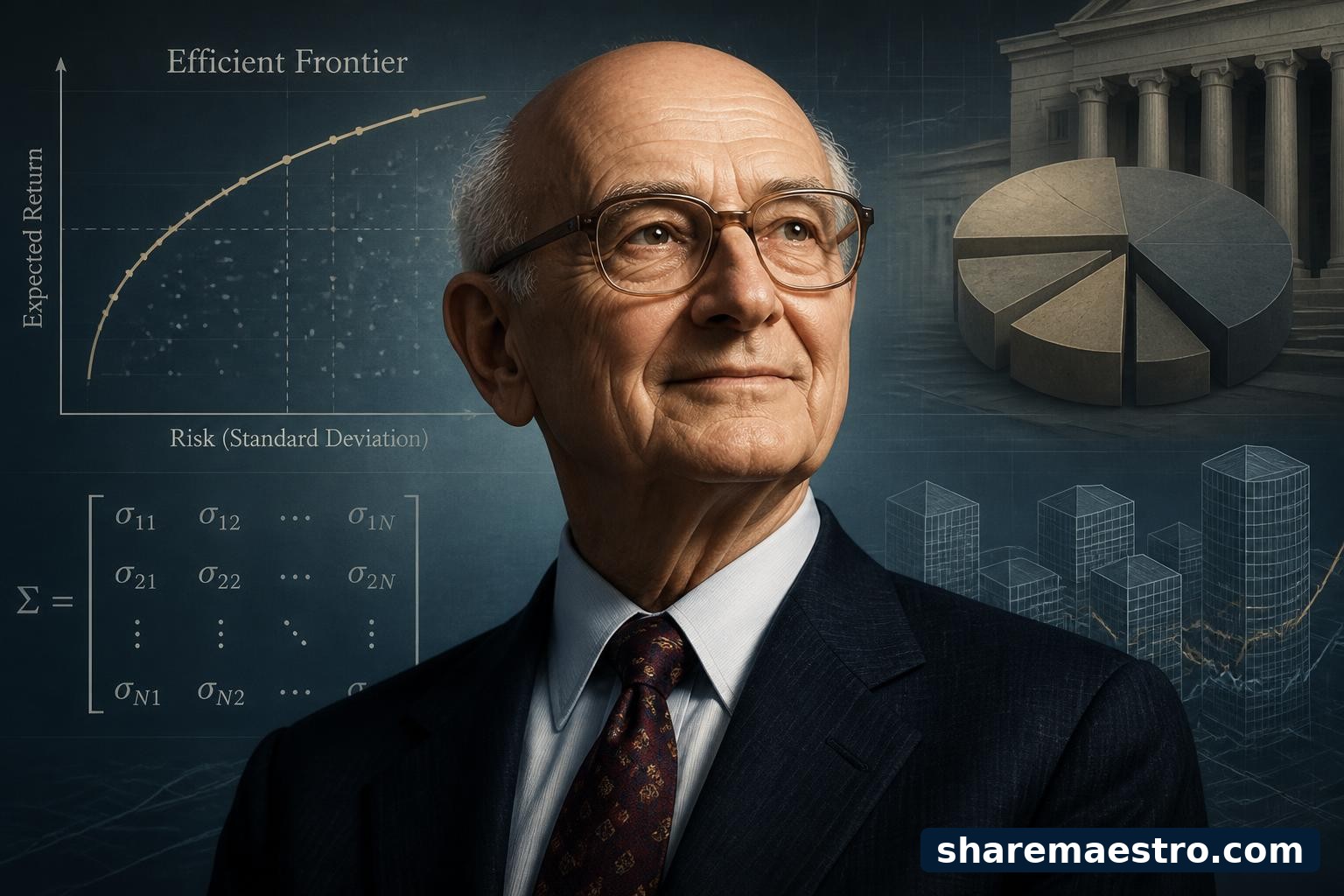
Harry Max Markowitz founded modern portfolio theory by arguing that investors should judge securities not in isolation but by how they combine inside a portfolio. His 1952 paper and 1959 book transformed diversification into a formal risk-return discipline, helped set the stage for CAPM and quantitative asset allocation, and left practitioners with both a powerful framework and a warning about false precision.
- Markowitz’s central insight was that portfolio risk depends not just on each asset’s volatility, but on covariance, the way assets move together.
- His mean-variance framework made the efficient frontier a foundation for institutional asset allocation, portfolio optimization, and financial economics.
- The approach influenced CAPM, index investing, risk budgeting, Black-Litterman allocation, resampling methods, and modern wealth management.
- The model’s lasting weakness is not the logic of diversification but the fragility of its inputs, especially expected returns, correlations, and covariance estimates.
- Markowitz’s own later comments show a thinker less dogmatic than many of his followers, attentive to regret, behavior, uncertainty, and the limits of clean mathematics.
Performance and evidence
Performance markers
Visual Evidence
Charts and timelines
Risk
Timeline
Philosophy
Performance
The Afternoon Finance Became a Portfolio Problem
The origin story of modern portfolio theory does not begin on a trading floor, with a tape running hot and a crowd shouting prices. It begins more quietly, with a young University of Chicago graduate student reading John Burr Williams and realizing that the standard question in investing had been framed too narrowly. If the value of a security was the expected value of future cash flows, then why would a rational investor hold more than the single security with the highest expected return? The real world had already answered: investors diversified.
Harry Max Markowitz made that answer mathematically serious. His 1952 Journal of Finance paper, simply titled “Portfolio Selection,” shifted the unit of investment analysis from the individual security to the portfolio as a whole. It was a small paper with a large consequence: risk was no longer a vague warning printed below return. It became a measurable property of combinations, governed not only by the uncertainty of each asset but by the relationships among assets.
Markowitz’s achievement was not that he told investors not to put all their eggs in one basket. That proverb was old. His contribution was to show precisely why the baskets mattered, how to compare them, and how a disciplined investor could seek the highest expected return for a given level of risk, or the lowest risk for a given expected return. In doing so, he helped turn finance from a craft of judgment into a field of formal economic analysis.
Why Markowitz Matters
Markowitz matters because he changed the grammar of investment management. Before his work, a portfolio could be treated as a list of attractive securities, each chosen because its prospects seemed good. After Markowitz, a portfolio became a structure. Each holding had to be judged partly by its marginal effect on the whole, including whether it made the entire collection more fragile or more resilient. The question moved from “Is this a good stock?” to “What does this holding do to the portfolio?”
That shift helped make possible much of modern asset allocation. Pension funds, endowments, wealth managers, mutual fund complexes, target-date funds, and quantitative allocation desks all work in a vocabulary that Markowitz made unavoidable: expected return, volatility, covariance, efficient frontiers, trade-offs, constraints, and risk tolerance. Even investors who reject formal optimization often explain their rejection in Markowitz’s terms. The framework became the language that both disciples and critics had to speak.
The Nobel committee recognized that his theory of portfolio choice was a pioneering contribution to financial economics. It also linked his work to the later Capital Asset Pricing Model, which used the optimizing investor in Markowitz’s framework as a stepping stone toward an equilibrium theory of asset prices. Markowitz’s reach therefore extends beyond portfolio construction. He gave finance a microeconomic foundation for thinking about uncertainty in capital markets.
Chicago, Cowles and the Discipline of Uncertainty
Markowitz was born in Chicago on August 24, 1927, and his education had the compressed intensity of the University of Chicago at mid-century. He earned a bachelor’s degree in liberal arts in 1947, a master’s degree in economics in 1950, and a doctorate in economics in the 1950s. His early interests included physics and philosophy, a pairing that later showed in his style: empirical respect for how the world behaves, joined to a taste for axioms, definitions, and rigor.
At Chicago he encountered teachers who were central to the economics of uncertainty and optimization, including Milton Friedman, Jacob Marschak, Leonard Savage, and Tjalling Koopmans. Koopmans’s treatment of efficiency and efficient sets was especially important. Markowitz was not merely absorbing finance. He was absorbing a way of thinking about constrained choice, subjective probability, and the disciplined comparison of alternatives when the future cannot be known.
The institutional setting mattered. The Cowles Commission was a small but influential center of mathematical economics and econometrics. Markowitz’s dissertation idea emerged from a conversation about applying mathematical methods to the stock market, encouraged by Marschak. Finance was not yet the heavily theorized academic field it would become. That made the subject both risky and open. There was room for a new foundation because the old one was still largely informal.
The 1952 Paper That Rejected Return Alone
“Portfolio Selection” begins by dividing the investor’s task into two stages. First come observation, experience, and beliefs about future securities. Second comes the choice of a portfolio based on those beliefs. Markowitz was explicit that his paper focused on the second stage. He was not claiming to solve the forecasting problem. He was asking how a rational investor should choose once expectations and risk assessments had been formed.
The critical move was his rejection of the rule that investors should maximize expected return alone. If that were the only objective, diversification would be hard to justify. The investor would concentrate in the security with the highest expected return. Because investors do diversify, and because they should care about uncertainty, Markowitz proposed evaluating portfolios by both expected return and variance of return. The mean-variance formulation gave structure to a familiar intuition.
The paper’s most durable idea was the efficient set, later known as the efficient frontier. Portfolios on that frontier are not dominated by other portfolios offering more expected return for the same risk or less risk for the same expected return. It was an elegant way to avoid pretending there was one universally correct portfolio. The investor’s preferences still mattered. Markowitz supplied the menu of efficient choices, not a commandment that all investors must order the same meal.
Covariance, the Quiet Variable
The most radical part of Markowitz’s framework was not variance alone. It was covariance. A security’s risk could no longer be understood only by examining the security in isolation, because the risk of a portfolio depended on how its holdings moved together. Two volatile securities could reduce portfolio risk if their returns were not perfectly aligned. Two seemingly safe securities could leave the investor exposed if they failed at the same time.
That insight is now so embedded in finance that it can sound obvious. It was not obvious in the investment literature Markowitz inherited. Investors talked about risk and diversification, but the mathematics of joint movement was not at the center of portfolio advice. Markowitz put it there. The portfolio became a system of relationships, not a container of individual bets. Correlation, covariance, and interaction became practical investment concerns.
The idea also clarified the limits of diversification. Diversification could reduce risk, but not make risky assets riskless. If all assets moved together, the benefit shrank. If relationships changed under stress, the historical comfort of diversification could vanish. Markowitz’s own work left room for such caution. He treated probability beliefs as inputs, not divine facts, and later emphasized that portfolio theory was about making choices under uncertainty, not abolishing uncertainty.
From Paper to Machinery
A theory of efficient portfolios was one thing; computing them was another. Markowitz left Chicago and joined the RAND Corporation in 1952, where he encountered George Dantzig and the world of mathematical programming. The connection was decisive. The portfolio problem was an optimization problem, and optimization required algorithms that could handle constraints, trade-offs, and large calculations in an era when computing power was scarce.
Markowitz’s 1956 work on the critical line algorithm helped trace the efficient frontier. His 1959 book, “Portfolio Selection: Efficient Diversification of Investments,” expanded the paper into a more complete treatment, written largely while he was at the Cowles Foundation at Yale at James Tobin’s invitation. The book applied modern analysis and computation to combinations of securities and was designed to reach readers beyond pure mathematics, while still giving the theory its formal development.
This evolution from insight to computation is essential to understanding Markowitz. He was not only a theorist of risk. He was a builder of analytical machinery. Mean-variance analysis was useful because it could be operationalized. In time, the tools of portfolio optimization would become standard in institutional settings with the data and computing resources to use them. The efficient frontier was not merely a diagram. It was a computational object.
A Theory Built for Institutions
Markowitz’s theory arrived before the infrastructure needed to make it routine. In 1952 there were no desktop optimizers, no broad commercial databases of return series, no cheap computational engines waiting for portfolio managers. That gap is one reason the framework’s practical adoption took time. It was born as a normative theory of how wealth should be allocated under uncertainty, but it needed institutional capital, data, and computing to become everyday practice.
The later investment industry supplied those missing pieces. Large pension plans, insurance companies, endowments, and asset managers had both the scale and the incentives to ask portfolio-level questions. They cared about policy allocations, constraints, benchmark risk, and the consequences of adding or subtracting asset classes. Markowitz’s framework gave them a disciplined way to connect those questions to a common mathematical structure.
His broader career reinforced that institutional orientation. INFORMS credited him not only for portfolio selection but also for mathematical programming and simulation. His work on sparse matrices and SIMSCRIPT belonged to the same practical universe: decision problems made tractable by computation. The finance world remembers Markowitz for the efficient frontier, but operations research remembers a wider figure, one committed to using mathematics and computers to improve decisions under constraints.
Optimization With Humility
The caricature of Markowitz is a cold optimizer who believed risk could be reduced to a formula. The real Markowitz was more careful. His framework assumed beliefs about expected returns, variances, and covariances, but he did not claim those beliefs were easy to form. The 1952 paper set aside the forecasting stage precisely because it was a separate and difficult problem. Mean-variance analysis began after beliefs had been supplied.
That distinction is central. Portfolio theory could discipline the use of forecasts, but it could not guarantee the forecasts. It could tell an investor how different assumptions translated into portfolio choices. It could not make uncertain assumptions certain. This is where many later misuses of the framework began. Treating estimated inputs as if they were known facts turns a disciplined model into an instrument of overconfidence.
Markowitz also resisted a common misunderstanding: that mean-variance analysis necessarily assumed normally distributed returns. He argued later that the theory could be justified in several ways, including as an approximation to expected utility under certain conditions. He also acknowledged the appeal of semivariance, a measure focused on adverse deviations. The founder of modern portfolio theory was therefore more pluralistic about risk than many simplified classroom summaries suggest.
The 50/50 Story and the Human Investor
No anecdote has been used more often against Markowitz than his own early retirement allocation. As he later explained, around 1952 he faced a choice involving stock and bond retirement vehicles and chose a 50/50 mix. His reasoning was regret. If stocks rose sharply, he would regret being out; if they fell sharply, he would regret holding no bonds. The split minimized the maximum regret he imagined at the time.
The story is often told as if it discredits mean-variance theory. It does not. It shows that Markowitz understood the difference between a model and a human decision made with limited tools, limited data, and a young person’s uncertainty. He later emphasized that the 50/50 choice was not his standing recommendation for a young investor and that modern investors had access to an infrastructure that did not exist when he made that allocation.
This side of Markowitz links him to behavioral finance as much as mathematical finance. Regret, comfort, and the ability to stay invested are not embarrassments to be hidden from theory. They are practical constraints. A portfolio that is optimal on paper but intolerable to its owner is not operationally optimal. Markowitz’s legacy is strongest when the efficient frontier is paired with investor behavior, not when it is treated as a machine that overrides it.
From Markowitz to CAPM
Markowitz supplied the optimizing investor. William Sharpe and others later used that investor to help build the Capital Asset Pricing Model. The Nobel committee described this as a movement from portfolio choice to price formation: if investors choose efficient portfolios in a particular way, what does that imply about expected returns in market equilibrium? Markowitz’s work was thus the microeconomic first step in a larger theory of capital markets.
The connection matters because it explains why a paper about portfolio selection had consequences far beyond portfolio management. CAPM, beta, the market portfolio, risk premiums, and debates over market efficiency all sit downstream from the Markowitz revolution. His framework helped make it possible to ask which risks should be rewarded and which risks can be diversified away. That distinction became a cornerstone of modern investment thought.
The 1990 Nobel Prize in Economic Sciences recognized Markowitz, Sharpe, and Merton Miller for pioneering work in financial economics and corporate finance. Markowitz’s share was for the theory of portfolio choice. In public memory, this often becomes a general prize for diversification. More precisely, it honored the formalization of optimal asset allocation under uncertainty, a theory that gave later finance a structure on which to build.
The Record Was Intellectual, Not a Fund Track Record
Markowitz was not a famous investor in the sense of running a public mutual fund with a decades-long return table. His record is better measured by adoption, citation, institutional practice, and the architecture of financial economics. The 1952 paper became one of the canonical articles in finance. The 1959 book became the expanded statement of efficient diversification. The Nobel Prize made public what the profession had long understood: the field had been reorganized around his insight.
His career also complicates any narrow finance label. INFORMS awarded him the 1989 John von Neumann Theory Prize for contributions to portfolio selection, mathematical programming, and simulation. He worked at RAND, General Electric, IBM, CACI, and universities including Baruch College and UC San Diego. He co-founded CACI with Herb Karr to commercialize and support SIMSCRIPT, a reminder that his intellectual home included computation as much as Wall Street.
At UC San Diego, where he later taught at the Rady School of Management, Markowitz remained part of the academic community into old age. He retired from teaching in 2019 and died on June 22, 2023, at 95. The tributes after his death emphasized both his influence on money management and his personal qualities as a teacher. That combination fits the career: a rigorous theorist whose most famous idea became practical because generations learned to use it.
Where the Model Breaks
The weakness of mean-variance optimization is not diversification. It is estimation. Expected returns are hard to forecast. Covariances are unstable. Small changes in inputs can produce large changes in optimized weights. A model that appears precise can become an amplifier of noise if it treats uncertain estimates as fixed truths. This problem is especially acute when optimizers chase tiny differences in expected returns that are well inside any reasonable error band.
Richard and Robert Michaud made this critique central in “Efficient Asset Management,” arguing that practical failures of mean-variance optimization often come from unrealistic treatment of investment information rather than a conceptual flaw in the Markowitz framework itself. The optimizer is sensitive because it is doing what it was designed to do: exploit the inputs. If the inputs are fragile, the output can be fragile, concentrated, and unintuitive.
Academic work comparing optimized portfolios with naive equal-weighting has pressed the point further. Studies have found that estimation error can allow the simple 1/N rule to compete with, or beat, more sophisticated rules in some settings. That does not repeal Markowitz. It identifies the cost of pretending the unknown is known. In practice, robust portfolio construction often means constraining, shrinking, blending, or otherwise humbling the inputs before optimization.
How Practitioners Repaired the Machinery
The investment industry did not abandon Markowitz when it discovered input fragility. It modified him. Constraints on position size, sector exposure, leverage, turnover, taxes, liquidity, and tracking error became part of applied optimization. Rather than seeking the pure mathematical optimum, practitioners often sought a portfolio that was robust, implementable, and defensible. In this sense, real-world mean-variance analysis became less like solving a theorem and more like engineering a resilient system.
Michaud’s resampled efficiency, Bayesian approaches, shrinkage estimators, and other robust methods all emerged from the same practical need: make optimization less hypersensitive to estimation error. Equal-weighting research, including work combining naive and sophisticated allocations, pointed to a similar lesson. Sometimes a less ambitious portfolio can perform better because it makes fewer fragile claims about the future. The best use of theory may involve knowing when to restrain it.
Black-Litterman offered another important repair. Developed at Goldman Sachs, it blended equilibrium assumptions with investor views and confidence levels, creating allocations that could appear more balanced than unconstrained mean-variance output. It did not replace Markowitz so much as domesticate him for professional use. The portfolio still passed through a mean-variance logic, but the expected return inputs were no longer raw forecasts dropped into an optimizer without context.
Criticism After Crashes
Every major market crisis renews suspicion of models that define risk as volatility. Investors do not experience risk only as standard deviation. They experience it as permanent loss, forced selling, illiquidity, margin calls, career risk, funding gaps, and the discovery that correlations rise when diversification is most needed. Markowitz’s framework can accommodate some of these concerns through better inputs and constraints, but a simple mean-variance diagram cannot capture all of them.
This criticism is partly fair and partly misdirected. Markowitz did not claim that variance was the only conceivable measure of risk. His Nobel lecture discussed semivariance as a more plausible measure in some respects because it focuses on adverse deviations. He also recognized the analytical and computational difficulties of moving beyond variance. The trade-off was not between perfect realism and foolish simplicity. It was between tractable structure and a messier account of investor pain.
The danger lies in mistaking tractability for truth. A covariance matrix estimated from calm markets may not describe a liquidity crisis. A long-run volatility estimate may not capture the path that forces an investor out. A portfolio can sit on an efficient frontier and still be unsuitable for its owner’s liabilities, time horizon, tax position, or temperament. The criticism that survives is therefore not that Markowitz was wrong, but that his tools become dangerous when stripped of judgment.
The Continuing Relevance of Markowitz
Markowitz’s relevance today is everywhere and therefore easy to miss. Asset allocation models, retirement glide paths, diversified index portfolios, risk-parity debates, factor portfolios, institutional policy portfolios, and advisory questionnaires all inherit his central premise: the portfolio is the object that matters. The investor’s problem is not to admire assets one at a time, but to combine uncertain payoffs into a structure that can be held through time.
His work also remains relevant because it teaches humility. The efficient frontier is not a prophecy. It is a map drawn from assumptions. Change the assumptions and the map changes. This is not a defect that ruins the theory. It is a warning label built into it. Markowitz’s best readers understand that the model forces the investor to state beliefs, compare trade-offs, and confront the cost of concentration, but it cannot remove the need for judgment.
That is why his legacy is both useful and dangerous. Useful, because diversification, covariance, and risk-return discipline are still indispensable. Dangerous, because a beautiful optimization can seduce investors into believing they have measured more than they have. Markowitz did not give investors certainty. He gave them a way to reason under uncertainty. Seventy years later, that remains a more durable contribution than any single portfolio recommendation could have been.
Disclosure
Educational financial journalism and market research only. Not financial, investment, trading, tax, or legal advice.