In brief
This profile examines Jim Rogers as a global macro investor whose career moved from the Quantum Fund's extraordinary 1970s record to a public second act built on world travel, commodities, and contrarian country calls. It weighs his research method, the power and limits of his supply-demand worldview, his influence on commodity investing, and the risks of turning long-cycle judgment into public prediction.
- Rogers matters because he helped define the early global macro tradition, linking currencies, commodities, equities, policy, and national development before such investing became institutionalized.
- The Quantum Fund years gave Rogers a durable reputation, with official and regulatory sources describing a gain of roughly 4000% to 4200% over about a decade while the S&P 500 rose less than or around 50%.
- His later public identity rested on a distinct research doctrine: go see the country, study what people produce and consume, read history, and buy what is hated before the capital markets notice.
- The Rogers International Commodity Index made his commodity thesis investable as a broad futures basket rather than a single-metal or oil call.
- His weaknesses are inseparable from his strengths: long-cycle conviction can be early for years, commodity futures returns depend on term structure and rebalancing, and public macro forecasts often look imprecise when judged on calendar time.
Performance and evidence
Performance markers
Visual Evidence
Charts and timelines
Risk
Timeline
Philosophy
Performance
The investor who preferred the road to the trading desk
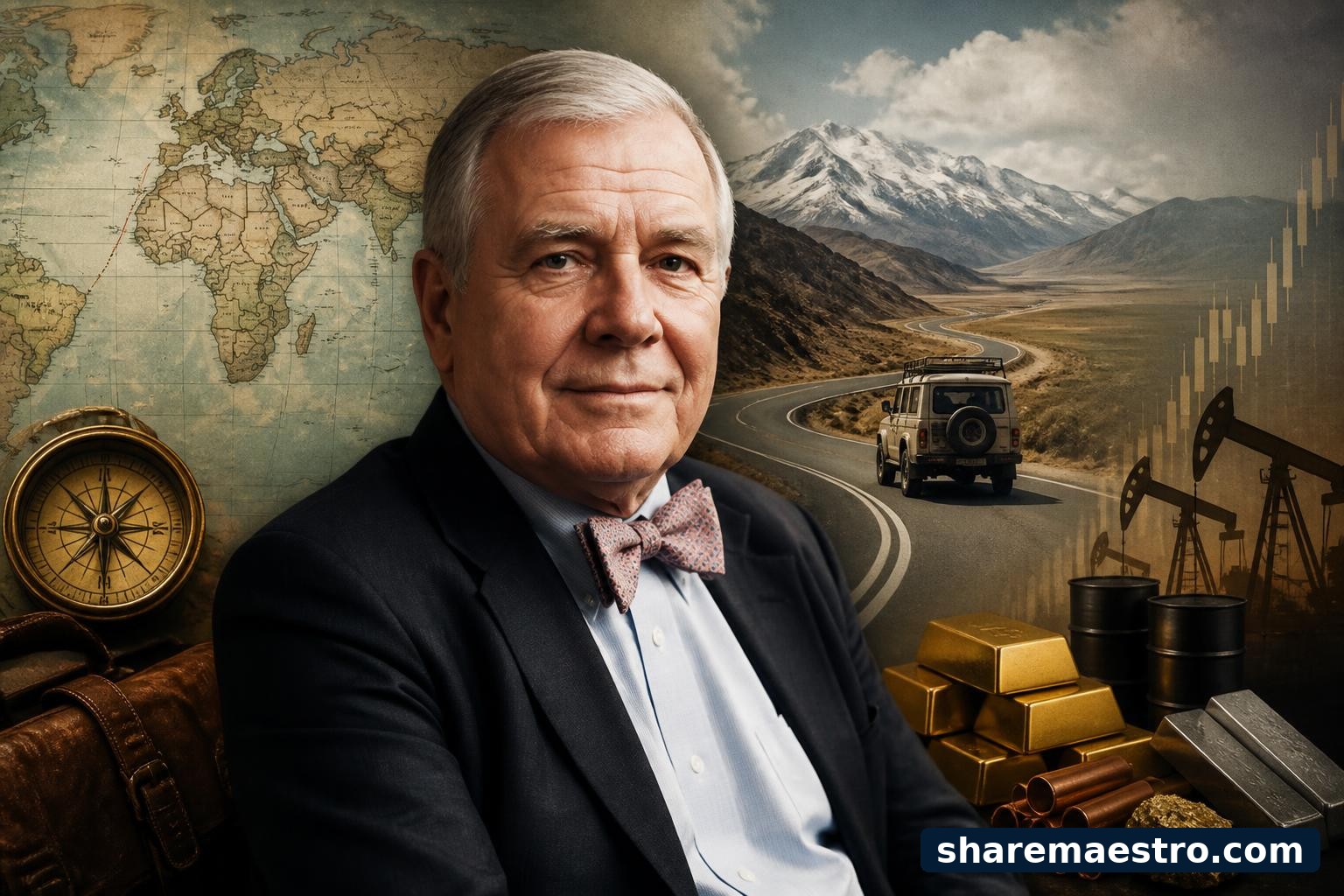
Jim Rogers has always looked slightly out of place in the mythology of modern hedge funds. The industry's usual setting is a dark screen, a risk meeting, a prime-broker lunch, a row of terminals pulsing in Midtown or Mayfair. Rogers preferred a border crossing, a farm road, a customs official, a currency dealer in a back room, a factory floor, a port, or the dusty inconvenience of travel. His best-known investing image is not a trading desk at all. It is a man in motion, using a motorcycle and later a custom Mercedes as research equipment.
That is not a branding flourish attached to an ordinary career. Rogers' case rests on a real record, a clear philosophy, and an unusually vivid second act. He co-founded the Quantum Fund with George Soros, helped build one of the most famous early global investment partnerships, retired from active money management at 37, and then recast himself as a private investor, author, professor, commentator, and relentless advocate of commodities. In a business that tends to reward proximity to information, he argued for distance from consensus.
His importance is not that he was always right. He was not. It is that he helped popularize a style of macro investing that treated the world as an interconnected balance sheet. Stocks, bonds, currencies, commodities, policy mistakes, capital controls, wars, harvests, shipping routes, and demography were not separate subjects. They were different expressions of the same capital cycle. Rogers became famous for insisting that investors should understand the real economy before trusting the financial one.
From Demopolis to the first age of global macro
James Beeland Rogers Jr. was born in 1942 and grew up in Demopolis, Alabama, far from the inherited networks of Wall Street. The official biography he now keeps through Beeland Interests presents the origin story in plain Southern-commercial terms: a child who started in business early, selling peanuts, and later moved through Yale and Oxford before entering finance. That mixture of local commerce, historical study, and international education became a recurring pattern in his work.
Rogers entered Wall Street in the 1960s, when American finance was still far more domestic than global. The postwar American equity cult was powerful, the Nifty Fifty era was forming, and foreign markets were often treated as curiosities or specialist terrain. Rogers' later edge came partly from refusing that provincial frame. He wanted to know what was happening in Austria, Botswana, China, Russia, and raw materials markets as readily as in New York listed equities.
The crucial professional meeting was with George Soros at Arnhold and S. Bleichroder. Soros is remembered as the speculative philosopher, but Rogers became central to the partnership's research culture. The two men were not clones. Soros emphasized reflexivity, instability, and the way markets shape the realities they price. Rogers leaned toward history, balance sheets, politics, and the observable flow of goods. Their combination belonged to a period when global macro was still being invented in practice rather than described in consultant language.
The Quantum years and the burden of a legendary number
The number attached to Rogers' Wall Street reputation is so large that it can crowd out analysis. Beeland Interests says the Quantum portfolio gained 4200% during the next 10 years while the S&P 500 rose less than 50%. A Securities and Exchange Commission filing tied to a Rogers International Commodity Index product used a close formulation, saying the fund grew approximately 4000% from 1970 to 1980 while the S&P 500 rose approximately 50%. Either way, the record was extraordinary.
It was also the product of a partnership and an era, not a clean laboratory test of one man's permanent genius. The 1970s were rich with macro dislocations: inflation, oil shocks, currency changes after Bretton Woods, equity valuation collapse, and widening opportunities outside the most crowded American growth stocks. A fund willing to go global, short fashionable securities, and hold unpopular assets could find bargains unavailable to domestic-only managers.
The performance matters because it gave Rogers permission to become independent. He did not build a traditional asset-management empire. He withdrew from active fund management, taught at Columbia Business School, appeared in financial media, and invested his own capital. That decision is one reason his career remains hard to categorize. Rogers is famous as a hedge-fund co-founder, but his lasting public identity was formed after he stopped running outside money.
A research method built around seeing for himself
Rogers' most distinctive contribution was not an index, a model, or a patented trading signal. It was a way of looking. He believed that investors should travel, read history, observe incentives, and test official narratives against ordinary economic behavior. In Investment Biker, the motorcycle trip was presented as a financial education as much as an adventure. Penguin Random House describes the book as a 22-month, 52-country motorcycle odyssey that mixed travel with advice on the direction of international economies.
The method sounds romantic, but it had an analytical core. Rogers wanted to know whether a currency black market contradicted an official exchange rate, whether roads and ports supported a growth story, whether farmers were planting, whether capital controls trapped savings, whether bureaucrats blocked enterprise, and whether a country was hated for reasons already reflected in prices. He saw travel as a check against spreadsheet abstraction.
That approach also carried a quiet critique of Wall Street. Rogers implied that analysts can know too much about the stock and too little about the society that produced its earnings. The field note, in his hands, became a macro input. A border delay said something about institutions. A broken refinery said something about supply. A crowded shop selling imported goods said something about currency, taste, and future demand.
The retirement that became a second career
Retirement at 37 did not make Rogers quiet. It gave him a platform from which he could turn private curiosity into public persona. His official biography notes that he continued to manage his own portfolio, taught finance at Columbia Business School, and moderated or hosted financial programs including The Dreyfus Roundtable and The Profit Motive with Jim Rogers. The post-Quantum years made him visible to investors who never saw the partnership's original trades.
The first great journey, from 1990 to 1992, took him more than 100,000 miles across six continents, according to Beeland Interests. The later Millennium Adventure was larger still. Rogers' own site says he and Paige Parker left Iceland on January 1, 1999, returned to New York on January 5, 2002, traveled 1101 days, passed through 116 countries, and covered more than 245,000 kilometers.
Those trips hardened the central theme of his later investing: the world was changing faster than American investors recognized. Emerging markets were not merely ticker symbols; they were countries with roads being built, families saving, governments failing or reforming, and resource needs compounding. Rogers turned the physical act of crossing countries into a claim about where capital should look next.
Contrarianism as temperament, not theater
Rogers' contrarianism was often presented with showmanship, but it was not merely a desire to shock. His better calls followed a consistent pattern: find an asset, country, or sector that has endured years of neglect; ask whether supply has been damaged or capital has fled; then wait for the cycle to turn. The logic is old-fashioned and powerful. Low prices cure low prices by forcing producers to cut investment, and those cuts eventually create scarcity.
That framework helps explain why he was drawn to hard assets after the equity mania of the late 1990s. As capital chased technology shares, Rogers argued that raw materials had been starved of investment. Mines, farms, oilfields, and logistics systems cannot be rebuilt instantly. If demand from Asia rose while supply had been underfunded, commodities could outperform the assets investors preferred. The thesis was simple, but it rested on long lead times and the economics of neglect.
The danger is that long-cycle contrarianism can make early look identical to wrong. A hated market can remain hated for years. A structurally cheap asset can become cheaper. A country that looks ready for reform can disappoint repeatedly. Rogers often had the emotional capacity to wait, but public investors listening to his forecasts did not always have his balance sheet, time horizon, or tolerance for embarrassment.
Commodities as a worldview
Hot Commodities, published after Rogers had already turned heavily toward raw materials, gave retail and professional readers the distilled version of his hard-asset creed. Penguin Random House describes the book as his first practical investment-advice book and says he argued that a commodity bull market had begun in 1998. The language of the book was accessible, but the underlying claim was institutional: commodities were not a fringe trade, they were a way to value companies, economies, and purchasing power.
Rogers saw commodities as the base layer of economic life. Food, fuel, fiber, metals, and energy were not abstractions. They were the materials without which no growth story could operate. If billions of people in Asia entered more resource-intensive patterns of consumption, and if producers had spent years underinvesting, the result would not be solved by clever financial engineering. Prices would have to move enough to bring forth supply.
The appeal of this argument was strongest after the technology bust and during China's industrial rise. It gave investors an alternative to paper assets and a language for thinking about inflation, development, and scarcity. It also placed Rogers in tension with economists and portfolio managers who viewed commodity futures returns as more complex than simple spot-price appreciation.
The Rogers International Commodity Index and the attempt to codify a thesis
The Rogers International Commodity Index was the institutional expression of Rogers' commodity view. A regulatory filing says the index was founded by James B. Rogers on July 31, 1998 and was composed then of 35 underlying commodity futures contracts divided into agriculture, metals, and energy. The current Beeland Interests description says the RICI is a composite, US dollar based total return index designed by Rogers in the late 1990s.
The index's design reveals much about Rogers' thinking. Beeland says the RICI represents a basket of commodities consumed in the global economy and tracks futures on exchange-traded physical commodities. The current RICI page lists 38 futures contracts across four currencies, ten exchanges, and four countries. It also emphasizes stability, infrequent composition changes, world consumption patterns, and liquidity. This was not a single commodity bet. It was a claim that raw materials as a class deserved a broad, transparent benchmark.
The weights also show the practical side of the philosophy. The current Beeland table places energy at 40.00%, agriculture at 34.90%, and metals at 25.10%, with crude oil, Brent, natural gas, gold, corn, cotton, aluminium, copper, silver, and soybeans among the notable components. Rogers wanted exposure to the costs of daily life, but he wanted it implemented through an index rather than a suitcase of anecdotal trades.
Portfolio construction: broad exposure, concentrated conviction
Rogers' public method can look contradictory. He admired broad commodity exposure, but he also became known for emphatic country and asset-class views. The reconciliation is time horizon. At the index level, he valued breadth because commodities are idiosyncratic: weather can drive grains, inventories can move metals, geopolitics can shock oil, disease can hit livestock. Broad exposure reduced dependence on one forecast while preserving the larger scarcity thesis.
At the personal level, Rogers was more willing to sound concentrated. He often discussed owning or favoring particular commodities, being skeptical of certain currencies, or preferring Asia to the United States. In a 2024 interview with S&P Global Commodity Insights, he argued that oil had reasons to remain supported because new discoveries had been limited and substitutes were not arriving quickly enough. He also tied commodity demand to money creation and Asia's economic path.
That blend of broad basket and sharp opinion is central to his appeal and his risk. The basket acknowledges uncertainty. The commentary does not always sound as modest. Investors who copied only the declarations could miss the structure, patience, and diversification behind the larger approach.
What the academic record says about the commodity case
Rogers' commodity campaign did not develop in an intellectual vacuum. Academic work in the same broad period helped legitimize commodities as an asset class. NBER's 2015 update to Facts and Fantasies about Commodity Futures summarizes the original finding that fully collateralized commodity futures historically offered returns and Sharpe ratios comparable to US equities, while showing negative correlation with stocks and bonds. The update said those conclusions largely held up out of sample.
That evidence supported part of Rogers' case, particularly the diversification argument. If commodities could behave differently from stocks and bonds, then they belonged in serious portfolio conversations. The argument was especially attractive to investors worried about inflation or overreliance on financial assets. Rogers' intuitive, ground-level thesis met a growing institutional appetite for alternative risk premia.
Yet the academic literature also complicates any simple bull story. Erb and Harvey cautioned that investors face challenges in estimating prospective commodity futures performance, that the average annualized excess return of individual commodity futures had been close to zero, and that equity-like returns in rebalanced portfolios could arise from diversification and portfolio mechanics. For Rogers, commodities were real things. For futures investors, the path also ran through collateral, roll return, term structure, and rebalancing.
Risk management and the problem of time
Rogers has often said, in substance, that he is not a short-term trader. That distinction matters. His risk management was less about tight stops and more about research depth, price, patience, and the willingness to own unpopular assets until the premise changed. This can work when capital is permanent and leverage is limited. It can fail when investors confuse a secular thesis with immunity from drawdowns.
Commodity futures add a second layer of risk. An investor can be right that a physical commodity matters and still lose money through adverse futures curves, roll costs, volatility, or poor timing. Erb and Harvey's work is especially relevant here because it separates the romance of owning scarce resources from the mechanics of futures returns. Spot price, roll return, collateral yield, and rebalancing can point in different directions.
Rogers' public career also shows the reputational hazard of macro timing. A long-term investor can warn about debt, money creation, currency debasement, or commodity scarcity for years before markets care. The warning may eventually look prescient, or it may look like a stopped clock. Rogers' method demands patience, but audiences often judge forecasts by the next quarter, the next election, or the next headline.
China, Asia, and the wager against American complacency
Rogers' bullishness on Asia, especially China, became one of his signature themes. Adventure Capitalist presented the view that the twenty-first century would belong to China, and Street Smarts continued the argument that Asia would become the dominant economic force of the century. He eventually moved to Asia with his family, a biographical choice that reinforced the investment claim.
The thesis had several layers. One was demographic and developmental: rising incomes would increase demand for food, energy, metals, and consumer goods. Another was cultural and political: countries that saved, invested, built infrastructure, and opened markets would attract capital. A third was comparative: Rogers believed the United States had become too indebted and too dependent on finance. His Asia argument was therefore also a critique of American policy.
The weakness of this worldview is that national rise is not a straight line. China's property stress, policy interventions, demographic pressures, and capital-market disappointments have all complicated the simple ascent narrative. In the 2024 S&P Global interview, Rogers still argued that China's economy had likely bottomed, but he also acknowledged that a property bubble can take a long time to work through. That sentence captures both the persistence and the caution in his later Asia view.
The public forecaster and the cost of being memorable
Rogers became a financial media fixture because he spoke plainly, favored strong claims, and did not hide his disdain for conventional policy. That made him useful television and dangerous copy. He could connect debt, central banks, currencies, commodities, and political incentives in a few sentences. The strength of the performance was clarity. The weakness was that macro reality rarely obeys the neat timing such clarity implies.
Some of his warnings aged well as broad concerns but poorly as immediate calls. He was often skeptical of the dollar, bonds, debt-driven growth, and richly valued US equities. Those themes had intellectual coherence, yet markets could rally for years under the very conditions he disliked. The investor listening to Rogers needed to distinguish between diagnosis and trade. He was often describing fragility, not providing an entry ticket with an expiration date.
This is the fairest criticism of Rogers' later career. He sometimes made the world sound more mechanically cyclical than it is. Policy can extend imbalances. Innovation can change resource intensity. Capital markets can absorb debt longer than skeptics expect. Supply can respond. Demand can disappoint. A contrarian with a sound historical framework can still underestimate the market's capacity to postpone the reckoning.
What he changed in the investing conversation
Rogers helped make global curiosity respectable as an investment discipline. Before emerging markets became benchmark weights and before commodities became packaged allocations, he was arguing that investors should look beyond domestic equities and beyond the financial sector's preferred stories. He treated countries as investable organisms, shaped by politics, culture, infrastructure, currency regimes, and incentives.
He also gave commodities a public advocate with a real hedge-fund pedigree. That mattered. Commodities had long been the province of merchants, producers, futures specialists, and inflation hedgers. Rogers spoke about them in a way that a stock investor could understand. He connected copper to China, oil to underinvestment, agriculture to demographic change, and gold to confidence in paper money. Whether one agreed or not, the frame was durable.
His influence is visible less in disciples than in habits. Investors now routinely discuss supply chains, frontier markets, commodity cycles, capital scarcity, and geopolitical constraints. Rogers was not alone in pushing those ideas, but he embodied them with unusual consistency. He made the road trip a metaphor for due diligence and made the commodity cycle a test of whether investors understood the real economy beneath the securities market.
What remains useful and what remains dangerous
The useful Rogers is the one who asks basic questions before they become fashionable. What is hated? Where has capital stopped flowing? What do the balance of payments, black markets, roads, farms, and ports reveal? Are official statistics consistent with observed behavior? Has low price destroyed supply? Has high price attracted too much competition? These questions remain valuable because markets still overfinance yesterday's winner and underfinance tomorrow's necessity.
The dangerous Rogers is the one readers may simplify into slogans. Buy commodities, distrust paper money, favor Asia, short complacency, avoid fashionable assets. Those may be conclusions from a particular analysis, but they are not a process by themselves. Without valuation, sizing, liquidity discipline, and attention to futures mechanics, the same themes can become expensive convictions.
Rogers' career is best understood as a warning against both narrow finance and loose macro storytelling. He proved that investors can gain insight by leaving the screen and studying how the world actually works. He also showed that even powerful historical judgment does not remove the need for humility about timing, instruments, and policy. His legacy is a map, not a model.
Disclosure
Educational financial journalism and market research only. Not financial, investment, trading, tax, or legal advice.