In brief
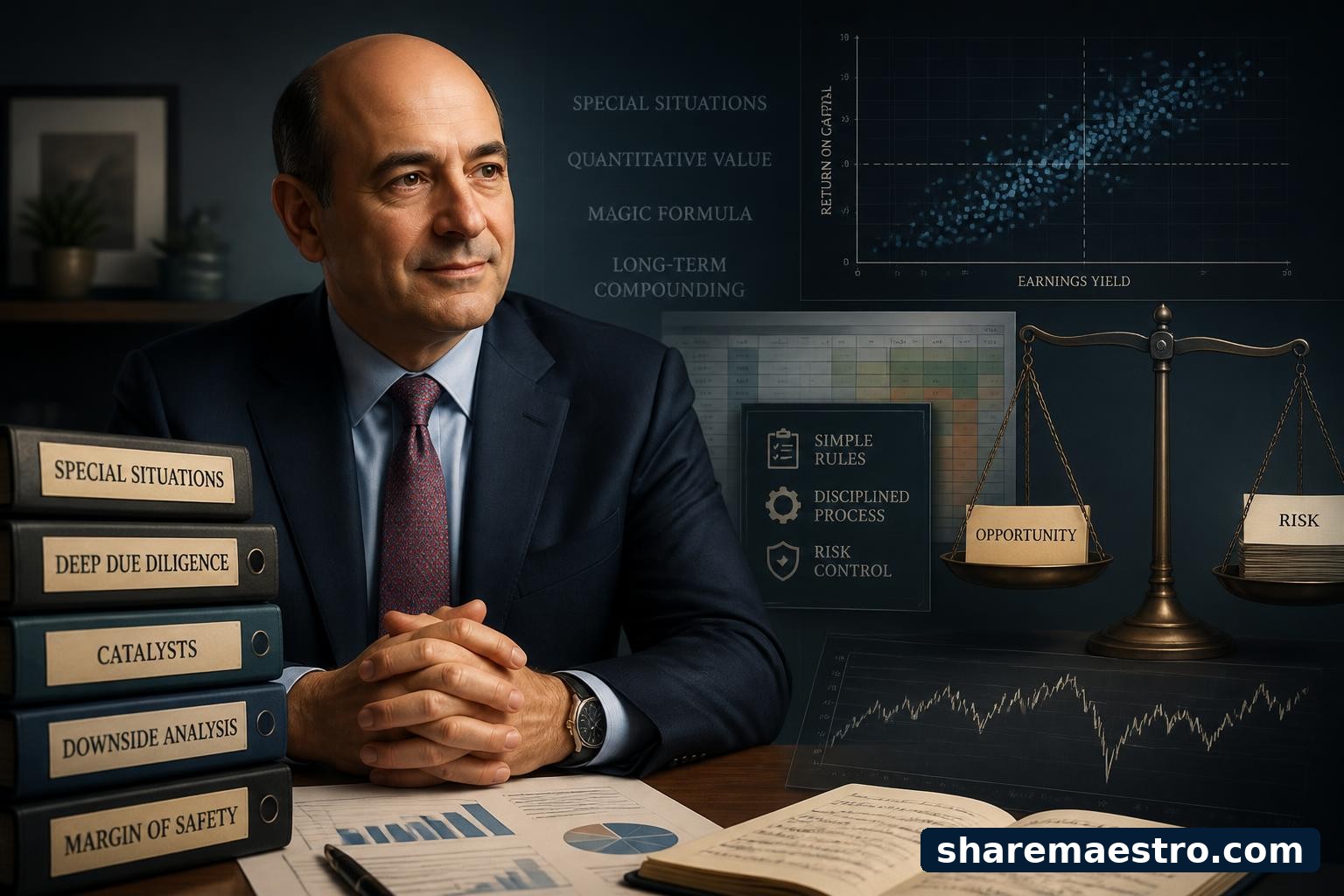
Joel Greenblatt's career runs from concentrated special-situation investing at Gotham Capital to popular factor-style value investing through the Magic Formula and institutional long/short funds. His enduring contribution is not that investing can be reduced to two ratios, but that valuation, patience, selectivity, and structure matter most when markets make those ideas painful to practice.
- Greenblatt founded Gotham Capital in 1985 and later became managing principal and co-chief investment officer of Gotham Asset Management, the successor firm.
- His early reputation rests on a concentrated special-situations record that he has described as 50 percent annualized before fees and 30 percent net over Gotham's first decade.
- You Can Be a Stock Market Genius made spinoffs, restructurings, and other overlooked corporate events a cult curriculum for serious value investors.
- The Little Book that Beats the Market popularized the Magic Formula, a ranking method built around buying good businesses at cheap prices.
- Greenblatt's later Gotham funds moved from concentrated bets toward diversified long-only and long/short portfolios, a shift that traded explosive upside for a more institutionally usable process.
- The method's weakness is also its source of durability: long stretches of underperformance can drive investors away before the valuation thesis has time to work.
Performance and evidence
Performance markers
Visual Evidence
Charts and timelines
Risk
Timeline
Philosophy
Performance
The investor who made simplicity look dangerous
Joel Greenblatt's office mythology has always had an unlikely tension at its center. He is one of the most widely read value investors of the last half century, yet the strategy that made his name was never really easy. It required buying securities that were ignored, technically messy, recently orphaned, or hated enough to look broken. It required concentration. It required tolerating interim losses that could make a prudent investor look reckless. Above all, it required believing that a share of stock was a claim on a business long after the market had begun treating it as a flashing quote.
That is why Greenblatt matters. He did not merely beat the market in a private partnership and then retire into legend. He tried to turn the logic of his success into a teachable language. First came special situations, the craft of locating mispriced securities in spinoffs, restructurings, merger securities, rights offerings, and other corners where institutional investors often sell before reading. Then came the Magic Formula, a two-part sorting device that asked investors to look for good businesses at bargain prices. Later came Gotham's mutual funds and ETFs, which attempted to translate value discipline into diversified, risk-controlled portfolios.
The arc is a rare one in finance. Greenblatt moved from hand-built, high-conviction investing toward systematic application without entirely abandoning the Graham-and-Buffett premise that price and value can diverge. His career is therefore best read not as a story about a formula, but as a story about how formulas, judgment, patience, and client psychology collide.
Why Greenblatt occupies a different place in value investing
The standard value-investing lineage often runs from Benjamin Graham to Warren Buffett, then branches into distressed credit, activist investing, quality compounding, quantitative factors, and private equity style underwriting. Greenblatt sits at a junction among several of those roads. He absorbed Graham's insistence on margin of safety, admired Buffett's upgrade from merely cheap assets to good businesses at cheap prices, and built much of his early reputation in the market's plumbing, where corporate events can force non-economic selling.
His public influence is unusually broad because he wrote for different levels of investor. You Can Be a Stock Market Genius, published in 1997, became a cult text among hedge fund analysts because it treated obscure securities as a hunting ground rather than a footnote. The Little Book that Beats the Market, published in 2005 and later revised, turned a professional value idea into a children's-book-simple presentation for ordinary investors. Gotham's official biography now lists both books, later titles, his Columbia teaching, and his current role as managing principal and co-chief investment officer.
Greenblatt's importance also comes from institutional design. Value Investors Club, founded in 1999 with John Petry, created a selective online forum where serious investors could share well-developed theses. Gotham Asset Management, the successor to Gotham Capital, then pushed his method in a different direction, building long-only and long/short products that apply valuation across hundreds of names. Few investors have moved so visibly from concentrated partnership to teaching, publishing, online community, and systematic asset management.
The Wharton test that became a career habit
Greenblatt's origin story is less about a trading desk than a library. At Wharton, he and fellow students including Rich Pzena worked on a thesis that revisited Graham's stock-picking ideas using data gathered from Standard & Poor's stock guides. This was not an era of cheap cloud databases or instant factor screens. The exercise required manually gathering accounting and price information, then testing simple rules against actual companies. The point was not to prove that a formula could replace thought. It was to see whether Graham's logic had empirical bite.
That early project shaped Greenblatt's unusual combination of skepticism and system. He learned accounting in school, but he has described his real understanding of markets as self-taught through Graham, David Dreman, Buffett's letters, and his own reading. The efficient-market view did not resonate with him because daily price variation looked too large to represent precise changes in intrinsic value. Greenblatt saw the market not as a perfectly calibrated machine, but as an auction where emotion, neglect, and institutional constraints could create openings.
The lasting habit from that period was reduction. Greenblatt has spent much of his career stripping investing down to questions that can survive market noise: What is the business worth, what price is being offered, what can go wrong, and why is the opportunity available? The later Magic Formula was a polished version of this instinct. The earlier special-situation work was its messier and more lucrative laboratory.
Gotham Capital and the search for places others avoided
Greenblatt founded Gotham Capital in 1985. Gotham Asset Management describes itself as the successor to that firm, and Greenblatt's publisher biography credits Gotham Capital with extraordinary long-term results. The most precise early-period account comes from Greenblatt himself in later interviews: over the first decade, he has said, Gotham earned about 50 percent a year before fees and about 30 percent net of fees. Those figures should be treated as manager-reported history rather than the public time series of a mutual fund, but they explain why his name became shorthand for special-situation prowess.
The strategy was not glamorous in the usual Wall Street sense. It did not depend on forecasting GDP, calling interest-rate cycles, or owning the market's best-loved companies. It focused on securities whose ownership base had been disrupted. A spinoff might be too small for the parent company's shareholders. A post-bankruptcy equity might be dumped by creditors that did not want stock. A rights offering might be too awkward for institutions. In those moments, the market's structure, not just its opinion, could create mispricing.
Alliant Techsystems illustrated a more activist edge in that era. In 1994, a group of money managers won control of the munitions company after a proxy fight, and Greenblatt was among the newly elected board members. The episode showed that Gotham's special-situation work was not confined to passive screens. It could involve governance, balance-sheet change, and corporate control. That was a different world from the later Magic Formula website, but the same question ran through both: who is selling for a reason unrelated to value?
Concentration as both engine and hazard
Greenblatt's early portfolio construction was a direct challenge to conventional diversification. In a Columbia interview, he said that for much of his career six or eight positions could represent more than 80 percent of his portfolio. To a consultant, that could look indefensible. To Greenblatt, the right analogy was not a basket of tickers but ownership stakes in businesses that had been studied carefully. If a local investor bought pieces of several understandable businesses at attractive prices, he argued, that might be more conservative than owning dozens of things he barely knew.
The distinction matters because Greenblatt's risk definition was never simply volatility. A stock that drops because investors panic is not necessarily riskier if the underlying business value is intact. A stock that appears diversified but cannot be valued well may be more dangerous. His preferred asymmetry came from limited downside and credible upside, not from the biggest payoff. He has said that if he could not analyze a company because technology, competition, or industry change made the future too uncertain, the right answer was to skip it.
That philosophy explains both the brilliance and the fragility of his early method. Concentration allows a few good ideas to matter. It also forces the investor to be right about value, balance-sheet risk, liquidity, and time. Greenblatt's own later shift toward broader portfolios did not repudiate concentration. It acknowledged that the structure suitable for his own capital was not always suitable for outside investors who might redeem at the worst possible time.
The decision to give the money back
At the end of 1994, Greenblatt returned Gotham's outside capital while continuing to invest his own and his partners' money. The decision has become part of his legend because it cut against the asset-gathering reflex of the investment business. Most managers with a celebrated record try to raise more capital, launch adjacent products, and institutionalize the brand. Greenblatt chose the opposite. He had made enough, did not expect the first decade's returns to be easily repeated, and wanted a life and investment structure that fit his temperament.
The move was also a lesson in client risk. Greenblatt has described sharp downdrafts in the concentrated portfolio every few years. With his own money, he could treat losses as the price of opportunity. With other people's money, the same volatility carried a different emotional burden. This is an underappreciated part of his career. He was not merely asking what strategy had the highest expected return. He was asking which strategy could be owned by the people whose capital was in it.
That question would shape Gotham's later evolution. The post-2000s Gotham products are more diversified, more systematic, and more explicit about risk controls. They do not try to recreate a six-stock special-situation partnership for daily-liquid investors. The trade-off is obvious: less possibility of spectacular concentration-driven returns, more attention to whether investors can stay through a full cycle.
From hidden corners to a formula anyone could understand
You Can Be a Stock Market Genius was Greenblatt's first attempt to share the special-situation playbook. Its title sounded almost unserious, but the content was serious enough that hedge fund managers treated it as a field manual. The book's central message was that market inefficiency often hides where investors do not want to look. Spinoffs, merger securities, recapitalizations, bankruptcies, restructurings, and odd lots are not merely legal events. They are moments when incentives and forced selling can overwhelm valuation.
Greenblatt later concluded that the book was more sophisticated than he intended. That realization helped lead to The Little Book that Beats the Market. Instead of guiding readers through intricate corporate events, he reduced value investing to two rankings: one for cheapness and one for business quality. The revised Wiley edition describes the idea as systematically seeking good businesses when they are available at bargain prices. The public knew it as the Magic Formula.
The original formula's appeal was its audacity. It told investors that the core of intelligent investing could be explained without pretending to forecast the next quarter. A good company earns attractive returns on capital. A cheap company offers a high earnings yield relative to the price paid for the business. Combine the two, diversify, rebalance, and wait. The simplicity was the point, but also the trap. A simple rule can be followed mechanically, yet the psychological difficulty remains unchanged.
What good and cheap really meant
The Magic Formula is often misread as a stock screen. Greenblatt's deeper point was conceptual. Cheapness without quality can be a value trap. Quality without a bargain price can be a wonderful business but a mediocre investment. The formula tried to combine the Graham instinct to pay less than value with the Buffett insight that returns on capital matter. It did not promise that every selected company would be attractive on close inspection. It argued that, on average and over time, a basket of good and cheap companies should have a favorable edge.
Gotham's current process is a more elaborate version of that same idea. The firm says its research effort seeks to value companies in a U.S. large- and mid-cap universe, then buy those trading at the largest discount to its assessment of value and short those selling at the largest premium. The process uses absolute and relative valuation, daily portfolio adjustment, position weighting by assessed cheapness or expensiveness, and risk controls around diversification, sector concentration, gross exposure, and net exposure.
Greenblatt has resisted the notion that formulaic investing frees investors from judgment. In interviews, he has distinguished the not-trying-very-hard version in The Little Book from Gotham's more sophisticated business valuation work. The formula was a proof point, not the full machine. It showed that valuation and quality have power. It did not remove the need to understand accounting, normalize earnings, compare opportunity costs, and survive periods when the market refuses to agree.
The machinery of modern Gotham
The modern Gotham is not the small, concentrated partnership that built Greenblatt's early reputation. It is a value-oriented investment firm managing long-only and long/short equity strategies through private funds, mutual funds, ETFs, and institutional separate accounts. Greenblatt and Robert Goldstein serve as managing principals and co-chief investment officers. The firm's public materials emphasize that all Gotham funds share the same investment philosophy and research process used in institutional offerings, but they express that process with different market exposures.
The differences are important. Gotham Absolute Return has generally been described as a long/short fund with roughly 50 percent to 60 percent net long exposure, often illustrated as 120 percent long and 60 percent short. Gotham Enhanced Return targets a higher net long exposure. Gotham Neutral is designed to derive its return primarily from the long/short spread with minimal correlation to the stock market. Gotham Index Plus combines index exposure with an active long/short overlay.
This architecture reflects Greenblatt's central compromise with scale. A portfolio of a few special situations may be ideal for a skilled investor with permanent capital, but not for a daily-liquid fund serving a broad investor base. Gotham's diversified portfolios, often with hundreds of long and short positions, attempt to turn valuation work into repeatable spread capture. They are less romantic than the original Gotham Capital story, but they address the business problem Greenblatt learned early: a strategy is only useful to clients if they can own it through discomfort.
Risk management beyond the textbook definition
Greenblatt's career is a long argument about risk. In the early phase, he accepted high portfolio volatility because he believed concentration in well-understood businesses could be rational. In the later Gotham phase, he accepted lower expected explosiveness in exchange for diversification, long/short balance, and explicit controls. These are not contradictory positions. They are different answers for different capital bases. The first asks whether the investor can endure mark-to-market pain. The second asks whether a fund can deliver a value spread without allowing leverage, shorts, sectors, or factor exposure to dominate the thesis.
The firm warns plainly about the risks embedded in its products. Short sales can theoretically produce unlimited losses. Leverage can magnify losses. Swaps and other derivatives add volatility, liquidity, counterparty, and loss risks. Frequent portfolio adjustment can increase transaction costs. Small- and mid-cap securities can be more volatile and less liquid than larger companies. Those disclosures are not boilerplate in Greenblatt's case; they map directly onto the hazards of turning valuation into long/short implementation.
The subtler risk is behavioral. Greenblatt has repeatedly argued that a strategy that worked every day, month, and year would quickly attract capital and stop working. The pain is part of the edge. But pain also creates abandonment. Investors who buy a value strategy after a strong period and sell after underperformance can turn a sound process into a poor personal result. Greenblatt's most persistent lesson is that process without temperament is incomplete.
Value Investors Club and the market for serious ideas
Greenblatt's influence is not confined to his own portfolios. In 1999, he and John Petry founded Value Investors Club as a selective forum for sophisticated individual and professional investors. Its current public description says applicants must submit a well-researched, well-articulated, attractive value idea, and that only about one in fifteen applicants are admitted. The site says it now has about 500 active members, nearly 10,000 investment write-ups, and about 130,000 comments. In a market flooded with promotion, VIC was designed around filtration.
An academic paper by Wesley Gray studied VIC submissions from 2000 through 2008, when the club operated with a smaller membership cap. The paper described the site as an exclusive community founded with $400,000 of start-up capital and built to surface high-quality ideas. It analyzed 3,273 investment submissions and found a culture focused on fundamentals, intrinsic value, undervaluation, insider signals, buybacks, and special situations. The paper's broader claim was that the recommendations showed evidence of investment skill, especially in smaller securities where information advantages may matter more.
VIC reflects a Greenblatt theme: good investing is not only about information, but about incentives. Public message boards often reward noise, speed, and performance theater. VIC attempted to reward depth, anonymity, peer criticism, and limited idea flow. That structure did not democratize investing in the mass-market sense. It created a club. Yet its delayed public archive and reputation helped shape how a generation of analysts wrote investment theses.
The performance record, and the public record's complications
Greenblatt's early record remains the cornerstone of his reputation. In a 2018 interview, he said Gotham's first decade produced 50 percent annualized returns before fees and 30 percent net of fees. His publisher biography for You Can Be a Stock Market Genius cites 40 percent annualized returns since Gotham Capital's founding in 1985. The difference reflects varying periods and fee conventions, not a neat public-fund record. The responsible conclusion is that Gotham Capital produced an extraordinary private-partnership record, but one that cannot be evaluated like a long-running mutual fund with standardized public reporting.
The Magic Formula's performance claims also require care. The published approach became famous for a backtest covering 1988 through 2004, often cited as showing about 30.8 percent annualized returns for the top-ranked portfolio versus roughly 12.4 percent for the S&P 500, before trading costs and taxes. Backtests are not live records. They can be sensitive to universe construction, liquidity, survivorship, transaction costs, tax treatment, and whether an investor can follow the rule after a few ugly years.
Gotham's public funds provide a more transparent but less mythic record. As of March 31, 2026, Gotham's quarterly returns table showed since-inception annualized returns of 8.81 percent for Gotham Absolute Return, 11.88 percent for Gotham Enhanced Return, 13.39 percent for Gotham Index Plus Fund I, 11.70 percent for Gotham Large Value, and 3.46 percent for Gotham Neutral. Those are respectable figures in several cases, but they are not the early Gotham legend. The contrast is the point: strategy, scale, vehicle, fees, and volatility budget all change what a value edge can look like.
The criticism of Greenblatt's method
The most common criticism is that the Magic Formula became too famous to be magic. Once a simple ranking system is published, screened, copied, and packaged, the obvious fear is that arbitrage erodes the edge. That criticism is partly fair and partly too easy. Greenblatt never claimed that two crude metrics captured every business reality. He argued that buying quality at a bargain price is a durable principle, and that the formula was a simple way to demonstrate it. The formula's public popularity may have reduced easy returns, but it did not repeal the behavioral tendency to overpay for glamour and abandon discomfort.
A second criticism is that the method can confuse cheapness with opportunity. High returns on capital may be backward-looking. Earnings yield may be inflated by cyclical peaks. Accounting can miss intangible investment, platform economics, balance-sheet liabilities, or impending disruption. A hardware company facing technological obsolescence can look statistically attractive before the economics collapse. Greenblatt's answer has generally been to either diversify a systematic approach or, in concentrated investing, skip what cannot be understood. The danger comes when investors borrow the screen without borrowing the humility.
The harshest real-world test was value's long underperformance after the global financial crisis. Institutional Investor reported in 2020 that value investing had lagged for more than a decade and that Gotham's strategies had delivered positive returns in 2019 while still underperforming the S&P 500. This period forced Greenblatt's followers to confront the difference between believing in value and enduring value. A strategy can be intellectually sound and still be commercially punishing for years.
What he changed for other investors
Greenblatt's first major contribution was to legitimize special situations as a mainstream value-investing curriculum. Before Stock Market Genius, many investors knew that spinoffs and restructurings could be fertile, but few books explained the mechanics in such practical terms. He gave analysts permission to look where portfolio managers with large mandates, benchmark constraints, or liquidity needs could not. The book's continued reputation among professionals comes from that practical orientation.
His second contribution was translation. The Little Book did not invent quality value investing, but it made the concept memorable. It gave investors a vocabulary for the blend of return on capital and earnings yield. It also anticipated the factor-investing boom in retail language. Long before quality-minus-junk, smart beta, and multi-factor ETFs became common distribution products, Greenblatt had shown that a disciplined combination of value and quality could be explained without academic machinery.
His third contribution was cultural. Through Columbia teaching and Value Investors Club, he helped shape a form of value analysis that prizes clarity of thought, concise thesis writing, and peer challenge. VIC's structure gave serious investors a way to share ideas without turning every thesis into marketing. Gotham's later funds showed another kind of influence: the migration of hedge fund style valuation into registered products. Greenblatt helped move value investing from apprenticeship to repeatable frameworks, even if he never removed the need for judgment.
The continuing relevance, and the danger, of the Greenblatt playbook
Greenblatt remains relevant because the conditions he exploited have not disappeared. Institutions still face mandate constraints. Shareholders still sell spinoffs for non-economic reasons. Career risk still shortens time horizons. Markets still extrapolate winners and discard difficult businesses. Data has made obvious screens less lucrative, but it has not made patience common. If anything, faster information flow may increase the premium on a stable valuation framework because investors are now bombarded by more reasons to abandon one.
The dangerous part is thinking that Greenblatt made investing easy. He made it explainable. Those are different things. A simple formula can identify candidates, but it cannot force an investor to hold through underperformance, distinguish cyclical cheapness from secular decline, account for leverage, or know when a business is outside the circle of competence. The same investor who popularized a mechanical screen also repeatedly warned that most people cannot value most companies well. His practical advice to skip what cannot be analyzed is as important as the formula itself.
Greenblatt's career is best understood as a progression from edge to structure. Gotham Capital exploited neglected events with concentrated capital. His books converted hard-won experience into principles. VIC built a community around better idea filtration. Gotham Asset Management turned value into diversified products with explicit risk controls. The lesson is not that every investor should copy him. It is that good investing requires a home base, a valuation discipline, and the emotional capacity to look wrong long enough for value to matter.
Disclosure
Educational financial journalism and market research only. Not financial, investment, trading, tax, or legal advice.