In brief
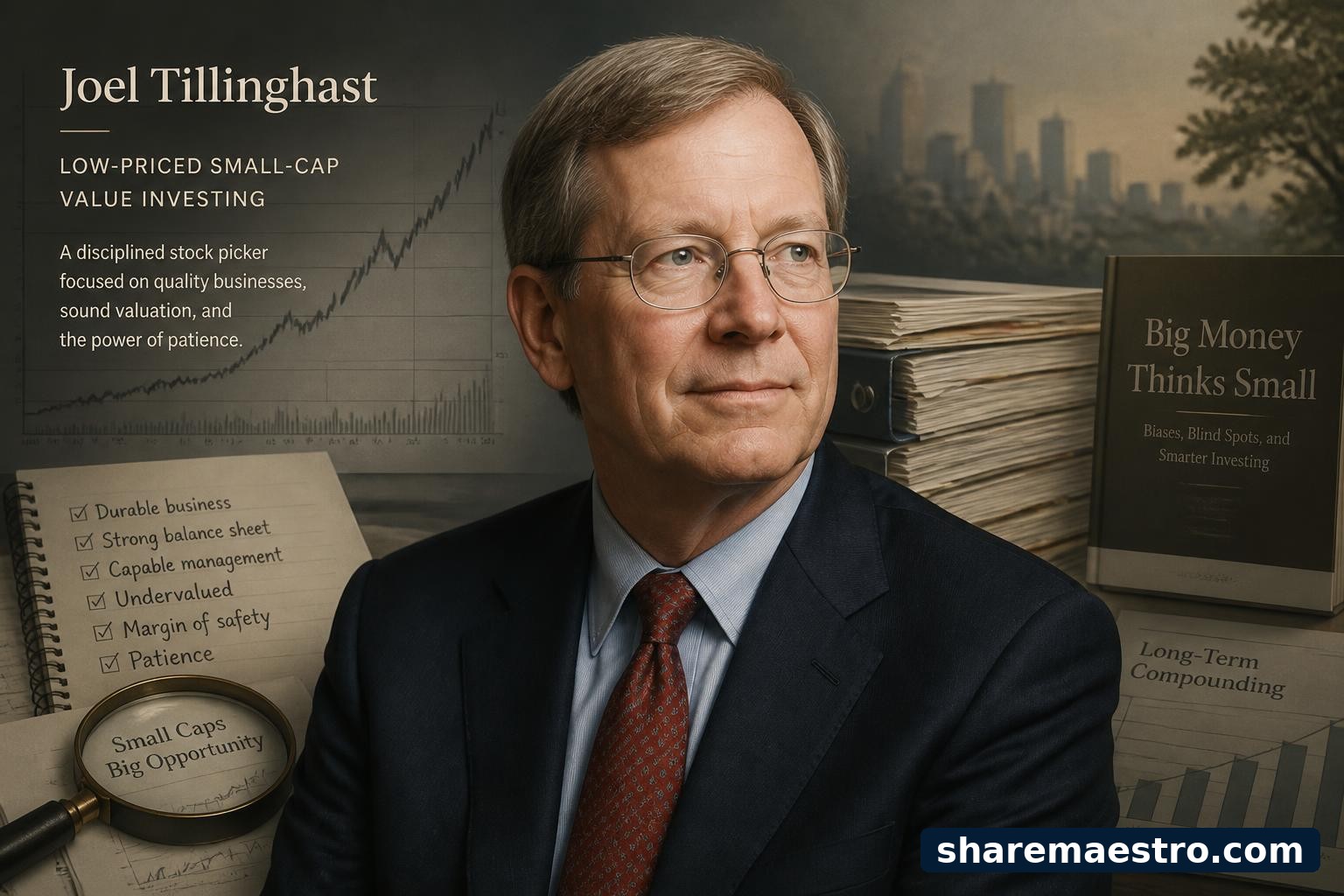
A profile of Joel Tillinghast, the longtime Fidelity Low-Priced Stock Fund manager whose blend of value discipline, business analysis, risk avoidance and global small-cap curiosity produced one of the mutual fund industry’s most distinctive public records.
- Tillinghast managed Fidelity Low-Priced Stock Fund from its launch in December 1989 through December 2023, building a rare public record in a hard-to-scale corner of active management.
- The fund’s mandate made nominal share price a hunting ground, not a valuation shortcut: Tillinghast looked for businesses priced below intrinsic value, run by capable managers and supported by resilient balance sheets.
- His process was intentionally conservative, emphasizing understandable businesses, management character, recurring revenue, free cash flow and a willingness to avoid areas he could not value.
- The strongest evidence for his reputation is long-term compounding: Fidelity reported that from the fund’s December 1989 start through September 30, 2021, it annualized at 13.45 percent versus 10.02 percent for the Russell 2000 Index.
- The record was not linear. Scale, cash drag, currency exposure, value traps and missed speculative surges such as GameStop all exposed the limits of a fair-value selling discipline.
- Tillinghast’s continuing relevance lies less in the low share-price screen than in the habits behind it: patience, skepticism, valuation humility and a refusal to let market fashion define business worth.
Performance and evidence
Performance markers
Visual Evidence
Charts and timelines
Risk
Timeline
Philosophy
Performance
The quiet contrarian inside Fidelity’s stock-picking machine
The name sounded almost too plain to become a Wall Street legend: Fidelity Low-Priced Stock Fund. It did not promise technological foresight, global conquest or a secret quantitative formula. It began with a prosaic constraint, stocks that looked cheap by price or valuation, and asked a young Fidelity manager to find durable businesses where other investors saw dullness, distress or neglect.
Joel Tillinghast made that constraint his craft. From December 1989 to December 2023, he was the defining figure behind the fund, moving from lead portfolio manager to senior adviser after more than four decades in the investment industry. In a business that often turns managers into marketing slogans after one good cycle, his career stood out for duration, public accountability and a recognizable method.
The story matters because Tillinghast’s success did not come from a single heroic wager. It came from thousands of smaller judgments about balance sheets, competitive position, management honesty, valuation and patience. His edge was cumulative rather than theatrical. The fund became a proof point for a quieter form of active management, one that survived by being selective, skeptical and willing to look foolish in fashionable markets.
Why a mutual fund manager became a market figure
Tillinghast occupies an unusual place among famous investors. He was not a hedge fund celebrity, an activist, a macro trader or a founder building a boutique around his own name. He worked inside Fidelity, one of the most powerful mutual fund organizations in the world, and his reputation came through a regulated public vehicle open to ordinary investors. That made his record easier to observe, but also harder to polish. The fund’s returns, holdings, expenses, turnover and mistakes were disclosed in a way private partnerships rarely tolerate.
The scale of the achievement is clearest in the long arc. Fidelity reported that from the fund’s inception on December 27, 1989, through September 30, 2021, Fidelity Low-Priced Stock Fund produced a 13.45 percent average annual total return, compared with 10.02 percent for the Russell 2000 Index. A hypothetical $10,000 investment at inception grew to $551,717, versus $207,772 for the benchmark over the same period.
Recognition followed, but not in the usual Wall Street rhythm of boom-time adulation. Morningstar named Tillinghast its Domestic Stock Fund Manager of the Year in 2002 and Outstanding Portfolio Manager in 2021. Kellogg later described him as MarketWatch’s 2007 Stockpicker of the Decade. The industry’s praise rested on something more durable than a single cycle: a manager who kept exploiting overlooked securities long after the fund became too large to behave like a nimble small-cap account.
The formation of a business analyst
Tillinghast’s route to Fidelity helped shape his later style. He earned a bachelor’s degree from Wesleyan University in 1980 and an MBA from Northwestern University’s Kellogg School of Management in 1983. Before joining Fidelity in 1986, he worked as an analyst at Value Line Investment Survey, a research economist at Drexel Burnham Lambert and director of research and strategy at Bank of America Futures. Those jobs made him fluent in both company-level analysis and the larger market pressures that can distort it.
At Fidelity, he first worked as a research analyst covering industries such as coal, personal care, appliances, natural gas and tobacco. None of those fields reward superficial glamour. They require attention to cost structures, demand cycles, distribution, regulation, brand power and management incentives. That early analytical terrain suited a future manager who preferred recurring revenue and understandable businesses to narratives that could not be modeled.
Kellogg’s account of a 2008 visit captured the intellectual core of his method: understand the business before worshiping the numbers. Tillinghast urged students to study annual reports before meeting management and to watch whether executives addressed difficult issues directly. This was not a romantic view of small companies. He described them as more vulnerable to market volatility than corporate giants, making judgment about management and financial resilience central to the work.
A gimmick that became a discipline
Low-priced stock investing sounds like a beginner’s error. A $10 share is not cheaper than a $500 share if the business value and share count tell a different story. Tillinghast understood that. He conceded in a Washington Post interview that the label had a gimmicky side. The more important point was that low nominal prices and low valuations often drew less institutional attention, creating a hunting ground where a patient analyst could find inefficiency.
The formal mandate evolved. The fund originally focused on stocks trading at $15 or less, but the threshold later moved to $35 or less. The current prospectus defines low-priced stocks as those priced at or below $35 per share, or those with an earnings yield at or above the median for the Russell 2000 Index. Earnings yield, the inverse of the price-earnings ratio, turned the mandate from a nominal price screen into a broader valuation filter.
That distinction is central to Tillinghast’s legacy. He did not build his reputation by buying low-dollar lottery tickets. He used a low-price universe to find companies that could be understood, valued and owned for years. In interviews, he described the ideal stock as a business with honest and capable management, resilience, growth, a good balance sheet and a modest valuation. The share price opened the door; the business analysis decided whether to enter.
Inside the stock picker’s checklist
Tillinghast’s process was rigorous without being mechanical. He wanted businesses he could understand well enough to forecast, and he preferred companies whose economics did not depend on heroic assumptions. In his book, he framed investing as an exercise in avoiding self-deception, knowing one’s circle of competence, choosing trustworthy collaborators, avoiding flawed investments and remembering that the investor’s first responsibility is to identify mispriced stocks.
The checklist was both financial and behavioral. Balance sheets mattered because debt can destroy optionality when prices collapse. Management mattered because poor capital allocation can turn a cheap stock into a permanent impairment. Industry structure mattered because high returns on equity rarely last without barriers to entry. Tillinghast’s fascination with business quality kept him from becoming a simple low multiple buyer.
His caution also had a practical edge. In a 2017 interview, he warned against industries he could not value, including unprofitable biotechnology for investors without the right expertise. He was blunt about fraud, incompetent management and overbuilt projects. The point was not that every holding had to be pristine. It was that a bargain had to survive contact with the real business, not merely screen well in a database.
The portfolio as a mosaic, not a monument
Fidelity Low-Priced Stock became famous not only for performance, but for its unusual construction. As assets grew, Tillinghast could not run a concentrated small-cap portfolio without overwhelming the very securities he wanted to buy. The answer was breadth. Kiplinger noted in 2018 that the fund held about 950 stocks and that its size limited its ability to take large positions in smaller companies. Many positions represented less than 0.1 percent of assets.
That breadth was not closet indexing. It was a practical adaptation to scale. Tillinghast and his team cast a wide net across industries, countries and market capitalizations, using thousands of small decisions to preserve exposure to inefficiency while reducing the risk that one mistake would dominate the portfolio. The fund could own an obscure industrial, a regional bank, a foreign consumer company and a larger fallen value stock in the same structure.
The current fund remains broad. Fidelity’s June 30, 2026 quarterly review listed 553 holdings and showed the ten largest positions at 9.80 percent of net assets. The same review showed financials, industrials, consumer discretionary, technology, health care and consumer staples as meaningful exposures. The portfolio’s architecture still reflects Tillinghast’s original compromise: use diversification to make patient stock picking possible at mutual fund scale.
The global turn that separated the fund from its benchmark
One of Tillinghast’s most important departures from a narrow small-cap value template was his willingness to go overseas. The Russell 2000 Index is overwhelmingly domestic, but Fidelity Low-Priced Stock often owned a large non-U.S. allocation. This was not a macro call in the usual sense. It was a bottom-up response to valuation, balance sheets and competitive position in markets where research coverage could be thinner.
Japan became a recurring example. In 2017 and 2018 interviews and profiles, Tillinghast pointed to Japanese companies as fertile ground, citing reasonable prices and strong balance sheets among smaller firms. The point was characteristically specific. He was not simply buying a country. He was finding businesses that met his standards at valuations he considered more attractive than comparable opportunities elsewhere.
The global tilt remains visible after his portfolio management tenure. Fidelity’s June 30, 2026 review showed international equities at 34.63 percent of the fund, compared with 2.42 percent for the Russell 2000 Index. It also showed cash and net other assets at 4.09 percent. That global profile is one reason the fund’s performance can diverge sharply from its benchmark, especially when U.S. small-cap growth or domestic risk appetite dominates a market cycle.
Risk management began with saying no
Tillinghast’s risk management was not built around trading speed. It was built around exclusion. He preferred understandable businesses, honest management, resilient operations and modest prices. The fund’s stated process today echoes that language, describing a search for understandable, resilient and growing businesses with honest and capable management, purchased at modest prices. The phrasing could have been lifted from his career.
Avoidance was especially important because low-priced stocks are often low for a reason. Some have weak franchises. Some are cyclical. Some have balance sheets that leave equity holders little room for error. Some are promotional stories wearing the clothes of value. Tillinghast’s method treated those hazards as central, not incidental. Cheapness was an invitation to investigate, not a conclusion.
The prospectus risks are a reminder that the strategy’s dangers never disappear. Stock markets can fall sharply, foreign securities carry currency and political risks, and smaller, lesser-known companies can be more volatile than larger companies. Tillinghast’s long-term approach sought to manage those risks through business analysis and diversification, but it could not eliminate them. A patient investor still owns drawdowns, currency moves and the occasional wrong thesis.
The record that made the reputation
The numbers behind Tillinghast’s reputation are unusually transparent. Fidelity’s 2021 transition document reported that from December 27, 1989, through September 30, 2021, the fund annualized at 13.45 percent, compared with 10.02 percent for the Russell 2000 Index. That spread, compounded over more than three decades, explains why a low-key manager became a reference point in active management.
Fidelity’s 2021 award release added another lens: as of May 31, 2021, the fund had beaten 100 percent of its Morningstar Mid-Cap Value category peers over Tillinghast’s 32-year tenure and had outperformed the Russell 2000 Index by 3.49 percentage points per year. The same release put fund assets at $34 billion at that time, a size that would normally make small and mid-cap inefficiency harder to exploit.
The later period shows the record’s unevenness. The 2025 annual report listed Retail Class total returns of 45.83 percent for the fiscal year ended July 31, 2021, negative 4.16 percent in 2022, 10.78 percent in 2023, 18.19 percent in 2024 and 3.06 percent in 2025. Long-term success did not mean immunity from weak years. It meant that the process had survived many different market regimes without surrendering its basic logic.
When bigness became part of the investment problem
The irony of Tillinghast’s career is that success made his opportunity set harder. A small fund can buy obscure companies and let a few winners reshape the portfolio. A fund with tens of billions must spread capital across more names, accept smaller position sizes in true small caps and sometimes own larger companies that still fit the valuation discipline. Size becomes a constraint on purity.
Kiplinger’s 2018 profile noted that the fund’s $37.4 billion asset base generally prevented it from taking large positions in smaller firms. By June 2026, Fidelity listed fund size at about $24.25 billion, still a large pool for a strategy rooted in neglected securities. The portfolio’s weighted average market capitalization was $44.3 billion, while its weighted median market capitalization was $8.7 billion, reflecting the mix of larger liquid holdings and smaller opportunities.
This is the central trade-off in public mutual fund greatness. Tillinghast’s record attracted assets, and those assets diluted some of the small-stock intimacy that helped create the record. His answer was breadth, global reach and a team structure. The result was not the purest possible small-cap value vehicle. It was a living compromise between capacity and craft, a compromise that defines many successful active funds.
The discipline that sold GameStop too soon
Every investment philosophy has a failure mode. Tillinghast’s was clearest in GameStop. In 2020, the struggling video-game retailer fit the fund’s value profile. It was fundamentally challenged, but Tillinghast believed it was undervalued when the shares were in single digits. When the stock surged above his estimate of fair value during the 2021 meme-stock frenzy, the fund sold its position for a profit.
The sale was rational by his own rules and painful by hindsight. Bloomberg reported that Fidelity Low-Priced Stock held about 2 million GameStop shares at the end of October 2020, when the stock traded just above $10, and had exited by the end of January 2021, when GameStop reached an intraday high of $483. Tillinghast acknowledged regret, while also saying that selling above his estimate of fair value was precisely what a value investor is supposed to do.
The episode is useful because it resists easy moralizing. Holding longer would have produced a spectacular windfall, but it would also have required ignoring the valuation discipline that defined the career. Tillinghast did not miss GameStop because he failed to see value. He missed the final speculative phase because his process was designed to sell when price outran business value. In most cycles that discipline protects capital; in a meme-stock squeeze, it leaves money on the table.
The years when patience looked like stubbornness
Tillinghast’s style could lag sharply when the market rewarded traits he disliked. In 2017, he attributed a period of underperformance partly to elevated cash and foreign currency exposure, including British holdings hurt by sterling’s decline after the 2016 U.K. referendum. That was not a stock-specific disaster, but it showed how a global, valuation-sensitive portfolio can suffer from macro effects even when the manager is not trying to make macro bets.
The same pattern appears in more recent fund commentary. In the second quarter of 2026, the fund gained 10.84 percent but underperformed the Russell 2000 Index, which rose 21.49 percent. Fidelity attributed the gap partly to stock selection, industry positioning, cash and an underweight in information technology during an AI-driven rally. The commentary said many technology stocks did not meet the fund’s valuation approach.
This is the recurring cost of Tillinghast’s inheritance. A value and quality discipline can look wise over decades and still look obstinate over quarters. Cash can be prudent or costly. Avoiding expensive growth can protect shareholders or leave them behind. International diversification can uncover bargains or import currency losses. The method works only for investors willing to tolerate periods when the market’s favorite assets are precisely the ones the process rejects.
A book that turned habits into doctrine
Tillinghast’s 2017 book, Big Money Thinks Small, clarified that his investing method was as much psychological as analytical. The subtitle, Biases, Blind Spots, and Smarter Investing, signaled the theme. The book was not a list of favorite stocks. It was a manual for avoiding the mental traps that turn intelligence into overconfidence, lucky gains into false skill and attractive stories into bad capital allocation.
Columbia University Press summarized the book around five steps: know yourself and your susceptibility to self-deception; make decisions based on expertise; choose trustworthy and capable collaborators; avoid investments with inherent flaws; and keep searching for bargains. That framework neatly explains his portfolio record. Tillinghast treated valuation as necessary, but never sufficient. Character, process and humility mattered because investors themselves are often the weakest link.
The book also placed him in a tradition of value investors who view markets as behavioral institutions, not just pricing machines. His emphasis on blind spots, flawed incentives and accounting riddles reflected decades of watching cheap stocks become cheaper for good reasons. The intellectual legacy is not a screen for low share prices. It is a temperament: curious, suspicious, business-centered and aware that mistakes often begin before the spreadsheet is opened.
Succession without reinvention
Fidelity began preparing for Tillinghast’s departure well before it happened. In November 2021, the firm announced that he planned to step down from portfolio management responsibilities in the fourth quarter of 2023. Sam Chamovitz and Morgen Peck became co-lead managers alongside him, with the plan that they would remain co-lead managers after his retirement from managing the fund. Fidelity emphasized that Tillinghast would remain at the firm as a senior adviser and mentor.
The transition was notable for its deliberateness. Fidelity described a two-year process in which Chamovitz and Peck would immerse themselves more deeply in the strategy, share responsibility for new ideas and eventually lead while Tillinghast remained a co-manager. The firm also said there was no plan to change the fund’s investment policies, describing the related portfolios as value and quality oriented, primarily investing in small and mid-cap securities.
By 2026, Chamovitz and Peck were listed as the fund’s managers. The strategy still used language familiar from Tillinghast’s tenure: opportunistic undervalued stocks, a focus on small and mid-cap companies, a global perspective, patient ownership and comparison of price to value. The question for shareholders is not whether the new managers can imitate his personality. It is whether the culture he built can keep making independent judgments without the original stock picker at the center.
What he changed about active management
Tillinghast’s influence is partly institutional. He helped prove that a large mutual fund could remain meaningfully active by looking beyond the obvious domestic benchmark and by using a wide, research-heavy portfolio to manage capacity. He did not solve the active versus passive debate. He complicated it, showing that stock picking could still add value when practiced with discipline, patience and humility over a very long horizon.
His influence is also pedagogical. Kellogg’s account of his classroom visit reads less like celebrity finance and more like an apprenticeship in asking better questions. Read the annual report. Study the business before the numbers. Watch management’s candor. Look for barriers to entry. Pay attention to high returns on equity. Seek information that is not obvious. Network, but do your own research. These are simple instructions, but few investors apply them consistently.
The most durable lesson may be that active management is not a personality cult when it is done well. Tillinghast had a distinctive voice, but his method was transferable because it was grounded in repeatable habits: identify mispricing, insist on business understanding, distrust weak balance sheets, avoid what cannot be valued and let time work. That made his succession possible, at least in theory, and made his book more than a retirement-period summation.
The usefulness and danger of thinking small today
Tillinghast’s approach remains relevant in a market that often rewards size, liquidity and narrative speed. The June 2026 fund review showed a portfolio trading at 16.1 times trailing earnings, compared with 39.0 times for the Russell 2000 Index, and at 12.0 times one-year forecast earnings, compared with 23.7 times for the index. It also showed a higher five-year trailing return on equity than the benchmark, 12.9 percent versus 7.4 percent.
Those figures capture the continuing appeal of the method: cheaper valuations, higher quality measures and a willingness to stand apart from the index. The same review also shows the danger. The fund’s underweight to expensive technology and its cash position hurt during a powerful small-cap growth rally. Valuation discipline can become a drag when the market pays heavily for possibility and penalizes skepticism.
Tillinghast’s career does not offer a formula that investors can copy casually. It offers a standard of seriousness. Low-priced stocks are not bargains by default. Small companies are not virtuous by default. Patience is not a cure for a broken business. The enduring value of his career is the insistence that investing is a craft of evidence, temperament and price. The danger is forgetting that all three must be present at once.
Disclosure
Educational financial journalism and market research only. Not financial, investment, trading, tax, or legal advice.