In brief
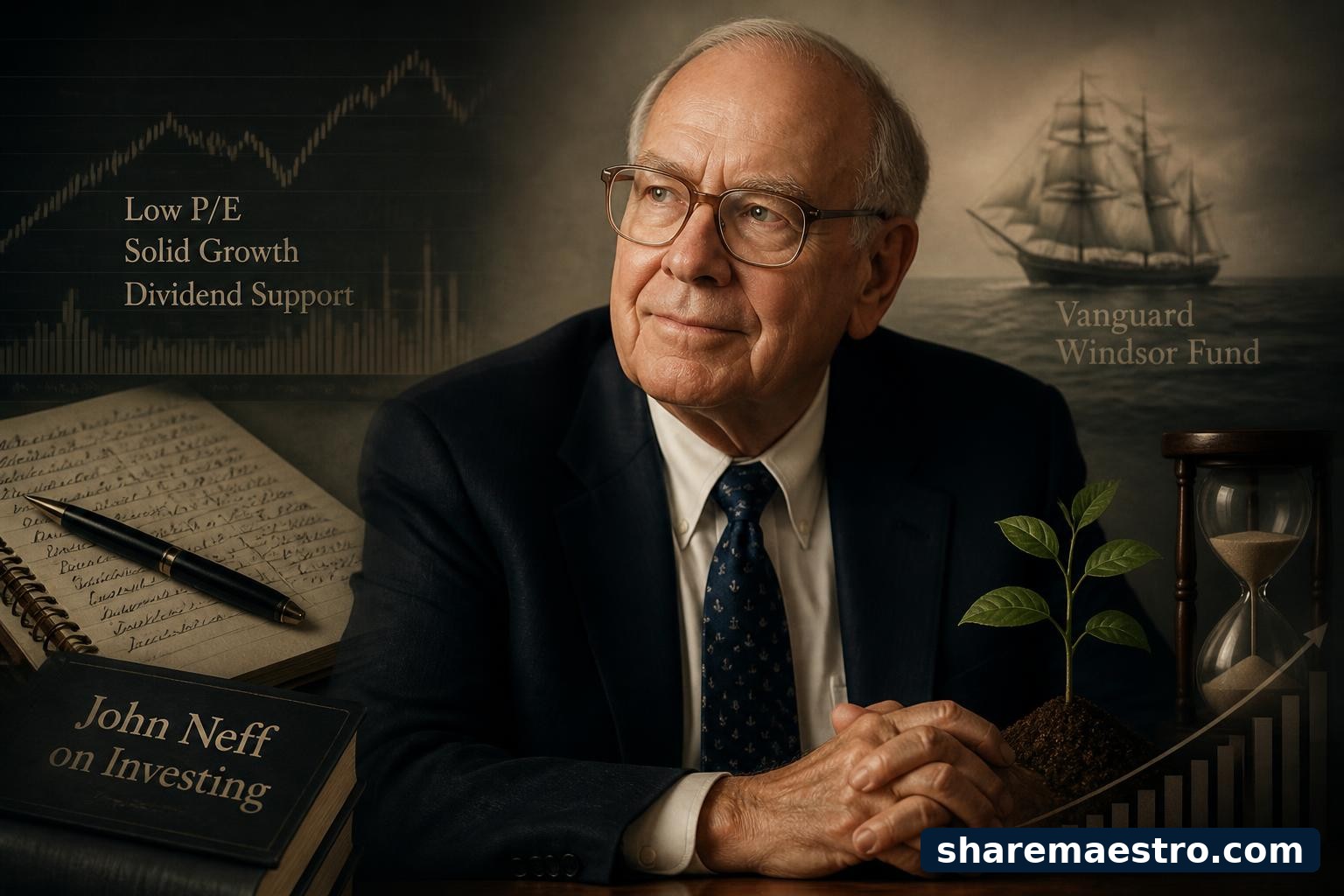
John B. Neff, the longtime manager of Vanguard Windsor Fund, built one of the mutual fund industry's defining active management records by buying out-of-favor companies at low price-to-earnings ratios, insisting on dividend support, and selling when expectations had largely normalized. His tenure at Windsor produced a widely cited 13.7% annual return from 1964 through 1995, versus 10.6% for the S&P 500, while growing the fund from $75 million to $13.6 billion. Neff's method remains influential because it combined valuation discipline with practical security analysis, but it also carries enduring risks: value traps, style cycles, concentration, capacity limits, and the temptation to mistake a low multiple for a margin of safety.
- Neff managed Vanguard Windsor Fund from 1964 until his 1995 retirement, building a record that made him one of the most important active mutual fund managers of the late twentieth century.
- His preferred label was not value investor or contrarian, but low P/E investor, a distinction that put price, expectations, dividends, and earnings growth at the center of his process.
- Windsor's success was not a simple screen. Neff used industry work, company analysis, dividend yield, growth estimates, appreciation targets, and sell discipline to separate bargains from damaged businesses.
- His record became a paradox inside Vanguard: an active stock picker who helped strengthen a firm that would become the emblem of low-cost indexing.
- The continuing lesson is not to buy the cheapest stocks mechanically, but to demand a large spread between market expectations and plausible business outcomes.
Performance and evidence
Performance markers
Visual Evidence
Charts and timelines
Risk
Timeline
Philosophy
Performance
The bargain hunter inside the index house
John Neff's place in market history begins with a tension that never really disappears. He was a stock picker at the house that made index investing a mass-market creed. While Jack Bogle turned Vanguard into a monument to cost control and skepticism about active management, Neff ran Windsor Fund as proof that a disciplined active manager could still matter. He was not loud, promotional, or theatrical. His public persona suited his portfolio: plain, skeptical, patient, and difficult to intimidate.
The Windsor record gave that temperament unusual authority. During Neff's 31 years at the fund, the widely cited annualized return was 13.7%, compared with 10.6% for the S&P 500. CFA Institute also noted that Windsor outperformed the index in 23 of those 31 years and grew from $75 million in assets to $13.6 billion under his watch. Those numbers explain why Neff's name still circulates among value investors long after the mutual fund industry shifted toward indexing, factor products, and low-fee model portfolios.
Yet the most important fact about Neff is not merely that he bought cheap stocks. Many investors have done that badly. Neff bought unpopular stocks only when the business case, dividend support, and expected total return created a favorable bargain. He liked companies that Wall Street had pushed aside, but he was not collecting wreckage for its own sake. His edge was the discipline to ask whether pessimism had gone too far and the humility to sell when the market had come around.
Why Neff still matters
Neff matters because his career sits at the crossroads of three arguments that still define investing. The first is the argument between active selection and broad market ownership. The second is the argument between glamour and value. The third is the argument between a formula and a judgment. He did not win those debates permanently, because no investor does. He did, however, leave an unusually clear case study in how a method can be both systematic and human.
His record also matters because it was earned in a public mutual fund, not in a lightly disclosed partnership where the facts are difficult to reconstruct. Windsor had shareholders, statements, capacity issues, peer comparisons, and daily liquidity. Success in that format required more than brilliance. It required repeatable portfolio habits, communication with investors, and a willingness to keep practicing an unfashionable style through long stretches when the market wanted something else.
The fund's story also complicates the popular caricature of Vanguard. The firm is often treated as a pure indexing machine, but its formative years included major active funds and outside advisers. Bogle later described Windsor as a dominant force in Vanguard's equity lineup, and he acknowledged Neff's importance to the firm's early survival. That made Neff both an exception to Bogle's critique of active management and one of the reasons Vanguard had the scale and credibility to preach low costs.
From Ohio thrift to professional skepticism
Neff was born in Wauseon, Ohio, in 1931, and the Midwestern origin story is not incidental to the way his career has been remembered. Friends, colleagues, and family accounts tend to emphasize modesty, thrift, and plain speech. The style can be over-romanticized in finance, where every successful investor eventually acquires a legend. In Neff's case, though, the personal manner was inseparable from the investment process. He distrusted market fashion because he distrusted waste.
He graduated from the University of Toledo in 1955, later earned an MBA from Case Western Reserve University in 1958, and worked in securities analysis at a Cleveland bank before moving east to Wellington Management. University of Toledo accounts credit professor Sidney M. Robbins with introducing him to finance, and family recollections describe a young graduate who tried New York first, found no welcome on Wall Street, and built his career through Cleveland and Philadelphia instead.
That path helps explain why Neff never sounded like a market celebrity, even when his record entitled him to celebrity treatment. Philadelphia money management had its own culture, more restrained than the go-go mythology of Wall Street or the star-manager aura that later surrounded Boston growth funds. Neff's bargain hunting reflected that culture: count the cash, respect the dividend, distrust the crowd, and do not confuse a good company with a good price.
Taking command at Windsor
Windsor Fund was not born as a Neff legend. Bogle's later account described it as Wellington Management's first equity fund, launched in 1958, and noted that it lagged the S&P 500 in its early years. Then Neff became the manager, and the fund's identity changed. By the mid-1980s, Windsor had become one of the central products in Vanguard's equity business, a value-oriented counterweight to the growth managers that had dominated earlier market cycles.
The assignment was large enough to matter and narrow enough to be teachable. Neff was not running a private collection of special situations. He was managing a diversified mutual fund that had to absorb inflows, hold liquid securities, and serve hundreds of thousands of shareholders. That structure forced him to turn contrarian instinct into process. A cheap stock had to fit into a portfolio. A portfolio had to survive redemptions, market stress, and style unpopularity.
By 1985, according to Bogle's history, Windsor had about $4 billion in assets and had become the nation's largest equity fund. The fund later closed to new investors to avoid the handicap of excessive assets. That decision now looks as important as many of the stock picks. It recognized that value investing is not infinitely scalable. A bargain strategy can be damaged when success attracts too much money, especially when the manager wants to buy neglected names rather than the most liquid glamour stocks.
The low P/E identity
Neff is usually filed under value investor, but he preferred a more specific description: low P/E investor. The distinction matters. Value can mean a hundred things, from asset discounts to quality franchises at fair prices. Low P/E investing begins with a visible market judgment. A stock with a low price-to-earnings ratio tells the investor that expectations are muted, fear is high, growth is doubted, or some combination of all three is in force.
His own writings and later summaries of his method emphasized that the multiple was only the entrance to the argument. Wiley's description of John Neff on Investing points to a method built around buying when stocks were cheap and volatile, avoiding overextended growth names, studying the businesses themselves, and remaining flexible. That is a sharper philosophy than simply ranking stocks by the lowest multiple and buying the bottom decile.
Neff wanted the market's pessimism, but not its worst businesses. Later interview excerpts attributed to him make the point plainly: not all low P/E stocks are attractive, and some are poor companies in poor industries. That warning is essential to understanding his method. A low multiple could be an opportunity, but it could also be a diagnosis. The investor's job was to tell the difference before the income statement made the answer obvious to everyone.
This is where Neff differs from a purely statistical contrarian. He did use numbers, and he liked numbers that could be checked. But his process depended on a practical opinion about the company, its industry, its likely earnings path, and the market's willingness to revalue it. Low P/E was the starting price of admission. It was not the full investment case.
The total return bargain
The most teachable part of Neff's method was the relationship among earnings growth, dividend yield, and the P/E ratio. He looked for stocks whose expected growth plus dividend yield offered attractive total return relative to the price being paid. In practice, that meant a company did not need heroic growth to be interesting. A moderate grower with a meaningful yield and a depressed multiple could be more compelling than a faster grower priced for perfection.
Dividends were not decoration in this system. They made the waiting period tolerable and gave the portfolio a return component that did not depend entirely on near-term revaluation. CFA Institute's account of Neff's career cites his low price-to-earnings strategy and his hunt for undervalued businesses. Later excerpts of his CFA discussion make the dividend point more explicit, describing yield as a meaningful part of Windsor's advantage.
The dividend also served as a test of corporate reality. A company able to support and raise a dividend had to produce cash, not merely a story. That did not make dividends foolproof, since payouts can be cut and balance sheets can be abused. But for Neff, the yield helped separate a neglected operating company from a speculative recovery hope. It made valuation less abstract.
This framework also explains why Neff's style had room for cyclicals. A cyclical company can look statistically cheap near peak earnings, which is one of the classic traps of low P/E investing. Neff's answer was not to avoid all cyclicals. It was to understand the cycle, price, dividend, and industry position well enough to decide whether the market was extrapolating weakness too aggressively or ignoring deteriorating fundamentals.
How Windsor was built
The Windsor portfolio was not a closet index. At the time of Neff's retirement transition, Kiplinger's account in the Deseret News described a $13 billion fund with roughly 400,000 shareholders and a process that began with stocks whose P/E ratios were generally two-thirds or less of the market multiple. It also reported that the 10 largest holdings, out of 71 stocks, represented 39% of assets. That was diversified, but not timid.
The concentration reflected conviction, and the conviction came from work. The same 1995 account described research that included direct industry contacts and repeated company visits. Charles Freeman, Neff's successor and longtime colleague, said the approach had become institutionalized. That phrase is easy to pass over, but it is central to Windsor's continuity. Neff's method was not only a personal instinct. It had become a shared routine inside the team.
The portfolio construction was therefore a hybrid. It had the breadth expected of a large mutual fund, but the top positions could influence results. It had a valuation discipline, but it still required analysts to judge whether earnings estimates, management behavior, and industry structure supported the case. It had a contrarian bias, but it was not designed to be contrarian in every security at every moment.
That combination made Windsor different from both a deep-value basket and a concentrated activist portfolio. Neff did not need control, board seats, or public campaigns. He needed a sufficiently wide gap between price and plausible value, enough liquidity to build a position, and enough patience from shareholders to let the thesis mature.
Measured patience, not romance
Contrarian investing is often described in heroic language, as if buying what others hate is automatically courageous. Neff's career suggests a less romantic version. Buying the unpopular stock is only the visible part. The harder part is measuring why it is unpopular, how long the unpopularity may last, and what evidence would show that the original thesis is wrong. Patience without measurement becomes stubbornness.
Neff's own sell discipline was built to prevent that. Later interview excerpts describe a process in which Windsor estimated appreciation potential and began selling an individual holding once much of that potential had been realized. The exact thresholds were not magic numbers for all investors. Their importance was behavioral. They forced the manager to decide in advance what success looked like, rather than letting pride expand the target after the stock rose.
That discipline also explains one of Neff's best-known lines: when an investor feels like bragging, it is probably time to sell. The remark is memorable because it treats emotion as a valuation signal. Euphoria in the owner can mirror euphoria in the market. If the original reason to buy was that expectations were too low, then a moment of triumph may mean the expectation gap has closed.
Neff's patience was therefore conditional. He would wait for the market to recognize value, but he did not worship ownership for its own sake. Once a stock moved toward his estimate of fair value, the bargain had changed. A low P/E investor who refuses to sell after revaluation quietly becomes a momentum investor without admitting it.
Cash, capacity, and the right to say no
One underrated part of Neff's record was his willingness to let opportunity, not asset gathering, dictate action. The Inquirer noted that Penn's endowment, influenced by Neff, at times parked funds in U.S. Treasuries when bargains were scarce. That detail matters because contrarian investing is often mistaken for constant buying. Neff's version required the right to say that available prices were not good enough.
Windsor's closure to new investors made the same point at the fund level. Bogle described the closure as a response to the handicap of excessive assets. In an industry where asset growth usually increases management fees and institutional status, restricting inflows is a meaningful statement about process. It admits that a strategy's return potential can decline as its capital base grows.
This is a useful corrective to the myth that a great investor's method can be scaled without friction. Low P/E opportunities are not evenly distributed across capitalization ranges and market cycles. If too much capital chases the same neglected securities, the investor must either own larger, more efficient companies or accept liquidity and concentration risks. Neff's success created exactly the problem that disciplined success often creates: the strategy became famous enough to threaten its own flexibility.
The record and the arithmetic
The headline record remains striking. CFA Institute gives Windsor's annualized return under Neff as 13.7%, compared with 10.6% for the S&P 500, with outperformance in 23 of 31 years. The difference looks small to casual readers, because three percentage points can sound like rounding error. Over three decades, it is not. Compounding turns a modest annual edge into a large wealth gap.
Forbes' archived account of the successor era, reflected in search summaries and consistent with other reports, has often been cited for the same basic arithmetic: a $10,000 investment in Windsor during Neff's tenure would have grown to far more than the comparable S&P 500 investment. Even without leaning on that exact illustration, the underlying point is mathematically unavoidable. A persistent three-point annual spread over 31 years is career-defining.
Bogle's own history rounded the record to roughly 14% for Windsor versus 11% for the S&P 500, again underscoring the same relationship. He also placed Windsor in a broader discussion of reversion to the mean, noting that many star funds eventually fell back toward average results. That context is important. Neff's record was extraordinary not because it escaped the risk of mean reversion forever, but because the outperformance persisted for an unusually long managerial tenure.
The record should not be read as a promise attached to low P/E investing. It was the product of a specific manager, institution, period, shareholder base, and valuation regime. Still, it is one of the cleanest public demonstrations that price discipline, dividends, and company work can compound powerfully when applied with enough consistency.
The Penn chapter
Neff's career was not confined to Windsor. Beginning in 1980, he volunteered to help manage the University of Pennsylvania's endowment despite not being a Penn alumnus. The Inquirer reported that over the next 18 years the endowment grew from $200 million to $3 billion, and CFA Institute cited the same broad increase in its remembrance. The role reinforced Neff's reputation as a practitioner whose influence extended beyond a single mutual fund.
The Penn chapter also showed his resistance to institutional fashion. According to the Inquirer, Neff pushed back against suggestions to move aggressively into real estate, hedge funds, and private equity in pursuit of higher returns. That stance did not make him universally right about all alternative investments. It did reveal a consistent preference for understandable assets, liquidity, and discipline over the social pressure to imitate other elite endowments.
There is a deeper point here about fiduciary temperament. Neff's public image was built around bargains, but his institutional image was built around trust. He was the person boards and committees could imagine guarding capital when others wanted novelty. That reputation is a source of influence as real as his stock picks, because finance relies on confidence in judgment under pressure.
Vanguard's useful paradox
Neff's relationship to Vanguard remains one of the great paradoxes in modern fund history. Vanguard's public philosophy came to be associated with low-cost indexing and the argument that most active managers fail after fees. Neff was the active manager who helped make the firm stronger. CFA Institute quoted Bogle as saying it would be impossible to overestimate Neff's importance to Vanguard's survival in the early years.
The paradox is less contradictory than it first appears. Bogle's critique was not that no active manager could ever outperform. It was that investors, in aggregate, face costs, turnover, taxes, and the difficulty of identifying winners in advance. Neff was a rare counterexample, but he also shared Bogle's suspicion of fees, fashion, and salesmanship. His active management was low ego, valuation driven, and cost aware.
Vanguard's own history emphasizes the firm's broader low-cost revolution, including its no-load distribution move in 1977 and later expense advantages. Neff's Windsor operated inside that cost culture. The lesson is that active management's odds improve when the manager has a repeatable edge, reasonable costs, patient shareholders, and institutional restraint. Remove those conditions and the romance of stock picking can quickly become an expensive illusion.
That is why Neff's career belongs in the same conversation as indexing rather than outside it. He did not disprove the case for passive funds. He clarified how demanding the active case must be.
The critique of cheapness
The most obvious critique of Neff's method is also the most important: low P/E stocks are often cheap for a reason. A declining business can look statistically attractive just before earnings collapse. A cyclical company can look cheapest at the top of its profit cycle. A heavily indebted firm can show a low multiple while equity holders are quietly absorbing balance-sheet risk. Cheapness can be a margin of safety, but it can also be a warning label.
Neff understood this, which is why his method demanded company and industry work. Later excerpts of his CFA discussion stress that poor companies in poor industries should not be treated as bargains merely because they have low P/E ratios. That sentence is the dividing line between Neff's discipline and the weaker imitation of his style. The imitation says buy low multiples. The discipline says buy low expectations only when the market has mispriced survivability, earnings power, or normalization.
Academic research adds another layer. Fama and French's 1992 work found that size and book-to-market equity helped explain cross-sectional differences in average stock returns, embedding value characteristics in modern asset pricing. But factor evidence does not eliminate judgment. It can show that cheap groups have historically earned premiums, but it cannot tell a portfolio manager which specific company is a bargain and which one is a trap.
The danger today is that Neff's language can be turned into a screen, stripped of the labor that made it work. A ranking by low P/E, dividend yield, or dividend-adjusted growth can identify candidates. It cannot replace the question that animated Windsor: what does the market believe, why does it believe it, and where is it wrong?
After Neff, the market changed
The world that followed Neff became less hospitable to simple stories about value. Index funds grew from ridicule to default allocation. Factor investing translated some old value insights into systematic portfolios. Technology companies became a larger share of market value, and many of the best businesses carried intangible assets that conventional book value and near-term earnings did not capture well. The bargain basement became harder to map.
AQR's later writing on systematic value investing argued that valuation spreads between cheap and expensive stocks can become extreme and that criticism of traditional value measures, especially price-to-book, has some force but is often overstated. That debate is directly relevant to Neff's legacy. His approach was never limited to book value, but it relied on the idea that market expectations can become too high for glamour stocks and too low for dull or distressed ones.
The current Windsor Fund also illustrates how institutions evolve after a legendary manager. Vanguard's 2025 shareholder report shows a large, diversified value fund with $23.758 billion in net assets for Admiral Shares reporting purposes, 133 holdings, a 45% turnover rate, and sector exposures led by financials and health care. The name survives, but no current fund should be treated as a time capsule from Neff's desk.
That distinction matters for investors and historians. A method can influence a fund family without remaining unchanged. Neff's era was defined by a human manager reading companies, industries, and expectations. The post-Neff world is defined by teams, models, benchmarks, and a much larger passive core. His relevance now is not in recreating 1980s Windsor, but in preserving the discipline behind it.
What survives
What survives from Neff is not a command to buy low P/E stocks. It is a sequence of questions. Is the market's expectation low enough to create opportunity? Is the business good enough to survive disappointment? Does the dividend support the wait, or does it hide financial strain? Is the expected total return large enough relative to the multiple? What would prove the thesis wrong? When will success be sold rather than admired?
Those questions remain useful because investor psychology has not become obsolete. Markets still overpay for certainty, extrapolate recent growth, abandon dull companies, and confuse narrative excitement with return potential. They also still punish value investors who are early, careless, or stubborn. Neff's career is a reminder that contrarianism is not a personality costume. It is a disciplined refusal to pay for consensus when the facts do not justify it.
His limits survive as clearly as his strengths. Low multiple investing can underperform for years. Concentrated value portfolios can suffer when the market rewards growth, quality, or momentum. Dividends can be cut. Estimates can be wrong. Scale can dilute opportunity. The manager can mistake patience for denial. Neff avoided those traps often enough to build a legendary record, but he did not abolish them.
The final measure of Neff is that his method still sounds simple until one tries to practice it. Buy good companies in decent industries at low price-to-earnings ratios, insist on total return, and sell when the bargain has been recognized. The words are plain. The execution demands temperament, arithmetic, and a rare tolerance for being unfashionable. That was John Neff's true edge.
Disclosure
Educational financial journalism and market research only. Not financial, investment, trading, tax, or legal advice.