In brief
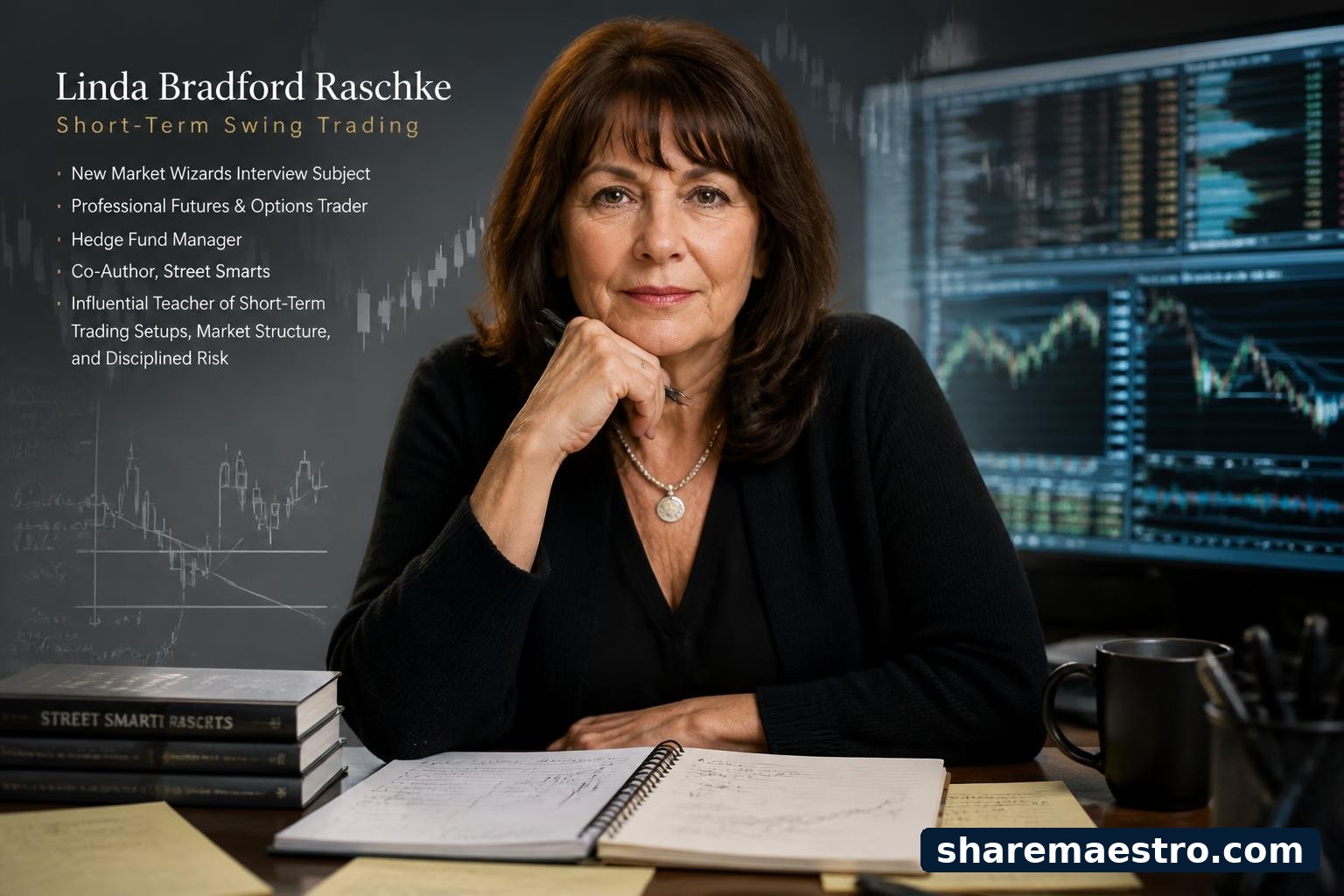
This profile examines Linda Bradford Raschke's evolution from options floor trader to CTA, hedge fund manager, author, and influential teacher of short-term trading. It focuses on her price-based philosophy, her blend of discretionary judgment and statistical preparation, the public record around her funds and career, the limits of pattern trading, and why her work still matters in electronic markets.
- Raschke began professional trading in 1981 as an options market maker and later became a registered Commodity Trading Advisor in 1992.
- Her reputation rests less on a single system than on a repeatable craft: price structure, momentum, market internals, trade location, and disciplined exits.
- Street Smarts, co-authored with Laurence A. Connors, made several short-term setups part of the trader's vocabulary, including retracements, breakouts, climax reversals, and the widely discussed Holy Grail pattern.
- Her record is notable for longevity: industry profiles cite a hedge fund ranking of 17th out of 4,500 for five-year performance and only one losing year during her outside-capital career.
- The method's danger is also clear: public patterns can decay, discretionary judgment is hard to transmit, and short-term trading costs punish weak execution.
Performance and evidence
Performance markers
Visual Evidence
Charts and timelines
Risk
Timeline
Philosophy
Performance
The trader who kept the floor in her head
Linda Bradford Raschke's trading career begins in the noise of the options floor, but its significance is easier to understand in silence. The market closes, the screens stop flickering, and the work begins again. Her version of short-term trading was never the cartoon of impulse speculation. It was homework, levels, notebooks, model tendencies, contingency plans, order placement, and the discipline to abandon a view when the tape refused to confirm it.
That is why Raschke occupies a particular place in the canon of traders. She was not primarily a macro theorist, a value investor, or a black-box system builder. She became known for taking the old skills of floor trading, the reading of order flow, rhythm, failed moves, and pressure points, and translating them into an upstairs trading process that could survive screens, faster markets, and outside capital.
The frame of her career is unusually long. Public professional biographies place her start as a full-time professional trader in 1981, her CTA registration in 1992, her later work as principal trader for several funds, and her retirement from CTA and CPO roles in the mid-2010s. In a field where many reputations are built on a few spectacular years, Raschke's story is about repetition: showing up, recording, testing, refining, cutting risk, and doing it again.
Why Raschke matters
Raschke matters because she made short-term trading look less like prediction and more like professional practice. Her public teaching was built around the premise that markets do not have to be forecast in grand narratives to be traded. A trader can define a structure, wait for a specific event, size the bet against an exit point, and judge the next decision by the market's response rather than by personal conviction.
That distinction separated her from many retail trading educators. She did not promise that a setup was a machine. In interviews she repeatedly framed systems and indicators as aids, not substitutes for judgment. She described statistics as signposts, not commandments, and saw the best trading ideas as simple structures that still required timing, execution, and risk management.
Her influence also reflects representation, though not in a token sense. Raschke was profiled in Jack Schwager's Market Wizards universe and later in books and interviews on technical analysis and women in finance. For traders who came after the open-outcry era, she offered a rare bridge: a woman who had survived the pit, managed money, published tactics, and continued to talk about the hard parts of trading without sanding away the stress, mistakes, or boredom.
From the options pit to the screen
The floor gave Raschke her first apprenticeship in uncertainty. She began as an options market maker in 1981 and spent years as a member of the Pacific Stock Exchange and the Philadelphia Stock Exchange. Market making in equity options required a different education from reading annual reports. It meant arbitrage, spread awareness, volatility sensitivity, quick error correction, and comfort with being wrong in public.
The transition from the floor to upstairs trading was not automatic. Active Trader later described her move away from the pits as a difficult passage for many floor traders, because the advantages of proximity and crowd information could disappear once the trader sat in front of a screen. Raschke's adaptation depended on converting floor intuition into observable structure: price levels, momentum shifts, ranges, pullbacks, and failures.
A revealing episode came after she first embraced analysis software in the 1980s. According to Active Trader, she had initially posted a long run of profitable weeks after leaving the floor, then lost money for three months when new software distracted her from the tape-reading skills that had made her effective. The lesson was not anti-technology. It was that tools must serve attention, not replace it.
The philosophy: listen first, decide second
Raschke's philosophy can be compressed into one practical rule: the market gets the final vote. In a 1997 interview about Street Smarts, she discussed the danger of imposing a view on price action. Fundamental opinions, valuation judgments, and elaborate scenarios were less important to her than whether the market showed thrust, range expansion, a failed low, a gap, or another observable message.
This was not nihilism. It was a demand for evidence. Raschke's work treated price as the condensed output of positioning, sentiment, liquidity, and information, even when the trader could not know which force mattered most. Her attention went to how the market behaved at important reference points: prior highs and lows, moving averages, Globex levels, momentum readings, breadth extremes, and the edges of ranges.
The result was a form of humility that could look aggressive from the outside. She might trade quickly, use leverage, and act without a long explanatory thesis. Yet the decision was disciplined by context. The market was either retracing, testing, breaking, failing, or confirming. A trade that did not behave correctly after entry was information, not an invitation to argue.
Discretion with a spine
Raschke has often been described as discretionary, but that label can mislead. Her discretion was not a license to improvise without structure. She studied recurring market tendencies, counted patterns, used indicators to quantify behavior, and prepared scenarios before the open. The discretionary element came in how she weighed those signposts in real time and adjusted the trade as price developed.
In Active Trader, she explained that she did not design full-blown systems in the conventional sense, with fixed rules for every entry, exit, and stop. Instead, her notebooks of statistics and tendencies were guides. A daily S&P bar closing in the upper portion of its range might suggest next-day follow-through above the high, but not necessarily a strong close. That distinction mattered because it turned a statistical tendency into a trade management idea.
This is the key to her professional appeal. Raschke's method sat between two extremes. It was not pure intuition, because she grounded decisions in repeated market behavior. It was not pure automation, because she insisted that entries, exits, execution, and position management depended on conditions. The spine was the framework; the craft was applying it without pretending that any one rule could solve every market.
Street Smarts and the codification of the setup
Street Smarts: High Probability Short-Term Trading Strategies, published by M. Gordon Publishing Group in the mid-1990s and co-authored with Laurence A. Connors, became Raschke's most durable public text. Its importance was not that it gave traders a magic formula. It collected a vocabulary of short-term market behavior: retracements, pattern breakouts, volatility expansion, gap reversals, climax behavior, and momentum confirmation.
The book's popularity came from specificity. Many trading books stay in the realm of aphorism, but Street Smarts named conditions and triggers. It discussed short-term tactics for futures and equities, including ADX-based trend pullbacks, oscillator divergences, volatility breakouts, and failure patterns. It gave discretionary traders enough structure to begin asking measurable questions.
That public codification created both influence and risk. Once a setup is named, it becomes easier to teach, test, imitate, and misunderstand. Raschke's own interviews show why the book should not be read as a static recipe collection. She treated patterns as starting points whose usefulness depended on market condition, trade location, volatility, and the trader's ability to execute and exit.
The Holy Grail was less holy than disciplined
The Holy Grail pattern became one of the best-known ideas associated with Raschke and Connors, partly because the name was memorable and partly because the logic was simple. The setup looked for a strong trend, often identified by a rising 14-period ADX above 30, followed by a pullback toward a 20-period exponential moving average and an entry above a prior bar's high for long trades, with a protective stop near the new swing low.
The appeal was not mystical. It formalized the idea of buying the first meaningful pullback after momentum had already declared itself. That was consistent with Raschke's evolution away from trying to pick extremes and toward joining pullbacks within trends. It also addressed a common psychological problem: traders hesitate to buy after strength because they fear the top, while the setup asks whether the pullback is a lower-risk continuation point.
The danger is that a named setup can become detached from the context that made it work. Raschke emphasized that timing affects risk and follow-through, and that buying in the middle of a range is often the worst location. The Holy Grail was therefore not a universal buy signal. It was a lesson in trade location, momentum confirmation, and the practical relationship between entry and stop.
The routine behind the trade
Raschke's edge was built as much after the close as during the session. Active Trader described the long hours she devoted to analysis and preparation, even after two decades in the business. Her routines included worksheets, market numbers, trade logs, and nightly game plans across multiple markets, some of which would never produce a trade the next day.
The ritual had two purposes. First, it created familiarity. Writing down numbers helped her internalize market behavior so that levels and relationships were available under pressure. Second, it managed anxiety. A trader who has prepared a map before the open is less likely to confuse motion with opportunity when price begins to move.
This is a recurring theme in her work: discipline is not merely the heroic act of taking a stop. It is the mundane structure that reduces the need for heroics. Logging trades, reviewing tendencies, building scenarios, and knowing the market's reference points are all ways to narrow the field of action before money is at risk.
Execution as a source of returns
One of Raschke's most distinctive contributions was her insistence that execution is not clerical. In Active Trader, she called execution one of the most overlooked parts of trading and estimated that it accounted for a large share of the bottom line. That view came from the floor, where the difference between being filled and chasing could determine whether a good idea became a good trade.
Her execution advice was condition-specific. In a high-volume trending market, she was willing to use market orders. In a choppy, thin, range-bound market, trade location and limit orders mattered more. She understood that the same order type could be prudent in one environment and expensive in another.
This focus is especially important because short-term trading has thin margins for error. A trader can have the right directional view and still lose money through poor entry, missed exits, bad fills, or stubborn order placement. Raschke treated execution as learned motor skill, closer to sport than theory. Practice, feedback, and pattern recognition mattered because the trade was not finished when the signal appeared.
Risk management: the lesson of lower volatility
Raschke's mature risk philosophy was shaped by experience. She acknowledged that in the 1980s she was more countertrend and more willing to scale into trades. When she began managing outside money in the early 1990s, her style changed. She made it a policy not to average trades, reduced leverage, and focused more on pullbacks within trends than on guessing when a market had gone too far.
The shift is central to understanding her longevity. Short-term traders often talk about entries because entries are exciting. Raschke's record was built on the less glamorous problem of making small losses stay small. In her 1997 interview, she argued that there was no reason for small losses to become big losses, except for sloppy habits, trader error, or stubbornness.
Her risk language was practical rather than abstract. In one Active Trader interview she described initial risk points, trade management after entry, tightening stops when necessary, and varying stops by market and timeframe. The point was not that every trader should copy those levels. It was that every trade needed an initial insurance point and a plan for what to do if the market failed to behave.
The record and what can be verified
Public performance data for Raschke's funds is not as complete as it is for a mutual fund manager with decades of audited annual reports. That limitation matters. A serious profile should distinguish between documented career facts, industry rankings, and claims that are repeated in biographies without full return tables attached. Raschke's reputation rests on a combination of public recognition, professional longevity, and third-party profiles, not on a neat sequence of annual numbers available to any reader.
The strongest widely cited record markers are nonetheless notable. CMT Association and IFTA profiles state that she became a registered CTA in 1992, later served as principal trader for several funds, started her own hedge fund in 2002 as CPO, and that her hedge fund ranked 17th out of 4,500 for best five-year performance by BarclayHedge. IFTA's 2025 update also states that she retired as a CPO and CTA in 2015 and continued trading daily for her own account.
Those markers should be read with care. Rankings can be powerful but incomplete, because they depend on the universe, reporting practices, survivorship, fund size, and category definitions. Still, the combination of a long trading career, outside-capital responsibility, peer recognition, and cited ranking puts Raschke in a different category from educators whose public record consists only of commentary.
Electronic markets changed the arena, not the problem
Raschke's career spanned the decline of the open-outcry floor and the rise of electronic execution. That shift could have made a floor trader obsolete. Instead, she treated technology as infrastructure. By 2004, Active Trader described a sophisticated office setup with multiple CPUs, many monitors, backup data feeds, redundant connectivity, and backup power, reflecting the operational seriousness required for managing money electronically.
Yet the essence of her method did not become technological theater. She still focused on price behavior, market internals, timeframes, and the relationship between momentum and pullback. Electronic trading increased access and speed, but it did not remove the need to define where the trade is wrong, how much to risk, and whether the next bar confirms the premise.
This balance is part of her continuing relevance. Many modern traders are surrounded by more data than Raschke had in her early career, but abundance can degrade attention. Her experience with software distraction in the 1980s reads as an early warning: tools are useful only if they sharpen the trader's ability to see the market more clearly.
The criticism: patterns are not property
The central criticism of Raschke's public method is that once a pattern is widely known, it may lose edge or be arbitraged into a weaker form. That is not a trivial objection. Street Smarts became a reference text for generations of technical traders, which means its setups became easier to scan, program, and test. Popularity changes a market technique's ecology.
Later research has treated that question seriously. A CMT Association presentation on Are The Streets Still Smart? reviewed popular Street Smarts strategies across major asset classes from 2005 to September 2021 and applied statistical hypothesis testing and bootstrap methods. Its premise was that market structure had changed and that classic swing trading ideas should be re-evaluated rather than revered.
This is where Raschke's own framework protects her from a simplistic critique. She did not argue that every pattern works in every regime. In 1997, she said most methods do not work in all market conditions and that conditions do not persist forever. The danger for followers is not that Raschke taught patterns. It is that they may copy the pattern while ignoring context, costs, volatility, and the trader's own capacity to execute.
The broader debate over technical analysis
Raschke also sits inside a larger argument about technical analysis. To skeptics, chart patterns can look like after-the-fact storytelling. To practitioners, price behavior is the visible record of supply, demand, positioning, and psychology. Her career is a case study in why the debate is hard to settle: the same public chart pattern can be useless in one trader's hands and valuable in another's process.
The Heretics of Finance, by Andrew Lo and Jasmina Hasanhodzic, placed Raschke among leading technical practitioners interviewed about the craft. The book's premise was not that every technician is right. It was that technical analysis deserved a more serious conversation between academics and market professionals, especially because some empirical research has found incremental information in certain price patterns without proving easy profits.
Raschke's version of technical trading was pragmatic. She cared less about defending the label than about knowing what price was doing, where risk could be defined, and how the market responded after entry. That does not answer every academic objection. It does explain why traders continued to study her work: she framed technical analysis as disciplined observation, not prophecy.
Teacher, author, and institutional memory
Raschke's post-floor influence came through books, interviews, lectures, and professional associations. CMT Association notes that she served on the board of the CMT Association's predecessor organization and was president of the American Association of Professional Technical Analysts. IFTA says she taught professionals and bank traders in more than 22 countries while on tour with Dow Jones and lectured for organizations including the Managed Futures Association, Bloomberg, and technical analysis groups.
Her later book, Trading Sardines: Lessons in the Markets from a Lifelong Trader, extended that role from setup instruction to trading memoir. Its importance is not merely bibliographic. It reflects the evolution of her public voice from tactic provider to institutional memory, someone able to describe what the business feels like across decades of changing technology, market structure, and trader psychology.
The 2024 IFTA Lifetime Achievement Award formalized that influence. The award language emphasized career achievement, education, research, professional conduct, and regard by peers and the investment community. For a trader whose work centered on short-term decisions, the recognition highlighted a longer arc: Raschke helped preserve a practice-based tradition of technical trading while forcing it to adapt to screens, statistics, and scrutiny.
What remains useful and what remains dangerous
What remains useful in Raschke's work is the refusal to separate method from behavior. A setup without a stop is not a strategy. A statistic without execution is not an edge. A strong opinion without price confirmation is just a liability with a narrative attached. Her mature method links market structure, preparation, execution, risk, and psychology into one process.
What remains dangerous is the seduction of simplicity. The same clarity that made Raschke's patterns teachable can make them easy to misuse. A trader can memorize ADX settings, moving averages, oscillator names, or failed-breakout language and still lack the judgment to know when a market is trending, when a range is too noisy, when volatility has changed, or when costs have consumed the expectancy.
Raschke's best lesson is therefore not any single trade. It is professional restraint. She showed that short-term trading can be rigorous without being fully mechanical, intuitive without being careless, and opportunistic without being reckless. In modern markets, where speed and data can tempt traders into constant action, her career argues for a harder standard: wait for structure, define the risk, execute cleanly, and let the market tell the truth.
Disclosure
Educational financial journalism and market research only. Not financial, investment, trading, tax, or legal advice.