In brief
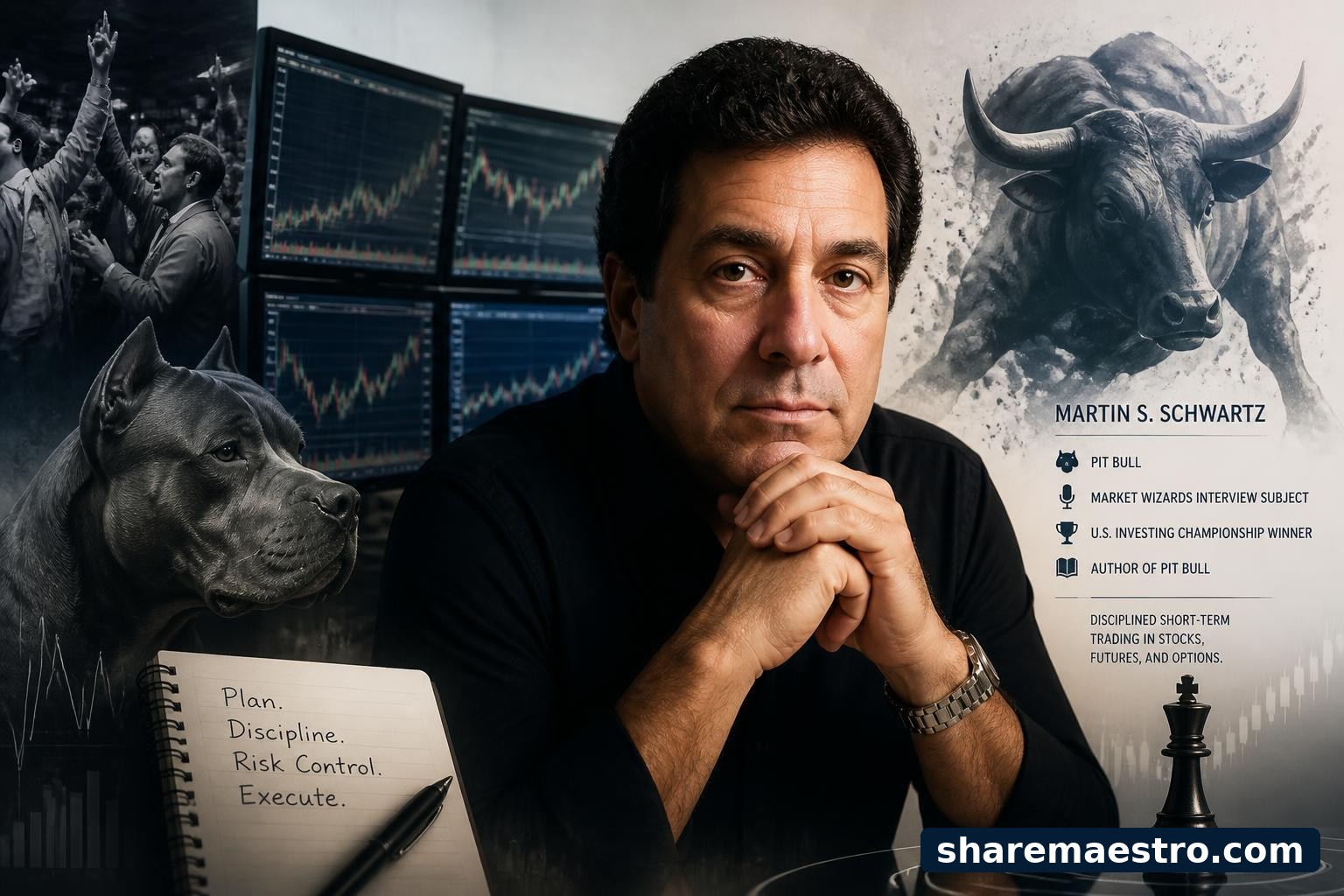
Martin S. Schwartz, known to traders as Marty or Pit Bull, became famous through the U.S. Trading and Investing Championship circuit, Jack Schwager's Market Wizards and his memoir Pit Bull. His approach mixed short-term momentum, technical filters, aggressive preparation and fast loss-taking. His record includes extraordinary contest returns and a reported run from a $40,000 account to more than $20 million, but his career also exposes the pressure, health costs and limited replicability of professional day trading.
- Schwartz matters because he made short-term technical trading visible at a time when Wall Street still gave greater intellectual status to fundamental analysis and long-only investing.
- His edge was less a secret indicator than a conversion of temperament: he learned to stop treating losses as personal insults and began treating them as routine operating costs.
- Public performance evidence is strongest around the trading-contest record cited by Jack Schwager: nine four-month contests averaging 210 percent nonannualized and a single one-year contest return of 781 percent.
- The method depended on a trend filter, especially the 10-day exponential moving average, daily preparation, price reaction to news and disciplined exits.
- The caution is central: academic evidence on retail day trading shows that most individuals fail, making Schwartz a rare professional case rather than a template for easy imitation.
Performance and evidence
Performance markers
Visual Evidence
Charts and timelines
Risk
Timeline
Philosophy
Performance
The trader who had to beat himself first
Marty Schwartz's legend begins not with a graduate degree, a valuation model or an institution's balance sheet, but with the moment he stopped needing the market to confirm his intelligence. Before he became Pit Bull, before the contests and the swaggering memoir, he was a well-paid securities analyst who kept losing money. He had the credentials and the Wall Street job, yet the account statement told a harsher story. The early Schwartz was not undone by ignorance alone. He was undone by the familiar trader's disease of wanting to be right after the market had already proved him wrong.
That is why Schwartz remains more interesting than the usual trading hero. His career is not a clean fable about talent recognized early. It is a study in forced adaptation. He spent years learning that analysis, conviction and education were useless if they hardened into ego. When he finally remade himself, the new method was brutally practical: trade with the immediate direction, respect the tape, cut losses, do the work every night and never confuse an opinion with a position.
The nickname Pit Bull captured the surface: aggression, tenacity and a taste for the contest. But the durable lesson is almost the opposite of uncontrolled aggression. Schwartz's real achievement was the construction of a self-limiting machine around a volatile personality. He was competitive enough to enter public trading championships, yet his best rule was retreat. He wanted to win every round, but he survived because he learned to leave the ring when the punches were no longer his.
Why Pit Bull matters
Schwartz matters because he gave short-term trading a vivid professional case study at the exact moment modern markets were becoming faster, more derivative-driven and more index-centered. He was not a portfolio manager explaining why a company would compound capital for a decade. He was a trader exploiting increments of movement in stocks, options and S&P futures. His time horizon was often measured in hours or days, and the central question was not what a business was worth but whether the market's immediate pressure favored buying, selling or standing aside.
His fame came partly from a public record that other traders could not easily dismiss. In Schwager's Market Wizards, Schwartz appeared as Champion Trader, a solitary operator whose contest results and month-end drawdown record made him one of the book's clearest examples of technical trading success. The contrast with fundamental investors was sharp. Schwartz had worked as a securities analyst, yet his prosperity came after he abandoned the idea that fundamentals would save a bad trade.
That makes him a bridge figure. He came from the old Wall Street of floor seats, paper tickets, voice brokers and visible aggression, but he anticipated a later culture obsessed with charts, risk points, price momentum and process. Many retail traders know his aphorisms, but professional readers should focus on the structure beneath them. His career shows that short-term trading can be disciplined, but also that discipline is not the same as accessibility. The skill is scarce, the stress is real and the evidence from the broader day-trading population is severe.
From credentials to the American Stock Exchange
Schwartz did not arrive at trading as an outsider fantasizing about Wall Street from a distance. He passed through elite educational and professional channels, including Amherst and Columbia Business School, and served in the U.S. Marine Corps Reserves during the era when military service and Vietnam shaped many young men's choices. The Marine experience later became part of the mythology around his discipline, but the more important point is that his early path gave him both ambition and a sense of hierarchy. Wall Street was a place to climb, prove and rank oneself.
The conventional route did not satisfy him. Publishers Weekly's account of Pit Bull describes Schwartz as having worked for years in what he considered a dead-end job as an E.F. Hutton financial analyst. He accumulated about $100,000, quit the firm and on August 13, 1979 bought a seat on the American Stock Exchange. That date matters because it marks the move from commentator to risk-taker. He was no longer writing opinions for others. He was paying for the right to stand closer to the machinery.
The results were immediate enough to become part of the legend. In his first full year as an independent trader, he made $600,000, and the following year he made $1.2 million. The numbers are large, but they also need context. This was leveraged, high-speed, high-pressure trading by a man who had concentrated his financial and psychic capital in one profession. The same move that released him from the analyst's desk also removed the insulation that a salary provides.
The conversion from fundamentals to the tape
Schwartz's break with fundamental analysis was not theoretical. He did not reject it after reading an efficient-market paper or after joining a technical-analysis sect. He rejected it after losing money while using it. That distinction is important. His conversion came through account damage, not ideology. He came to believe that the market's response to information was more useful than the information itself. A company could be cheap, a story could be persuasive and a macro view could sound elegant, but if price moved against him, the trade was wrong for his purposes.
In the Market Wizards tradition, Schwartz is often presented as the rich technician answering the old fundamentalist sneer that no wealthy chartist exists. The answer was personal. He had used fundamentals for years and prospered only after becoming a technician. The exact indicator mattered less than the shift in authority. He stopped treating research as a shield and started treating price as the final court of appeal.
That made him a short-term momentum trader, but not a trend follower in the classic long-term managed-futures sense. He did not build a diversified program of mechanical signals across dozens of markets. He synthesized moving averages, oscillators, market tone, news reaction and tape reading into a personal decision system. It was discretionary, but not casual. He wanted objective checks before acting, then quick obedience once the market invalidated the trade.
Red light, green light
The most famous tool in the Schwartz toolkit was the 10-day exponential moving average. He used it as a regime filter, not as a decorative line on a chart. If price was above the average, he considered the market to be in a positive mode and preferred the long side. If price was below it, he treated conditions as negative and preferred the short side. He called the approach red light, green light, a phrase simple enough to be remembered and strict enough to prevent many self-destructive trades.
The simplicity is deceptive. A moving average does not forecast the future with mystical precision. It imposes behavior. It makes the trader answer a basic question before acting: am I aligned with the prevailing pressure, or am I trying to prove I know better than the market? For Schwartz, the moving average was a way to reduce ego disguised as analysis. It did not make him right. It kept him from fighting the tape too often.
His method also paid close attention to how markets responded to news. A market that falls on good news is revealing weakness; a market that rises on bad news is revealing underlying demand. That idea fits his broader philosophy. He was less interested in the headline than in the market's metabolism. Information was valuable only after being translated into price, volume, momentum and the willingness of other traders to keep pressing.
The night's work behind the floor persona
The public image of Schwartz is all adrenaline: the pit, the stare, the quick exit, the competitive insult, the refusal to be intimidated. Schwager's profile adds a more prosaic picture. He found Schwartz still doing market analysis after trading hours and still unfinished when the interview ended. The routine was not ornamental. Schwartz calculated ratios and oscillators, posted charts and prepared each night because he wanted to be better prepared than whoever would be across from him the next day.
That work ethic complicates the romance of instinct. Schwartz had feel, but he did not worship feel in isolation. He built a daily operating process that forced him to update levels, examine trend, assess risk and enter the next session with a plan. The appearance of rapid decision-making was supported by slow preparation. By the time he pulled the trigger, much of the thinking had already been done.
This is where the Marine analogy becomes more than biography. Good short-term trading, in Schwartz's version, was rehearsal under uncertainty. He could not know tomorrow's market, but he could know his levels, his bias, his maximum pain and his conditions for retreat. The nightly routine converted chaos into a smaller set of decisions. It also gave him a psychological advantage: if he lost, he could blame the trade and not the absence of preparation.
Contest proof and what it can prove
Schwartz's most marketable proof came from the public trading championships run by Norm Zadeh. The official United States Investing Championship still lists him among prior participants, and a 1986 Los Angeles Times article described Zadeh's competitions as a reaction against empty market commentary. The contest idea was blunt: verified performance would speak louder than television opinions, brokerage production or reputation. For traders who believed they had skill, it offered public certification.
Schwager's numbers became the canonical record. In nine of ten four-month trading championships, Schwartz reportedly made more money than all the other contestants combined, with an average nonannualized return of 210 percent in those nine events. In his single one-year contest, he scored a 781 percent return. These are extraordinary figures, and they explain why his reputation traveled beyond the floor. They also explain why he was not merely another colorful trader with a memoir.
Yet contests prove a narrow thing. They show what a trader did under particular rules, market conditions, account sizes and time windows. They do not prove that the same method can be scaled indefinitely, taught easily or repeated by outsiders. Schwartz's record is strongest when treated as evidence of an exceptional specialist. It is weakest when treated as a universal invitation. The contests validated him, but they did not abolish the arithmetic of competition.
Trading the new index age
Schwartz's rise coincided with one of the most important structural changes in American markets: the emergence of stock-index futures. CME's S&P 500 futures contract arrived in 1982, giving traders a direct, leveraged instrument for expressing a view on the broad equity market. For someone with Schwartz's temperament and time horizon, that mattered enormously. The index future was liquid, volatile and macro enough to compress many stock-market judgments into one tradable vehicle.
His specialty in S&P futures placed him near the center of a new kind of trading. The instrument helped connect cash equities, futures, portfolio insurance, arbitrage and institutional risk management. It also sharpened intraday feedback loops. A trader like Schwartz could read the broad market through futures, execute quickly and adjust exposure without building or unwinding a basket of individual stocks. The product did not create his discipline, but it gave that discipline a powerful arena.
This is part of why his career cannot be separated from market plumbing. He was a trader of personality, but also a trader of infrastructure. The American Stock Exchange seat, listed options, index futures and the post-1982 futures complex created opportunities that earlier generations did not have in the same form. Schwartz's method was personal, but the stage was institutional innovation.
Risk as identity, not appendix
The core of the Schwartz method was risk control expressed as identity. He did not merely use stops as a portfolio-management technique. He built his self-image around being the trader who could take a loss. That distinction matters because the hard part of risk management is rarely the spreadsheet. The hard part is emotional obedience when the market humiliates a carefully reasoned view. Schwartz's mature answer was to get flat, regain objectivity and, if necessary, put the trade back on later.
His reported drawdown record is central to the legend. Schwager wrote that Schwartz had turned a $40,000 account into more than $20 million without a month-end drawdown greater than 3 percent during the period discussed. Month-end data can hide intramonth pain, and the figure should not be confused with a complete institutional risk report. Still, as a behavioral marker, it is striking. It suggests a trader obsessed with preventing small errors from becoming career-threatening ones.
This is also where the danger of imitation begins. Fast loss-taking sounds easy until it becomes a series of realized losses. A trader needs a positive expectancy on the remaining trades, not just a talent for exiting. Schwartz's skill was not simply that he cut losers. It was that his entries, sizing, timing and market selection apparently left enough winners to pay for those exits. Without that edge, disciplined stopping can become disciplined bleeding.
October 1987 and the discipline of getting flat
The cleanest illustration of Schwartz's risk doctrine came during the October 1987 crash. According to the Schwager interview excerpts, he came in long and quickly liquidated the position as the market moved against him. The loss was painful, roughly $315,000 on a position described as 40 contracts, but the decision preserved far more capital than stubbornness would have. Schwartz later reasoned that adding to the losing position could have turned a bad day into a multi-million-dollar disaster.
The episode matters because it strips away the motivational poster version of trading discipline. Schwartz did not avoid being wrong. He did not foresee everything. He entered the crash exposed in the wrong direction. His greatness in that moment, if the word is justified, was not prediction but response. He accepted the loss before it metastasized. He chose survival over the fantasy of immediate vindication.
The lesson also speaks to the difference between tactical bravery and strategic cowardice. Many traders confuse courage with holding on. Schwartz's version of courage was the willingness to look foolish, crystallize a loss and protect the account. In a crash, the priority was no longer profit maximization. It was keeping what had already been made. That defensive reflex is one reason his career is studied by traders who know that one uncontrolled day can erase years of skill.
The fund that tested the loner
Schwartz's strengths were those of a solitary trader: concentration, autonomy, speed and a high tolerance for the emotional violence of his own account. Managing other people's money changed the psychological equation. Publishers Weekly's review of Pit Bull notes that as his success grew, he began a fund that managed outside capital as well as his own, a move he came to regret. The stress of running the fund contributed to pericarditis, a health crisis that nearly killed him.
This is an underappreciated fault line in trading careers. Proprietary success does not automatically translate into asset-management success. Outside capital brings questions, redemptions, explanations, client psychology and the burden of losing for people who do not share the trader's nervous system. Schwartz's own style depended on decisiveness and emotional intensity. The investor-relations layer made that style harder to sustain.
His move to Florida in his late forties, after doctors urged him to slow down, was not a retirement from markets so much as a renegotiation with them. He continued trading in a reduced, more controlled manner. The arc is revealing: the man who made money through speed had to preserve his life by reducing the speed of the life around the trading. The market had been mastered only partially. The body delivered its own margin call.
Critics, ego and the myth of the heroic trader
Schwartz's memoir was never received as a modest manual. Kirkus portrayed him as a hard-driving, successful day trader with chutzpah, but also emphasized the book's appetite for status, luxury and self-display. Publishers Weekly went further, calling the story a cautionary tale about addiction to money and power. TheStreet's James DePorre described the book as a revealing glimpse inside the mind and stomach of a Wall Street trader while also questioning the scale of Schwartz's public reputation outside the trading-book canon.
The criticism is not incidental. It is part of the profile. Schwartz's ego was both fuel and hazard. The desire to be Champion Trader pushed him into public contests and relentless preparation. The same desire could produce excess, stress and self-dramatization. The mature trader's task was not to eliminate ego, which may have been impossible, but to keep ego from overruling the stop. In that sense, his career is a case study in the partial domestication of a dangerous trait.
This balance is why the heroic reading of Schwartz is incomplete. He was not a serene master floating above markets. He was intense, status-conscious, competitive and often abrasive in the way the old floors rewarded. The achievement lies in the fact that he extracted a discipline from that temperament. The warning lies in the fact that the temperament still took a toll.
A second market in horses
Schwartz's later prominence in thoroughbred racing looks at first like a wealthy trader's hobby, but it also reveals continuity. America's Best Racing identifies him as a successful Wall Street trader and racehorse owner whose horses included Breeders' Cup Filly and Mare Turf winner Zagora and Grade 1 winning mares such as Stacelita, Samitar and Angara. The same profile lists substantial lifetime racing earnings, evidence that this was not a casual weekend diversion.
The racing strategy had a recognizably Schwartzian cast. Thoroughbred Racing Commentary described a plan built around buying European turf fillies and campaigning them in America, where the right horse could exploit conditions, race placement and breeding value. Zagora, already a Group 3 winner in France, gave trainer Chad Brown his first Grade 1 victory in the 2011 Diana, then won the 2012 Breeders' Cup Filly and Mare Turf and was later sold for $2.5 million.
The horse business is not trading, but the analogies are clear enough to matter. Schwartz liked asymmetric situations, competitive arenas and records that could not be talked away. He also liked numbers. The racing chapter softens the image only slightly. It shows a man still drawn to risk, selection and public scoreboards, but operating in a market where patience, partners and bloodlines replaced ticks, futures and intraday exits.
What survives in electronic markets
The markets that formed Schwartz are gone in many visible ways. The old exchange-floor ecology has been displaced by electronic books, algorithmic market making, high-frequency competition, lower commissions and far broader retail access. A trader can now see charts, indicators and futures prices from a phone. That democratization makes the superficial Schwartz toolkit easier to copy and the actual Schwartz edge harder to replicate. Everyone can plot a 10-day exponential moving average. Few can turn it into a complete operating discipline.
What survives is not the indicator but the hierarchy of decisions. First, identify the market's current direction. Second, decide whether conditions favor offense or defense. Third, define the exit before emotional pressure rises. Fourth, reduce size or stop trading when attention, health or market conditions deteriorate. Those principles remain useful because they address trader behavior, not just market structure.
What is less transferable is the old discretionary advantage of the floor-trained operator. Schwartz traded in a world where human reaction, access, nerve and local knowledge could matter in ways that today's fragmented, machine-mediated markets have altered. Modern traders compete against faster systems and denser data. The enduring lesson is discipline; the dangerous fantasy is that reading about discipline produces an edge.
The dangerous lesson
The most responsible reading of Marty Schwartz is neither worship nor dismissal. He proved that short-term technical trading could be practiced with rigor, and he did so with enough public evidence to earn a permanent place in trading literature. He also proved that the price of such trading could be psychological, physical and social. The same intensity that produced the record nearly consumed the man behind it.
Academic evidence makes the caution sharper. The SSRN study Day Trading for a Living? examined individuals who began day trading in Brazilian equity futures between 2013 and 2015 and found that 97 percent of those who persisted for more than 300 days lost money. Only a small fraction earned more than basic wage benchmarks, and the authors emphasized the risks. That does not invalidate Schwartz. It defines him as an exception.
His continuing relevance lies in that tension. For professionals, he is a reminder that liquidity, leverage and speed demand humility. For private traders, he is a warning against confusing a famous survivor with a broadly repeatable path. Schwartz's great lesson was that making money mattered more than being right. The harder lesson is that most people who try to prove that lesson in real time will discover the market is a very expensive teacher.
Disclosure
Educational financial journalism and market research only. Not financial, investment, trading, tax, or legal advice.