In brief
Michael H. Steinhardt built one of the defining hedge fund records of the late twentieth century by turning variant perception into a practical discipline. His Steinhardt Partners combined fundamental research, short selling, tactical trading, and macro flexibility in a style that looked less like classic value investing than a permanent search for mispriced consensus. Contemporary accounts put the fund's long-run record around 24 percent a year net over 28 years, an achievement that made him a hedge fund archetype. Yet the same career also carried severe drawdowns, a major Treasury market settlement, later misconduct allegations tied to philanthropy, and a 2021 antiquities scandal that ended with the surrender of 180 objects valued at about $70 million. The useful lesson is not that investors should imitate Steinhardt's aggression. It is that market edge often begins with a differentiated view, but only survives when conviction is paired with restraint.
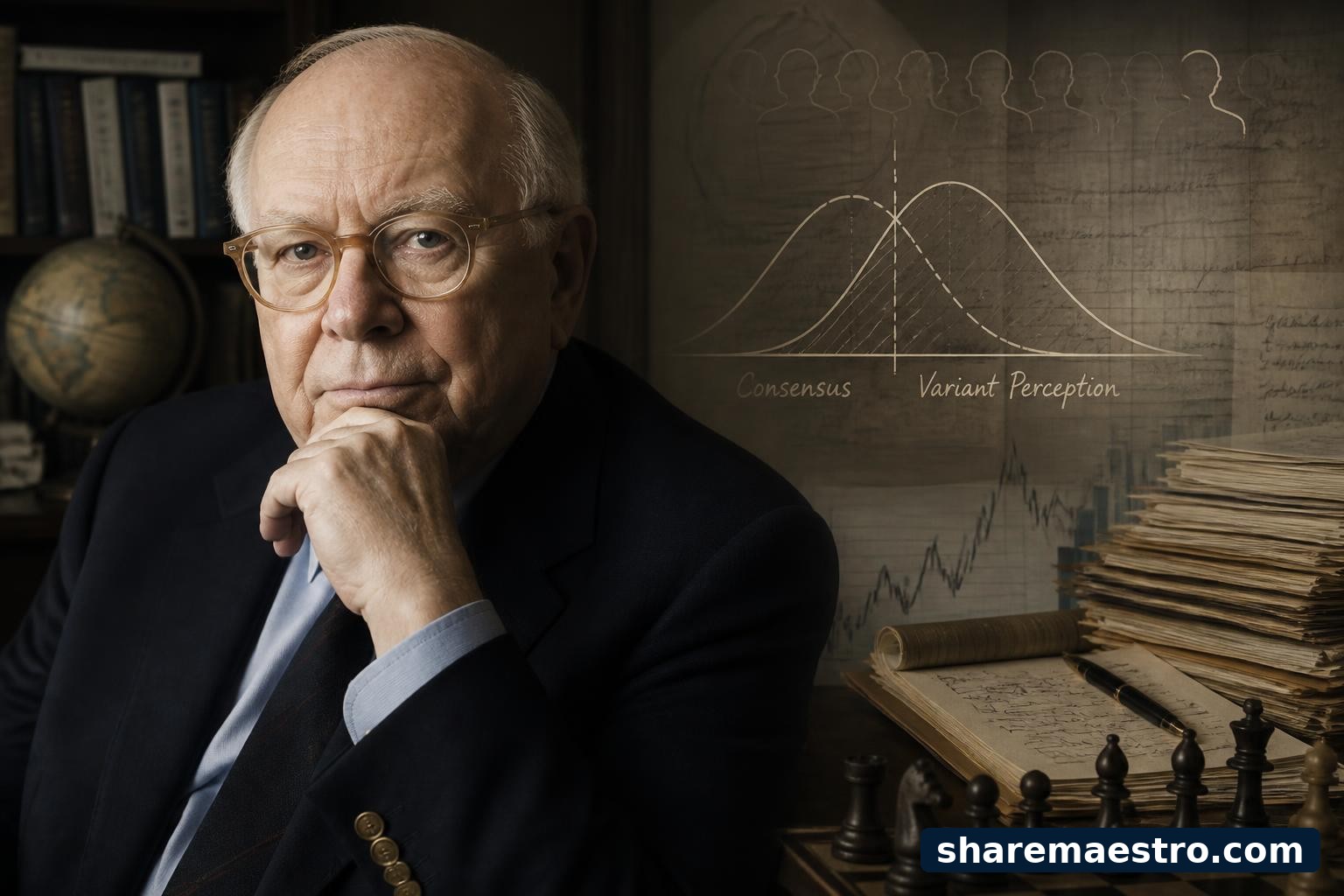
- Steinhardt's most durable contribution was the investor's demand for a variant perception: a view that differs from consensus and can be tied to a catalyst.
- Steinhardt Partners was a formative hedge fund of the modern era, using long-short equity, macro trades, leverage, and short selling well before those tools became institutional vocabulary.
- The record was exceptional, but it was not smooth. Contemporary accounts cite a roughly 24 percent net annual return over 28 years, plus painful episodes in the 1987 crash and the 1994 bond selloff.
- His career's central weakness was inseparable from its strength: conviction could become large, crowded, and hard to reverse when the market moved against him.
- The later record includes serious controversies, from the 1994 Treasury settlement to allegations of sexual harassment in nonprofit settings and the 2021 antiquities surrender and lifetime collecting ban.
- Steinhardt remains relevant because his method forces investors to separate being contrarian from being right, and to define what would make a differentiated view pay off.
Performance and evidence
Performance markers
Visual Evidence
Charts and timelines
Risk
Timeline
Philosophy
Performance
The day a trader chose to stop
When Michael H. Steinhardt said in October 1995 that he was leaving the investment business, Wall Street did not lose a quiet allocator. It lost one of its loudest embodiments of conviction: the hedge fund manager as analyst, trader, interrogator, speculator, and institutional force. He was 54, still young by the standards of money management, and still powerful enough to announce that he would liquidate billions in securities and return cash to clients by year-end. The retirement was striking because it came not after obscurity, but after a year of rebound from one of the most damaging losses of his career.
By then Steinhardt had already become a figure of finance folklore. He founded his firm in 1967, when hedge funds were still private partnerships for wealthy investors rather than a global asset management industry. Over the next 28 years, his flagship partnership compounded at a rate contemporary accounts described as roughly 24 percent a year net of fees, depending on the presentation. One dollar invested with him at inception was later described as becoming hundreds of dollars, far ahead of the broad stock market over the same period.
The retirement did not close the argument over him. It sharpened it. Steinhardt's record made him a pioneer of the aggressive long-short, cross-asset hedge fund. His temperament made him a legend and, for some, a warning. His later public life, dominated by philanthropy and then by controversy, made clear that the power created by financial success does not remain inside a portfolio. It spills into institutions, culture, and reputation.
Why Steinhardt still matters
Steinhardt matters because he helped shift the image of the investor from patient security analyst to adversarial market thinker. He did not merely ask whether a company was good or cheap. He asked what the market believed, why that belief existed, and where the crowd might be wrong. In Jack Schwager's Market Wizards, the Steinhardt interview was framed around the concept that would become his shorthand: variant perception. That phrase gave later generations a concise language for investment disagreement.
The idea sounds simple only after it has been absorbed into professional vocabulary. A variant perception is not a mood of contrarianism or a reflexive desire to oppose the majority. It is a structured difference from consensus, based on evidence and tied to an expected recognition mechanism. In Steinhardt's world, a recommendation had to contain not just an idea, but the prevailing view, the differentiated view, and the event or condition that might cause the market to reprice the asset.
That framework traveled well because it fit many styles. Value investors could use it to test cheap stocks. Growth investors could use it to challenge underappreciated earnings power. Credit traders could use it to examine default probabilities. Macro investors could use it to challenge rate, currency, and policy assumptions. Steinhardt's own career showed a more volatile application: use the framework, size it aggressively, and keep changing instruments when the opportunity set changed.
From Brooklyn appetite to Wall Street pressure
Steinhardt's origin story has always been part of the mythology. No Bull, his memoir, presents the narrative of a boy from Bensonhurst drawn early to markets and risk. Time later described the young Steinhardt receiving shares of stock as a bar mitzvah gift from his father, then breaking into Wall Street as a research analyst before founding his own firm at 26. That mix of precocity, family complexity, and market obsession became a durable part of his public persona.
The early career was rooted in research, not pure tape reading. Steinhardt came up in an era when information moved slowly enough that sharp analysts could still gain a real edge by knowing an industry better than competitors. His memoir's publisher emphasizes his skill as an industry analyst and stock picker, as well as his willingness to trade against the prevailing market trend. That combination became central: fundamentals supplied the rationale, but the portfolio was run with a trader's urgency.
This background helps explain why Steinhardt never fit cleanly into a single school. He was not a Graham-style balance sheet purist. He was not a buy-and-hold growth investor. He was not a systematic trend follower. He was a generalist with a specialist's intensity, willing to short favored stocks, buy unloved securities, shift to bonds, and treat the market as a debate he intended to win before others understood the question.
The hedge fund before the hedge fund boom
To appreciate Steinhardt's influence, it is important to place him before the industry he helped foreshadow. In the late 1960s, hedge funds were not mass institutional products. They were private partnerships, lightly advertised and often organized around a manager's personal edge. Time described hedge funds of the period as distinct from mutual funds, private vehicles with concentrated investors and more freedom to short securities and use leverage. That structure suited Steinhardt's temperament.
The model gave him room to be flexible in a way that traditional institutions could not be. He could own stocks, short stocks, use leverage, and move across securities. Los Angeles Times coverage at his retirement noted that hedge funds could invest in domestic and overseas stocks and bonds, currencies, futures, and bankrupt companies, while also using borrowed money to magnify positions. The point was not hedging in the cautious sense. It was freedom to express relative conviction.
Steinhardt's ascent came as Wall Street itself was changing. Block trading, institutional money, derivatives, global capital flows, and an expanding Treasury market were turning the United States financial system into a larger, faster machine. He was not outside that transformation. He was one of its beneficiaries and one of its accelerants, using the growing depth of markets to put on positions that would have been difficult for earlier generations of stock pickers.
Variant perception as a discipline, not a slogan
The phrase most associated with Steinhardt can be misunderstood because it sounds like a personality trait. In practice, it was closer to a due diligence standard. A Steinhardt-style idea had to begin with what the market already believed. Without a consensus to oppose, there was no mispricing to exploit. The concept, consensus view, variant view, and trigger created a compact test: what is the idea, what is priced in, why is it wrong, and what will force recognition?
That last element is what separates the framework from vague contrarianism. Many investors can argue that a stock is misunderstood. Fewer can specify why the misunderstanding exists and how it will change. Steinhardt's formulation pushed analysts toward causality and timing. A cheap stock without a trigger could remain cheap. An expensive stock could become more expensive if enthusiasm had not yet exhausted itself. The edge lay in marrying a differentiated view to a plausible change in perception.
The framework also carried an ethical and practical warning. Disagreement can be intoxicating. A manager who is rewarded for being different may begin to mistake difference itself for insight. Steinhardt's best periods suggest the power of disciplined dissent; his worst periods show the cost when a variant view becomes too large, too leveraged, or too slow to concede that consensus may have been right for longer than expected.
The operating system inside Steinhardt Partners
Steinhardt's process was built for argument. Ideas did not arrive as elegant reports to be admired from a distance. They entered a room where assumptions could be attacked, timing challenged, and conviction tested. The requirement that a thesis define consensus and a trigger imposed pressure on analysts to think about price, not only business quality. What mattered was not whether a company looked attractive in isolation, but whether the market's expectation set was wrong in a monetizable way.
The portfolio that came out of that process was not a diversified expression of modest estimates. It was an active instrument. Steinhardt could be long and short, fundamental and macro, equity-focused and bond-heavy. His memoir's publisher highlights both his industry analysis and his willingness to trade against the prevailing trend. That phrasing captures the hybrid nature of his edge. He wanted facts, but he also wanted the courage to act when those facts contradicted market psychology.
This style required unusual emotional machinery. A manager who shorts popular stocks or buys in a panic must endure being wrong at first. The pain is not incidental; it is often the entry fee. Yet the same emotional tolerance can become a failure mode. Staying with a view because the original thesis remains intact is rational only if the thesis was complete, position size was survivable, and the manager is still willing to notice disconfirming evidence.
Long-short stock picker, macro trader, and liquidity taker
The public shorthand often labels Steinhardt a hedge fund pioneer, but that phrase is too broad to explain his method. He was a stock picker who became comfortable making large macro statements. He was a fundamental analyst who traded actively. He was a short seller who understood that beloved stocks could be more dangerous than obscure ones because institutional enthusiasm could detach price from reality. His tools were diverse, but they were joined by a common question: what does the market believe that may not be true?
The bond market became one of the clearest examples of his reach beyond stocks. No Bull's publisher highlights Steinhardt's 1981 decision to stake heavily on bonds as one of his sensational coups. The same description also identifies his global macro foray in the mid-1990s as a sensational failure. The symmetry matters. The very expansion that allowed Steinhardt to exploit cross-asset mispricing also increased the risk that a wrong macro call could overwhelm years of equity craft.
That duality made him different from more method-bound investors. He did not confine himself to a circle of competence defined narrowly by industry. He defined competence by his confidence in a differentiated perception, wherever it appeared. The advantage was opportunity. The danger was domain drift, the gradual move from markets where one's informational edge is deep into markets where leverage, liquidity, and correlation can punish overconfidence before the thesis has time to mature.
The record that built the legend
Steinhardt's record remains the foundation of his status. Contemporary accounts around his retirement described Steinhardt Partners as earning about 24 percent to 24.3 percent a year net over 28 years. Time wrote that one dollar invested with him in 1967 would have been worth $462 by 1995, compared with $17 for a dollar invested in the Standard & Poor's 500. Such comparisons are blunt, but they explain why investors treated him as more than an aggressive trader.
The record was not only about return. It was about return produced before hedge funds became mainstream institutional allocations. Steinhardt compounded during an era that included inflation shocks, the 1970s bear market, the early 1980s rate regime change, the 1987 crash, and the bond market rupture of 1994. The number therefore carried narrative power: it suggested that a manager with enough analytical force and trading flexibility could defeat multiple market regimes.
Still, the record should not be read as a clean template. It came from a private partnership, not a mutual fund open to ordinary investors. It depended on a founder's personal judgment, intense trading, access, leverage, shorting, and a fee structure unavailable to most savers. The lesson is not that high returns can be reproduced by adopting the phrase variant perception. The lesson is that edge, when real, is usually specific, difficult, and embedded in an operating culture.
The drawdowns behind the compounding
Steinhardt's career also shows why long-run records can conceal violent interim pain. The Los Angeles Times reported that Steinhardt Partners was estimated to have lost $250 million in the 1987 stock market crash after he loaded up on stocks shortly before the collapse. Time's retirement account recalled that 1994 was worse than a minor stumble, with funds losing 29 percent of value amid a collapse in European bonds. Other contemporary accounts placed the 1994 damage in a broad range of hundreds of millions.
Those episodes were not random footnotes. They were intrinsic to a style that sized conviction aggressively. A manager who insists on differentiated views cannot expect smooth tracking against benchmarks. If the thesis is early, the position bleeds. If the thesis is wrong, it can do far more damage. If the market shock hits positions that are large, financed, or correlated, the drawdown can become existential even for a legendary manager.
The 1994 bond losses were especially instructive because they came after profitable earlier macro work. No Bull's publisher contrasts the 1981 bond coup with the disastrous global macro trading of the mid-1990s. That contrast captures a recurring problem in finance: a domain that once rewarded boldness can later punish the same behavior under different conditions. Past success does not merely create confidence. It can create permission to be larger just when the environment has become less forgiving.
The Treasury settlement and the edge of acceptable aggression
The most consequential market controversy of Steinhardt's investment career involved the Treasury market, not a stock thesis. In December 1994, the Justice Department and the Securities and Exchange Commission announced settlements with Steinhardt and Caxton related to allegations that they conspired to limit the supply of, or squeeze, the April 1991 two-year Treasury note. The government said the combined position was almost $20 billion, or 160 percent of the $12 billion issue.
Steinhardt agreed to pay $40 million to settle the charges. The Justice Department said the payment included forfeiture, an SEC penalty, and money for a disgorgement fund for victims. Caxton agreed to pay $36 million. The Los Angeles Times reported that Steinhardt's firm did not admit wrongdoing. Even with that legal posture, the episode became part of the broader debate over hedge fund power in core markets.
The case matters because it marks the line between aggressive trading and market structure risk. Hedge funds often argue that they provide liquidity, price discovery, and willingness to take the other side of consensus. Regulators worry when size and coordination appear to distort access to a key government security. For Steinhardt's legacy, the settlement complicates any simple celebration of boldness. A variant perception is admirable only when expressed within markets that remain fair, open, and functional.
Retirement as performance, fatigue, and reinvention
Steinhardt's 1995 exit carried more than one explanation. The Washington Post reported that he planned to sell most of the $2.8 billion of investments he controlled and return cash to customers. He said he had spent his life on Wall Street and wanted to leave while he could do more than serve as an arm-chair philanthropist. Time also portrayed a manager worn by the intensity of his work, yet still restless enough that retirement looked less like leisure than another campaign.
The timing was almost theatrical. After the brutal 1994 bond year, Time reported that Steinhardt was back on form in 1995 with returns around 20 percent. Leaving after a recovery allowed him to frame the decision as choice rather than defeat. It also fit a trader's instinct for exits. The moment to get out, in that account, was not necessarily at peak glory, but when reputation, investor capital, and personal energy could still be converted into another life.
Yet retirement did not erase the operating habits of the trader. Steinhardt moved into philanthropy, Jewish communal initiatives, and later another financial role through WisdomTree. The search for influence continued. What changed was the field on which influence was exercised. That transition is one reason his story remains richer than a performance profile. The same intensity that built a fund also shaped institutions that had to manage the power of a dominant donor.
The second act at WisdomTree
Steinhardt's most important post-hedge-fund business role came through WisdomTree. The company's 2019 proxy statement listed him as non-executive chairman since November 2004 and described his earlier service as senior managing partner of Steinhardt Partners from 1967 through 1995. It also noted that after closing the partnership, he managed his family office through Steinhardt Management. The role placed him near one of the most important shifts in asset management: the rise of exchange-traded funds.
WisdomTree's 10th anniversary release for its first ETFs described the summer 2006 launch of 20 fundamentally weighted funds in a single day. The firm positioned dividend weighting as an alternative to capitalization weighting, arguing that weighting by income could introduce a measure of valuation into index construction. That was not Steinhardt's old hedge fund style. It was a rules-based, transparent product architecture aimed at public markets and mass distribution.
The contrast is revealing. Steinhardt had made his name in private funds built around human judgment, confrontation, and concentration. WisdomTree represented a different kind of variant perception: challenge a dominant indexing convention, encode the challenge into rules, and distribute it through an ETF wrapper. By 2019, WisdomTree said he had served 15 years as chairman and credited his early support with helping the company attract capital and talent. It was a quieter form of market disagreement, but still recognizably Steinhardtian in spirit.
Philanthropy and the problem of donor power
Steinhardt's philanthropic identity was not incidental to his public life. No Bull's publisher describes him as widely known for Jewish philanthropy and as cofounder, with Charles Bronfman, of Birthright Israel. WisdomTree's 2019 proxy also identified him as chairman of The Steinhardt Foundation for Jewish Life, co-founder and supporter of Birthright Israel, and a New York University trustee. In retirement, capital became institutional influence.
That influence later faced scrutiny unrelated to market performance. In 2019, ProPublica, in collaboration with The New York Times, reported that six women said in interviews, and one woman said in a lawsuit, that Steinhardt had asked them for sex or made sexual requests while they were relying on or seeking his support. ProPublica also reported that he appeared in two sexual harassment lawsuits against an Upper East Side art gallery, though he was not named as a defendant.
The allegations matter to a finance profile because they illuminate the social afterlife of financial power. A hedge fund fortune does not merely buy art, endow programs, or fund institutions. It can create dependence, deference, and silence. Steinhardt's philanthropy was large and consequential, but the controversy surrounding his behavior forced nonprofits and universities to confront a difficult governance question: how should institutions weigh gifts and influence when the donor becomes a reputational liability?
The antiquities scandal that reshaped the late legacy
The most damaging post-finance controversy came from Steinhardt's antiquities collecting. In December 2021, Smithsonian Magazine reported that a deal with the Manhattan district attorney barred him from buying ancient objects for the rest of his life and required him to surrender 180 stolen relics worth more than $70 million. The artifacts, according to the report, had been smuggled out of 11 countries by criminal networks and lacked legal paperwork.
The facts were stark enough to overwhelm the usual separation between finance and private collecting. The district attorney's office said the investigation traced looted goods to Steinhardt's apartment and office. The surrendered objects included a Stag's Head Rhyton, a Larnax from Crete, a Herculaneum fresco, and a gold bowl from Nimrud. Smithsonian also reported that authorities declined to prosecute as long as Steinhardt complied with the agreement, allowing repatriation rather than a prolonged evidentiary process.
Steinhardt's lawyers, quoted in the same coverage, said he was pleased the investigation concluded without charges and that items wrongfully taken by others would be returned to their native countries. That response did not prevent the episode from altering his public standing. For a man whose market identity depended on seeing what others missed, the antiquities scandal posed a different judgment: whether a collector with vast resources had ignored warning signs that should have demanded restraint.
What remains useful, and what remains dangerous
The useful part of Steinhardt's legacy is the intellectual discipline of non-consensus thinking. Markets are not beaten by repeating what prices already imply. The investor must know the prevailing view, identify why it may be wrong, and understand what might change. That remains true in equities, credit, macro, and even rules-based products. The best version of variant perception is humble before evidence and precise about the path from insight to return.
The dangerous part is the romance of being against the crowd. Steinhardt's record can seduce readers into thinking that intensity itself is an edge. It is not. His career required research, access, temperament, capital, and risk tolerance that most investors do not possess. Even for him, the method produced severe losses and regulatory controversy. A differentiated view with no risk limit is not a strategy; it is a wager seeking a story.
Steinhardt's continuing relevance lies in that tension. He helped create a language for active management that still cuts through vague stock picking. He also supplied a case study in the costs of force, scale, and power. The lesson is not to trade like Michael Steinhardt. It is to ask his hardest question before every serious investment judgment: what do I believe that the market does not, why do I believe it, and what would prove me wrong before the position becomes too large to survive?
Disclosure
Educational financial journalism and market research only. Not financial, investment, trading, tax, or legal advice.