In brief
Nicolas Darvas remains one of the market's strangest and most instructive figures: a touring dancer who turned a self-taught trading method into a bestselling book, a regulatory dispute, and a durable template for breakout traders. His Darvas Box system was neither pure chart mysticism nor conventional growth investing. It was a hybrid of price action, volume, emerging-industry selection, pyramiding, and stop-loss discipline, shaped by distance from Wall Street and by a performer’s instinct for crowd behavior. His claimed achievement, turning modest capital into more than $2 million, still requires context because New York authorities later challenged the book's figures. Yet the method's core lesson survives the controversy: speculation is less about prediction than about rules, risk, and the courage to exit when the tape says the thesis is wrong.
- Darvas mattered because he translated momentum trading into a simple public language: boxes, breakouts, volume, and stops.
- His edge came partly from constraint. Touring the world forced him to avoid intraday noise and issue orders by cable, turning distance from Wall Street into discipline.
- The famous $2 million figure is best treated as a documented public claim and publishing event, not as an audited performance record.
- His system anticipated later growth and trend-following ideas by buying strength, adding to winners, and refusing to average down.
- The method's dangers are as important as its appeal: bull-market dependence, false breakouts, stop-loss gaps, concentration, leverage, and narrative seduction.
Performance and evidence
Performance markers
Visual Evidence
Charts and timelines
Risk
Timeline
Philosophy
Performance
The dancer at the edge of the tape
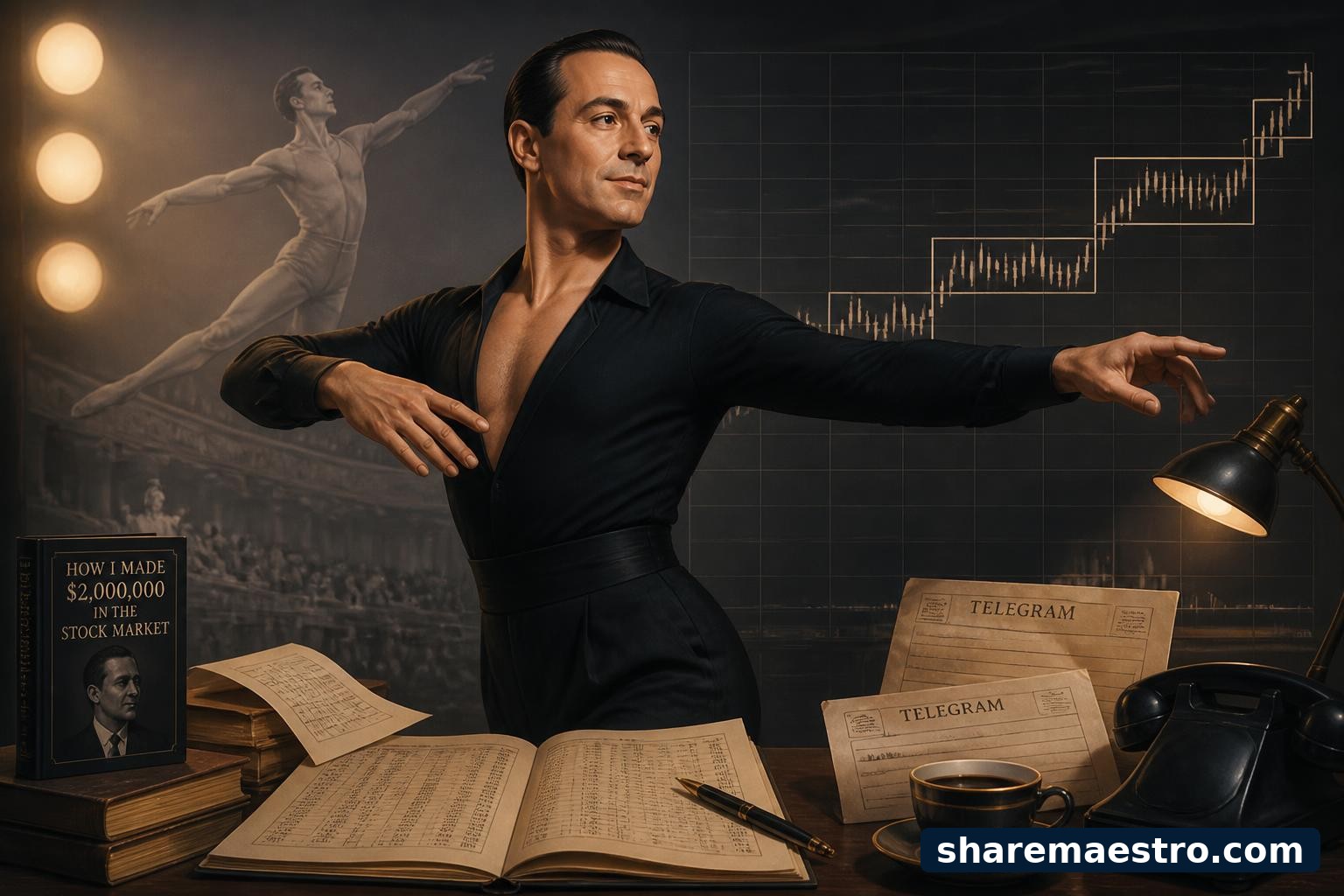
The story begins in a place Wall Street did not expect to find a speculator: not at a brokerage desk, not on the floor of the New York Stock Exchange, but under nightclub lights. Nicolas Darvas was a professional dancer, appearing with his half-sister Julia, when he became a market celebrity in 1959. TIME's profile introduced readers to a Hungarian-born performer who studied stock tables after shows and claimed to have built a fortune of more than $2 million while touring the world.
The image was irresistible. A dancer in white tie, moving from stage to hotel room, scanned Barron's, received nightly wires from a broker, and sent buy and sell instructions by cable. It was a glamorous tale, but the lesson was not glamorous. Darvas was trying to remove himself from the most dangerous part of speculation: the social noise around it. Tips, gossip, broker enthusiasm, and financial journalism were, to him, expensive distractions.
His method became famous as the Darvas Box. A stock that moved within a defined range was said to be inside a box. A move above the box, especially on heavy volume and in a stock with a promising growth story, was his invitation to buy. A move back below the box was his command to sell. Behind the show-business mythology sat a hard rule: the market did not owe him validation, and he would not stay in a trade that stopped acting right.
Why Darvas still matters
Darvas matters because he brought together several ideas that later became central to active trading: momentum, relative strength, volume confirmation, pyramiding, and preplanned exits. He was not the first to watch price and volume, and he was not a theorist in the academic sense. His importance is that he turned a speculative process into a practical operating language that individual traders could understand.
The name of his 1960 book, How I Made $2,000,000 in the Stock Market, did much of the marketing work. The title was audacious, but the book's enduring appeal comes from its confessional arc. Darvas did not present himself as a born market genius. He described losing money through tips, hunches, broker influence, and poorly timed purchases before arriving at his box theory. The book sold because it promised fortune, but it lasted because it dramatized the conversion of a gambler into a rules-based operator.
That conversion is the bridge between Darvas and later market practice. William O'Neil's growth-stock discipline, modern breakout screens, trend-following programs, and momentum factor research all differ from Darvas in important ways, but they share his core intuition: strength can be information. A rising stock on abnormal participation may reveal institutional demand before the fundamental story is widely understood. Darvas had no Bloomberg terminal and no earnings database. He had a weekly paper, cables, and a willingness to obey price.
From refugee and performer to market student
Darvas's life before Wall Street mattered to the way he traded. TIME reported that he had studied economics at the University of Budapest, fled Hungary for Turkey during World War II, and later built a professional dance career with Julia. The discipline of dance was not a decorative detail. Darvas trained methodically, traveled constantly, and learned to read an audience from a stage. He later applied that same performer’s sensitivity to the market crowd.
The stock market entered his life almost accidentally. In the early 1950s, a Toronto nightclub owner paid him in shares of Brilund, a Canadian mining stock. The stock rose sharply, giving Darvas an early taste of speculative gain. That first experience was dangerous because it looked easy. Like many new traders who mistake a favorable accident for skill, he spent years turning early luck into later tuition.
His education became obsessive. TIME wrote that he read roughly 200 market and speculation books, including Gerald Loeb's The Battle for Investment Survival and Humphrey Neill's Tape Reading and Market Tactics. Darvas later framed his market education like professional training: if he could not dance without practice, he could not expect to trade profitably against experts without learning the rules of the game.
The point is not that he became a conventional expert. He did not. He remained an outsider, and that outsider status became part of the edge. He was far enough from Wall Street to avoid its daily emotional contagion, yet close enough through price and volume to know when capital was moving. In a market culture built around access, Darvas built a method around distance.
The expensive apprenticeship
Darvas's early trades were messy. He bought on tips, listened to brokers, chased stories, and discovered that being right about a company was not the same as making money in its shares. He experienced a familiar trader's humiliation: buying a stock that then dropped, selling in frustration, and watching it rise afterward. Those incidents pushed him away from opinion and toward timing.
One of the formative moments in his book came after a painful purchase of Pittsburgh Metallurgical. Darvas believed he had found a strong, dynamic stock, but he later concluded that he had bought at the wrong point in its movement. The price history looked less like chaos than a sequence of ranges. From that observation came the box idea: a stock could move upward in stages, pausing inside a band before forcing its way into a higher one.
By September 1957, after years of work, Darvas wrote that his original capital of roughly $37,000 was almost intact, but he had the sobering distinction of coming out of a major bull market with a net loss of $889. That admission is central to the Darvas legend. The famous fortune did not begin with uninterrupted brilliance. It began after a long period in which experience, confidence, and knowledge accumulated faster than profits.
The apprenticeship also gave him a principle that many traders learn too late: a stock can be attractive and still be unbuyable at the present price. Darvas's box theory was a timing device, but it was also a humility device. It told him to wait. The discipline to do nothing until the market crossed a defined level became as important as the courage to buy.
How the box worked
The Darvas Box is often described too casually, as if it were just a rectangle around a price range. In Darvas's hands it was more than that. A box formed when a stock traded between a top and a bottom after an advance. If it stayed inside the range, he waited. If it broke upward into a new range, he bought or added. If it fell decisively below the lower boundary, he sold. The box gave shape to uncertainty.
Volume was the confirming clue. Darvas was not merely buying any stock at a high. He wanted abnormal demand. The market, he believed, revealed informed buying through price advance and increased turnover. In his most technical formulation, he did not need to know why a stock was moving before the move. If the buying was real, the tape would say so. If it was not, his stop would remove him.
Stops were not an accessory to the system. They were the system's moral center. Darvas placed protective sell orders below his buy levels or below the lower edge of a new box. As the stock moved upward and formed higher boxes, he raised the stop. This let him ride a trend without pretending he could identify the exact top. He accepted that he would never buy at the low or sell at the high. He wanted the middle of the move.
The appeal of the box is its clarity. It turns the vague language of bullishness into conditional instructions: buy above here, sell below there, add only if price confirms, retreat if it fails. That clarity remains useful. It is also deceptive. Drawing a box is easy. Knowing which boxes matter, in which market, with what position size, and with what tolerance for gap risk is the harder art.
A growth investor hidden inside a technician
Darvas is often remembered as a pure technician, but that label misses an important part of his evolution. He eventually called his approach 'techno-fundamentalist.' The technical side told him when to buy. The fundamental side told him what kind of stocks deserved attention. He wanted companies tied to the future: electronics, missiles, rocket fuels, and other infant industries that could capture investor imagination and show improving earnings power.
This was not value investing. Darvas did not seek low price-to-earnings ratios, fat dividends, or asset discounts. He wanted future earnings power large enough to excite the crowd. In TIME's telling, he steered away from blue chips and looked for growing companies where earnings could double or triple. To Darvas, the market paid for the dream before it paid for the audited reality.
That emphasis placed him in a lineage of growth speculation rather than balance-sheet analysis. He believed leadership changed from cycle to cycle. The stocks that led one bull market might not lead the next. After the 1957 decline, he searched for names that resisted weakness and looked capable of becoming the new leaders when the market turned.
The hybrid is what made the method durable. A pure chart trader could buy too many meaningless breakouts. A pure growth investor could hold a collapsing story too long. Darvas tried to combine narrative potential with price proof. He wanted the story, but only if the tape confirmed it. He wanted the tape, but preferably in a stock whose business could plausibly inspire a large repricing.
The edge of being unreachable
The oddest part of Darvas's process may have been its most useful feature: he did not trade in real time. He was often performing, flying, or sleeping during market hours. Financial television did not exist, the internet was decades away, and his information arrived slowly. CMT's later discussion of Darvas emphasized that he relied on the Wall Street Journal, Barron's, closing prices, charts, and telegrammed orders.
Modern traders may see that as a handicap. Darvas turned it into insulation. He was not watching every tick, not reacting to every rumor, and not being seduced by the emotional theater of intraday price movement. He acted after the market closed or through standing instructions. The distance forced him to define his plan before the next session tested him.
His broker relationships were functional rather than social. He asked for price ranges, closes, and execution. He did not want persuasion. This mattered because many of his earlier losses had come from letting other voices into the decision. Once he had the system, the broker became a transmission mechanism, not a source of conviction.
The broader lesson is not that traders should ignore information. It is that information has to be filtered through a process. Darvas's process was primitive by modern standards, but it solved a modern problem: too much immediacy. By slowing himself down, he reduced the number of decisions he could make and increased the importance of the decisions that remained.
The trades that made the legend
Darvas's book presents several trades as the staircase from experiment to fortune. E.L. Bruce, a hardwood-flooring company, became one of the most dramatic. TIME reported that he bought at 51 after seeing the stock move sharply on heavy volume, although he knew little about the business. He sold at 171 six weeks later. In his book, Darvas calculated the profit from that operation at $295,305.45.
Other names became part of the mythology: Lorillard, Universal Controls, Thiokol, Texas Instruments, Fairchild Camera, Zenith Radio, Litton Industries. These were not quiet income stocks. They were vehicles of growth, speculation, and public excitement. Some were tied to postwar technological optimism; others were simply acting with unusual strength.
Darvas's method of pyramiding was central to the outcome. He did not merely buy a stock once and wait. He used pilot buys, then increased exposure if the stock confirmed by moving into higher boxes. That is a powerful technique when a trend persists because capital is concentrated into winners. It is also dangerous when false breakouts cluster, because the trader can repeatedly enter at points of maximum enthusiasm.
By 1959, according to the book, Darvas met with brokers and concluded that selling his positions would realize more than $2.25 million. That is the figure that made him famous, though it should be read with care. It came from Darvas's published account, not from an audited fund record. The achievement became public record as a claim, a bestseller, and a controversy.
Performance, proof, and the uncomfortable footnote
No profile of Darvas can treat the $2 million claim as a simple audited fact. The book's title made a precise assertion, and the publicity around it drew official scrutiny. In December 1960, New York Attorney General Louis Lefkowitz charged that the theme of the book was 'unqualifiedly false' and alleged that Darvas's profits had been grossly exaggerated. TIME reported that the state could find ascertainable profits of only $216,000, while also noting that investigators had not tracked all of Darvas's brokerage accounts.
The Attorney General's release alleged several points: that the book misrepresented amounts made in securities transactions, suppressed other transactions, omitted collateral loan financing, and concealed the true nature of some trading. The release also claimed that, from January 1953 to October 1960, ascertainable transactions showed about $152,000 in profit, and that for the period covered by the book, January 1953 to July 1959, ascertainable profits were about $216,000.
Darvas denied the accusations from Paris and called the action irresponsible. The legal path was not a clean public exoneration. A lower court vacated the investigative order, the Appellate Division affirmed, and the New York Court of Appeals later reversed, reinstating the ex parte order and emphasizing the broad investigatory power available under the Martin Act. That means the controversy should be framed as contested rather than resolved in Darvas's favor.
The fair journalistic position is therefore careful. Darvas undeniably became a celebrated trader-author whose method influenced generations. He publicly claimed a fortune of more than $2 million, and his book supplied trade records, cables, and charts. New York authorities challenged the presentation and the accounting. The method can be analyzed without requiring the reader to accept every dollar of the legend as audited performance.
The book as market event
How I Made $2,000,000 in the Stock Market was not merely a trading memoir. It became a market event. TIME reported in August 1960 that the book had sold more than 100,000 copies within five weeks. By December, the magazine put sales at 120,000 copies. A trading method that had been personal and remote suddenly became mass-market instruction.
That popularity created a feedback loop. TIME's 'Darvas Effect' article described brokers blaming sudden jumps and dips in certain stocks on the increased use of stop-loss orders by readers trying to imitate him. Specialist John Coleman estimated that stop-loss orders had increased 25 percent in five weeks and had nearly doubled in some glamour stocks. The same risk-control device that protected Darvas could, in crowded use, add instability to thin markets.
The episode revealed a paradox of published trading systems. A method can work partly because few people use it with discipline. Once a book turns it into a popular formula, imitation can change market behavior. Readers may copy the visible technique, such as stops near obvious levels, without copying the judgment, patience, candidate selection, and position control that gave the technique context.
Darvas became famous for controlling emotion, yet the public reception of his method produced its own emotion: fear of missing out, eagerness for shortcuts, and the fantasy that a box drawn on a chart could replace market experience. His best readers learned discipline. His worst readers likely learned how to place crowded stop orders.
Risk management as philosophy
The central Darvas rule was simple: if a stock did not behave, sell it. That rule carried more philosophical force than it first appears. Darvas was not trying to defend his intelligence. He was trying to defend capital. He treated the market as a judge, not as an opponent he could argue into agreement.
This mindset separated him from many losing speculators. He did not average down. He did not cling to a story because he liked the product or admired management. He did not need to know the exact reason a stock was falling. If it violated the box, the trade was wrong enough to exit. The stop transformed uncertainty from a psychological burden into an operational trigger.
Yet Darvas's risk management had its own weaknesses. Stop-loss orders do not guarantee a precise exit price. TIME explained in 1960 that if the only bid was several points below the stop level, the seller could take a much larger loss than expected. This was not a theoretical concern in thin or excited stocks. A stop can prevent paralysis, but it cannot eliminate liquidity risk.
His approach also relied on concentration. Darvas limited selections and often focused heavily on a small number of leaders. Concentration is why the fortune was possible. It is also why the method can be hazardous. A concentrated breakout trader must be a good loser, because a string of false breakouts can damage both capital and temperament. Darvas's stops were designed to keep those losses survivable.
Bull markets, false breakouts, and the danger of the easy retelling
The most common criticism of Darvas is that his method flourished in a powerful market environment. That criticism has weight. Breakout systems are naturally favored by strong trends, expanding liquidity, and investor appetite for growth stories. Darvas's own winning period coincided with a market recovery after the 1957 decline and a speculative enthusiasm for emerging industries.
Darvas understood some of this. He wrote about staying out during a 'baby-bear market' and watching for stocks that resisted the decline. He did not claim that all markets were equally favorable for aggressive long-side trading. His system had a market filter, even if it was expressed through observation rather than a formal index rule. He wanted leaders in an environment where leadership could be rewarded.
False breakouts remain the box method's chronic failure mode. A stock pushes above a range, attracts breakout buyers, then falls back into the box or below it. The trader who follows Darvas exits, but repeated small losses accumulate. The trader who refuses to exit turns a disciplined strategy into a hope-based investment. The box is useful only if the trader accepts both sides of the rule.
The easy retelling says Darvas made millions by buying stocks that went up. The harder truth is that he built a structure for being wrong. That structure was tested by the same features that make growth trading seductive: exciting companies, fast price movement, and the social proof of heavy volume. The danger today is not that traders forget Darvas. It is that they remember only the winnings.
Darvas and the later evidence on momentum
Darvas developed his method before modern academic finance gave momentum its vocabulary. Decades later, research by Narasimhan Jegadeesh and Sheridan Titman documented that strategies buying past winners and selling past losers generated significant positive returns over three- to twelve-month holding periods in their sample. That does not validate every Darvas trade, but it places his intuition within a broader empirical tradition.
Trend-following research reaches a related conclusion from a different angle. Brian Hurst, Yao Hua Ooi, and Lasse Heje Pedersen studied trend-following across global markets since 1880 and reported positive average returns in each decade, with low correlations to traditional assets. Darvas's equity boxes were not a diversified managed-futures program, but they shared the same behavioral premise: trends can persist longer than skeptical observers expect.
The difference matters. Academic momentum is usually diversified, systematic, and tested across large samples. Darvas was concentrated, discretionary, and narrative-driven in his candidate selection. He used price and volume, but he also used judgment about industries and public appetite. His method was not a factor portfolio. It was a trader's craft.
That is why Darvas remains relevant but not sufficient. He anticipated a truth that later research would examine more rigorously: buying strength is not automatically foolish. But he also showed the part that research papers can understate for individuals: the lived difficulty of following a rule when money, ego, and fear are involved.
The later Darvas: casino critic and OTC operator
After the famous book, Darvas kept writing. Wall Street: The Other Las Vegas, published in the 1960s, sharpened his critique of speculation and market machinery. The title itself signaled a more skeptical tone. The dancer who had made his name with a disciplined system also understood how easily the stock market could become a casino for those without rules.
He later published The Darvas System for Over-the-Counter Profits, extending his interest to less formal parts of the market. Google Books describes the 1971 volume as observations on price action and the strategies of stock-market professionals, with suggestions for beginning investors. That continuation is important because it shows Darvas was not merely living off one memoir. He kept trying to adapt his framework to new venues.
His later work did not achieve the cultural impact of How I Made $2,000,000 in the Stock Market. The first book had the perfect combination: a startling title, a strange protagonist, a bull-market fortune, and a method simple enough to sketch on paper. Later books lacked that original narrative electricity.
Still, the later Darvas reinforces the main theme of his career. He saw speculation as both opportunity and trap. The market could reward discipline, but it could also monetize human weakness. His answer, again and again, was a system that made the trader act before emotion had time to negotiate.
What survives for traders now
The most useful part of Darvas today is not the literal box. It is the architecture of the decision. Define the setup before entering. Demand evidence of demand. Size positions so that being wrong is tolerable. Add only when the market confirms. Raise stops as the trade works. Exit when price invalidates the premise. These principles remain sensible even for traders who never draw a Darvas Box.
The most dangerous part is the promise embedded in the legend. A $2 million title invites the reader to focus on the destination rather than the discipline. It can make a trader underestimate the role of market regime, concentration risk, leverage, taxes, commissions, and luck. It can also turn a risk-control tool into a crowded trigger if too many traders place stops at obvious levels.
Darvas is best read as a study in constraint. He had limited data, limited contact, and limited opportunity to interfere with his own trades. Modern traders have the opposite problem. They can watch every tick, scan every market, and alter a plan with a thumb tap. Darvas's example argues for fewer decisions, better-defined decisions, and more respect for the market's ability to punish improvisation.
His legacy is not that a dancer beat Wall Street with a magic rectangle. It is that an outsider built a process around what price was doing, not what he wished it would do. The box was only the visible form. The real Darvas method was the refusal to let hope outrank evidence.
Disclosure
Educational financial journalism and market research only. Not financial, investment, trading, tax, or legal advice.