In brief
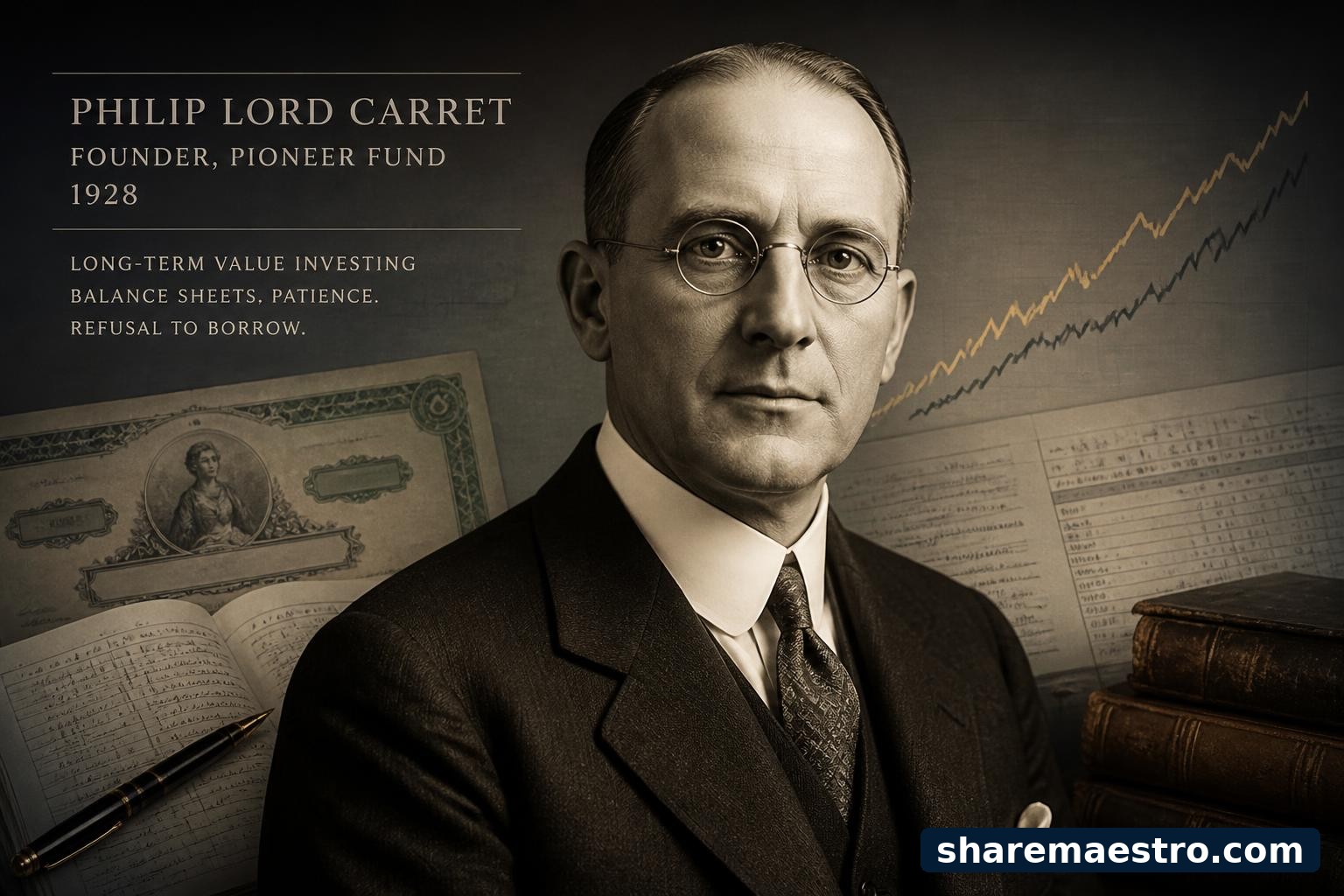
This Sharemaestro profile examines Philip Lord Carret, founder of the Pioneer Fund and one of the earliest American value-investing practitioners. It traces his path from Barron's reporter and World War I aviator to mutual-fund pioneer, his 1930 book The Art of Speculation, his emphasis on balance sheets, management quality, low debt, diversification, income, and patience, and the long-run record and limits of the Pioneer approach. The piece also weighs criticism of active management, the caveats around long-run fund marketing data, Carret's influence on Warren Buffett and later managers, and why his method remains useful only when paired with price discipline and skepticism about fees, size, and leverage.
- Carret founded the Pioneer Fund in 1928, after managing a pooled investment trust for friends and family, and helped establish the idea that public investors could own a professionally managed, diversified equity portfolio through an open-end fund.
- His basic value investing emphasized sound balance sheets, reasonable earnings records, little or no leverage, capable management, useful products and patience rather than price targets, tips or mechanical formulas.
- The Art of Speculation, published in 1930, framed speculation not as gambling but as disciplined appraisal and gave investors a practical code: diversify, reappraise holdings, avoid inside information, seek facts and use borrowed money sparingly.
- Pioneer Fund survived the 1929 crash, the Great Depression, war, inflation, bear markets and changes of ownership, but its record must be read with care because benchmark definitions, sales charges, survivorship and later management periods complicate simple legend-making.
- Carret's continuing relevance lies in what he refused to do: he distrusted leverage, disliked excessive turnover, favored long holding periods, and treated management judgment as inseparable from financial analysis.
Performance and evidence
Performance markers
Visual Evidence
Charts and timelines
Risk
Timeline
Philosophy
Performance
The old investor who made patience look active
Late in life, Philip Lord Carret could still make Wall Street sound too hurried. He had lived through the 1929 crash, the Depression, a world war, inflation, the rise of institutional money management and the spread of derivatives, yet his explanation of the job remained disarmingly plain: buy good companies and sit on them. In 1995, when he was already near 100, he told an interviewer that his philosophy was simple because good companies were only a relative handful and the manager's job was to recognize them before the market fully did.
The simplicity was deceptive. Carret's long career began before the modern regulatory architecture of mutual funds, before electronic screens, before index funds, before the efficient-market debate became academic orthodoxy. He had been a Barron's reporter, a Harvard graduate, a World War I aviator and a money manager who first handled a small pool for friends and family. By the time he died in 1998 at 101, he had become a bridge between the hand-written balance-sheet era and the professional asset-management industry.
Carret matters because he made two institutions meet early: value investing and the mutual fund. He gave public investors access to a portfolio run on fundamental research at a moment when American finance was still crowded with pools, trusts and promotional schemes. His great lesson was not that patience is passive. It was that patience, properly practiced, is the result of work done before the purchase and restraint applied afterward.
Why Carret belongs in the market canon
Carret is often overshadowed by Benjamin Graham, David Dodd, John Maynard Keynes, Philip Fisher and Warren Buffett, partly because he did not build a school around himself. Yet his place in market history is unusually concrete. The Pioneer Fund was launched on February 13, 1928, and later materials from the fund describe it as the second-oldest mutual fund in the United States. A manager who creates a vehicle just before the worst equity collapse in American history and keeps it alive earns a different kind of credibility than one who merely writes a persuasive rulebook.
He also belongs in the canon because he gave value investing a working vocabulary before it became a formal doctrine. Carret Asset Management, the firm that carries his name, notes that he wrote about value investing in Barron's articles in 1927 and developed the ideas further in his 1930 book, The Art of Speculation. The claim that he anticipated Graham and Dodd should not erase Graham's intellectual architecture, but it does place Carret among the earliest American investors to make price, value and business quality the center of a professional discipline.
There is another reason he remains important. The mutual fund was one of the great democratizing devices of twentieth-century finance, and Carret helped prove that a fund could be run as a long-term business rather than a stock-market parlor. The Investment Company Act of 1940 would later impose a stronger legal framework on funds, but Carret's early career belongs to the pre-1940 period when trust in the manager's judgment and integrity carried special weight.
From Barron's to a pooled trust
Carret was born in Lynn, Massachusetts, in 1896 and graduated from Harvard College in 1917. He attended Harvard Business School, trained as a pilot in the Army Signal Corps and later began his career in financial journalism. The Los Angeles Times obituary placed him at C.W. Barron's publication in 1922, an apprenticeship that mattered. To write about markets then was to learn them from ledgers, rails, utilities, banks, industrials and the claims of promoters who had to be tested against numbers.
Two years after joining Barron's, Carret began managing money for friends and family in a pooled investment trust. Harvard's obituary of its alumnus put the pool at $25,000, a modest beginning for a vehicle that would evolve into one of America's earliest mutual funds. The essential decision was not just to buy stocks. It was to pool capital, apply a research discipline and give outside investors a diversified stake in the growth of American companies.
The journalism background left fingerprints on his investing. Carret's recurring commands were to seek facts, distrust advice and keep looking at the business rather than the tape. His world rewarded curiosity. He found ideas in balance sheets, in management character and even in observation outside the office. The habit of noticing trucks on the road, banks changing their revenue mix or an enterprise with unusual stewardship was part of the same method.
Launching Pioneer on the edge of collapse
The pooled trust was reorganized as a corporation in 1928 and became the Pioneer Fund. The timing was almost theatrical. Carret entered the public fund business near the top of a roaring market, shortly before the crash of October 1929 and the grinding losses of the early 1930s. A lesser record could have been buried there. Instead, the fund's survival became part of the case for a conservative approach to common stocks.
That survival was not accidental. Carret later described himself as fundamentally cautious, willing to buy securities but unwilling to do so with borrowed money. His explanation was blunt: without borrowed money, an investor cannot go broke in the same forced way. That view sounds almost old-fashioned in a market accustomed to derivatives, structured products and systematic leverage, but it was forged in an era when leverage was not a theoretical risk factor. It was the way fortunes disappeared.
The Pioneer Fund's later reports present Carret as one of the earliest proponents of value investing and fundamental research. That institutional memory should be read with the caution due any firm's own history, but the broad outline is consistent across obituaries, interviews and regulatory filings. Carret launched an equity fund just before catastrophe, kept faith with balance sheets and income-producing securities, and built a reputation less on brilliance than on remaining solvent long enough for compounding to matter.
The Art of Speculation was less reckless than its title
The title of Carret's most important book can mislead modern readers. The Art of Speculation, published in 1930, was not an invitation to punt on rumors. It was a manual for distinguishing informed risk-taking from gambling. Google Books' bibliographic record describes chapters on market machinery, vehicles of speculation, market movements, balance sheets, income statements, short selling, arbitrage, unlisted securities and the point at which speculation becomes investment. Carret was trying to discipline a practice that the 1920s had made dangerously loose.
His famous precepts were practical, almost severe. Hold at least ten securities across five fields. Reappraise each security at least every six months. Keep at least half the fund in income-producing securities. Treat yield as the least important factor in stock analysis. Take losses quickly and profits reluctantly. Avoid inside information. Seek facts rather than advice. Ignore mechanical valuation formulas. Borrow sparingly and only when market and credit conditions are unusually favorable.
Those rules reveal a mind neither purely Grahamite nor purely Fisher-like. Carret cared about price and asset value, but he also cared about management, growth prospects and whether the product served a useful purpose. He disliked formulas because formulas create false certainty. He disliked tips because they outsource judgment. He disliked excessive borrowing because borrowing turns price volatility into a deadline. The result was not a neat theory. It was an operating code for staying rational in markets built to make investors emotional.
Basic value investing before the label hardened
Carret called his method basic value investing, a phrase that sounds modest but carried a specific meaning. He wanted companies with healthy balance sheets, reasonable earnings records and little leverage, preferably none. In the 1995 interview, he separated businesses into a small group of genuinely well-managed companies, a larger group of merely tolerable companies and a dangerous group whose debt left them skating on thin ice. That taxonomy is plain language for what later investors would call quality, mediocrity and financial fragility.
He did not believe a stock became attractive because its dividend yield looked high. In fact, one of his precepts made yield the least important factor in analyzing a stock. This was not hostility to income, since he wanted a fund to own income-producing securities. Rather, it was a warning that a yield could be bait if the business was weak, overleveraged or poorly led. Income mattered when it arose from durability, not when it distracted from deterioration.
Carret's patience also differed from blind buy-and-hold. He thought an analyst who bought at 12 and set a target of 18 had misunderstood the nature of an excellent company. If the business kept compounding and nothing important went wrong, premature selling could be the mistake. Yet his call to reappraise holdings every six months shows that patience required verification. Sit on good companies, yes, but keep asking whether they remained good.
Management was a financial variable
Carret's version of value investing put unusual pressure on management assessment. The Los Angeles Times obituary summarized his style as finding good managers and holding stocks for a long period. That sentence can sound soft beside balance-sheet ratios, but to Carret it was central. A balance sheet showed the accumulated result of prior decisions. An income statement showed the current economics. Management explained whether those numbers were likely to improve, decay or be squandered.
His affection for banks illustrates the point. In a 1996 American Banker interview cited after his death, Carret observed that a banker who made no bad loans was doing a poor job for stockholders, while a banker who made too many bad loans was doing a poor job for the bank. The task was judgment, not abstinence from risk. That is a sophisticated view of financial companies: the asset is the underwriting culture, and the reported numbers are only a lagging expression of it.
In later Pioneer materials, the fund's process is described as fundamental, bottom-up research that includes communication with management teams and attention to the specific risks of each security. The modern portfolio is not Carret's portfolio, and the organization has changed hands, people and tools. Still, the continuity of language is revealing. Carret's concept of value was never only cheapness. It was cheapness in relation to a business whose people could be trusted with capital.
The unusual moral screen inside an old value fund
One distinctive feature of the Pioneer tradition is its avoidance of alcohol, tobacco and gaming stocks. Amundi's 2023 anniversary materials attribute that tenet to Carret's basic value approach, which favored businesses providing goods and services he considered truly useful. In the history of responsible investing, that matters. It means one of America's oldest mutual funds carried a values-based exclusion well before environmental, social and governance language became standard asset-management vocabulary.
The screen should not be romanticized. Avoiding certain industries can help define a fund's identity, but it can also narrow the opportunity set and create periods of relative underperformance. Amundi's own long-run marketing material later notes that excluding issuers can mean foregoing investment opportunities available to funds without similar standards. That is the honest trade-off. A principle can be enduring and still have a cost.
For Carret, the moral screen appears less like public branding than a branch of business judgment. He wanted useful enterprises, prudent finances and managements that did not depend on exploiting human weakness. That view will not satisfy every modern investor, and it does not remove the need for valuation discipline. But it shows that Carret's fundamentalism was broader than accounting. He thought the character of a business belonged inside the investment case.
A record built across several market regimes
The Carret legend rests heavily on duration. He actively managed Pioneer until 1983, according to the Christian Science Monitor interview, and remained associated with the Pioneer organization long after. The fund's own later materials emphasize its endurance across economic stress, including the Depression, war and bear markets. Carret Asset Management says he personally experienced 31 bull markets, 30 bear markets and 20 recessions, a firm legacy claim that captures the unusual length of his market life even if the exact counting depends on definitions.
Amundi's 96-year illustration, covering 1928 to June 30, 2024, says a $1,000 investment in Pioneer Fund Class A shares grew to $52,226,504, while its comparison index figure was $2,483,630. The implied annualized rates from those published numbers are about 11.9 percent for the fund illustration and about 8.4 percent for the comparison series. Those are marketing figures, not a clean measure of Carret alone, and they require careful attention to share class, fees, index construction and reinvestment assumptions.
A fair reading is therefore neither hagiography nor dismissal. Pioneer produced a record that was long enough to be meaningful and distinctive enough to keep Carret's name alive. But the record spans many managers, market structures, regulatory regimes and ownership periods. The useful conclusion is not that an investor should chase any old active fund with a long chart. It is that an unusually consistent philosophy, applied over decades, can turn survival itself into a source of return.
The Buffett connection and the test of respect
Carret's influence is often measured by Warren Buffett's admiration. American Banker reported that Buffett, who had known Carret for about 50 years, called him his hero when Carret was unable to attend a Berkshire Hathaway annual meeting because of a hip injury. Carret was also a Berkshire shareholder, and in the 1995 interview he used Berkshire as an example of the danger of selling a great compounding business too early.
The admiration makes sense. Carret's code overlaps with Buffett's mature practice in several respects: emphasis on business quality, management, long holding periods, skepticism toward leverage and hostility to unnecessary trading. But Carret was not a Buffett clone before Buffett. He ran a mutual fund with diversification rules, income preferences and a more explicit willingness to own a range of securities. He also wrote under the language of speculation, not the later vocabulary of moats and owner earnings.
That difference is important because it prevents a lazy genealogy. Carret did not simply anticipate every later value investor. He preserved an older Wall Street tradition in which bonds, banks, industrials, utilities, unlisted securities, balance-sheet work and macro credit conditions all belonged to one craft. Buffett's respect tells us Carret passed the hardest test in investing culture: another great investor looked at the full length of the record and saw judgment, not luck.
Risk control as temperament, not a department
Carret's risk management began with the refusal to borrow. In the 1995 interview, he said he ventured into securities but never with borrowed money. In The Art of Speculation, he permitted borrowing only sparingly and under depressed market and favorable money-rate conditions. This was not a technical asset-allocation tweak. It was a view of human fallibility. If markets can stay irrational, economies can deteriorate and investors can panic, debt turns temporary impairment into permanent loss.
Diversification was another layer of humility. His rule to hold at least ten securities across five fields stands in contrast to the later romance of extreme concentration. Carret wanted conviction, but he did not confuse conviction with omniscience. He accepted that investors make mistakes, that companies change and that information can be incomplete. His insistence on reappraisal every six months also made risk control an ongoing practice rather than a document written at purchase.
Yet the same rules contained possible failure modes. A bias toward income-producing securities can miss young companies whose value lies in reinvestment. A moral screen can remove profitable sectors. A cautious investor can sell cyclicals too early or avoid transformative businesses that look statistically expensive. Carret's answer was judgment. Modern investors may find that unsatisfying, but it is also the point. He believed no formula could rescue an investor who had stopped thinking.
Mistakes, missed booms and the danger of being too sensible
Carret's career invites a particular criticism: did caution cost money? A manager who avoids leverage, dislikes fads, distrusts derivatives and emphasizes sound balance sheets will miss certain speculative booms. He may also underestimate businesses whose intangible assets are more important than book value. The shift from railroads and utilities to software, platforms and data businesses made old balance-sheet instincts less sufficient. Financial strength still matters, but it is harder to read from the same lines of a statement.
His own comments show awareness of limits. He admitted that investment options had become bewildering and that many derivatives were mysterious to him. That humility is admirable, but it also marks a boundary. A method built around what one can understand will properly exclude many things. The discipline is useful when it prevents error. It becomes costly when the circle of competence is too narrow or too slow to adapt.
The active-management record also creates a sharper modern challenge. S&P Dow Jones Indices' SPIVA U.S. Year-End 2025 scorecard reported that 79 percent of active large-cap U.S. equity funds underperformed the S&P 500 in 2025 and that majorities across categories underperformed over 15 years. Carret's record is therefore evidence that active management can work, not proof that it usually does. His example raises the hurdle for active managers rather than lowering it.
The mutual fund industry Carret helped foreshadow
The world into which Pioneer was born was not yet the regulated fund market investors know today. The SEC has described early investment companies and trusts of the late 1920s as vehicles that often left investors in the dark about holdings, leverage and conflicts. The Investment Company Act of 1940 became a foundational response, creating a legal framework for funds after the crash revealed abuses and fragility. Carret's early fund survived that transition from trust-based reputation to statutory oversight.
That context sharpens his importance. Carret was not merely selecting securities. He was helping prove that pooled equity investing could be a durable public product if run conservatively and transparently enough. The mutual fund's later growth into a retirement and household-savings staple depended on regulation, distribution, tax treatment and market expansion, but it also needed early examples that did not vanish in the first great storm.
The industry that followed would become far larger, more segmented and more commercial than anything Carret could have imagined in 1928. By 2025, the Pioneer Investments brand itself had moved again, with Victory Capital announcing the closing of a transaction with Amundi and the reintroduction of the Pioneer name as part of a strategic partnership. The brand's survival across corporate owners is a reminder that Carret built not just a portfolio, but an institutional asset.
Carret and the institutional problem of size
Carret understood that size could become an enemy of performance. In 1995, when asked about large mutual funds, he said his criticism was that they were too active in buying and selling stocks. The comment can be read two ways. First, trading too often taxes the power of compounding. Second, a large pool of money can mistake activity for control because doing nothing becomes institutionally uncomfortable.
The Pioneer Fund's later history illustrates the tension. A fund that survives for nearly a century must institutionalize its process, replace its leaders, satisfy regulators, distribute through intermediaries and operate inside large asset-management organizations. That permanence is a triumph for investors who value continuity, but it also means the founding personality inevitably fades. Carret's name becomes philosophy, marketing, memory and constraint rather than daily judgment at the desk.
This is the paradox of every market pioneer. The method becomes influential precisely because it can be copied, packaged and scaled, but scaling changes the method. Carret's own rules were designed for a thinking investor with enough flexibility to move among securities and enough discipline to wait. A giant fund complex must manage liquidity, style boxes, ratings, flows, compliance and business economics. The bigger the institution, the harder it is to preserve the founder's quiet opportunism.
What remains useful now
Carret's most useful idea today is not a screen but a sequence: understand the business, appraise management, examine the balance sheet, pay attention to debt, distrust easy advice, recheck the thesis and let a good company compound if the facts still support it. That sequence remains robust in a market of algorithms and instant commentary because it addresses the investor's permanent weaknesses: impatience, borrowed conviction, overconfidence and the desire for a formula.
His most dangerous idea is also patience, if it is detached from price and evidence. Sitting on a declining business is not discipline. Refusing to sell because of identity or nostalgia is not long-term investing. Ignoring new industries because their assets are intangible is not prudence. Carret's own rule of periodic reappraisal is the antidote. The patient investor is not asleep. He is asking whether the original reasons still hold.
Carret's career endures because it refuses the false choice between speculation and investment. He saw that all common-stock ownership contains uncertainty, but uncertainty can be approached with facts, balance-sheet discipline, management judgment and restraint. The market has become faster and the fund industry more competitive, and SPIVA's data make clear that active management is usually a hard bargain. That only makes Carret's standard more severe: if a manager asks for trust, the record must show patience with evidence and caution with capital.
Disclosure
Educational financial journalism and market research only. Not financial, investment, trading, tax, or legal advice.