In brief
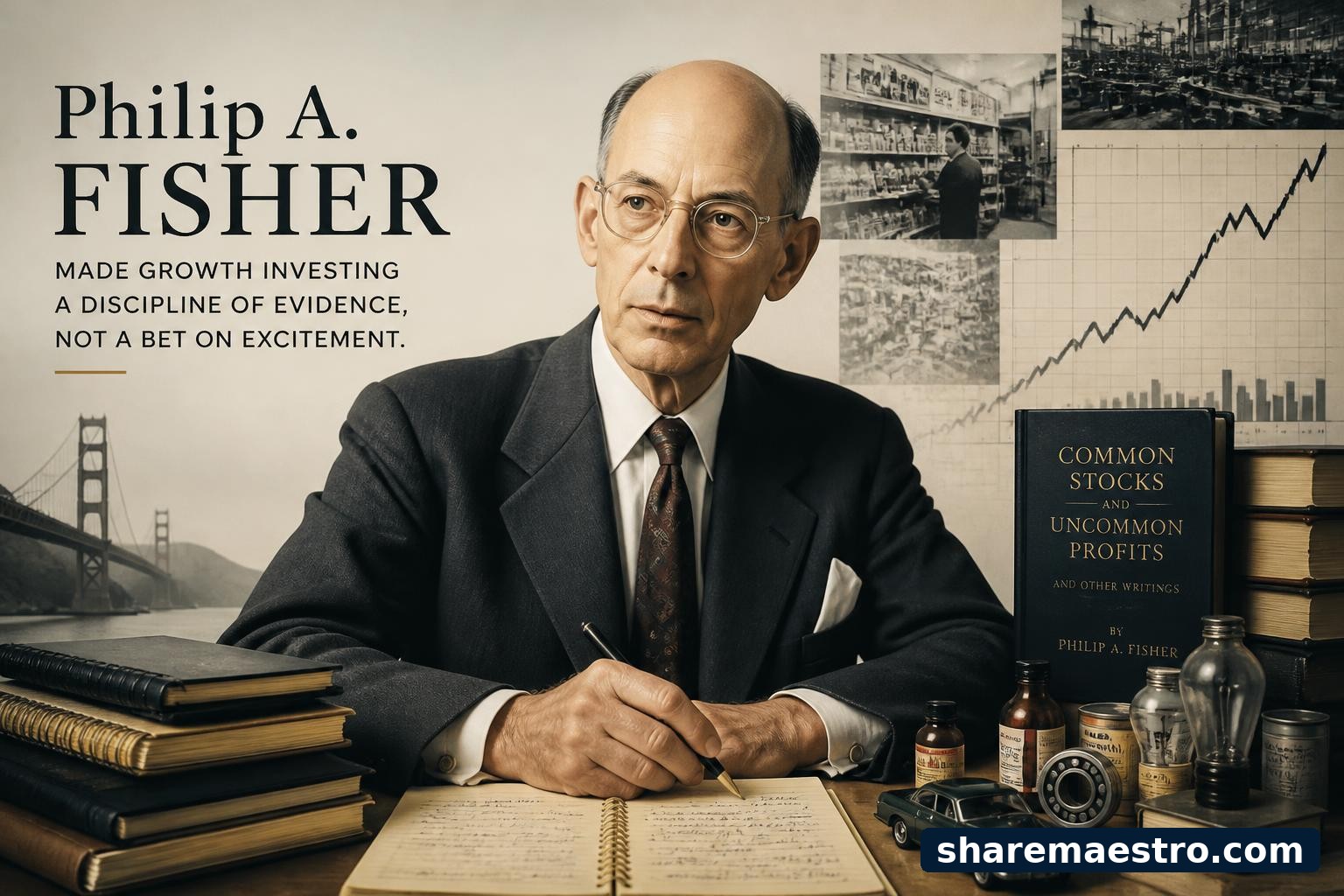
Philip A. Fisher stands apart from the Benjamin Graham lineage because he made the case that a superior business could be worth owning for decades, provided the investor understood its products, managers, margins, culture, reinvestment runway, and competitive position. His 1958 book, Common Stocks and Uncommon Profits, gave public form to a method he had built as a private San Francisco investment counselor: scuttlebutt research, a 15-point qualitative checklist, concentration in rare companies, and a reluctance to sell merely because a stock had risen. Fisher's record is difficult to audit because he did not run a public mutual fund with a published composite, but his influence is unusually clear in the language of quality investing, in Warren Buffett's later emphasis on business excellence, and in modern research practices that try to separate durable compounding from fashionable story stocks.
- Fisher shifted security analysis away from a narrow search for statistically cheap stocks and toward the study of business quality, management integrity, innovation, and long-term reinvestment opportunity.
- His scuttlebutt method treated suppliers, customers, competitors, former employees, scientists, trade contacts, and management conversations as a disciplined evidence network rather than gossip.
- The 15 points in Common Stocks and Uncommon Profits remain a compact due diligence framework for evaluating sales runway, research productivity, margins, labor relations, executive depth, accounting controls, financing needs, candor, and integrity.
- Fisher's limitations are inseparable from his strengths: concentration, long holding periods, qualitative judgment, and confidence in management can produce both exceptional patience and dangerous attachment.
- His continuing relevance lies in the fusion of growth and value: the price paid still matters, but the central question is whether the company can compound intrinsic value for a long time.
Performance and evidence
Performance markers
Visual Evidence
Charts and timelines
Risk
Timeline
Philosophy
Performance
The quiet radical in San Francisco
Philip Fisher built one of the most durable reputations in investing without the theatrical machinery that usually creates financial legend. He was not a Wall Street promoter, not a trader with a famous tape, and not a manager of a giant public fund. His stage was narrower and more exacting: a small investment counseling practice in Northern California, a circle of carefully chosen clients, and a habit of asking more questions than the market thought necessary.
The image is almost countercultural by modern standards. Fisher's craft was not based on speed, screens, or the kind of televised decisiveness that rewards instant opinions. He wanted to know how a company sold, how it hired, how it treated customers, whether its engineers were solving difficult problems, whether competitors respected it, and whether managers were candid when the numbers disappointed. He approached common stocks as claims on operating organisms, not as symbols on a board.
That is why Fisher matters. He helped move serious investing from a ledger-bound discipline into the study of living companies. Benjamin Graham gave investors the grammar of price, assets, earnings, and margin of safety. Fisher gave them a language for quality, growth, management, and evidence gathered outside the annual report. In the long arc of market history, his contribution was not simply that growth could be profitable. It was that growth had to be investigated with unusual rigor.
A Depression-era start with a future-facing bias
Fisher's professional life began at a moment that should have made any young analyst conservative in the narrowest sense of the word. Born in San Francisco in 1907, he came into finance as the market mania of the late 1920s was nearing its peak and opened his advisory career during the early Depression. Publisher biographies place the start of Fisher & Company in 1931, after he had begun as a securities analyst in 1928. The dates matter because they locate Fisher's philosophy in an era when survival, not optimism, was the first investment requirement.
That background makes the later caricature of Fisher as merely a growth-stock enthusiast too thin. He did not arrive at growth investing from a bull-market seminar or a technology fad. He came to it through the wreckage of excessive promotion, fragile capital structures, and business models that could not survive stress. The lesson he drew was not that investors should ignore risk. It was that the most protective businesses were often those with unusual economics, technical leadership, and managements capable of adapting before the income statement made the adaptation obvious.
Fisher's geography also mattered. Operating from San Francisco placed him away from the Wall Street consensus and closer to the emerging industrial and electronics companies that would later define much of postwar American growth. He specialized early in research-driven companies, particularly those linked to chemicals, electronics, instruments, and new technologies. That distance from the New York crowd was part of the method. It trained him to listen to engineers, customers, salespeople, and plant contacts rather than rely solely on brokerage chatter.
The book that made qualitative analysis respectable
In 1958 Fisher published Common Stocks and Uncommon Profits. The original Harper edition ran 146 pages, but its influence has far outlived its modest size. Later Wiley editions grouped it with his other writings and presented it as a classic of modern investment theory. The book did something rare for its time: it made a serious case that the investor's job was to find a small number of exceptional companies capable of expanding intrinsic value over many years.
The timing was significant. Postwar America had created a new corporate class built around research laboratories, consumer brands, defense electronics, chemicals, semiconductors, and global distribution. Traditional balance-sheet bargains still existed, but the great wealth creation increasingly came from companies whose most important assets were not always visible on the balance sheet. Fisher put that change into investable language. He argued that future earning power, if carefully investigated, could be more important than static cheapness.
The book's structure also reveals Fisher's priorities. It begins with lessons from the past, moves quickly to scuttlebutt, then to the 15 points for selecting a common stock, followed by chapters on when to buy, when to sell, dividends, investor mistakes, and the search process. It was not a formula book. It was a discipline book, meant to train the investor's judgment before capital was committed.
Scuttlebutt as a research system
Fisher's most famous term, scuttlebutt, is easily misunderstood. In ordinary speech it can sound like rumor. In Fisher's hands it meant something closer to channel research before the phrase existed: a disciplined effort to learn about a company by speaking with people around it. Competitors, customers, suppliers, distributors, former employees, scientists, trade associations, and management all formed part of the evidence map.
The power of the method was triangulation. A single customer's enthusiasm could mislead. A competitor's complaint could be self-serving. A supplier might know volumes but not profitability. Fisher's idea was that many imperfect sources, questioned intelligently and compared against one another, could reveal the texture of a business more accurately than the financial statements alone. The method was especially useful for companies whose earnings power depended on research productivity, product acceptance, and management competence before those factors showed up in reported numbers.
The discipline also placed unusual demands on the investor. Scuttlebutt required humility, patience, industry knowledge, and a tolerance for ambiguity. It asked the analyst to act less like a calculator and more like an investigative reporter. That is why the method has survived. Modern investors may use transcripts, expert networks, regulatory filings, data sets, and supply-chain analysis, but the central Fisher question is unchanged: what do informed people who deal with this company actually know that the market has not properly weighed?
The 15 points and the anatomy of a superior company
Fisher's 15 points remain the core of his method because they turn a broad admiration for growth into a testable set of questions. The first group asks whether a company has products or services with enough market potential to increase sales for many years, and whether management is determined to develop additional products as current lines mature. Growth, in this framework, is not a single product cycle. It is an institutional ability to renew the business.
A second group examines the machinery of execution: research and development effectiveness relative to size, sales organization, profit margins, plans to maintain or improve those margins, labor relations, executive relations, management depth, and accounting controls. These items made Fisher more operational than many investors who later borrowed his vocabulary. He was not looking for a pretty story. He wanted evidence that the company could convert opportunity into profits without administrative decay.
The final points move into capital allocation and character: long-range profit outlook, future financing needs, candor with shareholders, and unquestionable management integrity. The last point is not decorative. Fisher believed that a company with doubtful integrity should be excluded no matter how attractive the apparent growth. In an investment world that often confuses access with insight, this remains one of his sharper warnings.
Growth with a margin of reality
Fisher is often placed opposite Graham, but the more useful reading is that he expanded the meaning of value. Graham sought a gap between price and demonstrable worth, often using assets, normalized earnings, and conservative appraisal. Fisher sought a gap between price and future value creation, but only when that future was grounded in durable business evidence. He was not asking investors to pay any price for a fashionable company. He was asking them to recognize that the best businesses could look statistically expensive before their long runway became obvious.
That distinction is vital. Fisher's growth investing was not momentum investing. He disliked promotional companies, fads, shallow diversification, and the habit of following the crowd. He thought the investor's edge came from knowing a company better than the market, not from guessing what the next buyer would pay. The same logic explains his attitude toward price-earnings ratios. A low multiple could be a trap if the business was deteriorating, while a higher multiple could be justified if future earning power was materially underestimated.
The result was a philosophy that bridged two traditions often treated as rivals. Fisher's best companies were growth companies, but his discipline was fundamentally value-seeking because it required a reasoned appraisal of future cash generation, management quality, and competitive position. The danger, then and now, is that investors keep the phrase and discard the rigor. A great business at a foolish price can still become a poor investment.
A portfolio built for rarity, not coverage
Fisher's approach implied concentration because truly exceptional companies were rare. He was not trying to own a representative sample of the market. He was trying to find a handful of businesses with unusual long-term prospects and then hold them long enough for compounding to matter. That put him far from the institutional habit of owning many names to manage career risk or benchmark resemblance.
Concentration in Fisher's hands was not bravado. It was the logical consequence of research depth. If an investor has done months of work on a company, has tested it through customers and competitors, has developed confidence in management, and believes the market underestimates the runway, a small token position may not be meaningful. Fisher's method asked for conviction, but conviction earned by evidence. He was selective enough that the search process itself functioned as risk control.
The other side is obvious. Concentration magnifies error. If the investor misjudges management, overestimates the market, misses technological displacement, or becomes emotionally attached to a past winner, the portfolio can suffer badly. Fisher's own writings warn against excessive diversification, but they do not excuse casual concentration. The method is demanding because it gives the investor fewer places to hide.
When buying is easier than selling
Fisher's reputation for long holding periods rests partly on his view that the best time to sell a truly superior business is often much later than the market expects. His most frequently cited example is Motorola, which he bought in the 1950s and held for decades. The point was not that every winner should be worshiped. It was that premature selling can be a severe error when a company is still expanding its market, improving its position, and reinvesting at attractive returns.
This was a direct challenge to the trading culture around common stocks. Many investors sell because a stock has advanced, because a profit feels emotionally complete, or because a price target has been reached. Fisher thought that logic could destroy the economics of a great investment. If the original thesis has strengthened, if management remains capable, and if the company's opportunity has expanded, the rise in price may be evidence of validation rather than a sell signal.
Yet Fisher did not argue for paralysis. A sale becomes rational when the original analysis was wrong, when the company no longer meets the standards that justified purchase, or when a clearly superior opportunity appears. The difficulty is that these are judgment calls, not mechanical triggers. Fisher's strength was patience. His risk was that patience can turn into loyalty if the investor stops rechecking the evidence.
Motorola and the appeal of the research-driven company
Motorola suited Fisher's imagination because it embodied the type of company he wanted to own: technical, adaptive, and tied to expanding fields. The company's own history traces its roots to Galvin Manufacturing in 1928, early commercial car radios in 1930, public-safety radio sales, wartime portable radios, and a research program strengthened by Daniel Noble in 1940. By 1955, the year commonly associated with Fisher's Motorola purchase, the company introduced its first mass-produced semiconductor, a high-power germanium transistor for car radios.
That history helps explain the Fisher lens. A conventional investor could have seen a radio manufacturer. Fisher saw a company with technical capability, product adjacency, and reinvestment possibilities in communications and electronics. The distinction is crucial. Growth investing at its best is not the extrapolation of last year's sales growth. It is the recognition that a company has developed a repeatable capacity to enter expanding fields with credibility.
Motorola was not a flawless corporation across its later history. Its eventual split in 2011, long after Fisher's death, reminds investors that even innovative companies can lose markets, suffer strategic drift, or be overtaken by new competitors. But as a Fisher case, Motorola shows what he was trying to identify: not a cheap stock in a stagnant business, but an organization whose internal capabilities could create decades of opportunity.
Texas Instruments and the postwar technology arc
Fisher's writings and later discussions are also associated with Texas Instruments, another company that helps clarify his preference for innovation backed by operating competence. TI emerged in the early 1950s as a semiconductor force, and the Computer History Museum notes that Texas Instruments engineers built and marketed the first commercial silicon transistor devices after Bell Labs had fabricated an earlier silicon transistor. By the end of the 1950s, silicon had become the preferred semiconductor material.
For Fisher, the relevant fact was not merely that semiconductors were exciting. It was that the industry combined technical difficulty, new end markets, and the possibility of large value creation for companies that could execute. That was exactly the zone where conventional accounting could understate future potential. Book value did not capture engineering depth. Reported earnings could lag the significance of a breakthrough. Scuttlebutt could reveal which companies were respected by customers and rivals before the stock market fully adjusted.
The lesson travels beyond semiconductors. Fisher's method works best when the investor can distinguish durable technical advantage from promotional novelty. The more complicated the field, the more necessary the fieldwork becomes. A great industry can still produce mediocre investments if too many competitors chase the same prize, if economics deteriorate, or if capital needs overwhelm shareholders.
Conservative investing, in Fisher's vocabulary
The title Conservative Investors Sleep Well can surprise readers who associate Fisher only with growth. In his usage, conservatism did not mean owning slow companies or avoiding equities. It meant reducing the probability of permanent capital loss by owning businesses that were unusually strong in their economics, management, and adaptability. Safety came from business quality examined deeply, not from low volatility or a high dividend yield alone.
This is one of Fisher's most durable inversions. A superficially safe company can be dangerous if its products are aging, its margins are vulnerable, its managers lack imagination, or its accounting masks decay. A seemingly aggressive company can be conservative if it dominates a growing field, funds innovation intelligently, and treats shareholders as long-term partners. The conservative act, in Fisher's mind, was not to avoid change. It was to own companies capable of benefiting from change.
That view remains challenging because it requires investors to tolerate reported uncertainty in exchange for deeper economic resilience. It also requires a sober estimate of what one can know. Fisher's conservatism was not a permission slip for buying every admired company. It was a demand to study the four dimensions of a business, including production, marketing, research, finance, and people, before deciding that growth was durable enough to deserve capital.
Influence on Buffett and the fusion of quality with value
Warren Buffett's public praise is one reason Fisher's name remains alive outside specialist circles. Berkshire Hathaway's 2012 annual report placed Common Stocks and Uncommon Profits just behind The Intelligent Investor and the 1940 edition of Security Analysis on Buffett's list for serious investors. That is an unusually prominent endorsement from the most visible heir of the Graham tradition.
The intellectual connection is not hard to see. Buffett's early partnership years were closer to Graham: statistically cheap securities, workouts, and control situations. Over time, with Charlie Munger's influence and Berkshire's growing capital base, the emphasis shifted toward superior businesses with durable economics. Fisher supplied part of the vocabulary for understanding why management quality, reinvestment prospects, and competitive advantage could justify owning a business for a very long time.
The 2018 Berkshire annual meeting showed the method's persistence. Buffett discussed Fisher's scuttlebutt approach in the context of understanding consumer behavior and noted that Berkshire investment managers Todd Combs and Ted Weschler used similar investigative work. Fisher's continuing influence is therefore not ceremonial. It lives in the operating habits of investors who try to understand products, customers, and competitive strength before they rely on a spreadsheet.
The record problem and the evidence that can be trusted
Fisher's investment record has a peculiar status. His reputation is enormous, his examples are famous, and his clients were widely described as having benefited from his counsel. Yet he did not leave behind the kind of audited, public, time-weighted performance record that investors expect from a modern mutual fund or institutional manager. That absence should not be ignored. It limits the precision with which any profile can compare him against an index.
The best verifiable evidence is therefore indirect but meaningful. We have his founding and career chronology, the publication history of his books, the long public life of Common Stocks and Uncommon Profits, the Motorola holding, the examples embedded in his writings, and the adoption of his ideas by investors with far more visible public records. Fisher's influence can be measured more confidently than his annual returns.
This distinction actually strengthens the serious reading of Fisher. He should not be studied as a set of miracle numbers. He should be studied as a designer of investment judgment. His contribution was a research architecture, not a product sheet. The absence of a public composite keeps the legend honest and pushes attention back where Fisher himself wanted it: the quality of the business and the quality of the inquiry.
Mistakes, criticism, and the danger of beautiful stories
The first criticism of Fisher's approach is that it can seduce investors into narrative overconfidence. A company with admired products, visionary managers, loyal customers, and large markets can still be a poor investment if expectations are already excessive. The Fisher method reduces ignorance, but it does not repeal valuation. In markets that love growth, qualitative conviction can become a way to rationalize paying too much.
The second risk is management capture. Fisher placed great weight on integrity, candor, and executive quality. That was sensible, but it also means the investor must remain alert to charisma. Managers are professional narrators of their own companies. They know the favorable metrics, the strategic language, and the comforting explanations. Scuttlebutt was Fisher's answer to this risk because it forced management claims to be tested against outside reality.
The third criticism is practical. Few investors have the time, access, temperament, or industry competence to apply Fisher's method properly. Many can repeat the 15 points. Far fewer can build a mosaic from customers, competitors, suppliers, and technical experts without becoming either credulous or cynical. Fisher's approach is simple in outline and hard in execution. That gap is where many imitators fail.
What survives in an indexed age
Fisher's career belongs to the age of the handwritten note, the plant visit, and the telephone call, but his relevance has not faded. If anything, the flood of public information has made his core question more important. The market has more data than ever, but data availability does not equal business understanding. Fisher's method asks what actually drives a company's future economics and whether the investor has earned the right to hold through uncertainty.
The counterweight is the modern evidence on active management. S&P Dow Jones Indices' SPIVA U.S. Year-End 2025 scorecard reported that 79 percent of active large-cap U.S. equity funds underperformed the S&P 500 in 2025. That does not disprove Fisher. It does remind investors that selection is difficult, fees matter, and the average active manager is not an adequate model for exceptional research. Fisher's method demands a standard far above average activity.
The safest conclusion is neither hero worship nor dismissal. Fisher remains useful for investors who want to understand what makes a business compound and what questions must be answered before committing capital. He is dangerous when reduced to slogans: buy growth, never sell, trust great managers, ignore valuation. His real legacy is sterner. Own few companies only if the work is deep enough. Hold for decades only if the evidence keeps improving. Treat quality as something to prove, not something to admire.
Disclosure
Educational financial journalism and market research only. Not financial, investment, trading, tax, or legal advice.