In brief
Roy Rothschild Neuberger was a rare Wall Street figure whose legend begins with a short sale before the 1929 crash and ends with a durable investment firm, a major art legacy, and a set of investing rules still recognizable in active management. His career was built on contrarian value judgment, skepticism toward crowd behavior, client loyalty, and an unusual willingness to combine long positions with short exposure. The measurable record is incomplete, but the institutional evidence is strong: Neuberger Berman grew from a 1939 partnership into a global, employee-owned manager, while Guardian, the no-load mutual fund he launched in 1950, became one of the early symbols of investor-friendly fund distribution.
- Neuberger's defining early trade was a short position in RCA before the 1929 crash, a formative lesson in crowd risk and capital preservation.
- He co-founded Neuberger & Berman in 1939 and helped build it around private-client money management, fundamental research, and service rather than product fashion.
- Guardian, launched in 1950, was among the early no-load mutual funds and gave Neuberger's client-first philosophy a retail-investor expression.
- His method blended value, timing, skepticism, and hedging, but he warned that long-short investing could lose on both sides when handled poorly.
- The firm's later history, including an IPO, sale to Lehman Brothers, survival of the 2008 bankruptcy, and return to employee ownership, became part of the Neuberger legacy.
Performance and evidence
Performance markers
Visual Evidence
Charts and timelines
Risk
Timeline
Philosophy
Performance
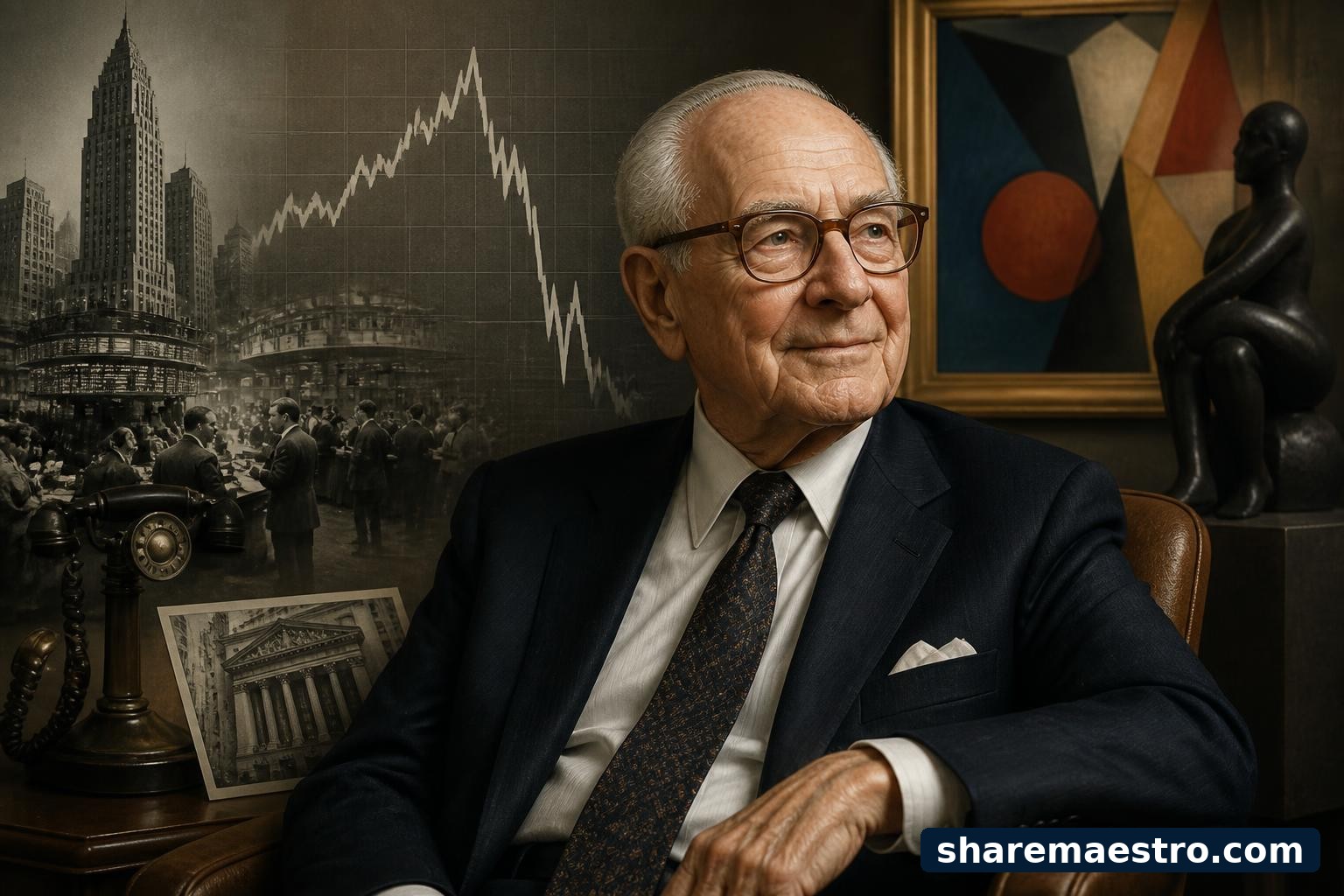
A short seller at the edge of 1929
Roy Neuberger's Wall Street story begins at the most theatrical possible moment: New York in 1929, when a young man who had recently been studying art in Paris took a job on a brokerage floor and looked at the era's darling stock with suspicion. Radio Corporation of America was not merely a ticker. It was a symbol of technological promise, public excitement, and the speculative confidence of the late 1920s. Neuberger did not need a macroeconomic model to doubt it. He saw popularity, price, and psychology moving together too smoothly.
The trade that made his legend was the short sale of RCA before the market broke. Accounts differ in their emphasis, as market stories often do after decades of retelling, but the broad outline is consistent: Neuberger sold short a celebrated stock at the height of a fever and emerged from the crash damaged but solvent. An Associated Press account later said he came through the crash losing only about 15 percent of his money. That figure is less important than the habit it reveals. To Neuberger, survival was not an abstraction. It was the first requirement of a career.
The lesson hardened into a philosophy that would run through the firm he later co-founded: avoid the crowd when the crowd has stopped thinking, study the security itself, accept that markets can move violently, and never confuse popularity with safety. His career did not produce the single clean performance table that modern allocators prefer. It produced something messier and more durable: a life that stretched from ticker-tape Wall Street to a global asset manager, from private clients to mutual funds, from a short book in 1929 to an employee-owned institution still trading on his name.
Why Neuberger still matters
Neuberger matters because he sits at an older junction in American investing, before the divisions hardened between broker, adviser, mutual fund manager, hedge fund operator, patron, and public-company executive. He was all of those things in partial form. He used short selling before long-short investing became institutional language. He built a private-client money manager before wealth management became a national industry. He launched a no-load mutual fund before fee pressure became the central drama of retail fund distribution.
He also matters because his firm's later history turned his principles into a stress test. Neuberger Berman went public in 1999, sold to Lehman Brothers in 2003, was pulled into the reputational blast radius of Lehman's 2008 bankruptcy, and later returned to private employee ownership. The founder's name survived not as a plaque in a lobby but as a live operating identity. As of March 31, 2026, Neuberger described itself as an employee-owned, private, independent investment manager with $567 billion in assets across equities, fixed income, private markets, real estate, and hedge fund portfolios.
That continuity does not mean Neuberger's method was timeless in every detail. Some of his advice is bracing and some is dangerous if copied without his experience. He believed in timing, but timing is where many investors overestimate themselves. He used hedging, but warned that hedging could destroy capital in inexperienced hands. He valued independence, yet he spent decades building an organization that required shared process. His significance lies in that tension: a fiercely individual investor whose largest achievement was institutional.
An orphan, Paris, and a reason to make money
Roy Rothschild Neuberger was born in Bridgeport, Connecticut, in 1903 and moved into a New York childhood that was shaped early by loss. Orphaned at 12, he was raised by a sister and developed the habits that later admirers would call energy, curiosity, and self-education. He spent time at New York University, but the conventional academic path did not hold him. Work in a department-store setting exposed him to design, taste, and the practical business of buying and selling.
The turn toward art came before the turn toward finance. Neuberger went to Paris in the 1920s and studied at the Sorbonne, living close enough to European art to understand both its beauty and its economic cruelty. The story he later told was rooted in his response to Vincent van Gogh. The notion that great artists could be ignored while alive and celebrated only after death disturbed him. He wanted to support living artists while support still meant rent, food, materials, and recognition.
That motive complicates the usual Wall Street profile. Neuberger did not come to markets only to accumulate. He came partly to finance a life in art and later to redirect capital toward artists he believed deserved a public future. This was not philanthropy as retirement decoration. It was present from the beginning. The finance career funded the collection; the collection sharpened his eye for intrinsic worth; and both pursuits required him to separate current price from lasting value.
The RCA wager and the discipline of survival
The RCA short was the trade that made Neuberger's biography irresistible, but it should not be read as a simple call on the market. He was not merely bearish. He was suspicious of excess admiration. RCA represented the sort of stock in which narrative can overwhelm arithmetic. Radio was new, transformative, and commercial. That did not make any price reasonable. Neuberger's instinct was to look where enthusiasm had become automatic.
He later treated that experience as evidence for hedging, not as an invitation for amateurs to imitate him. His own account of hedging was double-edged. Going long selected securities and shorting others helped protect him in 1929, but he warned that an investor could lose on both sides. That warning is essential. In a panic, shorts can work; in a melt-up, they can ruin a fundamentally correct investor before the thesis is recognized. Hedging is not simply prudence. It is a second portfolio with its own timing, borrow, volatility, and behavioral risks.
What survived from 1929 was less a formula than a posture. Neuberger learned that a market can be both glamorous and treacherous, that consensus is not a substitute for work, and that getting out matters as much as getting in. He never became a pure buy-and-hold romantic. He admired good businesses, but he did not believe affection should survive overvaluation. If a position turned against him and the thesis had failed, his preference was to accept a small loss before it became a large one.
From brokerage desk to partnership
By 1939, a decade after the crash, Neuberger had enough experience and confidence to help form Neuberger & Berman. The firm's history records Roy Neuberger, Robert Berman, and Howard Lipman as partners in the original enterprise, with the enduring public identity eventually centered on Neuberger Berman. Its first enduring specialty was private-client money management, especially for high-net-worth individuals. In that choice, the firm positioned itself away from pure trading glamour and toward an intimate advisory model.
The private-client focus mattered because it made service and reputation economic assets. A money manager serving wealthy families could not rely only on market brilliance. It had to retain trust through bear markets, estate decisions, taxes, and the ordinary anxieties of capital preservation. Neuberger's temperament fit that environment. He was competitive and opinionated, but the firm's pitch rested on the idea that investment expertise had to be paired with outstanding personal service and ethical dealings.
The culture also prized market experience. Later company histories describe the firm as valuing portfolio managers who had lived through several bear markets. That was not nostalgia. It was risk management expressed as hiring policy. Neuberger's own career began with a crash, and he understood that bull-market talent can be hard to distinguish from leverage, luck, or style exposure. The firm wanted investors who had already learned what clients feel when markets stop rewarding optimism.
Guardian and the retail investor before the fee war
In 1950, Neuberger & Berman launched Guardian Mutual Fund, one of the early no-load mutual funds in the United States. That fact is easy to understate because no-load distribution later became commonplace. In the mid-twentieth-century fund market, however, sales loads were a serious barrier. A no-load structure expressed a belief that the investor's capital should go to work rather than be consumed upfront by distribution costs.
Neuberger personally managed Guardian until 1978, giving the fund a direct line to his investment discipline. It also broadened the firm's audience beyond private-client accounts. The same founder associated with a short sale in 1929 now had a retail vehicle built around access and cost sensitivity. That combination is one reason his career does not fit neatly into the value-investor canon. He was not only picking stocks. He was also helping define how active management could be packaged and sold.
The modern successor shows how investment franchises evolve. Neuberger's fund page states that the product formerly known as Neuberger Berman Guardian Fund changed its name to Neuberger Berman Large Cap Growth Fund on September 30, 2022, and notes that the Investor Class dates to June 1, 1950. The continuity is legal and institutional, not stylistic purity. Guardian's legacy is not that the same value portfolio persists unchanged. It is that a client-friendly vehicle created in 1950 remained adaptable enough to survive successive regimes.
How he looked at stocks
Neuberger's investing rules were practical rather than academic. He urged investors to know their own temperament before studying companies, to specialize where they had knowledge, and to remain skeptical of tips they could not verify. This was not humility for its own sake. It was a defense against leverage of the mind, the habit of borrowing someone else's conviction without borrowing the work that produced it.
He also put management, product quality, and accounting honesty at the center of analysis. A good product, a necessary product, honest management, effective management, and honest reporting formed the kind of test he believed could outlast quarterly noise. Dividends mattered to him not as ornament but as evidence. A payout policy could reveal both financial strength and danger, especially when a company paid too much to sustain or too little to signal respect for outside owners.
His warnings about emotional attachment were just as important. A security was ownership in a business, but it was also a price on a screen. Investors who fell in love with a stock after making money in it could become blind to overvaluation. Neuberger's preferred answer was flexibility. He accepted that being wrong was part of the profession. The damaging error was not the first mistake. It was refusing to recognize it.
Contrarian value without the costume
Neuberger is often described as a value investor, and the label fits if value is understood as valuation discipline, skepticism toward fashion, and willingness to buy what others neglect. It fits less well if it implies a rigid formula. He was not simply a low multiple buyer. He cared about timing, momentum in market psychology, business quality, and the surrounding environment. His value investing was contrarian, but not mechanical.
He had a memorable phrase for crowd behavior: the sheep market. In his view, investors could herd not only around securities but around opinions, analysts, institutions, and styles. A single influential comment could move a stock violently because people were guessing what everyone else would do. That observation remains sharp in a market era dominated by social media, factor products, and rapid narrative cycles. Neuberger was describing reflexivity before most investors used that vocabulary.
Yet his contrarianism was not permanent bearishness. He believed weak markets could create opportunity and strong markets could create future buying power through selling. That is a harder discipline than simply opposing consensus. It requires buying when fear has done real work, not merely when headlines are bad, and selling when price has detached from probable value, not merely because a stock has risen. The danger is obvious: contrarianism can become ego. Neuberger's antidote was homework.
Portfolio construction: long, short, and diversified
Neuberger's early reputation came from hedging, but his mature advice was broader than long-short technique. He wanted investors to keep some principal safe, increase income as well as capital, and diversify. That sounds conservative, yet it sat beside a willingness to move decisively when conditions demanded. The balance was central to his appeal. He was not a doctrinaire risk avoider. He was a risk taker who believed risk had to be sized, offset, and watched.
The long-short element deserves careful treatment. In modern language, Neuberger's RCA trade looks like an early expression of hedged equity thinking. He went long selected opportunities and shorted securities he believed vulnerable. But he did not present hedging as a universal solution. Short positions can rise for reasons unrelated to fundamentals. Long positions can fall with the market even when analysis is sound. The spread can move against the investor in both directions, especially when liquidity disappears.
That is why his process leaned so heavily on self-knowledge. A hedged book demands emotional discipline because it removes the comfort of a single market story. A rising market can hurt shorts and help longs. A falling market can help shorts and hurt longs. The manager must distinguish thesis error from volatility while avoiding the vanity of being publicly right too early. Neuberger's career suggests that he understood this before the industry built a large vocabulary around gross exposure, net exposure, and factor risk.
The art collector as capital allocator
Neuberger's art collecting was not a hobby appended to a financial career. It was a parallel allocation system. He bought works by living artists because he believed the contemporary world should support contemporary creation. He acquired work by artists including Milton Avery, Jackson Pollock, Willem de Kooning, Edward Hopper, and Georgia O'Keeffe. He did not treat those works like trading inventory. The distinction mattered to him. Stocks could be sold; art was bought to own, study, and eventually share.
The Neuberger Museum of Art became the institutional expression of that philosophy. Purchase College records that he made a promised gift of 300 works to help establish the museum, and later accounts describe hundreds more works donated to the institution and to other museums. The museum opened formally in 1974, placing his private judgment inside a public educational setting. It is difficult to imagine a more literal conversion of market gains into civic capital.
There is an investing lesson here, but it should not be forced. Art markets and stock markets are not the same. Paintings do not produce cash flows, and patronage has motives that valuation cannot explain. Still, the habits rhyme. Neuberger looked for underrecognized quality, supported creators before the consensus formed, and refused to sell what he believed had enduring worth. In finance he was flexible. In art he was almost absolute. The contrast reveals a man who knew which assets were instruments and which were commitments.
The record that can be measured and the record that cannot
The cleanest performance evidence in Neuberger's career is not a single personal compound return. It is a chain of institutional milestones. The firm was formed in 1939, launched Guardian in 1950, expanded through private-client, mutual fund, and institutional channels, and by 2003 reported $63.7 billion in assets under management. A company release that year called that level an all-time high and described both private asset management and mutual fund and institutional segments.
The 2003 sale to Lehman Brothers provides another valuation marker. Lehman's filing later described the acquisition of Neuberger Berman Inc. as closing on October 31, 2003, with a net purchase price of approximately $2.788 billion, including cash consideration and equity consideration, excluding net cash and short-term investments acquired. That number reflects what a large investment bank was willing to pay for the franchise Neuberger's culture had helped create.
What cannot be measured as neatly is Neuberger's personal stock-picking record over seven decades. The mythology of the RCA short can crowd out the absence of a full audited series. A serious assessment has to accept that limitation. His record is best judged through survival, franchise value, client retention, product durability, and cultural influence. Those are not substitutes for performance data, but in an advisory business they are part of performance's economic aftermath.
Limits, mistakes, and the value drought
No profile of Neuberger should turn discipline into sainthood. His method carried failure modes. Timing can become overtrading. Contrarianism can become stubbornness. Hedging can become a tax on returns when markets trend upward. A willingness to take quick losses can protect capital, but it can also force exits from volatile positions that later recover. The same traits that saved him in 1929 could have cost money in other periods.
The firm's own history shows the pressure of changing market regimes. In the late 1990s, growth and technology stocks dominated while value-oriented investors struggled. Company histories note that 1998 was difficult for value investors and that Neuberger Berman diversified its product lineup, including growth-oriented portfolios. Purists could view that as drift. Business managers could view it as adaptation. Both interpretations have merit. Asset managers must preserve philosophy without becoming commercially irrelevant.
The successor to Guardian also illustrates the point. A fund born in 1950 under a founder associated with value and no-load access later became a large-cap growth fund. That evolution does not erase the original achievement, but it warns against treating brands as permanent strategy descriptions. Investment organizations survive by changing. The question is whether they change because opportunity changes or because marketing pressure overwhelms discipline. Neuberger's own rule to avoid blindly following rules remains a useful but uncomfortable defense.
Institutionalization, public ownership, and Lehman
Neuberger turned daily management of the firm over to an executive committee in 1968, but institutionalization continued for decades. By 1999, the firm went public, selling 15 percent of its shares at $32 a share after earlier postponement during volatile markets. The IPO was a sign of maturity and a concession to industry consolidation. Private partnership culture now had to coexist with public shareholder expectations.
The 2003 sale to Lehman Brothers was the next turn. For Lehman, asset management offered steadier revenue than trading and investment banking. For Neuberger Berman, the transaction promised distribution, broader products, and scale. It also introduced a risk that investment boutiques often underestimate: parent-company exposure. A manager can preserve its process and still be harmed by the balance sheet, reputation, or incentives of the owner above it.
That risk became brutally visible in 2008, when Lehman Brothers collapsed. Neuberger Berman's survival after that event is one of the strongest institutional arguments for the resilience of the franchise. The firm emerged from the Lehman estate in 2009, and in 2014 announced that it had returned to 100 percent employee ownership. The arc from partnership to public company to bank-owned unit to employee-owned manager is a financial history of alignment lost, tested, and partly restored.
The firm after the founder
Roy Neuberger died in 2010 at 107, but the firm bearing his name did not become a memorial enterprise. It continued to expand across asset classes and geographies while emphasizing independence, employee ownership, active management, fundamental research, and engaged ownership. That current language is modern, but it is not wholly disconnected from the founder. Neuberger's skepticism of crowds and preference for research still fit the active manager's case for existence.
As of March 31, 2026, the firm stated that it managed $567 billion and employed approximately 3,000 people across 26 countries. It also reported $147 billion across its equities platform in an official 2026 announcement. Scale changes the problem. A founder can act on a single insight; a global manager must create repeatable systems. The challenge is to preserve independent thought when assets, compliance, client types, and product breadth multiply.
Employee ownership is the firm's chosen answer to that challenge. The 2014 return to full employee ownership was presented as a return to roots, intended to align the firm more closely with clients and to remove pressure from external shareholders or a corporate parent. That claim should be read with healthy skepticism, as all ownership claims should. Employee ownership is not a guarantee of performance. But in an industry where incentives often explain behavior, it is a meaningful structural choice.
What survives in the method
The most useful parts of Neuberger's method are not the most dramatic. The RCA short is memorable, but few investors should build a career trying to reenact it. What endures is the preparation behind the willingness to be different: know your temperament, understand the company, study management, respect price, watch the crowd, diversify, and admit mistakes before they become identity. Those ideas sound simple because they are old. They are hard because they are behavioral.
The dangerous parts are equally clear. Market timing can seduce intelligent investors into believing that every cycle is legible. Short selling can punish correct analysis with intolerable interim losses. Contrarian investing can turn into reflexive opposition. Even the no-load ideal, noble as it was, does not solve the deeper question of whether active management earns its fee after costs and taxes. Neuberger's career offers tools, not immunity.
His continuing relevance comes from the full shape of the life. He used markets to survive a crash, fund a collection, build a firm, serve clients, create a mutual fund, and support public art. He was not the clean archetype of the modern hedge fund manager or the textbook value investor. He was a bridge figure, and bridges are often more revealing than monuments. Neuberger's lesson is that capital allocation is not only a search for cheap assets. It is a test of temperament under pressure, incentives over time, and the ability to remain independent without becoming isolated.
Disclosure
Educational financial journalism and market research only. Not financial, investment, trading, tax, or legal advice.