In brief
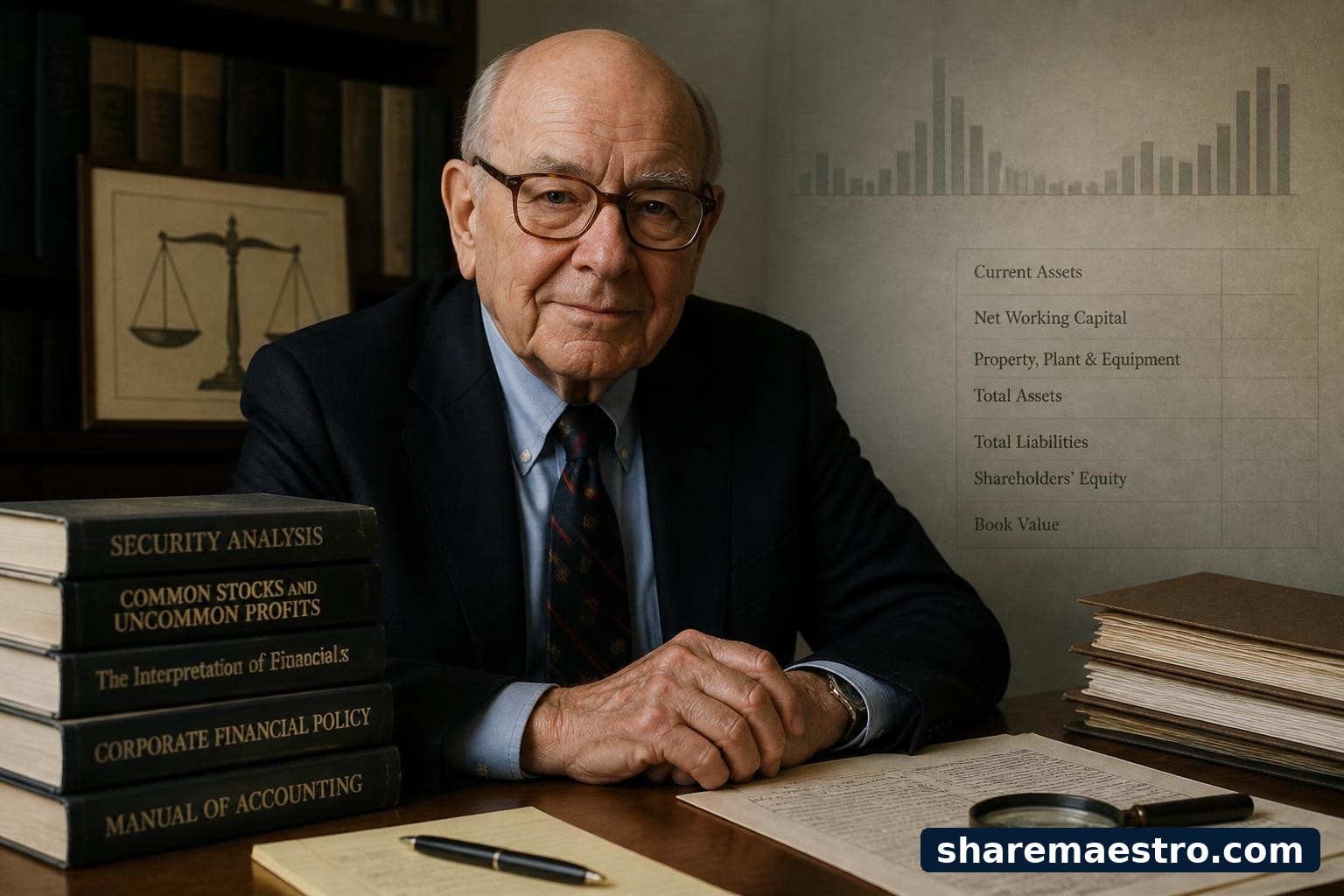
Walter Jerome Schloss was the least flamboyant member of Warren Buffett's Graham-and-Doddsville gallery and one of its most instructive. From a small office inside Tweedy, Browne, he and later his son Edwin used book value, low debt, diversification, patience, and emotional restraint to turn neglected stocks into one of value investing's most durable public records.
- Schloss came out of Benjamin Graham's orbit but practiced a purer statistical value style than Buffett, emphasizing price, book value, low debt, and tangible assets.
- Walter J. Schloss Associates began in 1955, Edwin Schloss joined in 1973, and the partnership was eventually known as Walter & Edwin Schloss Associates.
- Publicly cited performance records vary by period and fee treatment, but the central evidence is consistent: Schloss's partnerships beat broad market benchmarks for decades.
- The method relied on a large basket of unpopular stocks, minimal management contact, low overhead, little macro forecasting, and a willingness to buy more when prices fell.
- Schloss's legacy remains valuable, but the approach is dangerous when price-to-book bargains are really value traps in disrupted, asset-light, or overleveraged businesses.
Performance and evidence
Performance markers
Visual Evidence
Charts and timelines
Risk
Timeline
Philosophy
Performance
The man in the small room
Walter Schloss made a career out of refusing almost everything Wall Street usually sells as sophistication. He did not build a research department, court corporate access, or turn investing into a public performance. His office was famously spare, his staff essentially nonexistent, and his tools ordinary enough to embarrass a later generation of terminal-watching professionals. In an industry addicted to scale and theater, Schloss turned the closet-sized practice of comparing price with value into a durable business.
That setting is not a decorative detail. It is the clue to the entire career. Schloss believed a stock certificate represented part of a business, but he did not need to know every possible future of that business to buy it. He needed a depressed price, a balance sheet that offered protection, limited debt, and enough patience for the market or a buyer to notice what he had noticed. The method was humble, repetitive, and almost anti-charismatic.
The irony is that this quietness made him one of the loudest arguments in modern investment history. Warren Buffett used Schloss as a central example in the 1984 essay and speech known as The Superinvestors of Graham-and-Doddsville, a challenge to the idea that persistent market outperformance using public information was mostly luck. Schloss did not merely have a good run. He built an almost provocatively plain record that forced serious investors to ask whether markets were efficient in theory but far more disorderly in practice.
Why Schloss matters
Schloss matters because he represents a strain of investing that has become harder to admire in an age of story stocks, alternative data, and branded portfolio managers. His advantage was not genius as commonly marketed. It was the discipline to keep applying a few unglamorous filters when other investors wanted growth, excitement, or proof that a troubled company was about to become fashionable again. He bought statistical discomfort and waited.
The point is not that Schloss was the only heir to Benjamin Graham. Buffett, Bill Ruane, Tom Knapp, Tweedy, Browne, and others carried Graham's ideas in different directions. Schloss's importance is that he preserved the asset-based branch in unusually pure form. Where Buffett evolved toward business quality and management excellence, Schloss remained closer to the older craft of buying assets cheaply, spreading bets widely, and letting arithmetic rather than prediction do much of the work.
His career also gives value investing a moral dimension that is easy to miss. He charged modestly by hedge fund standards of later decades, kept expenses low, and, as Buffett later emphasized, took no money from partners unless they made money. His reputation among peers rested on more than performance. It rested on thrift, independence, and fiduciary restraint, values that rarely trend but matter most when markets stop rewarding charm.
A Wall Street education without a campus
Schloss was born in August 1916 and came to Wall Street early, not by the polished route of elite finance but as a runner in 1934. He did not attend college. The absence of formal credentials later became part of his legend, but it was less important than the kind of education he did receive. He studied under Benjamin Graham at the New York Stock Exchange Institute and absorbed a framework built around facts, skepticism, and the margin between price and appraised value.
That education suited a young man shaped by memories of financial insecurity. Later accounts of Schloss repeatedly connect his conservatism to the Depression years and family experience with loss. This was not merely psychological color. It explains why he preferred assets to projections, disliked leverage, and looked at permanent loss as the real enemy. For him, the market was not a casino to outwit with cleverness. It was a place where carelessness could injure families.
The early Wall Street he entered was tactile and paper-based. Prices moved across tickers, manuals mattered, and a persistent analyst could still uncover neglected securities in dull corners of the market. Schloss learned before investing became a technology business. He never really stopped working that way, and the stubborn continuity became both his strength and, in later years, the source of the method's most important questions.
The Graham-Newman apprenticeship
After wartime service in the U.S. Army Signal Corps, Schloss joined Graham-Newman in 1946. That firm was not just an employer. It was a laboratory for the value discipline. Benjamin Graham had made security analysis less a matter of tips and more a matter of comparative selection, liquidation value, working capital, balance sheets, and the recurring tendency of markets to overreact. Schloss saw the method practiced before it became a style box.
Graham's influence on Schloss was practical rather than ornamental. The younger investor learned to compare companies, examine the same business under different market conditions, and separate price movements from business value. Schloss later recalled Graham as original, clear, ethical, modest, and emotionally detached. Those qualities reappeared in Schloss's own practice: limited drama, limited debt, limited faith in forecasts, and a preference for buying securities when disappointment had already been priced in.
The Graham-Newman years also placed Schloss near Buffett, though the two men eventually expressed the same intellectual inheritance in very different portfolios. Buffett became more concentrated, more interested in business quality, and more willing to pay a fair price for a superior company. Schloss stayed closer to the old statistical quarry. He did not need to know that a business was wonderful. He wanted to know that the market was asking too little for what already existed.
Going out on his own
Schloss left Graham-Newman in 1955 and started Walter J. Schloss Associates. His timing was significant. Graham was moving away from active partnership work, and the postwar market was expanding into a more institutional era. Schloss did not respond by building an institution. He built a small partnership around one repeatable idea: buy securities for less than a conservative appraisal of their worth.
The business later became a family partnership in substance and name. Edwin Schloss joined in 1973, and Walter J. Schloss Associates eventually became Walter & Edwin Schloss Associates. The partnership remained tiny in operating structure even as its record became famous among value investors. Buffett later noted that the office went from one file cabinet in 1956 to four by 2002, a detail that sounds comic until one recognizes how much capital was managed with so little apparatus.
Scale was part of the strategy. Schloss did not want the pressure carried by very large money managers, and he saw no need to turn a simple process into an expensive machine. Low overhead increased the alignment between the partners and the people whose capital they managed. It also kept the focus on the only question he thought mattered enough to pay for: whether a stock was cheap enough.
Price before story
The Schloss method begins with a sentence that sounds almost too simple for professional finance: price is the most important factor in relation to value. His 1994 list of factors for making money in stocks put that principle first. The second point was to establish the value of the company, remembering that a share represented part of a business. The third was to use book value as a starting point while making sure debt did not consume the equity.
This was not naive cheapness. Schloss knew a low nominal price was meaningless. A five-dollar stock could be expensive and a fifty-dollar stock could be cheap. The question was price relative to assets, earning power, balance sheet resilience, and what a private buyer might pay. In earlier decades he had favored working-capital stocks, but as those disappeared he shifted toward companies selling at discounts to book value or at modest premiums to book in depressed circumstances.
Assets appealed to him because they changed more slowly than earnings. Earnings could collapse, recover, or be overstated by optimism. Assets were not immune to error, but they offered a more stable starting point, especially in industrial, retail, financial, and asset-heavy businesses of his era. He preferred the dull comfort of identifiable value to the excitement of a story that required many things to go right.
Debt was the recurring warning light. Schloss could buy trouble, but he did not want trouble financed by a fragile balance sheet. The difference mattered. A depressed company with assets and manageable debt might survive long enough for improvement, sale, liquidation, or cyclical recovery. A cheap company with too much leverage could transfer the upside to creditors and leave common shareholders with nothing.
A portfolio built like a warehouse
Schloss was diversified by temperament and design. Buffett observed that he owned many more stocks than Buffett did and was less interested in the underlying nature of each business. That was not a flaw accidentally offset by skill. It was the operating logic of a statistical value strategy. If the investor does not claim deep predictive knowledge about every business, the portfolio must be built to survive individual mistakes.
The typical Schloss portfolio could hold well over 100 securities. In the Graham tradition, diversification reduced the chance that one bad business, one dishonest management team, or one incorrect asset appraisal could destroy the record. The goal was not to find a single great company and marry it. The goal was to buy a collection of mispriced securities in which enough outcomes would work to make the whole portfolio rewarding.
Averaging down was part of the practice, but not as blind stubbornness. Schloss liked to buy on a scale and sell on a scale. If a stock declined and the balance sheet case remained intact, a lower price could improve the bargain. If the stock rose toward a fair price, he could sell without needing to identify the exact top. This was a way of removing ego from timing.
Turnover was moderate. Public accounts cite an average holding period around four years and turnover near 25 percent. That is long enough to let mean reversion or corporate action work, but not the buy-forever approach associated with Buffett's later Berkshire period. Schloss was patient, but his patience was linked to price. When the discount closed, the reason to own the security weakened.
Research without pilgrimage
Schloss's research style was striking because of what it omitted. He did not put much weight on meeting management, and Edwin later suggested that running around the country to visit companies could waste energy. The Schlosses used publicly available information, Value Line, annual reports, financial statements, dividend records, historical prices, and footnotes. The absence of management access was not a handicap to them. It was a guardrail against persuasion.
There was a philosophical reason for that restraint. Executives of troubled companies tend to be optimistic, and investor relations rarely volunteer the darkest version of reality. Schloss did not assume management was useless, but he did assume that reported numbers and long records were less theatrical than meetings. He wanted to know the company's history, ownership, debt, dividends, industry, and asset base. He did not need a polished pitch.
This made his practice unusually democratic. It suggested that public information, read patiently and skeptically, could still produce an edge when combined with temperament. Buffett later emphasized that Walter and Edwin did not rely on inside information and used outside information sparingly. Their edge came from choosing a less crowded emotional position: buying what other investors disliked, then allowing time and arithmetic to reduce the need for brilliance.
The record in numbers
Schloss's record is cited in several forms because different accounts use different periods, indexes, and fee treatments. The direction of the evidence is nevertheless consistent. Outstanding Investor Digest reported that for the 33 years ended December 31, 1988, Walter J. Schloss Associates earned a 21.6 percent compound annual return on equity capital versus 9.8 percent for the S&P 500 over the same period. The limited partners' return after the general partner's share was lower but still far ahead of the index.
Buffett's 1984 Graham-and-Doddsville presentation placed Schloss among a group of investors who shared a value philosophy but owned different securities and produced independent records. In that presentation, the WJS record from 1956 to 1984 was presented as dramatically superior to the market. Buffett's point was not that every Graham student bought the same stocks. It was that a common discipline could produce repeated success across different portfolios.
Later summaries extend the record. A 2012 obituary reported that from 1955 to 2002, by Schloss's estimate, his investments returned roughly 16 percent annually after fees compared with 10 percent for the S&P 500. Fordham's profile reported that through 2002, when the fund liquidation was completed, Walter & Edwin Schloss Associates earned a 20.5 percent annual gross return before profit-sharing fees for 47 years. Those figures are not identical, but they describe the same phenomenon: a very long, very high-quality record.
The annual record also matters because it was not smooth. Schloss lost money in some years, including difficult markets, and sometimes lagged glamorous rallies. But the partnership's performance in severe down markets often showed the benefit of buying already depressed securities. The result was not the absence of volatility. It was the avoidance, often enough, of permanent impairment.
What the performance did not prove
Schloss's record did not prove that cheap stocks automatically make their owners rich. It proved something narrower and more useful: a disciplined buyer of cheap securities, operating with conservative balance-sheet standards, wide diversification, low costs, and emotional restraint, could exploit market neglect for a long time. Remove those conditions and the record is no longer the same experiment.
It also did not prove that the market was always foolish. Schloss operated in areas where neglect could persist because the companies were small, dull, cyclically troubled, or institutionally inconvenient. If a stock was too ugly for growth investors and too complicated for casual investors, it might be cheap for reasons unrelated to ultimate value. But sometimes the market was right. Some businesses were cheap because their assets were overstated, their industries were deteriorating, or their managements were poor stewards.
Finally, the record did not rest on a few heroic winners. Buffett emphasized that Schloss invested in about 1,000 securities over the life of the partnership and that the outcome was not driven by a handful of spectacular bets. This is a key distinction. Schloss's success was not venture-style optionality dressed as value. It was repeated small-scale rationality, compounded over many years.
Junk, recoveries, and the uncomfortable middle
A 1973 Forbes profile captured the outsider's view of Schloss by calling attention to his interest in what the article framed as junk. The label was vivid but incomplete. Schloss was not indiscriminately buying weak companies. He was looking for high book value combined with low stock prices, for situations where the market price was depressed enough to create favorable leverage if modest improvement occurred. The ugliness was the entry ticket.
His examples often involved companies in disfavor, cyclical businesses, railroads, industrial concerns, and assets the market did not want to capitalize at full value. The logic was that a depressed company might improve earnings, attract a buyer, sell assets, or simply be revalued. A stock did not need a perfect future. It needed a price that already reflected a poor one.
But this middle ground was uncomfortable for good reason. The companies were often troubled. Not every asset was worth stated book value, not every cyclical downturn reversed, and not every buyer appeared. Schloss understood that no one could guarantee any single security would be a winner. His defense was price, diversification, and a refusal to let one position dominate the portfolio. The same features that made his approach look primitive were the features that kept mistakes from becoming fatal.
The Buffett comparison
Schloss is often introduced through Buffett, but the comparison is most useful when it highlights their differences. Both came from Graham's intellectual household. Both believed price mattered, markets overreacted, and investors needed emotional discipline. Yet Buffett increasingly sought exceptional businesses that could compound internally for long periods, while Schloss was comfortable owning many ordinary businesses if the discount to value was large enough.
Buffett admired that independence. In the Graham-and-Doddsville essay he noted that Walter was far less influenced by him than one might expect, and later he wrote admiringly of Schloss's record, honesty, and simplicity. That praise should not be mistaken for sameness. Schloss did not try to become Buffett. He did not need concentrated control positions, celebrity, or a theory of enduring competitive advantage to make his method work.
The contrast remains instructive because it shows that value investing is not one technique. It is a family of disciplines rooted in the relation between price and value. Buffett moved toward quality value. Schloss remained an asset-based bargain hunter. The former asks how good a business can be over time. The latter asks whether today's price already discounts enough disappointment. Both questions can be intelligent. They produce different portfolios, different risks, and different kinds of patience.
Temperament as risk management
Schloss's conservatism was not gloomy for its own sake. It was a practical response to the reality that markets punish emotional excess. His 1994 factors warned against tips, quick moves, hurry in selling, fear, greed, and leverage. Those cautions read like common sense, but their power came from being practiced over decades. Investors usually fail not because the rules are obscure, but because the rules become hardest to follow when they matter.
He also saw stress as a cost. In his 1996 lecture, Schloss described himself and Edwin as bargain hunters and explained that their approach fit their personalities. They did not want the strain of chasing high-growth stories or owning companies where expectations were already demanding. Buying depressed stocks could be stressful in the short run, but for Schloss it was less stressful than owning securities whose prices assumed excellence.
A crucial element was accepting loneliness. Schloss advised investors not to be afraid of being alone, but to look for weaknesses in their own thinking. That balance is rare. It avoids both crowd dependence and contrarian vanity. He did not buy merely because others hated something. He bought when the numbers, the assets, and the balance sheet gave him a reason to endure being early.
His risk management was therefore embedded in process. Avoid debt. Avoid leverage. Diversify. Buy at a discount. Keep expenses low. Do not rely on management optimism. Do not make one idea large enough to threaten the whole. This was not the modern language of factor models and value at risk, but it was a coherent system for preventing one error from ending the game.
The limits of a balance-sheet gospel
The fairest criticism of Schloss is not ethical. It is methodological. A low price-to-book ratio is not always a bargain. Book value can be stale, assets can be specialized, inventories can be marked too generously, real estate can be less liquid than hoped, and liabilities can expand at the worst possible time. In asset-light businesses, book value may understate value. In declining asset-heavy businesses, it may overstate it.
Edwin Schloss later acknowledged that the market had changed after the partnership closed. Companies with apparently attractive price-to-book or price-to-earnings ratios could be value traps, and some industries, including retail, faced disruption from technology. That observation does not refute Walter's record. It clarifies the conditions under which the method needs judgment rather than mechanical imitation.
The rise of intangible assets creates another complication. Brands, software, networks, data, patents, and customer relationships often matter more than factories or inventories in modern market leaders. A strict book-value investor may miss such businesses entirely. Schloss would likely have accepted that. He was not trying to own everything worth owning. He was trying to own what he could appraise with comfort.
There is also a behavioral trap in honoring Schloss too simplistically. Investors may use his name to justify buying statistically cheap companies without his diversification, patience, low-debt bias, low-cost structure, or emotional steadiness. That is not Schloss investing. It is merely buying stocks that look ugly on a screen. His discipline was broader and more demanding than a cheapness filter.
The continuing lesson
Schloss's continuing relevance lies in how little of his method depends on prediction. He did not need to forecast interest rates, technological winners, or next quarter's earnings with precision. He needed enough evidence that a security was priced below a conservative estimate of value, enough diversification to absorb mistakes, and enough patience to let the market's mood change. That simplicity remains radical because finance keeps rewarding complexity in presentation even when simplicity works better in behavior.
His career is also a reminder that process can be more important than personality. Schloss was not a market celebrity, but his process had an identity: cheap assets, low debt, many positions, public information, low expenses, scale buying, and emotional control. It was a way of investing that made room for human limitation. He did not pretend to know everything, and the portfolio was built around that confession.
For today's investor, the useful lesson is not to copy every historical screen. It is to copy the hierarchy of thought. Start with price, define value conservatively, distrust leverage, read the statements, control costs, know your temperament, and avoid needing a heroic forecast. The dangerous lesson is to believe that a stock is safe because it is down, cheap, or unfashionable. Schloss bought trouble, but he wanted trouble with assets and survivability.
The quiet man in the small room endures because his career strips investing down to its least glamorous test. Can an investor remain rational when the merchandise is unattractive, the crowd is elsewhere, and the payoff is uncertain? Walter Schloss answered yes for nearly half a century. His record did not make deep value easy. It made clear how much discipline the boring path requires.
Disclosure
Educational financial journalism and market research only. Not financial, investment, trading, tax, or legal advice.