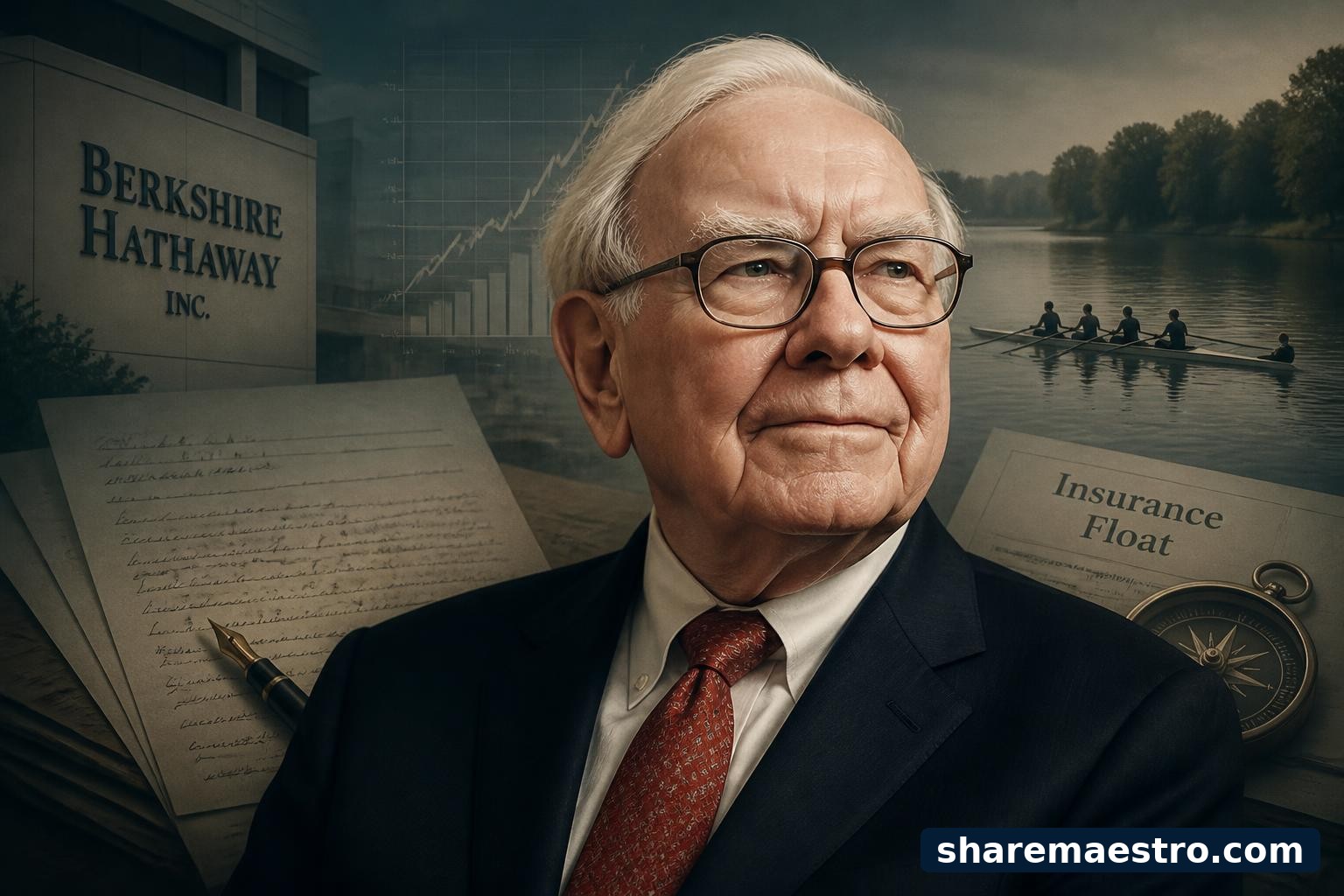
In brief
Warren Buffett turned a failing New England textile company into Berkshire Hathaway, a trillion-dollar-scale conglomerate, by combining value investing, insurance float, decentralized operations, and an unusually long owner time horizon. His record is extraordinary, but the method also carries limits: size reduces opportunity, concentrated judgment invites mistakes, and Berkshire's moral reputation has sometimes run ahead of the harder realities inside its subsidiaries.
- Buffett's central innovation was not merely stock picking. He converted value investing into an owner-oriented capital allocation system inside Berkshire Hathaway.
- Berkshire's insurance float, conservative balance sheet, and decentralized operating culture gave Buffett a permanent-capital structure few investors can replicate.
- The published record remains exceptional: Berkshire reports a 19.7% compounded annual gain in per-share market value from 1965 through 2025, compared with 10.5% for the S&P 500 with dividends included.
- Buffett's mistakes were not marginal footnotes. Berkshire's textile roots, Dexter Shoe, Tesco, and governance controversies show the failure modes of patience, loyalty, and concentrated judgment.
- The post-Buffett test is cultural as much as financial: Greg Abel inherited a company built to avoid dependence on one mind, but also one defined by that mind's standards.
Performance and evidence
Performance markers
Visual Evidence
Charts and timelines
Risk
Timeline
Philosophy
Performance
The quieting of Omaha
The most famous voice in American investing did not exit with theatrical flourish. Warren Buffett's last years as Berkshire Hathaway's chief executive were marked by the same plainness that made the annual letter a ritual: a public company, an owner base trained to think in decades, and a leadership handoff telegraphed long before it became official. In May 2025, Berkshire's board unanimously appointed Greg Abel to become president and chief executive effective January 1, 2026, while Buffett remained chairman. The announcement closed one chapter and tested the most important claim Buffett had made for years: that Berkshire was more than its founder.
By then, Buffett had become a rare figure in finance: a celebrity who preached anti-celebrity investing. His fame rested on exceptional compounding, but also on a corporate grammar of restraint. Berkshire did not cultivate earnings guidance, options-rich executive theater, or Wall Street fashion. It bought whole businesses when possible, bought minority stakes when rational, hoarded cash when prices looked poor, and tried to speak to shareholders as partners rather than customers. That combination made Buffett not only an investor to study, but a standard by which other capital allocators were judged.
The transition also came with a personal note of finality. In November 2025, Buffett told shareholders that he would no longer write Berkshire's annual report or speak at length at the annual meeting, though he planned to keep communicating through annual Thanksgiving messages. The detail mattered because the letters were not ancillary to Berkshire. They were part of the product: a decades-long education in how capital should behave when it is treated as both property and trust.
Why Buffett matters beyond the return table
Buffett matters because he joined two things that modern finance often separates: a philosophy of security analysis and a corporate structure capable of housing it for decades. Many investors have beaten markets for a period. Fewer have turned investment judgment into an operating company with insurance, railroads, utilities, manufacturers, retailers, and public equities under one roof. Berkshire's 2025 annual report describes a holding company with insurance and reinsurance, freight rail transportation, utilities and energy, manufacturing, service, and retailing businesses. The scale is far removed from the image of one man reading annual reports in Omaha.
The numbers explain the fascination, but not the full lesson. Berkshire reports that from 1965 through 2025 its per-share market value compounded at 19.7% annually, compared with 10.5% for the S&P 500 with dividends included. The cumulative gain from 1964 through 2025 was 6,099,294% for Berkshire against 46,061% for the index. Those figures are almost absurd in their distance from normal corporate life, yet Buffett's public explanation of the record was deliberately unsentimental: buy productive assets at sensible prices, avoid ruin, let time work, and do not confuse market quotations with business value.
His influence also lies in making investment behavior a subject of character. Buffett's language turned finance into a moral vocabulary: patience, candor, fiduciary duty, rationality, and temperament. That vocabulary could become folksy in imitation, but at its best it redirected attention from prediction to incentives. Buffett treated a stock as a partial business interest, a balance sheet as a survival tool, and a shareholder letter as an accountability device. In an industry organized around immediacy, he made duration the edge.
Graham's student, not Graham's clone
The intellectual beginning was Benjamin Graham. Buffett, born in Omaha in 1930, graduated from the University of Nebraska and studied under Graham at Columbia Business School, where he absorbed the distinction that would define his early career: price is what the market offers, value is what analysis estimates. After working in New York with Graham-Newman, Buffett returned to Omaha in 1956. It was a geographic retreat that became a strategic advantage. Away from Wall Street's social current, he built a partnership around discipline rather than fashion.
The early partnership letters show an investor still operating close to Graham's original terrain. Buffett classified opportunities into undervalued general securities, work-outs tied to corporate events, and control situations in which ownership could influence outcomes. The method was opportunistic but not casual. He wrote to partners that short-term market calls were not the center of the operation; the priority was finding securities materially below intrinsic value. The emphasis was already on process over prediction.
By 1969, however, the partnership era had run into a different problem: success, size, and a speculative market. Buffett chose to wind down rather than force a style he no longer believed fit the opportunity set. That decision is one of the least theatrical but most revealing in his career. He did not promise to adapt to every market. He accepted that some conditions were outside his circle of competence. The act of returning capital, and steering willing partners toward Berkshire shares, foreshadowed the larger architecture to come: permanent capital, fewer forced decisions, and a structure that could wait.
From cigar butts to compounding businesses
Buffett's early bargains were often the classic Graham type: statistically cheap, unloved, and sometimes mediocre. His later greatness came from escaping the trap embedded in that success. A poor business bought cheaply can produce a fine gain, but it rarely becomes a durable home for large amounts of capital. The skill that works with small sums can decay when the capital base expands. Buffett later framed this as the limitation of cigar-butt investing: one last free puff, then nothing more.
Charlie Munger's contribution was to push Buffett toward better businesses, not merely lower prices. The shift did not reject value investing. It deepened the definition of value to include durability, pricing power, management quality, and the ability to reinvest capital at attractive rates. See's Candies became the canonical example inside Berkshire because it showed how a modestly sized company with brand power could send cash to headquarters year after year, requiring little incremental capital relative to the profits it produced.
This evolution matters because Buffett is often caricatured as a buyer of cheap stocks. The more precise description is that he became a buyer of business quality when quality was not fully priced, and a steward of capital when there was no reason to sell. The Graham lesson remained the margin of safety. The Munger overlay was that a truly superior business can create its own margin of safety over time if purchased with discipline. That synthesis became Berkshire's operating religion.
The Berkshire engine: float, decentralization, and time
Berkshire's decisive structural advantage came from insurance. When Berkshire bought National Indemnity in 1967, it gained access to a business model in which premiums arrive before claims are paid. The resulting float can be invested, provided underwriting is disciplined enough not to turn cheap funding into expensive liability. Buffett did not discover float, but he built an empire around its rational use. Insurance became both operating business and financing mechanism.
The Owner's Manual explains the broader machine. Berkshire preferred direct ownership of cash-generating businesses that earned above-average returns on capital, with marketable common stocks as the second choice when whole-company opportunities were unavailable. It used debt sparingly and rejected opportunities that required leverage beyond the comfort of fiduciary duty. The corporate office stayed small, subsidiaries retained operational autonomy, and excess capital could be sent to Omaha for redeployment across a wider opportunity set than any one subsidiary could see.
The result was a hybrid: not a mutual fund, not a private equity firm, not a conventional conglomerate. Berkshire could buy companies without promising an exit, own public equities without client redemptions, and allow managers to operate with unusual independence. That structure strengthened Buffett's temperament. Patience is easier when capital is permanent, incentives are aligned, and the balance sheet is built to survive markets that periodically punish everyone.
A philosophy written for owners
Buffett's investment philosophy is sometimes reduced to slogans, but the more durable version is contractual. He wanted shareholders to understand what they owned and how management would behave before they bought the stock. Berkshire's Owner's Manual stated that although Berkshire was corporate in form, its attitude was partnership. That statement was not ornamental. It shaped everything from executive compensation to disclosure habits to the refusal to court shareholders who wanted short-term promotion.
Intrinsic value sat at the center of that contract. Buffett defined it as the discounted value of cash that can be taken out of a business over its remaining life, while insisting that the calculation is an estimate rather than a precise figure. The humility embedded in that definition is easy to miss. If intrinsic value is an estimate, the investor's task is not to produce false precision. It is to demand a margin of safety large enough to absorb error.
The same philosophy explains Buffett's unusual indifference to daily prices. Market quotations were useful when they offered a chance to buy or sell advantageously; otherwise they were noise. Volatility, in this framework, was not synonymous with risk. Permanent loss of capital, impaired earning power, excessive leverage, and bad incentives mattered more. This view influenced generations precisely because it felt both simple and difficult: anyone could state it, but few could live with its boredom, its missed fads, and its long periods of looking wrong.
How the portfolio was constructed
Berkshire's portfolio construction was less a spreadsheet recipe than a hierarchy of opportunity. At the top were wholly owned businesses that could send cash to headquarters while continuing to strengthen their own competitive positions. Next came large minority stakes in companies whose economics Buffett admired and whose managers he trusted. Finally came cash and Treasury bills, not as a market call for its own sake, but as optionality and protection.
The position sizes could be striking. Buffett was never a believer in diversification as a substitute for knowledge. Berkshire's public equity portfolio became famous for large holdings in businesses such as Coca-Cola, American Express, Apple, and banks at various times, but the principle was not blind concentration. It was the belief that the right business, bought at the right price and held through rational turbulence, could do more for shareholders than constant motion across dozens of marginal ideas.
The operating portfolio added another layer. BNSF, Berkshire Hathaway Energy, GEICO, reinsurance, manufacturing, and retailers did not move in lockstep. Some were capital intensive and regulated, some brand-driven, some underwriting-based, and some cyclical. That mix gave Berkshire a resilience different from the standard equity portfolio. It also created complexity: investors could no longer judge the company by one metric alone, and Buffett increasingly warned that book value had become an imperfect proxy for intrinsic value as Berkshire's controlled businesses grew.
Deals that revealed the method
Buffett's acquisition record is best understood as a sequence of lessons, not trophies. National Indemnity supplied the base for insurance. See's Candies demonstrated the power of a brand with pricing flexibility and low capital needs. Nebraska Furniture Mart reflected his willingness to back exceptional operators. GEICO, first studied when Buffett was young and later fully acquired by Berkshire, showed the value of a low-cost direct insurer that could grow for decades if underwriting stayed rational.
The crisis-era deals displayed another side: liquidity when others needed it. During the financial crisis, Berkshire invested in Goldman Sachs preferred stock and General Electric preferred stock, terms that drew attention because Berkshire had both cash and credibility when both were scarce. In 2009, Berkshire agreed to buy the rest of Burlington Northern Santa Fe, a capital-heavy railroad business Buffett framed as a long-term wager on American commerce. These were not cigar butts. They were large commitments to institutions and infrastructure Buffett believed could endure.
What linked the deals was not industry purity but capital logic. Buffett wanted businesses he could understand, managers he could trust, economics that could persist, and prices that did not require heroic assumptions. When those conditions were absent, cash was acceptable. That willingness to do nothing was itself a portfolio decision, one made easier by Berkshire's structure but made valuable by temperament.
The record, and what it does not prove
Berkshire's published performance record is the hard spine of the Buffett story. From 1965 through 2025, Berkshire's per-share market value compounded at 19.7% annually, versus 10.5% for the S&P 500 with dividends included. Over the full 1964 through 2025 span, the reported cumulative gain was more than 6 million percent. No serious profile can treat those numbers as incidental. They are the reason Buffett's letters became required reading far beyond Berkshire's shareholder base.
Yet the record does not prove that every Buffett principle is universally portable. Berkshire benefited from a particular historical arc: postwar American growth, the rise of deep capital markets, the availability of high-quality businesses at attractive prices in earlier decades, and an insurance platform that could be scaled under unusually disciplined leadership. The method was not magic. It was a rare convergence of skill, structure, reputation, and time.
The record also evolved. Berkshire's enormous capital base made high percentage returns harder. Buffett acknowledged that per-share progress would diminish as size grew. The company could still be exceptional and yet unlikely to replicate its earlier rate of compounding. That distinction is central to Buffett's maturity as a communicator. He celebrated the past without pretending arithmetic had been repealed.
The mistakes that sharpened the doctrine
Buffett's candor about mistakes became part of his authority because the errors were real. The original Berkshire purchase was one. He bought into a declining textile company at a statistical discount, then allowed irritation with management to pull him deeper into a terrible business. In the 2014 annual report, he described the decision as monumentally stupid and traced how a cheap stock became an expensive capital allocation problem. The textile operation was finally closed in 1985 after years of struggle.
Dexter Shoe was worse as a lesson in opportunity cost. Berkshire paid $433 million in Berkshire stock for the company in 1993. Buffett later wrote that Dexter's competitive advantage vanished and that using Berkshire shares compounded the damage. The dollars lost were only part of the wound; giving away pieces of an extraordinary compounding vehicle for a business that went to zero made the mistake far larger than the purchase price suggested.
Tesco showed a different failure mode: not buying the wrong business outright, but selling too slowly when the facts changed. Buffett admitted that a more attentive investor would have exited earlier, and Berkshire ultimately recorded an after-tax loss of $444 million. These episodes complicate the myth of perfect patience. Buffett's best holding period was long, but not infinite. Endurance was a virtue only when the business case remained intact.
Criticism, governance, and the cost of moral reputation
Buffett's reputation for integrity has always been one of Berkshire's assets, which means lapses and controversies carry special force. The David Sokol and Lubrizol episode in 2011 raised questions about judgment and governance after a senior Berkshire executive bought Lubrizol shares before recommending the company as an acquisition candidate. Sokol resigned, Berkshire completed the Lubrizol deal, and the affair became a reminder that a trust-based culture still needs controls, documentation, and skepticism when personal trading intersects with corporate opportunity.
Berkshire has also faced criticism beyond the investment office. Clayton Homes, its manufactured housing subsidiary, became the subject of investigations alleging predatory lending and troubling sales practices. Berkshire and Buffett defended Clayton, while critics argued that the company's lending model placed vulnerable buyers at risk. The controversy has persisted in different forms, including later regulatory scrutiny of a Berkshire-owned mortgage lender. For a company that speaks the language of stewardship, the moral scrutiny of subsidiaries is not a side issue.
The deeper criticism is that decentralization can blur accountability. Berkshire's model gives subsidiary managers room to run their businesses, which can preserve entrepreneurial energy and reduce bureaucracy. It can also make it harder for outsiders to know how deeply headquarters oversees practices that create social, legal, or reputational risk. Buffett's answer has long been to choose managers carefully and protect culture obsessively. The limitation is that culture is not self-executing.
Risk management as refusal
Buffett's risk management often looked passive because it was built around refusal. Refuse excess leverage. Refuse acquisition prices that require optimism. Refuse to write insurance at inadequate rates. Refuse to sell excellent businesses merely because someone offers a high headline price. Refuse to invest just because cash is uncomfortable. In an industry addicted to activity, refusal was a source of alpha.
By year-end 2025, Berkshire's scale made that posture visible in the balance sheet. The company reported total assets of $1.222 trillion and Berkshire shareholders' equity of $717.4 billion. In the Insurance and Other category, it held $47.7 billion of cash and cash equivalents and $321.4 billion of short-term U.S. Treasury bills. To critics, such liquidity can look like caution hardened into inertia. To Buffett, liquidity was the precondition for rational action under stress.
The risk, paradoxically, is that safety can become a drag. Cash protects against forced selling and creates optionality, but it also weighs on returns when markets rise and bargains are scarce. Buffett knew this. His defense was not that cash maximizes returns in every period, but that Berkshire should never need rescue. In November 2025, he reminded shareholders that Berkshire's stock had fallen about 50% three times in 60 years under current management. The balance sheet was designed so that such episodes were survivable rather than existential.
Munger, Abel, and the Berkshire culture
No serious account of Buffett can treat Charlie Munger as a supporting anecdote. Munger altered Buffett's trajectory by pushing him toward businesses that could compound rather than merely liquidate statistical cheapness. Their partnership lasted more than six decades and became a model of intellectual friction without public rivalry. Buffett supplied the public voice. Munger supplied much of the architectural discipline: avoid stupidity, prize quality, and do not overcomplicate what incentives and arithmetic can explain.
Berkshire's 2025 transition letter, written by Abel as chief executive, treated that culture as inheritance and obligation. Abel emphasized partnership with owners, decentralized operations, rational capital allocation, and continuity of values. The tone was important because Berkshire's culture is not housed in a product patent or regulatory monopoly. It exists in habits: how managers are chosen, how capital is moved, how mistakes are discussed, and how shareholders are addressed.
The succession question had always been the market's quiet anxiety. Buffett could insist that Berkshire was built to last, but only a post-Buffett Berkshire can prove it. Abel inherits advantages Buffett created: huge liquidity, operating diversity, trusted managers, and an owner base trained to think long term. He also inherits constraints Buffett could not eliminate: size, public scrutiny, changing insurance economics, and the impossible comparison with the greatest capital allocator in the company's history.
How Buffett changed investors
Buffett changed investors by making value investing legible to the public without making it easy. The annual letters translated accounting, insurance, acquisition math, incentives, and market psychology into language that intelligent non-specialists could understand. That was not simplification as marketing. It was simplification as discipline. If a principle could not be explained clearly, it probably had not been understood clearly enough to guide capital.
His 1984 essay on the Graham-and-Doddsville investors also gave value investing a public defense against the idea that market-beating records were merely statistical luck. Buffett's argument was not that all value investors win, or that markets are always inefficient. It was that a cluster of investors sharing a common intellectual origin had produced records difficult to dismiss as randomness. The essay became part of the canon because it linked performance to a way of thinking, not a secret formula.
The broader influence is visible in language now common across investment firms: owner earnings, moat, margin of safety, circle of competence, look-through earnings, and permanent capital. Some of that vocabulary has been diluted by overuse. Still, Buffett's central contribution endures. He made the investor answer a prior question before buying anything: what kind of owner am I trying to be?
What remains useful, and what remains dangerous
The useful Buffett is not the caricature who buys anything with a familiar brand and holds forever. The useful Buffett is the allocator who asks whether a business can defend its economics, whether management can be trusted with retained earnings, whether the price protects against error, and whether the investor can survive the time required for the thesis to work. Those questions remain valuable in public equities, private businesses, and corporate strategy.
The dangerous Buffett is the version used to excuse laziness. Long-term investing is not a waiver from reassessment. Concentration is not bravery if it rests on borrowed conviction. Buying a wonderful company is not enough if valuation assumes perfection. Admiring management is not due diligence. The Tesco and Dexter episodes are warnings from inside the temple: even Buffett misread competitive change, delayed exits, and underestimated the cost of using an overqualified currency to buy an inferior asset.
For today's investors, the hardest Buffett lesson may be structural humility. Berkshire's method depended on permanent capital, insurance float, tax efficiency, reputation, and access to deals unavailable to ordinary portfolios. The principles can travel; the machine cannot be copied casually. That is why Buffett's legacy is less a set of stock tips than a standard of behavior under uncertainty. In a market built to monetize impatience, he built a fortune by making patience institutional.
Disclosure
Educational financial journalism and market research only. Not financial, investment, trading, tax, or legal advice.