In brief
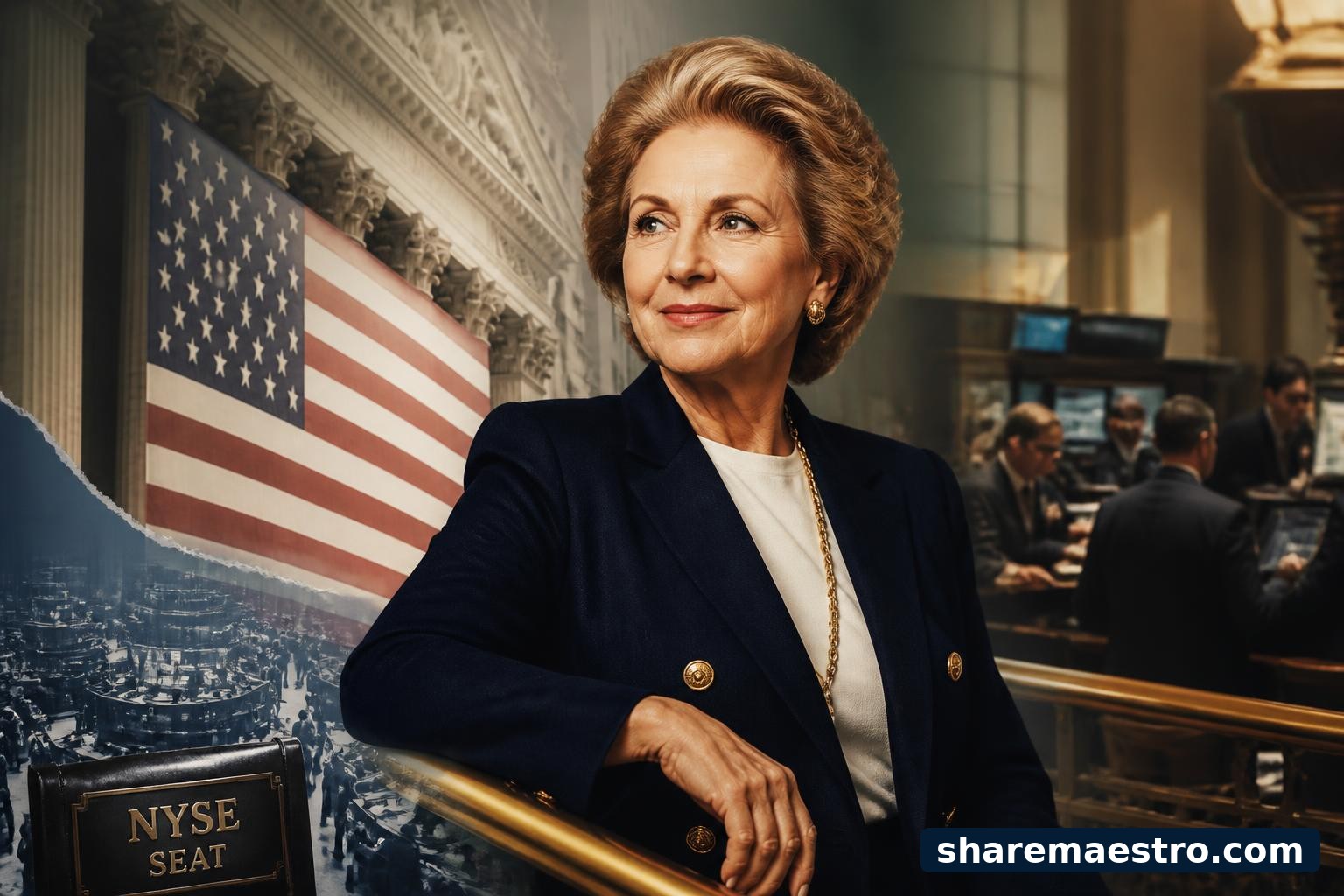
Muriel F. Siebert, known as Mickie, forced her way into the New York Stock Exchange in 1967, built a brokerage around hard research and institutional execution, became an early discount-brokerage competitor after May Day 1975, and later served as New York State Superintendent of Banks. Her career was not a conventional investment record measured by fund returns. It was a market-access record, built on lower commissions, narrower expertise, regulatory discipline, and a stubborn insistence that Wall Street's closed networks were not merely unfair but economically inefficient.
- Siebert became the first woman to own a seat on the New York Stock Exchange on December 28, 1967, after paying $445,000 and securing financing under conditions she regarded as unequal.
- Her early edge came from concentrated research in airlines and aerospace, institutional relationships, and block trading rather than broad market calls.
- After the SEC ended fixed brokerage commissions on May 1, 1975, Siebert moved her firm into discount brokerage and offered individual investors commission terms closer to institutional rates.
- As New York State Superintendent of Banks from 1977 to 1982, she oversaw hundreds of institutions and helped arrange bank combinations during a stressed period for thrifts and foreign banking expansion.
- Her legacy is best read as a finance strategy about access, costs, independence, reputation, and the institutional economics of who is allowed to participate.
Performance and evidence
Performance markers
Visual Evidence
Charts and timelines
Risk
Timeline
Philosophy
Performance
The day the club had to vote
On December 28, 1967, Muriel Faye Siebert entered the record books of American finance through a transaction that looked, on its face, like the purchase of a license. She bought a seat on the New York Stock Exchange. The price was $445,000, a fortune for a self-made analyst from Cleveland who had arrived in New York with a used Studebaker, a few hundred dollars, and no Wall Street family name. Yet the money was only the visible cost. The larger price was paid in refusals, ridicule, and the burden of proving that a woman could belong in a market institution that had operated since 1792 as a male preserve.
The exchange did not have an explicit constitutional ban on women. That mattered. Siebert found the absence of a rule and treated it as an opening. But the mechanics of membership were social as well as financial. She needed sponsors. She needed a bank loan. She needed men who had benefited from the exchange's culture to concede, at least procedurally, that the culture could not exclude her forever. The drama was not that she discovered Wall Street was inhospitable. The drama was that she discovered the rules could be used against the assumptions behind them.
Her seat made her famous, but fame is too thin a frame for what followed. Siebert did not simply become a symbol inside the old exchange. She built a brokerage business, used deregulation to cut trading costs, took a public regulatory office during a dangerous period for New York banking, and turned the idea of market inclusion into a commercial proposition. In a series often dominated by investors who compounded capital, her profile belongs to another lineage: the market pioneer who altered who could enter, what they paid, and how seriously access itself should be treated as a financial product.
Why Siebert matters beyond the first
The temptation is to reduce Siebert to a single adjective: first. First woman to own a New York Stock Exchange seat. First woman to own and operate a firm on the exchange. First woman to serve as New York State Superintendent of Banks. The chronology is accurate, but the repetition can flatten the finance. Her career matters because each first was attached to a mechanism. A seat let her execute and control business. A firm let her package research, execution, and reputation. Discount brokerage let her turn regulatory change into a price war. Public office let her test her judgment on bank solvency rather than stock selection.
Siebert's method was not an abstract doctrine. It was a practical response to closed markets. If a firm would not pay her like a man, she moved. If a resume with her first name went unanswered, initials got her in the door. If exchange members resisted her application, she kept looking for sponsors. If fixed commissions protected incumbents, she backed the new competitive regime and used lower rates as an invitation to individual investors. Her edge came from reading both balance sheets and institutions: the numbers in a company, and the incentives in the system around that company.
That is why her story has renewed relevance in an era when trading access has become cheap, digital, and sometimes dangerously frictionless. Siebert fought for access at a time when the problem was exclusion and high cost. Today's problem is often excess access without enough education, context, or risk discipline. Her career does not supply a sentimental answer. It offers a harder lesson: access is valuable only when paired with knowledge, price transparency, capital discipline, and an honest account of who benefits from each market rule.
Cleveland, numbers, and the first lesson in capital
Siebert was born in Cleveland in 1928 to Margaret and Irwin Siebert. Her father was a dentist, and the family expected a conventional path for a talented daughter at a time when professional ambition for women was often narrowed before it was tested. She attended Flora Stone Mather College, the women's division of Western Reserve University, and intended to major in accounting. The attraction was not glamour. It was the grammar of money: columns, ratios, obligations, and the way a page of figures could disclose a story that ordinary conversation concealed.
Her father's illness changed the family's finances and her own assumptions. He died broke, she later said, and she left college before graduating. The experience left her with a lifelong sensitivity to the gap between social confidence and financial security. Wall Street would later treat her lack of a degree as a credentialing defect, but it also sharpened one of her core instincts. Money was not status for its own sake. Money was room to maneuver, a defense against dependence, and a way to answer people who had made access conditional.
A 1953 visit to the New York Stock Exchange supplied the setting. Looking down from the visitors' gallery, she saw a floor of men in dark suits and, rather than feeling repelled by the exclusion, felt the electricity of the place. The response was characteristic. She did not romanticize the institution, but she wanted to understand its machinery. Within a year she was in New York, looking for work in finance at a time when women were more likely to be hired around the market than inside its decision-making ranks.
From glorified gofer to analyst with a following
The early labor was humble. After being turned down by the United Nations and Merrill Lynch, Siebert found work at Bache & Co. as a research-department trainee earning $65 a week. She carried telexes to senior analysts and absorbed how information moved through a brokerage house. This was not the Wall Street of real-time dashboards and automated feeds. Research was built through telephone calls, teletype, annual reports, plant visits, and the discipline of asking management questions precise enough to produce useful answers.
Her opening came in neglected industries. At Bache, she was assigned airlines, partly because more senior analysts did not want the sector. Jets were expensive, leverage mattered, and the industry's economics were difficult. Siebert turned the assignment into a specialty. She studied aircraft orders, financing needs, routes, managements, and the industrial suppliers around the companies. That habit became her most durable investment principle: know a limited number of businesses so well that a disappointing quarter can be sorted into structural weakness, temporary disruption, or opportunity.
The market rewarded specificity. Siebert moved from research into institutional sales, serving mutual funds, pension funds, banks, and other large accounts. She developed a following because clients believed she knew the numbers behind her recommendations. She later summarized the approach as knowing a lot about a little. In modern portfolio language, it was concentrated coverage rather than broad allocation. She was not trying to be a macro prophet. She was trying to own an information advantage in a narrow set of companies and to translate that advantage into execution flow.
The seat as strategy, not trophy
By the mid-1960s, Siebert had become a partner at several firms, but equal standing remained elusive. She could generate business and still be paid less than male peers. A client suggested the solution that changed her life: buy a seat and work for herself. The advice was both simple and radical. A seat on the exchange was not merely a badge. It was an economic gateway to commissions, trading access, and institutional legitimacy. For Siebert, it was also a way to stop negotiating her worth inside firms that had already decided the answer.
The process exposed how neutral rules could be made discriminatory in practice. Siebert needed sponsors, and multiple men refused. After repeated attempts, she found support from Ken Ward and Jim O'Brien. The exchange required her to obtain a bank loan for part of the seat price, a condition that the Harvard Business School exhibit notes had not been required of other applicants. Banks, in turn, were reluctant to lend without assurance that the exchange would admit her. The result was the familiar bureaucratic circle: no loan without acceptance, no acceptance without a loan.
Chase Manhattan Bank eventually provided the financing. Siebert put down 20 percent and secured a $300,000 loan toward the $445,000 seat. On the day she became a member, she was the only woman among 1,365 men. That ratio is more than a historical curiosity. It shows the scale of the social monopoly she had breached. The economics of the seat mattered because the culture had insisted she remain a dependent producer inside someone else's firm. Ownership changed the bargaining position.
A firm built around control, block trading, and reputation
Siebert began operating after her exchange admission and incorporated Muriel Siebert & Co., Inc. in 1969. As president and chair, she became the first woman to establish, own, and operate a business on the NYSE. Her firm initially reflected the strengths that had carried her to the seat: research credibility, institutional relationships, and the handling of large blocks of stock in companies she followed closely. The model was relationship-intensive and knowledge-intensive, not a mass-market retail machine.
Block trading suited her temperament. It required judgment about liquidity, clients, price, timing, and trust. A broker handling large orders needed to know not only the stock but the buyer and seller. Siebert's own description of the work emphasized fit: knowing the customer as well as the security. That may sound old-fashioned beside algorithmic execution, but it captured a central market function. Before screens fragmented liquidity across venues, skilled intermediaries could create value by finding the other side and reducing the market impact of size.
The limits were real. A small firm tied heavily to one founder's reputation could not match the balance sheets, sales forces, or product breadth of the largest houses. But Siebert's independence was itself part of the offering. She used publicity, direct language, and a visible personal brand to signal that clients were not dealing with a faceless branch of a club. Her business was built on the premise that an outsider could win flow by being more prepared, more responsive, and more clearly aligned with clients who felt underserved by incumbent firms.
May Day and the discount wager
The second defining turn in Siebert's career came not from a personal barrier but from a regulatory rupture. For generations, exchange commission rates had been fixed. That system protected broker revenue and shaped a complicated world of research, soft-dollar arrangements, and institutional bargaining. The Securities and Exchange Commission ended fixed commissions and implemented negotiated rates effective May 1, 1975. Wall Street called it May Day, with the double meaning fully intended. To many firms, it threatened margins. To Siebert, it threatened income but created a market.
She moved early into discount brokerage. Muriel Siebert & Co. would serve institutions and individual investors with execution-only services, separating trade execution from bundled research and advice. The decision was controversial because it attacked a pricing structure that had subsidized the old brokerage model. Siebert argued that individual investors should not pay materially higher rates simply because they lacked institutional bargaining power. The small investor, in her framing, deserved an even break. It was a moral argument, but also a business strategy.
The wager showed her ability to read incentives. She understood that deregulation would compress traditional commission income. She also understood that lower prices could expand volume and attract customers ignored by full-service houses. This was not philanthropy. It was inclusion through price competition. Decades before online brokerages and commission compression became central to retail finance, Siebert saw that access could be sold as a discount product without surrendering seriousness. The danger, then as now, was that cheaper trading might be confused with better investing.
The philosophy: narrow expertise, plain incentives, visible independence
Siebert's investment philosophy was practical rather than doctrinal. She did not build a school around factor premia, chart patterns, or macro cycles. Her operating rule was to understand a manageable list of companies deeply. She followed only a few closely, added selectively, and looked for industries where she could identify growth and financing needs. In her analyst years, the work meant studying management, suppliers, production, competition, research, labor conditions, and the capital demands behind reported earnings.
That approach carried into brokerage. The product was not merely an opinion on a stock. It was a chain of credibility: research judgment, institutional trust, trade execution, and client service. Her comment that she had to provide more and better advice, information, and service than customers could get elsewhere was not marketing filler. It was the survival plan of a small firm facing larger rivals. Without inherited network power, she needed a performance standard clients could experience directly.
Her independence also had an aesthetic dimension. Siebert understood that being visible could be a form of capital. Advertising that announced her status, television appearances, conference speeches, and a public persona made the firm memorable. That visibility carried risks. It could distract from process, invite condescension, or make the founder larger than the institution. But for an excluded entrant, obscurity would have been more dangerous. She built a brand because the old network already had one, even if it did not call itself by that name.
Risk without romance
Siebert spoke often about risk, but not as a trader glorifying volatility. Her risk sense was closer to liability analysis. What can go wrong, who owes whom, where is the financing, and what happens if the expected revenue pool changes? When May Day arrived, she knew lower commissions would reduce her income. The key offset was balance-sheet flexibility. In her later interview, she emphasized that she did not owe anybody money and could therefore accept a revenue shock that might have trapped a more leveraged operator.
That instinct helps explain her durability. She could be flamboyant in style but conservative in financial structure. Her brokerage faced the ordinary hazards of the securities business: trading errors, customer nonpayment, technology failures, falling volumes, shrinking commissions, advertising costs, regulatory capital demands, and competition from firms with greater scale. Public filings years later would list many of those risks in formal language. In Siebert's own career, they appeared as daily business conditions rather than theoretical footnotes.
The failure mode of her model was not excessive leverage in a portfolio. It was dependence on reputation, service, and a pricing edge that competitors could copy. Discount brokerage became an industry, and industries attract capital. Once electronic platforms and larger firms competed aggressively on cost, a small independent brokerage had to find new reasons to matter. Siebert's answer was to keep attaching the firm to trust, personal service, women's financial education, minority and women-owned underwriting, and later technology. Not all of those efforts scaled equally, but each reflected the same risk premise: do not let incumbents define the only acceptable business model.
The regulator's turn
In 1977, Governor Hugh Carey appointed Siebert Superintendent of Banks for the State of New York. It was a startling shift from brokerage entrepreneur to public regulator, and she put her firm into a blind trust. The job was not ceremonial. New York banking sat at the center of domestic finance and international banking activity. The period brought failing thrift institutions, foreign bank expansion, changes in technology, and pressure on the old structure of financial regulation. Siebert later acknowledged that she had little direct banking experience, but argued that the problems were new enough that old experience would not have solved them automatically.
The scale was formidable. The Harvard Business School exhibit describes her oversight as covering roughly 500 banking institutions, $400 billion in assets, and $100 billion in trust accounts. In Senate testimony in 1978, she described a department supervising more than 2,000 different entities with total assets of $400 billion, supported by a staff of 547 and a budget under $12 million. Those figures show how far her career had moved from the exchange-floor fight. She was now supervising the plumbing of credit, deposits, foreign branches, consumer finance, and thrift stability.
Her method as superintendent was consistent with her brokerage instincts: practical, transaction-oriented, and wary of abstractions. She helped arrange combinations between weak and stronger institutions, including thrift mergers, and pressed for mechanisms to manage failures before they became disorderly. HBS notes that no New York bank failed while she was superintendent. That record should not be overread as a one-person guarantee; banking outcomes depend on markets, law, supervision, and counterparties. But it does testify to a regulator who understood that confidence is built through early action, capital realism, and credible institutional partners.
What public office taught the broker
Public office changed Siebert's field of vision. Brokerage had taught her about securities, clients, and exchange politics. Bank supervision taught her about maturity transformation, public trust, and the social cost of institutional weakness. A brokerage client can lose money on a stock. A bank failure can damage households, municipalities, developers, employers, and the credit system around them. Siebert entered the job as a Wall Street figure and left with a sharper view of financial law, institutional fragmentation, and the need for reform.
Her tenure also complicated the caricature of her as merely a barrier breaker. She was not appointed only to symbolize progress for women, although that symbolism mattered. She testified before Congress on bank regulatory structure and foreign banking issues because New York's role required it. Her 1978 testimony defended the significance of state supervision and argued from administrative facts: number of institutions, assets, staff, budgets, and the changing nature of banking since the 1930s. The language was not glamorous. It was the language of operational authority.
In 1982, she left the post and ran unsuccessfully in the Republican primary for the U.S. Senate seat held by Daniel Patrick Moynihan. The campaign did not convert her market stature into political victory. It did, however, reinforce a recurring feature of her career: she was willing to leave a profitable lane for a more difficult arena if she thought the rules there needed pressure. After the loss, she returned to the firm. The brokerage had to be rebuilt in a market that had changed during her absence.
Back to a changed Wall Street
When Siebert returned, Wall Street was no longer the same place she had left. New products, new technology, and new competition had shifted the economics of brokerage. The old commission fight had become only one part of a larger transformation. HBS describes her post-public-office expansion into capital markets, brokerage, municipal finance, corporate bonds, government agencies, mortgage-backed securities, and improved customer-service tools such as 24-hour quote access. The work was less about winning admission and more about preventing an admitted firm from becoming obsolete.
The 1990s brought a new corporate structure. In 1996, Siebert took the firm public through a merger with a shell company, J. Michaels Furniture. The surviving holding company, Siebert Financial Corporation, gave her a publicly traded acquisition currency and a way to pursue expansion. HBS notes that the structure left Siebert with 97.5 percent ownership and J. Michaels shareholders with 2.5 percent. It was a characteristically unconventional path, but the strategic motive was conventional enough: public-company optionality for a small financial firm.
The same period also showed her commitment to minority and women-owned finance businesses. With Napoleon Brandford III and Suzanne Shank, she helped build Siebert, Brandford, Shank & Co., described by HBS as then the largest minority- and female-owned municipal-bond business. That move extended her access thesis from the exchange floor to public finance. If cities and states were issuing debt, and if diversity goals were becoming part of underwriting mandates, capable firms outside the old hierarchy should participate. Again, inclusion became a business line.
The record in numbers, and what the numbers cannot show
Siebert was not a hedge-fund manager publishing annual returns. Her record is therefore easier to distort and harder to compare. The measurable evidence lies in business formation, regulatory scope, firm survival, and public financial statements. The first hard number is the seat: $445,000 in 1967, with 20 percent down and a $300,000 loan. The second is institutional isolation: one woman among 1,365 men. These are not returns, but they are capital-allocation facts. She committed scarce personal capital to ownership because employment had capped her upside.
Later numbers show both resilience and limits. Siebert Financial's 2012 Form 10-K, the last annual filing before her death in August 2013, described her as chairwoman, chief executive officer, president, and owner of about 90 percent of the outstanding common stock. That filing reported 2012 total revenue of $20.983 million, assets of $33.456 million, stockholders' equity of $31.040 million, and a net loss of $171,000. The firm was real and conservatively capitalized, but it was not a Wall Street giant.
The surviving company has since changed under later management, which makes post-Siebert figures evidence of institutional continuity rather than her personal performance. Still, the 2024 annual report shows why her legacy remains commercially active: total revenue of $83.901 million, net income of $13.303 million, assets of $519.668 million, and business lines spanning retail brokerage, investment advisory, insurance, technology, stock-plan administration, market making, stock loan, and other services. The lineage from her brokerage to that diversified firm is not a straight line of strategy. It is proof that a firm born from one woman's seat did not disappear when the exchange floor ceased to be the center of retail access.
Criticism, contradictions, and the cost of being first
A serious profile of Siebert should avoid turning her into a marble statue. Her firsts were historic, but she was not the first woman ever to run a Wall Street brokerage. Victoria Woodhull and Tennessee Claflin had opened Woodhull, Claflin & Co. in 1870. Siebert's distinction was tied specifically to the New York Stock Exchange's membership structure and to owning and operating a business there. The correction matters because pioneer stories can erase predecessors even as they challenge exclusion.
Her public persona also invited mixed reactions. She used publicity aggressively, dressed in ways that rejected the subdued uniform expected of women in business, and made herself inseparable from the firm. That helped customers remember her and gave reporters a vivid subject. It also made the business vulnerable to founder centrality. A company so closely identified with one person can struggle with succession, institutional depth, and strategic reinvention after the founder's energy fades. Siebert's later public filings and the firm's post-2013 changes underline that her charisma was both asset and concentration risk.
There were contradictions in her relationship to feminism as well. She often framed her success as slugging it out in a man's world rather than as entitlement. Yet her actions were unavoidably feminist in their consequences: she challenged unequal pay, fought exclusionary clubs, supported financial education for women, and founded or joined organizations that advanced women in business. The tension is historically important. Many women who changed Wall Street had to prove individual toughness inside systems that later generations would critique structurally. Siebert did both, sometimes in the same breath.
Financial literacy as market infrastructure
Siebert's advocacy for financial literacy was not a side project detached from her brokerage career. It grew out of the same belief that access without understanding was incomplete. She observed that many women clients lacked basic preparation in personal finance, and she sponsored a 1968 survey of women's colleges that found gaps in money-management education. For someone who had learned finance through necessity and professional immersion, the omission was not benign. It left women dependent precisely when widowhood, work, inheritance, divorce, or retirement required independent judgment.
Her criteria were practical: mortgages, pension plans, profit-sharing plans, Social Security, savings accounts, credit, taxes, and investments. Later, as president of the New York Women's Agenda, she helped establish the Siebert Personal Finance Program, a 21-lesson curriculum that reached students through the New York City Department of Education and expanded beyond it. This was not stock-picking evangelism. It was civic finance, a belief that citizens should understand the instruments and obligations that shape household power.
The Siebert Entrepreneurial Philanthropic Plan extended that principle into underwriting. Established in 1990, it directed 50 percent of profits after clearing costs from certain new-issue fees to charity, with issuers or buyers able to select organizations serving local communities. Siebert linked the program to the opportunities her firm received as a woman-owned business enterprise. The logic was unusually explicit: if market inclusion created fee income, some of that income should be recycled into communities that had been excluded from capital, education, and business networks.
What remains useful, and what remains dangerous
The useful part of Siebert's career is the insistence that market rules are never merely technical. Commission schedules, exchange seats, club memberships, bank charters, underwriting syndicates, and financial-literacy curricula all distribute opportunity. Siebert understood that distribution because she had been on the wrong side of it. Her response was not to reject markets. It was to compete inside them, alter price where she could, use regulation where necessary, and demand that institutions justify exclusion in rule-based terms they often could not sustain.
The dangerous part is the temptation to simplify access into virtue. Lower trading costs can invite speculation. A public brand can obscure operational complexity. A pioneering founder can become a substitute for institutional succession. Inclusion can be marketed without transferring real economics. Siebert's own career warns against these traps because it paired access with work, balance-sheet caution, and financial education. Her model was not open the door and celebrate. It was open the door, know the numbers, manage the liabilities, and hold the door long enough for others to learn how the room works.
That is why Muriel Siebert remains more than a figure in exchange trivia. She belongs among finance's market builders because she saw that the cost of capital includes the cost of permission. She paid that cost with money, persistence, and reputation, then built a business that challenged others to reduce it for customers and competitors. The NYSE seat made her a historic first. The discount brokerage, regulatory service, public-company survival, and financial-literacy work made the first matter.
Disclosure
Educational financial journalism and market research only. Not financial, investment, trading, tax, or legal advice.