In brief
William Delbert Gann remains one of technical analysis's most influential and disputed figures. A 1909 magazine account presented him as a spectacular short-term trader, his books and courses turned price-time geometry into a durable trading language, and modern charting platforms still carry his name through Gann fans, Gann squares and related tools. Yet the evidence for his personal trading fortune is thinner than the legend, and his blend of rules, cycles, biblical symbolism, geometry and forecasting invites both serious study and justified skepticism.
- Gann matters less as an audited money manager than as a market language maker whose price-time concepts still shape charting tools and trader education.
- The 1909 Ticker and Investment Digest account reported 286 observed trades in 25 market days, with 264 profitable trades, but it remains a magazine demonstration rather than a modern audited record.
- His practical work emphasized trend, price action, volume, chart keeping, stops, conservative sizing and repeated historical study, even when wrapped in mystical language.
- The controversy around Gann comes from the gap between deterministic forecasting claims and the difficulty of independently testing his full rules, especially when chart scale and cycle selection can be subjective.
- What remains useful today is his insistence that time, risk and market structure matter together; what remains dangerous is the temptation to treat geometric coincidence as certainty.
Performance and evidence
Performance markers
Visual Evidence
Charts and timelines
Risk
Timeline
Philosophy
Performance
The operator with a ruler
In the autumn of 1909, Wall Street was given the kind of story it has never stopped wanting. A little-known trader from Texas was said to be taking both sides of the market with eerie precision, buying and selling stocks in rapid sequence, naming levels before they printed, and treating price as if it moved on hidden rails. Richard D. Wyckoff's Ticker and Investment Digest account placed William D. Gann before a representative for 25 market days and reported 286 transactions, 264 of them profitable. The account made him a phenomenon before he had become a brand.
The spectacle matters because it contained almost every element that would define Gann's afterlife. There was performance, or at least a published claim of it. There was secrecy, since Gann refused to disclose the full method. There was mathematics, dressed in the language of natural law. There was also marketing, because the article gave him a public identity as an operator whose calculations seemed to reach beyond ordinary tape reading. In finance, few reputations are built only on returns. Many are built on returns plus a story that can travel.
More than a century later, Gann's name survives in chart menus, trader forums, private courses and thick binders of annotated historical prices. He is not remembered like Benjamin Graham, who left a doctrine of business value, or Jesse Livermore, who left a myth of speculation and ruin. Gann left something stranger: a promise that price and time could be squared, that markets had proportion, and that a trader willing to count, chart and wait might locate order inside volatility.
Why Gann still matters
Gann matters because he sits at the fault line between disciplined technical analysis and market mysticism. His work forced traders to ask whether time deserved the same analytical weight as price. That question still runs through futures trading, systematic trend following, options positioning and chart-based discretionary speculation. A trader may reject Gann's cosmology and still recognize the usefulness of asking when a trend is old, when a range has consumed enough time, and when a break in structure deserves respect.
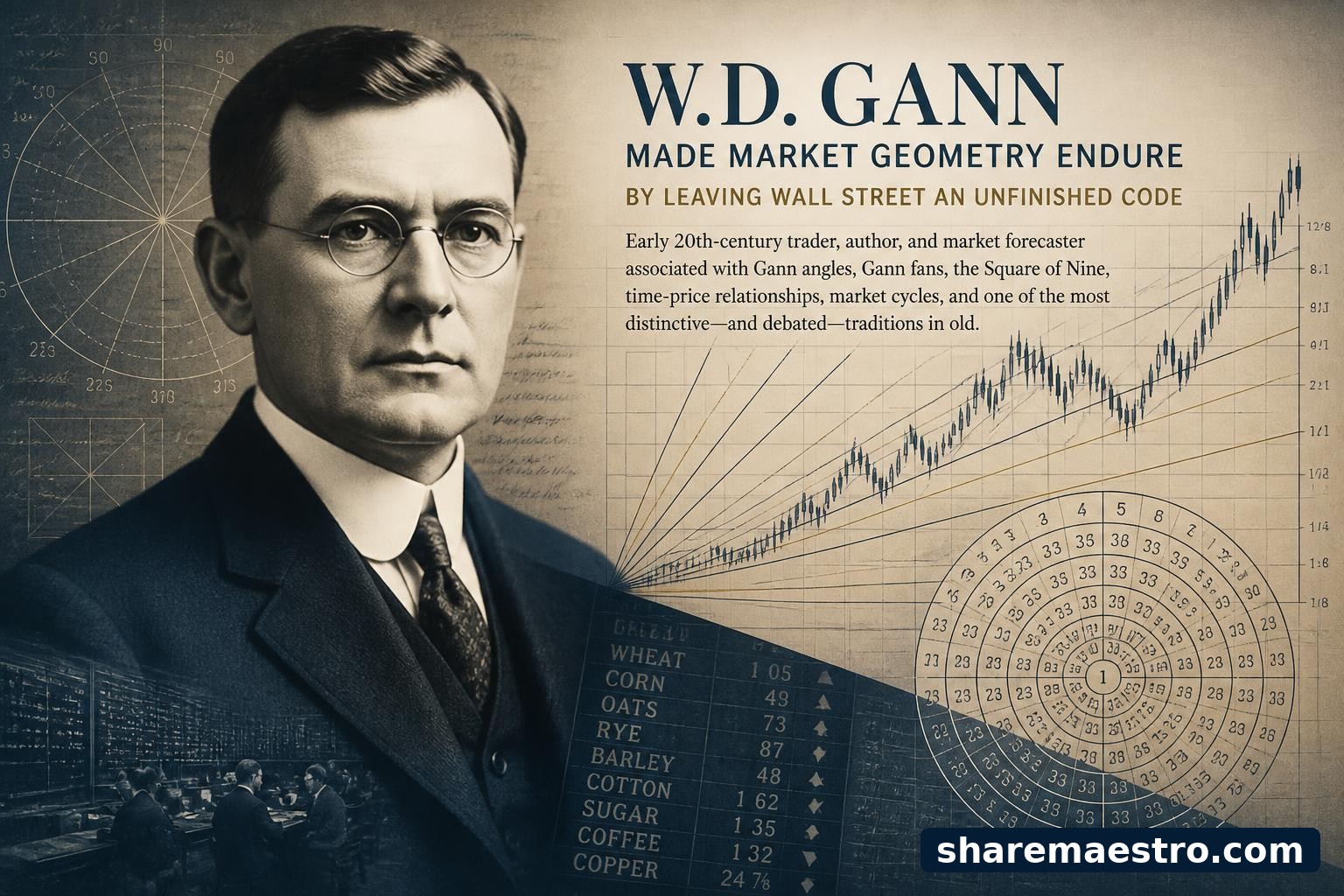
He also matters because his methods were visual. Gann angles, fans, squares and time cycles turned the market into something that could be mapped, not merely narrated. Modern charting software did not preserve most early twentieth-century market literature, but it preserved Gann's name because his ideas could become tools. A user can draw a fan from a high or low, test a scale, compare slope and trend, and feel that the chart has acquired a geometry. The appeal is immediate, even when the evidence is uncertain.
That persistence does not vindicate every claim. It does explain why Gann belongs in any serious history of trading technique. The efficient-market tradition has long challenged the idea that past price patterns can reliably produce excess returns, and empirical evidence on technical rules is mixed. Yet traders continue to study price behavior because markets are human, leveraged, reflexive and unevenly liquid. Gann's legacy lives inside that tension: the desire to measure patterns rigorously and the temptation to believe the measurement has revealed fate.
From Lufkin to the speculative tape
William Delbert Gann was born in Lufkin, Texas, on June 6, 1878, and died in New York on June 18, 1955. The bare dates place him in the decisive era of American market formation: the rise of national commodity exchanges, the railroad and steel securities culture, the pre-SEC world of pools and manipulation, the 1929 crash, the Depression, wartime controls and the postwar broadening of public investing. He traded and wrote through markets that were less regulated, less transparent and more personality-driven than today's electronic markets.
The 1909 account described him as 31 years old, born in Lufkin, gifted with numbers, and already seasoned by loss. Gann's own explanation in that article began with a confession common to many speculators: he had lost money early and concluded that trading without preparation was not a profession but a hazard. He presented himself as a student of markets, not merely a gambler, and claimed to have devoted years to studying recurrence in stocks and commodities.
That self-portrait became central to the Gann legend. He was the outsider who supposedly entered Wall Street through study rather than social position, the trader who treated charts as records of law, and the teacher who later sold the discipline he claimed to have discovered. His Texas origin also mattered symbolically. It connected him to cotton, weather, crop cycles and commodity markets, the arenas where time, season and price can appear more naturally linked than they do in common stocks.
The 1909 legend and its limits
The Ticker and Investment Digest article remains the indispensable Gann document because it provides the most specific public performance claim associated with him. It reported 286 trades during October 1909, 264 profitable and 22 losing, across long and short positions. It also said the capital he operated with ended the month at 1000 percent of the original margin. Those figures have been repeated for generations because they are vivid, measurable and almost impossibly flattering.
Yet a financial journalist has to handle them carefully. The account was a magazine article from an era before standardized performance reporting, independent account verification, modern audit practices or regulatory marketing controls. It described trades seen by a representative, not a full career record. It did not provide position sizes, commissions, slippage, complete timestamps, account statements or survivorship context. The same article that praises Gann's precision also emphasizes that he would not reveal his method at any price.
The result is a legend with a hard numerical core and soft edges. The numbers are specific enough to command attention. The conditions are loose enough to prevent modern validation. That duality would follow Gann permanently. Admirers could point to the 1909 demonstration as proof that something extraordinary had happened. Skeptics could answer that a spectacular episode is not a transparent record. Both positions have evidence; neither exhausts the man.
A market theory built on recurrence
Gann's theory began with recurrence. In the 1909 interview, he spoke of periodic rises and falls in stocks and commodities and argued that market movements followed natural law. His language was not the language of later statistics. It was closer to a cosmology of rhythm, proportion and causation. He believed that stocks had individual characteristics, that groups led under different conditions, and that time values could help identify support, resistance and trend changes.
This way of thinking was not wholly alien to his era. Early market technicians studied tape action, volume, seasonal tendencies and historical analogy because formal financial economics had not yet claimed the field. The market was often treated as a living organism, one that breathed through accumulation, distribution, panic and recovery. Gann pushed that impulse further than most. He did not merely say that history rhymed. He implied that the rhyme could be measured with enough data, patience and numerical discipline.
The strength of this approach was that it forced exhaustive historical study. The weakness was that recurrence can be seductive. A trader who believes every market event has a hidden prior form may begin to see confirmation everywhere. Gann's best practical inheritance is the habit of comparing present structure with prior movements. His most dangerous inheritance is the belief that pattern recognition can cross the line from probability to inevitability.
Price, time and the geometry of balance
The Gann concept most visible today is the union of price and time. A Gann angle is not just a line on a chart. It expresses a rate of movement, such as one unit of price for one unit of time. TradingView's documentation describes the Gann fan as a set of nine diagonal lines designed to show potential support and resistance, with the 1x1 angle representing a 45 degree relationship when price and time are properly scaled.
The scale requirement is crucial. Without it, a Gann line can become decorative geometry. Change the chart scale and a supposedly decisive angle can shift its meaning. Gann students have long argued that the analyst must find the correct price-time ratio for the instrument. Critics reply that this creates too much discretion, allowing the user to adjust the geometry after the fact. The same feature that gives Gann work its flexibility also makes it difficult to test cleanly.
Still, the insight behind the line is not trivial. Markets do not move only in price. They also consume time, exhaust participants, trap late entrants and test conviction. A slow advance differs from a vertical spike, even if the price change is the same. Gann's geometry gave traders a vocabulary for that difference. It made slope, duration and trend strength part of one visual grammar.
The practical trader beneath the mystic
The mystical reputation can obscure a plainer Gann: a trader obsessed with rules. His early books and later course material repeatedly emphasize charting, trend detection, resistance levels, price action, volume, seasonal tendencies, time counts and protective discipline. The authorized publisher's description of the stock course lists topics such as forecasting, natural resistance levels, time cycle points, form reading, Dow Jones data, volume of sales, seasonality and price resistance. That is a broad technical curriculum, not merely occult theater.
In Truth of the Stock Tape and Wall Street Stock Selector, the recurring message is conservative speculation. The trader should have a reason for each trade, avoid haste, and avoid positions too large for judgment. That advice is not exotic. It belongs with the enduring rules of speculation: know the trend, define the risk, do not average blindly, and do not confuse hope with analysis. Gann's distinctiveness was in embedding those rules inside a larger architecture of time and proportion.
This is why serious readers can separate two Ganns. One is the prophet of hidden order, whose followers search for planetary keys, coded fiction and master calculators. The other is the technician who insisted that markets be charted carefully and that a trade be governed by rules before emotion enters. The second Gann is less glamorous, but more useful. He makes fewer promises and demands more work.
Books, courses and the business of method
Gann was not only a trader. He was a publisher, educator and seller of market instruction. The modern authorized catalog presents a library of 10 books in 9 volumes, including How to Make Profits Trading in Commodities, New Stock Trend Detector, The Tunnel Thru the Air, Truth of the Stock Tape with Wall Street Stock Selector, 45 Years in Wall Street, The Magic Word, How to Make Money Trading in Puts and Calls, Face Facts America and W.D. Gann Economic Forecaster.
The course business is equally important to understanding the controversy. The modern stock course page says Gann sold these courses for over $5000, a striking sum in the mid twentieth century. It also describes a 400-page stock course drawn from archival material, with charts, examples of trades and lessons on Gann lines, time cycles, price-time relationships, Gann squares and calculators. Whatever one thinks of his trading record, Gann plainly created an educational franchise around his market persona.
That business model invites suspicion, but it does not by itself disprove his ideas. Finance has always had practitioners who teach, write and sell tools. The legitimate question is narrower: did the paid instruction deliver testable rules, or did it preserve dependence on the teacher's aura? Gann's output seems to have done both. It gave students detailed procedures and charts, but it also left enough mystery to keep the search alive.
Commodities and the independent contract
Gann's commodity work is central because it connected his interest in time with markets where calendar, season and storage can shape behavior. The authorized description of How to Make Profits in Commodities says Gann considered it the product of 50 years of experience and presents it as a rule-based treatment of commodity markets. The book's reputation among Gann students rests on its hundreds of examples and its effort to translate broad principles into grain and futures practice.
Commodities also suited Gann's belief that each market had its own character. A stock belongs to an industry group, a balance sheet and a speculative crowd. A commodity contract is tied to harvests, delivery months, weather, inventory and commercial hedging. That structure can encourage a trader to think cyclically. It can also punish anyone who treats a calendar pattern as a guarantee, since wars, policy shocks, crop surprises and liquidity squeezes can overwhelm historical rhythm.
The most defensible reading of Gann's commodity work is that he wanted traders to respect both individuality and repetition. Wheat was not cotton, and cotton was not steel. Each required its own record. That idea remains sound. The trouble begins when the record is treated as a secret code with only one answer. Markets have memory, but they also have mutation.
Forecasting, fiction and the coded reputation
No part of Gann's reputation is more unusual than The Tunnel Thru the Air, his 1927 novel. The Internet Archive catalog identifies it as a 1927 publication by Financial Guardian Publishing Co., 418 pages in the scanned copy. The Science Fiction Encyclopedia treats Gann as a finance trader and author whose fiction offered a near-future tale of prediction, war and invention, with the book itself often read by followers as more than a surface story.
The novel matters because it blurred the line between market forecast, prophecy and coded instruction. Gann's admirers have often treated it as a repository of veiled meaning, a text whose dates, names and events might unlock his deeper method. To outsiders, that can look like numerological overreach. To devotees, it is part of the apprenticeship. The same ambiguity that surrounds the chart work surrounds the fiction: is the reader studying a method, or searching for a key that may never be demonstrable?
Financial history is full of traders who wrote memoirs after they won or lost. Gann wrote a speculative novel that helped turn his market practice into an interpretive tradition. That made his legacy more durable, but also less falsifiable. A rule can be tested. A symbol can always be reread.
Risk management in deterministic language
One of the paradoxes of Gann is that a deterministic vocabulary coexists with conservative trading advice. He could write as if markets obeyed exact proportion, yet his practical rules warned against careless entry, excessive size and trading without reason. The tension is productive. If a trader truly believes a forecast is certain, risk controls become secondary. If a trader believes a setup is only probable, stops, sizing and patience become essential.
The better Gann tradition belongs to the second camp. His emphasis on protective action, chart study and defined levels can be read as a system for controlling error. A Gann angle may suggest support, but if the support breaks, the trader has information. A time count may suggest a turn, but if price does not confirm, the trader must wait. The method becomes dangerous only when interpretation is allowed to outrank market evidence.
Modern market efficiency arguments reinforce that humility. In developed markets, prices incorporate information quickly enough that any rule based on public price history faces a high burden of proof. That does not make every technical observation useless, but it makes certainty expensive. Gann's risk lesson, stripped of metaphysics, is that structure must be paired with invalidation. A forecast without an exit is not analysis. It is exposure.
The record: brilliant clip, thin audit
Gann's performance evidence is concentrated rather than continuous. The 1909 article is the bright flare: 286 observed trades, a reported 92.3 percent profitable-trade rate, and a month-end margin figure described as 1000 percent of the original amount. The same account includes third-party anecdotes about price predictions in Union Pacific, U.S. Steel, wheat and cotton. It is impressive, specific and historically consequential.
But it is not the same as an audited fund record. Gann did not leave a public series of annual returns comparable to a modern hedge fund, commodity trading advisor or investment partnership. Later promotional claims about vast fortunes should be treated cautiously unless tied to verifiable records. The title 45 Years in Wall Street suggests a long career of market involvement, and the publisher describes the book as a distillation of decades of technical experience, but experience is not the same as documented compounding.
That distinction does not diminish his influence. It locates it properly. Gann should not be profiled as a manager whose Sharpe ratio changed institutional allocation. He should be profiled as a market technician whose reported feats, publications and teaching created a durable school. His record is not absent, but it is incomplete. The honest profile must leave that incompleteness visible.
The criticism: arbitrary lines and weak-form doubt
The strongest criticism of Gann is not that geometry can never matter on a chart. It is that the full method can be too adjustable. If the analyst may choose the high or low, choose the scale, choose the cycle length and reinterpret a failed date as a near miss, the method risks becoming hindsight organized with a ruler. A tool that cannot be wrong in advance cannot prove much after the fact.
Financial economics adds another challenge. The weak form of market efficiency questions whether past price and volume data can reliably produce abnormal returns after costs. CFA Institute's market-efficiency reading notes broad evidence supporting semi-strong efficiency in developed markets, while recognizing that anomalies and behavioral explanations complicate a simple dismissal. The serious critique of Gann should therefore avoid caricature. Markets are not perfectly efficient machines, but neither are they obliged to honor a hand-drawn square.
Academic work on technical rules has produced mixed findings. Brock, Lakonishok and LeBaron famously tested moving-average and trading-range break rules on the Dow Jones Industrial Average from 1897 to 1986, showing why technical analysis can be studied empirically rather than accepted or rejected by taste. Gann's more complex toolkit is harder to test than those simple rules. That difficulty is part of its weakness and part of its mystique.
How charting platforms kept him alive
Gann survived digitization because his work translated into software. TradingView's Gann fan documentation describes a tool made of diagonal angles, anchored from market highs or lows, intended to judge support, resistance, trend and strength. The platform also groups Gann fan, Gann square and Gann box concepts as living chart objects. This is a remarkable afterlife for a trader born before radio broadcasting became commercial.
Professional technical-analysis circles also keep returning to him, though often in moderated form. CMT Association material around Hima Reddy notes her book on W.D. Gann's trading methodologies and her effort to apply price and time analysis to modern futures markets. That kind of work tends to domesticate Gann. It reduces the cosmic claim and emphasizes patterns, risk, timing and trader process.
This is the form in which Gann is most likely to remain relevant. Not as a secret master whose exact forecasts can be recovered, but as a historical source of charting concepts that can be adapted, simplified, tested and rejected when necessary. Software made his lines easier to draw. It did not make them automatically profitable. The burden still belongs to the trader.
What survives and what misleads
What survives from Gann is the insistence that price alone is insufficient. Time matters. Trend age matters. The rate of advance or decline matters. Repeated levels matter because traders remember, anchor and defend them. A market that rises too far too fast is not the same as one that advances in orderly steps. These insights can sit comfortably inside a disciplined technical process without requiring belief in a perfect hidden code.
What misleads is the promise of precision without evidence. Gann's vocabulary can make forecasts sound engineered even when they rest on discretionary choices. The Square of Nine, the fan, the anniversary date and the cycle count can become instruments of confirmation bias. A trader who wants certainty will find it easy to make the chart speak. The market, however, pays for execution, risk control and adaptability, not for symbolic elegance.
Gann's continuing relevance is therefore double-edged. He is useful as a reminder that markets have structure beyond news and valuation, and that the best traders often study history with obsessive care. He is dangerous when his methods are sold as destiny. The fairest verdict is neither genius worship nor easy dismissal. W.D. Gann turned speculation into geometry, then left enough mystery for every generation to decide whether the lines reveal the market or the trader drawing them.
Disclosure
Educational financial journalism and market research only. Not financial, investment, trading, tax, or legal advice.