In brief
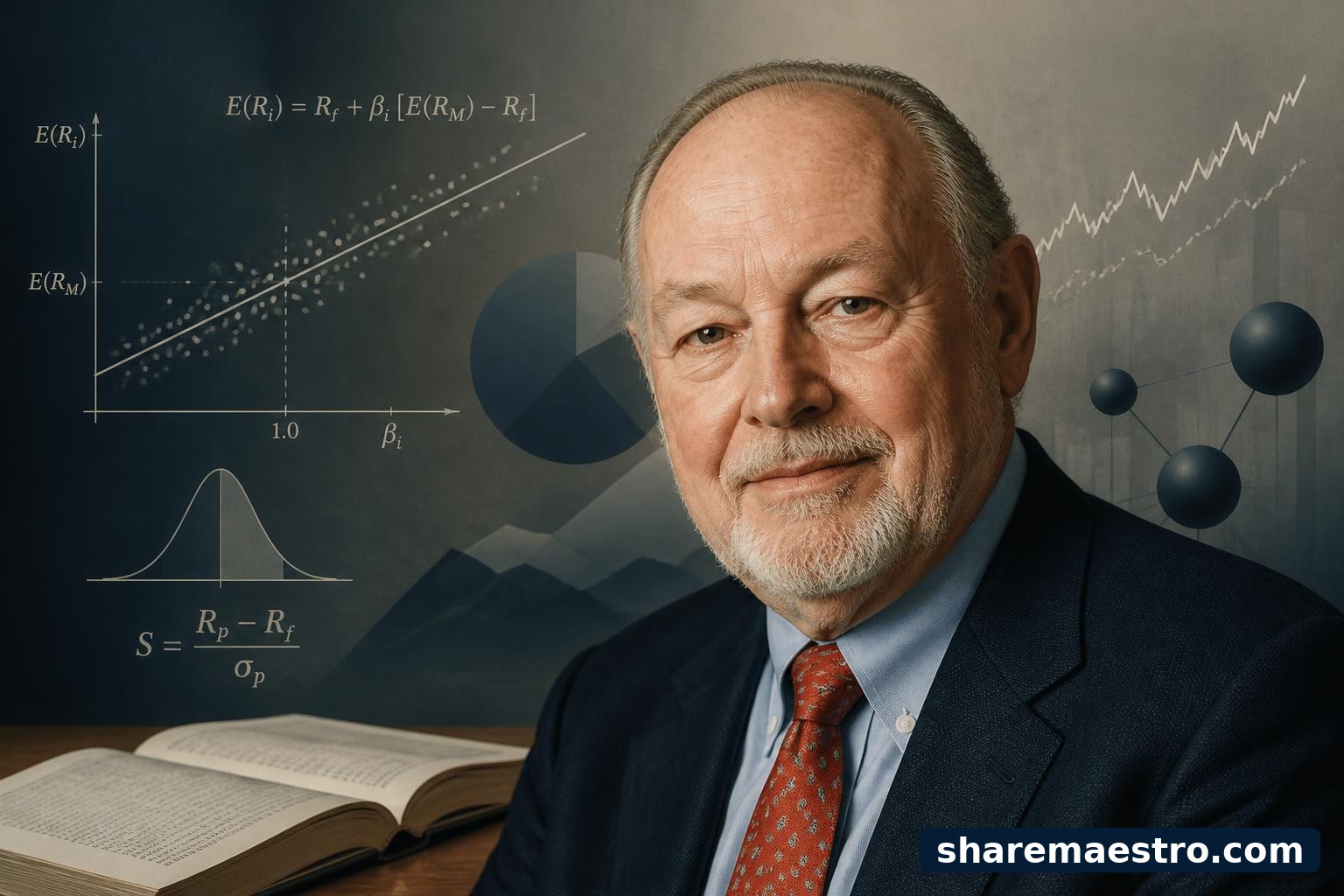
William F. Sharpe is best known for the Capital Asset Pricing Model and the Sharpe ratio, but his deeper contribution was to make risk measurable, comparable, and usable in portfolio decisions. His work moved finance from judgment and storytelling toward disciplined trade-offs among expected return, volatility, diversification, costs, benchmarks, and investor circumstances. The result shaped index investing, fund evaluation, asset allocation, retirement advice, and the professional language of investment committees. The same ideas also drew criticism when beta failed empirical tests, when backward-looking ratios were mistaken for reliable forecasts, and when simple measurements were used to justify complex products. Sharpe's enduring relevance lies in that tension: he gave markets a clearer ruler, while showing why the ruler is never the thing being measured.
- Sharpe helped transform finance from security-by-security judgment into a system for linking expected return to systematic risk, most famously through the Capital Asset Pricing Model.
- The Sharpe ratio grew out of his 1966 mutual fund performance work and became one of the most widely used measures of risk-adjusted return, although Sharpe repeatedly emphasized its limitations.
- His 1991 argument on active management gave index investing a powerful arithmetic defense: before costs, active dollars in aggregate equal the market, and after costs they lag in aggregate.
- Sharpe's returns-based style analysis gave institutions a practical way to separate manager style from selection, exposing how much performance came from asset allocation rather than stock picking.
- The main criticism of his framework is not that it is useless, but that beta, volatility, and historical averages can become dangerous when treated as sufficient descriptions of risk.
- His later work on Financial Engines and retirement income extended financial economics from institutional portfolios toward individual investors facing saving, drawdown, longevity, and uncertainty.
Performance and evidence
Performance markers
Visual Evidence
Charts and timelines
Risk
Timeline
Philosophy
Performance
The ruler on every trading desk
The most durable ideas in finance often win by becoming invisible. A portfolio manager ranks funds by risk-adjusted return. A consultant asks whether a mandate beat its style benchmark. A chief investment officer separates market exposure from manager skill. A wealth platform converts an investor's preferences into a mix of funds. In each case, some part of the intellectual machinery traces back to William F. Sharpe, the Stanford economist who helped teach Wall Street that return without risk is an unfinished sentence.
Sharpe is usually summarized in two nouns: CAPM and Sharpe ratio. That shorthand is accurate but too small. His career was a sustained campaign to convert loose investment language into operational rules. What kind of risk should command compensation? How should a fund be compared with another fund? What does active management become after costs? How much of a manager's record reflects style rather than skill? These questions are not antique classroom puzzles. They sit inside portfolio reviews, fund rating systems, target-date funds, risk models, and retirement advice engines.
The paradox of Sharpe's legacy is that his work became most powerful when practitioners made it routine, and most dangerous when they made it mechanical. He gave markets a clean way to discuss systematic risk, a simple ratio for comparing performance, and a hard-edged arithmetic case for passive investing. He also spent much of his later work qualifying those tools. Risk could be summarized, not fully captured. Past returns could be measured, not trusted. Models could discipline judgment, not replace it.
Why Sharpe matters
Before modern portfolio theory took hold, investment analysis was often organized around stories about securities, managers, industries, and cycles. Sharpe belonged to the generation that changed the unit of analysis. The investor was not simply choosing attractive stocks. The investor was choosing exposures, correlations, volatility, diversification, costs, and trade-offs across possible futures. Harry Markowitz had given finance its mean-variance architecture. Sharpe helped connect that architecture to asset prices in equilibrium and to performance measurement in practice.
His influence is not limited to one academic model. Stanford's own summary of his career credits him as an originator of the Capital Asset Pricing Model, developer of the Sharpe ratio, contributor to the binomial method for valuing options, developer of the gradient method for asset allocation optimization, and creator of returns-based style analysis for evaluating investment funds. That list shows the breadth of his work: theory, measurement, computation, implementation, and investor advice.
Sharpe shared the 1990 Sveriges Riksbank Prize in Economic Sciences in Memory of Alfred Nobel with Markowitz and Merton Miller for pioneering work in financial economics. The prize ratified what markets had already absorbed. By then, his ideas were part of the grammar of investment management. The language of beta, efficient portfolios, market risk, excess return, active return, tracking error, and style benchmarks had become a professional dialect. Few finance scholars have changed both the blackboard and the client report so completely.
From Boston to RAND
William Forsyth Sharpe was born in Boston on June 16, 1934, and came of age far from the later mythology of the trading floor. His formal path ran through the University of California, Los Angeles, where he earned an economics A.B. in 1955, an M.A. in 1956, and a Ph.D. in 1961. The timing mattered. Economics was becoming more mathematical, computers were moving from curiosity to research tool, and portfolio theory was beginning to look like a field rather than a set of scattered insights.
The decisive early institution was the RAND Corporation, where Sharpe worked as an economist from 1956 to 1961 while pursuing his doctorate. RAND offered an unusual mix: applied problems, mathematical methods, programming, decision theory, operations research, and an expectation that elegant analysis should still be useful. Sharpe later described RAND as a setting where fundamental research and pragmatic work could coexist. That combination would mark his finance career.
At RAND, Sharpe encountered Harry Markowitz, whose portfolio selection work had already reframed investment risk as something that belonged to a portfolio rather than to a security in isolation. Sharpe's dissertation, completed at UCLA, developed a simplified model of relationships among securities. The aim was not to deny complexity. It was to find a tractable structure that could make complexity manageable. That instinct, simplification without surrendering the economic problem, became the spine of his work.
The Markowitz inheritance
Sharpe's first great move was to extend the Markowitz revolution. Markowitz had shown that a rational investor should consider expected return, variance, and covariance, not simply expected return alone. Diversification was not a slogan. It was a mathematical relation among assets whose returns did not move perfectly together. Yet Markowitz's framework was computationally demanding and, on its own, did not fully explain how the market should price risk across assets.
Sharpe took the next step by asking what portfolio theory implied in equilibrium if investors had similar expectations and could lend or borrow at a risk-free rate. The result was the Capital Asset Pricing Model, published in The Journal of Finance in 1964. In simplified form, CAPM says that the expected return of a security should be related not to its total volatility, but to its contribution to the risk of the market portfolio. That contribution became beta.
The intellectual economy of the model was extraordinary. Idiosyncratic risk, the risk unique to a company, could be diversified away. Systematic risk, the risk tied to the market as a whole, could not be eliminated by holding more securities. Therefore, the market should reward systematic risk, not diversifiable noise. For investors trained in balance sheets and earnings stories, this was a stark message. A security's expected return depended on what it did to a diversified portfolio.
Beta as a new price of risk
Beta became one of finance's most famous simplifications. A beta above one suggested an asset that amplified market movements. A beta below one suggested a more defensive exposure. In the CAPM world, expected return rose with beta because beta represented exposure to market risk. The model gave analysts a way to estimate required returns, evaluate fund performance, think about cost of capital, and distinguish compensation for bearing market risk from skillful selection.
The model was not Sharpe's alone in the broader history of asset pricing. Jack Treynor, John Lintner, and Jan Mossin were also central to the early development of CAPM thinking. But Sharpe's 1964 paper became one of the canonical statements because it connected portfolio choice, equilibrium, and security prices in a form that could travel. It had the virtues that powerful models often have: parsimony, intuition, and portability.
For investment committees, the appeal was practical. If a manager delivered high returns by loading up on market risk, the accomplishment looked different from delivering high returns after controlling for that risk. If a corporate finance team estimated a discount rate, beta supplied a structured input. If a pension plan debated its asset mix, CAPM made the market portfolio a theoretical reference point. The model did not settle every argument, but it changed the terms of argument.
A model that was useful before it was true
Sharpe understood the power and fragility of assumptions. CAPM relies on a stylized world: investors care about mean and variance, share expectations, can access assets and borrowing on comparable terms, and face a market portfolio that can be defined and held. These assumptions are not a description of an actual trading day. They are a device for isolating a relationship between risk and expected return. The model's usefulness came from the clarity of that isolation.
That clarity produced a new way to ask whether a portfolio manager had added value. If a fund outperformed the market but did so with higher systematic risk, the excess was less impressive. If another fund matched the market with lower beta or beat an appropriate benchmark after risk adjustment, the result deserved a different interpretation. CAPM helped professionalize skepticism. It made raw performance look incomplete.
Yet the same elegance invited overuse. Beta can change. Market indexes are imperfect proxies for the true market portfolio. Investor constraints matter. Taxes, transaction costs, liquidity, short-sale limits, leverage limits, and behavioral pressures complicate the clean equilibrium. Sharpe's Nobel lecture later revisited capital asset prices with and without negative holdings, a sign that he did not regard the first model as the final model. His best work had a habit of producing a tool, then returning to the conditions under which the tool should be trusted.
The ratio that turned performance into a slope
The idea that made Sharpe a household name among analysts did not begin as a branding exercise. In his 1966 article on mutual fund performance, he introduced a reward-to-variability measure to compare funds by relating return above a riskless rate to the variability of that return. Later usage turned it into the Sharpe ratio. In his 1994 article, Sharpe accepted the common name while refining definitions for ex ante and ex post uses.
The attraction was immediate: one number could summarize excess return per unit of risk. In a world crowded with funds, strategies, and consultants, the ratio offered a common measuring stick. It moved performance evaluation away from league tables based on raw returns and toward a question more aligned with investor welfare. How much did the investor receive for bearing uncertainty? The answer could be plotted, ranked, annualized, compared, and debated.
Sharpe also stated the caveats clearly. The ratio depends on the period measured. It assumes that mean and standard deviation are sufficient for the comparison at hand. It does not by itself incorporate correlations with the investor's other assets and liabilities. It can be useful for comparing zero-investment strategies or excess returns, but it is not a full portfolio decision rule in every context. The warning is essential because the ratio's simplicity is exactly what made it easy to misuse.
The mutual fund test
Sharpe's 1966 mutual fund paper was not merely a formula in search of an application. It was an empirical attempt to evaluate funds with the tools of portfolio theory and capital market theory. The paper examined mutual fund performance in the 1954 to 1963 period and compared reward-to-variability ratios across funds and a Dow Jones industrial portfolio. It showed the practical ambition of his scholarship: theory should be able to say something measurable about actual investment products.
The exercise also exposed the discomforting nature of risk-adjusted comparison. A fund with a high average return could look less impressive once variability was included. A manager who seemed successful in a rising market could be revealed as a buyer of risk rather than a producer of skill. Conversely, a steadier fund might deserve more respect than raw returns suggested. Sharpe was giving investors a way to ask whether they had been paid for the ride they endured.
The 1966 work matters because it arrived before fund evaluation became a large industry. Today, consultant databases, institutional scorecards, and retail fund platforms routinely compute risk-adjusted measures. That machinery can feel inevitable, but it was built on conceptual decisions. Sharpe's measure turned performance into a slope: the incremental reward earned for taking incremental variability. It was a small mathematical object with large institutional consequences.
The arithmetic that humbled stock pickers
In 1991, Sharpe published one of the cleanest arguments ever made for passive management. The Arithmetic of Active Management did not depend on a heroic claim that markets are perfectly efficient. It began with definitions. Passive investors hold the market in market proportions. Active investors, collectively, hold everything else, which means that before costs, the average actively managed dollar must earn the market return. After costs, the average actively managed dollar must underperform the average passively managed dollar.
The force of the argument came from its refusal to overcomplicate. It did not say no active manager could win. It said active management in aggregate cannot be above average, because it is the other side of the market itself. Costs, fees, turnover, and taxes then turn the arithmetic against the group. This became one of the most important intellectual supports for indexing and for the later shift toward low-cost market exposure.
Sharpe's position was not anti-intelligence. It was anti-confusion. If an investor hires active managers, the investor should understand that the search is for a manager good enough to overcome costs and competition. If a plan sponsor pays for active selection, it should know what it is buying and what benchmark represents the alternative. The arithmetic made active management a burden-of-proof business. That burden remains one of Sharpe's lasting gifts to clients.
Style before skill
Sharpe's returns-based style analysis carried the same skeptical discipline into manager evaluation. In his 1992 Journal of Portfolio Management article, he described using asset class factor models to infer a fund's effective exposures from its return history. The method was powerful because it did not require full holdings data. Given fund returns and returns for asset class indexes, the analyst could estimate the passive mix that best explained the fund's behavior.
The conclusion was often humbling. Much of what investors called manager performance was really style exposure. A growth fund's return might be explained by growth indexes. A balanced fund might be a mix of bonds, cash, and equities. A successful manager might have been in the right style at the right time. In Sharpe's framework, the first task was to identify the return attributable to style; only then could one assess selection or active contribution.
The 1992 paper illustrated a 12 asset class model and applied style analysis to hundreds of open-end mutual funds from 1985 through 1989. It also showed striking explanatory power for some funds, including high shares of return variation attributable to style. The method gave consultants and institutions a practical tool for asking whether a portfolio's apparent diversification was real, whether managers overlapped, and whether fees were being paid for exposure that could be obtained more cheaply through index funds.
Portfolio construction as engineering
Sharpe's work had an engineer's quality, even when written by an economist. Define the objective. State the assumptions. Identify the relevant risk. Compare the result with a feasible alternative. Measure what can be measured, and name what remains unexplained. This is why his ideas migrated easily into software, consulting, and institutional routines. They were not just propositions. They were procedures.
His career after the first wave of CAPM work reflected that tendency. He taught at the University of Washington, the University of California at Irvine, and Stanford, where he joined the faculty in 1970 and later became the STANCO 25 Professor of Finance, Emeritus. He consulted with financial institutions, wrote textbooks, developed asset allocation methods, and pursued topics that sat between theory and application. The line between professor and practitioner was unusually porous.
That porous line is important to understanding his influence. Sharpe was not a trader in the profile-series sense, nor a fund manager whose record can be reduced to compounded returns. His record is embedded in the systems used to judge those people. He shaped how others' performance is measured, how risk budgets are discussed, how fund styles are decomposed, and how investors are warned against confusing a lucky outcome with a reliable process.
Financial Engines and the move to individuals
In 1996, Sharpe co-founded Financial Engines with Joseph Grundfest and Craig Johnson. The company was built around a practical problem: personalized investment advice had long been easier to deliver to institutions and affluent households than to ordinary retirement savers. Financial Engines tried to automate and scale portfolio advice for workplace plans, bringing techniques associated with institutional finance into the defined contribution market.
The company's 2010 initial public offering prospectus described its investment process as technology-based and tied to methodologies pioneered by Sharpe. It also noted his service as chairman from the company's founding in June 1996 until February 2003, and as a director until April 2009, after which he became director emeritus. The IPO offered 10.6 million shares at $12 each, a marker of how far the effort to industrialize retirement advice had traveled.
This phase of Sharpe's career is easy to understate because it lacks the elegance of a single famous equation. Yet it may be one of the clearest expressions of his lifelong project. He had spent decades asking how investors should choose under uncertainty. The defined contribution system pushed that problem onto millions of individuals with limited time, limited training, and high stakes. Financial Engines was an attempt to make the machinery of financial economics serve that audience.
Retirement as the harder problem
Sharpe's later attention to retirement income was not a departure from risk-adjusted thinking. It was an escalation. Accumulation problems are difficult enough: save, allocate, rebalance, and estimate a range of possible wealth at retirement. Decumulation adds mortality, spending needs, inflation, market uncertainty, annuitization, Social Security, taxes, household preferences, and the psychological burden of irreversible decisions. The answer is not a single optimal stock-bond mix.
This later work also showed Sharpe's skepticism toward easy rules. A fixed withdrawal rule may be memorable, but it compresses many risks into a comforting phrase. An annuity may solve longevity risk for some income needs, but it introduces trade-offs around liquidity, bequests, pricing, and inflation protection. A glide path may make sense for a default investor, but it cannot know every household balance sheet. Sharpe's instinct was to turn slogans back into probability distributions and preferences.
There is continuity here with CAPM and the Sharpe ratio. In each case, he sought a disciplined way to think about uncertainty. The difference is that retirement makes the human stakes more visible. A pension fund can revisit policy. A retiree who overspends early, underinsures longevity, or panics during a bear market may not get a second chance. Sharpe's later relevance lies partly in pushing financial economics toward this more personal, less forgiving problem.
Where the model breaks
The strongest critique of Sharpe's work is not that his models failed to matter. It is that they mattered so much that users often forgot the assumptions. CAPM's empirical record became a central problem in asset pricing. Tests found that beta alone did not explain the cross-section of average returns as cleanly as the model implied. Size, value, momentum, profitability, investment, and other factors later challenged the idea that one market beta could carry the full burden.
Fama and French's critical review of the CAPM argued that the model's empirical problems were serious for many applications. The market proxy problem was especially damaging: the true market portfolio is not simply a stock index, and if the model cannot be tested with the true market portfolio, its practical uses become more fragile. The lesson was not that CAPM should be discarded from memory. It was that the model should be used as a benchmark, not treated as a law of nature.
The Sharpe ratio has its own failure modes. Strategies that sell tail risk can look excellent for long periods and then collapse. Illiquid assets can report smoothed returns that flatter volatility-based ratios. Return distributions can be skewed or fat-tailed, making standard deviation an incomplete measure of pain. A high historical Sharpe ratio can invite leverage just before the pattern changes. Sharpe knew the ratio was a summary statistic. The market sometimes treats it as a certificate of quality.
What Sharpe did not promise
Sharpe's reputation occasionally suffers from the success of caricatures. He did not promise that markets are perfectly rational at every second, that beta is the only useful risk measure in every setting, or that the Sharpe ratio can replace judgment. He built models to clarify trade-offs. A model that strips away taxes, frictions, constraints, and changing expectations can still be useful if the user remembers what has been stripped away.
The same distinction matters in active management. The arithmetic argument does not say that all active management is foolish. It says that active management is a zero-sum game before costs and a negative-sum game after costs, for the active group as a whole. A talented manager can still win. An investor can still have non-market objectives. A taxable account, liability-driven portfolio, or values-based mandate may justify deviations from a pure market portfolio. Sharpe's framework demands that the deviations be named and paid for knowingly.
His best ideas impose humility. If a portfolio's return can be explained by cheap factor exposure, do not call it genius. If a high-return strategy also has high volatility, do not call it superior without adjustment. If an active manager wins, ask whether the result survived the right benchmark, risk measure, fee load, tax impact, and time period. Sharpe made investing more quantitative, but the deeper lesson was ethical as much as mathematical: be precise about what the client is receiving.
The continuing relevance of a cautious quant
Sharpe's influence has only broadened in the age of index funds, factor products, robo-advice, and institutional risk dashboards. The modern investor is surrounded by products that speak his language, even when they do not cite him. Smart beta funds decompose exposures. Alternatives pitch low correlation and high Sharpe ratios. Consultants distinguish policy return from active return. Retirement platforms convert risk tolerance into allocation. The vocabulary is Sharpean, even when the marketing is not.
That ubiquity creates a modern danger. Once a measure becomes standard, it can become a target. Managers can optimize for a reported ratio rather than for investor welfare. Product sponsors can mine historical data until a strategy looks efficient. Institutions can mistake benchmark-relative risk for the risk of failing beneficiaries. Retail investors can interpret a fund ranking as a forecast. Sharpe's own caveats are therefore more relevant, not less, in a market saturated with analytics.
The fairest verdict is that William Sharpe did not solve investing. He made it harder to speak carelessly about investing. He forced return to answer to risk, active skill to answer to arithmetic, manager labels to answer to style analysis, and elegant theory to answer to empirical criticism. His career is a reminder that the best financial models do not abolish uncertainty. They make uncertainty harder to ignore.
Disclosure
Educational financial journalism and market research only. Not financial, investment, trading, tax, or legal advice.