In brief
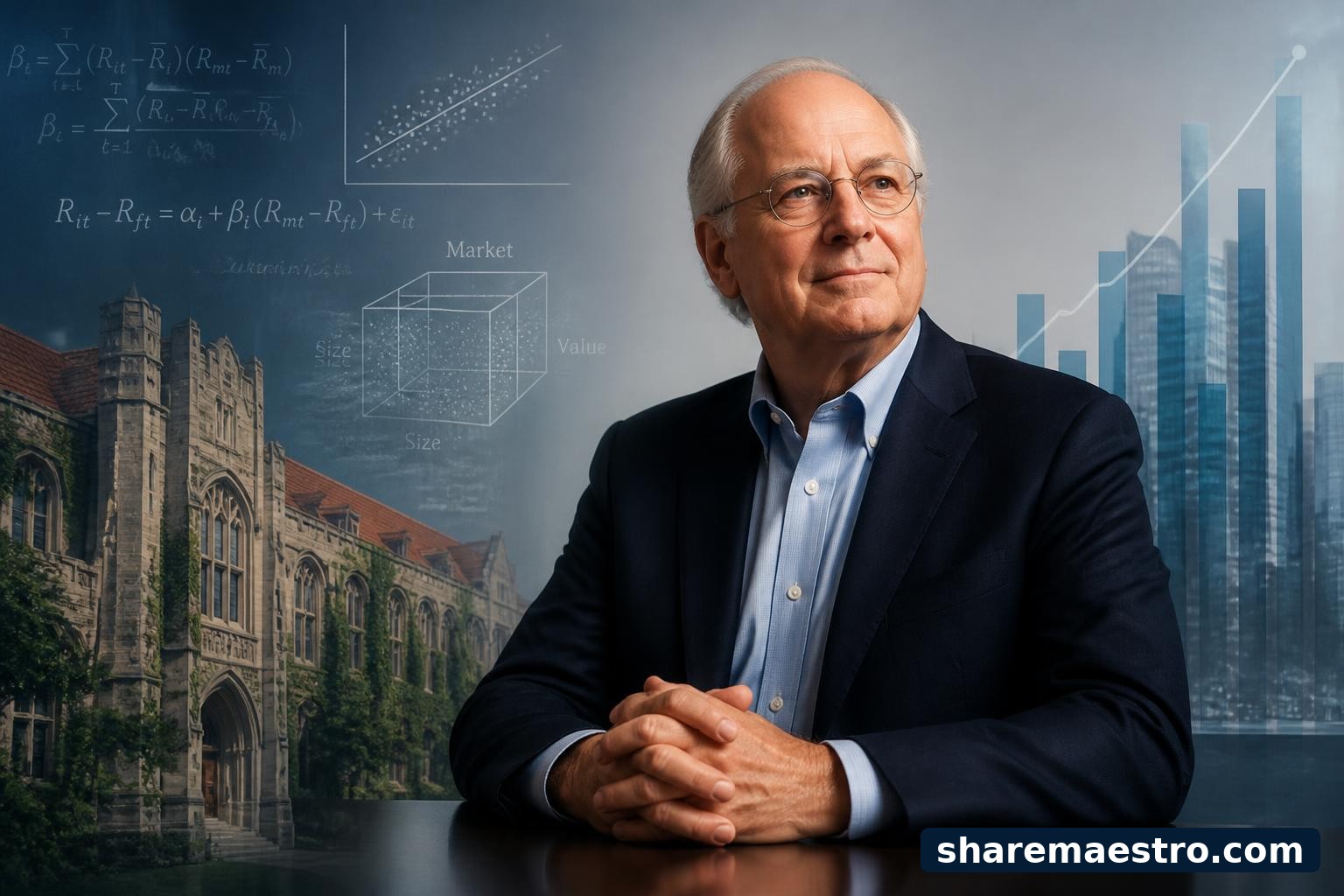
David G. Booth turned the efficient-market revolution into a durable asset-management business. After studying at the University of Chicago and helping build one of the earliest institutional index portfolios at Wells Fargo, he co-founded Dimensional Fund Advisors in 1981 around a simple but demanding proposition: markets are powerful information processors, but portfolios can still be designed to target higher expected returns through dimensions such as size, value, profitability, fixed income term, and credit. His record is not a clean triumph over indexing, nor a refutation of active management. It is a more complicated story about evidence, implementation, advisor discipline, factor droughts, fees, and the challenge of staying faithful to a probabilistic idea when the market spends years embarrassing it.
- Booth matters because he helped move academic asset pricing from seminar rooms into investable portfolios, especially through Dimensional's early small-company strategy and later factor-based equity and fixed income funds.
- Dimensional's method sits between conventional indexing and traditional active management: it trusts market prices, diversifies broadly, avoids forecasts, but deliberately tilts toward research-backed return drivers.
- The record is strong in some flagship strategies and more mixed in core equity products, which makes Booth's legacy more credible as implementation history than as a simple promise of persistent outperformance.
- The main risks are behavioral as much as statistical: small-cap and value tilts can lag for long periods, and investors may abandon the approach when the expected premium is most uncomfortable to hold.
- Booth's enduring influence is the model of the asset manager as an applied research institution, with academics, traders, advisors, and portfolio engineers joined in one commercial machine.
Performance and evidence
Performance markers
Visual Evidence
Charts and timelines
Risk
Timeline
Philosophy
Performance
The spare bedroom that became a theory factory
David Booth's most famous office was not an office at all. Dimensional Fund Advisors began in 1981 in the spare bedroom of his Brooklyn Heights brownstone, a modest setting for a firm that would spend the next four decades arguing that Wall Street's most lucrative myth was also its least reliable: that a gifted manager could repeatedly outguess the market by force of insight, charm, and proprietary conviction.
The scene matters because Booth's career was built on an inversion of the usual investment-founder story. He did not present himself as a market seer. He did not sell a heroic record of concentrated stock calls. His proposition was cooler and, in many ways, more radical. If prices already incorporated an enormous amount of information, the investor's problem was not to find hidden truth in a quarterly report. It was to design a portfolio that captured broad sources of expected return, minimized avoidable cost, and could be held when the statistical edge disappeared from view.
That is why Booth occupies a distinct place in modern finance. John Bogle made the index fund a moral and commercial weapon for the retail investor. Eugene Fama supplied the academic architecture of market efficiency. Booth's contribution was to build a working firm between those two worlds, one that accepted the humility of indexing but rejected the idea that a portfolio had to be mechanically tied to a commercial benchmark. Dimensional became the operating system for a particular kind of evidence-based investing.
Why Booth matters
Booth matters because his career changed what counted as an investable idea. The efficient-market hypothesis could have remained a set of papers, seminars, and PhD arguments. The small-company effect could have remained a pattern in historical returns. Factor models could have stayed on blackboards and in journals. Dimensional's commercial achievement was to turn those abstractions into funds, trading rules, advisor relationships, and client portfolios.
This was not merely passive investing with a different label. Dimensional's approach accepted that public markets set prices through millions of competing buyers and sellers, but it also argued that not all market exposure carries the same expected return. The firm emphasized dimensions such as company size, relative price, profitability, and, in fixed income, term and credit. In practice, that meant broad ownership rather than security selection, but with purposeful tilts away from a plain market-capitalization portfolio.
The result made Booth one of the most influential builders of systematic asset management. By 2026, Dimensional said it had grown into a global firm with more than 1,600 employees and about $1.1 trillion in assets under management. That scale is the tangible evidence of Booth's central wager: investors would accept a disciplined, probabilistic investment philosophy if it was implemented consistently and delivered through institutions and advisors who could help them stay with it.
From Lawrence to Chicago
Booth's intellectual formation began far from the financial centers that later adopted his ideas. He grew up in Lawrence, Kansas, earned an economics degree from the University of Kansas in 1968 and a master's degree in business there in 1969, then headed to the University of Chicago expecting a scholarly life. He arrived as a doctoral student, but the more important destination was the finance classroom.
Chicago in the late 1960s was unusually well positioned to unsettle received wisdom. Fama, Merton Miller, Myron Scholes, and others were part of a community that treated finance as an empirical discipline rather than a trade apprenticeship. Booth has described Fama's class as life-changing. The central proposition was both austere and explosive: security prices quickly reflect available information, making consistent outperformance through conventional forecasting far harder than the industry admitted.
The point was not that markets were perfect in a moral or metaphysical sense. It was that markets were difficult opponents. New information moved prices quickly, and the burden of proof rested on anyone claiming an easy way to earn excess returns. For Booth, this idea was not a counsel of despair. It was the beginning of a business plan. If investors could not reliably identify mispriced stocks, they could still own public markets intelligently.
Wells Fargo and the first implementation problem
After leaving Chicago with an MBA in 1971, Booth joined Wells Fargo Bank in San Francisco. That move placed him inside one of the earliest practical tests of index investing. John McQuown led the Wells Fargo effort to build an institutional index fund at a moment when the combination of computing power, security databases, and academic finance was just beginning to alter what portfolio management could do.
Indexing was not obvious in the early 1970s. The language of broad market exposure was still alien to an industry organized around manager judgment. The operational details were difficult, too. How should a portfolio approximate an index when trading costs were high, data were imperfect, and many institutions still believed low-turnover market exposure looked like intellectual surrender? Booth's education had prepared him for the theory. Wells Fargo exposed him to the plumbing.
That experience became essential to Dimensional. Booth learned that an investment idea does not become useful because it is elegant. It becomes useful when it survives costs, client constraints, trading frictions, governance, and human impatience. This emphasis on implementation would become a recurring theme in his career, and it is the reason Dimensional could later describe itself as something more than a research boutique and something more exacting than an index-fund shop.
The small-company fund as founding act
Dimensional's first great commercial insight was that the broad market was not the only market worth systematizing. Booth and Rex Sinquefield founded the firm in 1981 around the opportunity to give institutions exposure to small-company stocks, an area many large portfolios had neglected. Chicago Booth later described Dimensional as the first firm to introduce a fully indexed small-business stock fund.
The timing was not accidental. Rolf Banz's 1981 research examined the relationship between returns and market value and found that the size effect was concentrated among very small firms. The paper was careful about interpretation, noting that size itself might be a proxy for other unknown factors. Booth's practical move was to treat the evidence as sufficiently important to engineer a portfolio around it, while accepting that implementation would determine whether the idea helped clients.
Small-company investing also illustrated the tension that has followed Dimensional ever since. The evidence suggested higher expected returns, but the securities could be less liquid, more volatile, and more expensive to trade. A naive small-stock index could win the theory and lose the execution. Dimensional's early identity was therefore forged around a problem that looked technical but was deeply philosophical: how to pursue a premium without allowing costs to consume it.
Not quite indexing, not quite active management
The easiest mistake is to call Booth simply an index pioneer. He was that, but Dimensional's mature strategy was never pure index replication. The firm's rhetoric is built around trust in market prices, broad diversification, low costs, and skepticism toward forecasts. Yet its portfolios are deliberately different from standard benchmarks. They are designed to lean into characteristics that the firm believes are associated with higher expected returns.
This distinction gave Dimensional its commercial identity. Traditional active managers ask clients to believe in a person's ability to identify winners and losers. Standard index funds ask clients to accept the market portfolio or a benchmark slice of it. Booth's model asked investors to accept a third proposition: markets are hard to beat through stock picking, but portfolios can be structured to improve expected returns by changing weights, trading patiently, and avoiding the forced transactions that benchmarks impose.
The claim is powerful but limited. It is not a guarantee of outperformance in any year, or even over uncomfortable spans of years. Dimensional itself warns that value investing can underperform other equity strategies, and that small and micro-cap securities can be more volatile than other categories. Booth's innovation was not the elimination of disappointment. It was the conversion of disappointment into something clients could understand as part of the design rather than proof that the design had failed.
The academic bench as competitive advantage
One of Booth's most durable organizational moves was to keep academics close to the firm. Early in Dimensional's history he asked Fama to serve on the board of the mutual funds managed by Dimensional. Over time, the firm's orbit included Miller, Scholes, Roger Ibbotson, Ken French, George Constantinides, Abbie Smith, Robert Merton, and others. The point was not decoration. It was governance by argument.
The relationship was commercially unusual because it linked a money manager to the live evolution of financial economics. Fama and French's work helped formalize the size and value factors, and later research expanded the discussion to profitability and investment. Dimensional's own materials continue to frame portfolio design around dimensions of expected return, with market prices supplying information and systematic implementation translating that information into holdings.
There is also a built-in tension. Academics are paid to question models. Asset managers are paid to package models. The closer the two worlds become, the more important it is to distinguish evidence from marketing. Booth's best answer was process: high standards for research, global and out-of-sample testing, attention to costs, and willingness to refine portfolios as the evidence changed. That did not make the firm immune to error, but it made revision part of the institution.
The portfolio factory
Dimensional's portfolio construction process is best understood as a factory for small decisions rather than a stage for dramatic calls. The firm seeks broad exposure, then varies weights to emphasize expected-return drivers. It trades daily rather than waiting for a benchmark's scheduled rebalance. It can decide that a security is close enough for its purpose, too expensive to trade today, or better left alone until liquidity improves.
That flexibility is central to Booth's argument against traditional indexing. A standard index fund may have to buy and sell when a benchmark committee changes the list, a moment other market participants can anticipate. Dimensional has long argued that not being forced into those trades allows it to reduce costs and pursue better execution. The edge, if it exists, is not cinematic. It is measured in basis points, patience, spread management, and the refusal to overpay for precision.
The same logic applies across equities and fixed income. In equities, the firm emphasizes company size, relative price, and profitability. In fixed income, it points to term, credit, and currency as dimensions that can shape expected returns and risk. The unifying idea is not that each signal works all the time. It is that a diversified portfolio, built around persistent and sensible drivers, can offer a better expected outcome than either heroic selection or mechanical benchmark obedience.
The advisor as risk-control system
Dimensional's distribution strategy was as important as its portfolio strategy. For years, much of the firm's mutual fund access came through selected financial advisors and institutional channels. To critics, that looked like a gate. To Dimensional, it was part of the product. If the strategy required investors to survive long stretches of tracking error, the intermediary had to understand the philosophy well enough to keep clients from quitting at the wrong time.
This advisor-centered model also helped Dimensional avoid the common asset-management trap of gathering hot money after a strong run, only to lose it during the next reversal. The firm's educational culture, conferences, and advisor materials were designed to turn investment theory into client behavior. Booth's market view was not merely that investors should trust prices. It was that they should structure their financial lives so they were less tempted to turn noise into action.
The model had costs. Investors who could not access the funds directly sometimes paid advisory fees on top of fund expenses, and competitors later offered factor ETFs that were easier to buy on brokerage platforms. Dimensional's move into ETFs beginning in 2020 acknowledged that the distribution world had changed. Yet even in the ETF era, the firm continued to emphasize financial professionals, a sign that Booth's deepest conviction was behavioral as much as quantitative.
Record, scale, and the problem of measuring success
The cleanest evidence for Booth's achievement is scale. Dimensional said in February 2026 that it had crossed $1 trillion in global assets under management, a milestone for a firm founded in an apartment spare room. Its ETF business had also become central to its expansion. As of June 30, 2026, Dimensional reported 44 active ETFs and $299 billion in ETF assets, while calling itself the largest U.S. active ETF manager by assets.
Performance is more nuanced. Dimensional's own 20-year flagship equity data through March 31, 2026, show strong results in several strategies: the U.S. Small Cap Value Portfolio reported a 7.90% annualized 20-year return versus 6.98% for the Russell 2000 Value Index, while the International Small Cap Value Portfolio reported 7.17% versus 5.91% for its MSCI benchmark. Other core equity portfolios lagged their Russell 3000 benchmark over the same 20-year window.
That mixed record is important. Booth's legacy should not be reduced to the claim that Dimensional always beats indexes. It does not, and its own performance sheet makes that clear. The stronger claim is that some of its oldest and most distinctive strategies produced credible long-run evidence of implementation value, while the firm's broader business proved there was large demand for systematic, research-based portfolios that were neither conventional active funds nor plain index trackers.
When the factors do not cooperate
Every factor investor eventually meets the same unpleasant fact: expected return is not scheduled return. Small-cap and value strategies can lag for years, sometimes painfully. The difficulty is not merely financial. It is social and psychological. Clients compare their portfolios with the S&P 500, neighbors, headlines, and recent winners. A strategy that is rational over decades can feel foolish over five years.
This is the central failure mode in Booth's philosophy. If investors buy a factor tilt because recent backtests look persuasive, they may be least prepared for the periods that make the premium possible. Dimensional's own disclosures warn that small and micro-cap securities involve greater volatility and that value investing can underperform other equity strategies. That language is not boilerplate in this context. It is the price of admission.
Institutional Investor reported that by 2019 and early 2020 Dimensional faced weaker net flows, with Morningstar estimates pointing to outflows and to headwinds from the underperformance of value and small-cap stocks relative to growth. The article also noted that the firm's strategies occupied a middle ground, priced between active and passive approaches. That middle ground is where Booth built his franchise, but it is also where clients may ask why they should pay extra for disappointment.
Efficient markets after crisis
The 2008 financial crisis posed a philosophical challenge for anyone associated with market efficiency. If prices were efficient, how could so much credit risk, leverage, and housing optimism have been misjudged? Booth's answer, consistent with the Chicago tradition, was that market efficiency does not mean prices are always correct in hindsight. It means prices are the best competitive estimate available at the time, and risk includes the possibility that outcomes will be worse than expected.
That distinction is easy to state and hard to sell during a panic. Investors do not experience volatility as a theorem. They experience it as shrinking account values, forced decisions, job risk, and regret. Booth's method asks them to separate market prices from certainty. Public markets may process information rapidly, but they do not promise comfort, justice, or smooth compounding. They compensate investors precisely because the future remains unknowable.
This is where Booth's philosophy is strongest and most vulnerable. It inoculates investors against market timing and narrative overconfidence, but it can sound bloodless when prices are collapsing. The most persuasive version of the idea is not that markets are always wise. It is that the alternative, trusting one's fear or a manager's confident forecast, has an even weaker evidentiary base for most investors.
Criticism, competition, and the ETF turn
Dimensional's success invited imitators and critics. The rise of factor ETFs made once-specialized exposures easier to buy. Avantis Investors, launched by former Dimensional executives, became a visible competitor in systematic factor products. Large asset managers also learned the language of factors, smart beta, and low-cost active ETFs. What had been a distinctive translation of academic finance became part of the industry's general vocabulary.
The ETF turn was therefore not a cosmetic shift. It was a strategic response to a market in which investors expected tax efficiency, daily liquidity, visible pricing, and easier access. Dimensional's ETF page now presents a large active ETF platform, with pricing described as competitive relative to Morningstar peer categories. The firm that once defended a tightly controlled advisor channel had to adapt without losing the behavioral discipline that channel was meant to provide.
The criticism remains fair in part. If a factor strategy is only modestly different from an index fund, its total cost matters intensely. If it is meaningfully different, tracking error can be severe. If factors are crowded, data-mined, or regime-dependent, historical evidence can disappoint. Booth's answer has always been evidence plus implementation, but the burden of proof never disappears. The more factor investing becomes mainstream, the more each manager must prove that design and trading still add value.
The philanthropist who funded his intellectual home
Booth's name now belongs not only to Dimensional but also to the University of Chicago Booth School of Business. In 2008, he made a $300 million gift to the school, which was renamed in his honor. The symbolism was unusually direct: the practitioner who built a business around Chicago finance returned capital to the institution that shaped the ideas.
His philanthropy also extended to the University of Kansas, where his attachments were personal as well as institutional, and to arts and conservation. The Museum of American Finance's 2026 profile notes his support for artistic initiatives and the David Booth Conservation Center and Department at the Museum of Modern Art. In 2026, the museum honored Booth with its Financial Innovation Award, recognizing his role in applying financial theory to low-cost, systematic strategies.
The philanthropic arc reinforces the central theme of his career. Booth has repeatedly funded institutions that preserve, teach, and implement ideas. The business school gift was not incidental branding. It closed a loop between academic research and investment practice, and it made visible the source code of Dimensional's culture. Booth's fortune came from the commercialization of financial science, and a significant part of his public legacy is the support of places where that science is argued over and renewed.
What Booth changed
Booth helped make it normal for an asset manager to speak in the language of evidence rather than instinct. That shift is easy to understate because the vocabulary is now everywhere. Factor exposure, expected return, implementation cost, profitability, value, market efficiency, and advisor discipline are part of contemporary portfolio discussion. When Dimensional began, those ideas were far less commercial and far more likely to be treated as academic provocations.
He also changed the status of implementation. In the heroic active-management tradition, trading was often the end of the story: the manager had an idea, then bought the security. In Booth's world, implementation is the story. Portfolio design, liquidity management, tax awareness, rebalancing, and client behavior can determine whether a theoretical premium becomes an investor's actual return. The insight is modest in language and large in consequence.
The influence reaches beyond Dimensional's funds. Institutional portfolios, advisor model portfolios, and ETF platforms now routinely incorporate systematic tilts and low-cost active structures. Some of that evolution would have occurred without Booth, because the underlying research was broader than any one firm. But Booth's career demonstrated that academic finance could support a large, durable, global asset manager without pretending to forecast next quarter's winners.
The useful and dangerous lesson today
The useful lesson from Booth is humility with engineering. Investors can begin by assuming that market prices are hard to beat, then ask where evidence, diversification, cost control, and patient implementation may improve the odds. That is a more durable starting point than chasing recent performance or outsourcing judgment to a charismatic forecaster. It also respects the central fact of public markets: uncertainty is not a defect to be solved, but the condition under which returns are earned.
The dangerous lesson is overconfidence in the word evidence. A factor is not a bond coupon. A backtest is not a promise. A 20-year result can still conceal long stretches of regret, and a premium can be real without being harvestable by every vehicle, at every fee, for every investor. Booth's own achievement depended on turning research into tradable portfolios. Investors who copy the language without the discipline may own only a more complicated version of performance chasing.
Booth's career therefore ends in a paradox that suits the efficient-market tradition. He became famous by telling investors not to look for fame in markets. He built a trillion-dollar institution around the idea that no one should need a genius to invest well. His legacy is not a secret formula. It is a system of restraints: trust prices, diversify broadly, pursue dimensions with evidence behind them, trade carefully, control costs, and build portfolios that clients can hold when the market makes the theory feel wrong.
Disclosure
Educational financial journalism and market research only. Not financial, investment, trading, tax, or legal advice.