In brief
Jeremy J. Siegel is not a stock picker in the usual Wall Street sense. His influence rests on a historical claim: over very long horizons, diversified equity ownership has been the most reliable route to real wealth creation. This profile examines how Siegel built that argument, why it changed the way many investors think about asset allocation, how his work helped shape dividend-weighted indexing, and why recent criticism from valuation scholars and financial historians makes the thesis more useful when treated as a disciplined framework rather than a promise.
- Jeremy Siegel's reputation rests on a long-run equity thesis built from historical U.S. asset-return data and popularized through Stocks for the Long Run.
- His core claim is not that stocks are safe in the short run, but that diversified equities have historically rewarded patience better than bonds, bills, gold, or cash over long horizons.
- Siegel has paired equity optimism with valuation discipline, most visibly in his warning about large-cap technology stocks near the peak of the dot-com boom.
- His later work in The Future for Investors shifted emphasis toward dividends, valuation, and the risk that investors overpay for fashionable growth.
- Critics including Robert Shiller and Edward McQuarrie have challenged aspects of Siegel's valuation framework and deep-history return data, sharpening the limits of the long-run thesis.
- Siegel's continuing relevance lies in the tension between his enduring case for equities and the warning that time, price, inflation, taxes, and data quality all matter.
Performance and evidence
Performance markers
Visual Evidence
Charts and timelines
Risk
Timeline
Philosophy
Performance
The chart that made patience look rational
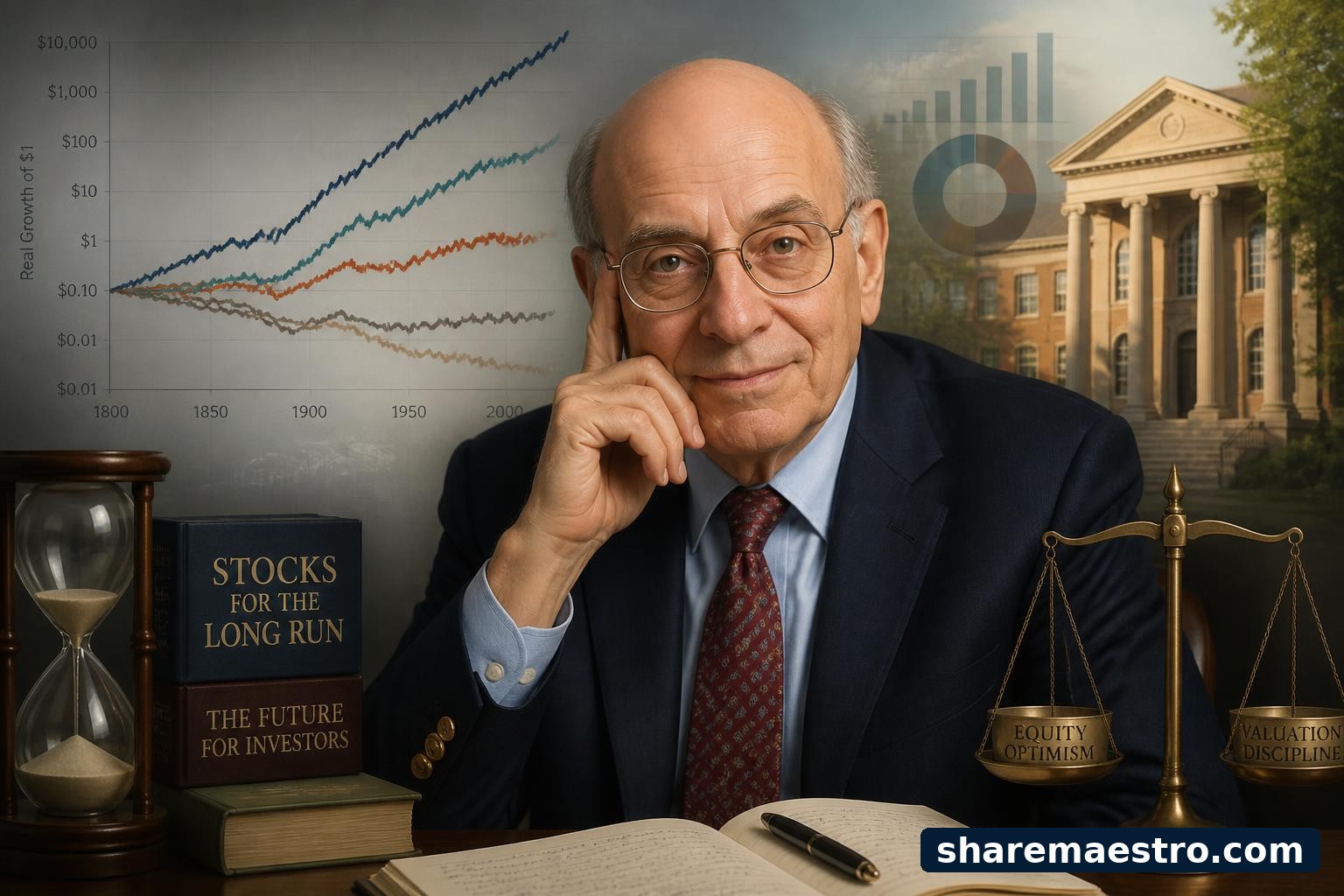
Jeremy Siegel's most famous argument begins with a single dollar and an almost absurdly long clock. Place that dollar in American stocks in the early nineteenth century, reinvest the dividends, adjust for inflation, and by the time the chart reaches the modern market, the equity line towers above bonds, bills, gold, and cash. It is a visual argument so simple that it has become part of the common grammar of retirement investing: the long run belongs to the shareholder.
That chart gave Siegel, a finance professor at the Wharton School, a rare kind of influence. He did not run a legendary hedge fund, corner a commodity, or build a trading desk around mathematical arbitrage. His power came from translating capital-market history into a claim that ordinary savers, advisers, pension committees, and financial journalists could understand. Stocks were not merely speculative slips of paper. They were fractional claims on businesses, and over long periods they had preserved and multiplied purchasing power better than the conventional havens.
The thesis was most fully packaged in Stocks for the Long Run, first published in 1994 and still being revised nearly three decades later. By the sixth edition, the book had been updated for value investing, ESG, interest rates, international investing, equity risk, and black swan events including the pandemic and the financial crisis. The premise remained recognizable, but the world around it had become more demanding. The challenge for Siegel has never been whether stocks can fall. It is whether the record of equity dominance can bear the weight investors put on it.
Why Siegel matters
Siegel matters because he helped give the equity culture of the late twentieth century an empirical backbone. Long before target-date funds became the default savings vehicle and low-cost index funds entered the mainstream, investors needed a story that could justify enduring volatility. Siegel supplied that story in numbers, teaching that the day-to-day drama of markets should be subordinated to the purchasing-power record of broad equity ownership over generations.
His standing also comes from the institutional setting. At Wharton, Siegel became the Russell E. Palmer Professor of Finance and later professor emeritus, with research interests spanning demographics, financial markets, long-run asset returns, and macroeconomics. His career placed him between academic finance and the public market conversation. He was not a cloistered theorist, nor a promotional market pundit. His unusual role was to speak academic history in a language portfolio managers and household investors could use.
That role brought professional recognition. Wharton's faculty profile lists awards for teaching and scholarship, including a Graham and Dodd Award for a Financial Analysts Journal article and the CFA Institute's Nicholas Molodovsky Award in 2005. His older curriculum vitae records that Stocks for the Long Run had sold more than 300,000 copies by the early 2010s and had been repeatedly honored by business publications. A professor's book became an asset-allocation text for a mass-investing age.
Yet his importance is not simply that he was bullish. Many market commentators are bullish. Siegel's durability comes from marrying optimism to a database, then returning again and again to the same basic question: what compensation have investors historically received for bearing the uncertainty of owning companies? The answer shaped how advisers talked about retirement, how institutions framed expected returns, and how a generation understood the trade-off between short-term pain and long-term compounding.
From MIT, Chicago, and Wharton to market history
Siegel's intellectual formation runs through three of the central institutions in modern financial economics. He earned a BA from Columbia University in 1967 and a PhD from the Massachusetts Institute of Technology in 1971. After an early academic appointment at the University of Chicago's Graduate School of Business from 1972 to 1976, he joined Wharton in 1976. The path put him close to the rise of efficient-market thinking, the development of modern portfolio theory, and the postwar project of measuring asset returns with increasing precision.
But Siegel's eventual signature was not an abstract model. It was historical reconstruction. His 1992 Financial Analysts Journal work extended stock and bond return comparisons back to 1802, well before the familiar Ibbotson and Sinquefield data that began in 1926. To do that, he had to confront the uneven raw record of nineteenth century finance: early stock-price series, railroad-heavy markets, missing Treasury bill histories, and the problem of comparing risky government debt across wars and monetary regimes.
The result was a hybrid of academic finance and historical craftsmanship. It asked a question practical investors cared about: did the case for equities depend on the modern data window, or did it survive across a much longer American record? Siegel divided the data into subperiods and constructed series intended to represent equities, long-term bonds, and short-term governments across regimes that included the gold standard, the Civil War, the creation of the income tax, the Great Depression, postwar inflation, and modern capital markets.
That habit of pushing back the starting date became one of his great strengths and, later, a source of vulnerability. The farther a historian reaches, the more dramatic the compounding becomes, but the more uncertain the data can be. Siegel's career has therefore sat at the boundary between two temptations: investors want timeless lessons, while financial historians know that markets are products of particular legal systems, accounting rules, institutions, wars, and political orders.
The argument in one dollar
The classic Siegel case is built on real returns, not nominal market levels. Inflation is the silent adversary in the story. A portfolio can rise in dollars while losing purchasing power, and a bond can appear safe while its coupons are quietly eroded by the price level. Siegel's historical presentation therefore emphasized total returns after inflation, with dividends and interest reinvested. That framing moved the conversation from market excitement to real wealth.
In his 1992 article, Siegel calculated that $1 invested in equities in 1802 would have grown to $86,100 in real dollars by 1990, while $1 in long-term governments grew to $520 and short-term governments to $242. Later updates extended the span. The CFA Institute Research Foundation's 2024 discussion of the iconic chart showed Siegel's updated January 1802 to December 2023 figures: stocks at a 6.8% annualized real return, bonds at 3.3%, bills at 2.5%, gold at 0.6%, and the dollar at negative 1.4%.
The terminal wealth figures are the more memorable version. In the 2023 update, $1 in stocks became $2,170,948 in inflation-adjusted value. Bonds became $1,463, bills $237, gold $4.18, and the dollar only $0.0392 in purchasing-power terms. No reader needs advanced calculus to understand the message. Small annual differences, compounded over two centuries, produce radically different destinations.
The danger is that the power of the final number can overwhelm the path. A 6.8% real return is an average, not an itinerary. It includes crashes, wars, depressions, panics, inflation shocks, bubbles, and long recoveries. Siegel's best readers understood the chart as a compensation schedule for bearing risk. His weakest readers treated it as an iron law.
Risk changes shape with time
Siegel's central contribution to investor psychology was to separate short-run volatility from long-run purchasing-power risk. Stocks are violently unstable over months and single years. Bonds and cash often feel calmer in those intervals. But Siegel argued that the investor's real problem is not simply mark-to-market discomfort. It is whether savings retain and grow their ability to buy future goods and services. On that measure, fixed income has not always been as safe as its reputation suggests.
His 1992 work showed that equities outperformed long-term bonds 57.7% of the time year by year over the full period, but 88.8% of the time over 30-year horizons. Since 1871, stocks underperformed short-term assets only once over holding periods of 20 years or more, and they outperformed long-term bonds 95% of the time over such horizons. That finding became one of the intellectual supports for high equity allocations among young savers.
The argument was especially powerful after the inflationary 1970s, when nominal bonds demonstrated that default is not the only threat to safety. Siegel emphasized that government bonds can protect nominal principal and still fail as long-run stores of purchasing power. In this view, ownership of productive businesses offers a partial hedge because revenues, assets, and earnings can adjust over time to changing price levels.
Still, time does not abolish risk. It transforms it. A 30-year horizon is long in a chart and finite in a human life. Retirement dates arrive during actual market conditions, not averaged conditions. Investors who need to sell during bear markets, fund liabilities, meet margin calls, or maintain spending cannot always wait for the long-run distribution to rescue them. Siegel's own framework works best when paired with liquidity, diversification, and an honest map of liabilities.
The bull who warned about a bubble
The caricature of Siegel as an unconditional stock-market bull misses one of the most important episodes in his public record. Near the height of the dot-com boom, he warned that many of the largest technology shares were priced far beyond plausible earnings support. Knowledge at Wharton later summarized his March 2000 Wall Street Journal column and noted that nine of 33 stocks with market capitalizations above $85 billion traded at price-to-earnings ratios above 100.
The timing mattered. The Nasdaq Composite peaked in March 2000 and subsequently collapsed. A year later, Siegel was still defending stocks for the long run, but he was not defending any price for any stock. He pointed to earnings and cash flow as traditional valuation tools that had regained authority after speculative excess. Yahoo, cited in the 2001 account, had fallen sharply from its bubble valuation but still traded at a very high multiple.
This episode clarifies the difference between strategic equity ownership and speculative growth chasing. Siegel's long-run case is strongest when applied to diversified claims on corporate profits purchased at reasonable valuations across time. It becomes hazardous when investors convert it into permission to buy fashionable companies at any price. The dot-com boom was not a refutation of stocks. It was a refutation of the belief that narrative could permanently displace valuation.
It also revealed Siegel's instinctive middle position in market debates. He could argue that stocks were the best long-term asset class while acknowledging that certain sectors or market segments were dangerously overpriced. That distinction is central to his influence. His message was never merely buy stocks. It was own productive assets, reinvest, diversify, pay attention to valuation, and do not confuse a great company with a great investment if the price already discounts impossible success.
The Future for Investors and the growth trap
If Stocks for the Long Run made Siegel the historian of the equity premium, The Future for Investors complicated his image as the professor who told America to love stocks. Published in 2005, the book argued that investors often overpay for novelty, high growth, and celebrated innovation. Economic progress can be real and still fail to reward shareholders if too much optimism is already embedded in the purchase price.
The publisher's description framed the lesson starkly: new technologies, expanding industries, and fast-growing countries can lead to poor returns when investors chase them at excessive valuations, while older companies in slower-growth or unfashionable industries can produce superior shareholder outcomes. The book's emphasis on dividends, reinvestment, valuation, and what Siegel called the tried-and-true was an important shift. It moved him from broad equity ownership to a more discriminating view of equity composition.
This argument is one of Siegel's most useful antidotes to market fashion. Investors routinely confuse social importance with investment return. Railroads, automobiles, radio, computers, the internet, electric vehicles, and artificial intelligence can transform the economy, but the surplus may accrue to customers, employees, suppliers, competitors, or later entrants rather than to the early public-market buyer. Siegel's lesson is not anti-innovation. It is anti-overpayment.
The dividend emphasis also connected his academic work to product design. WisdomTree notes that Siegel's research on dividend strategies in The Future for Investors coincided with the firm's development of its original family of dividend-weighted stock ETFs, first launched in 2006. In that sense, Siegel's second major investing argument moved beyond the bookshelf and into index construction.
From history to an investable process
Siegel's philosophy is often described as buy-and-hold equity investing, but the applied version is more textured. The broad allocation starts with the historical compensation for equity risk. The security-selection tilt favors cash generation, dividends, valuation discipline, and resistance to market-cap weighting's tendency to give the largest weights to stocks after their prices have already risen. The aim is not heroic stock picking. It is rules-based exposure to corporate earning power.
WisdomTree's dividend-weighted approach illustrates the translation. The firm's U.S. Total Dividend Index defines the dividend-paying portion of the U.S. equity market and weights companies by their projected share of aggregate cash dividends at the annual reconstitution. As of July 29, 2026, the index listed 1,169 components, a dividend yield of 2.09%, a price-to-earnings ratio of 21.51, and a total market capitalization of $56 trillion. The numbers are a snapshot, but the method shows the philosophy in mechanical form.
The logic is a critique of pure market-cap weighting. In a capitalization-weighted index, price determines weight. The more expensive a stock becomes relative to fundamentals, the more of it the index owns. Dividend weighting tries to anchor position size to a measure of corporate cash distribution rather than market enthusiasm. It is a form of systematic rebalancing toward companies whose prices have fallen relative to their dividend contribution and away from those whose prices have run ahead.
That process carries trade-offs. Dividend weighting can underweight young firms, companies that prefer buybacks, or highly profitable enterprises that reinvest rather than distribute cash. It can create sector tilts toward mature industries. It can also lag during speculative growth-led markets. The Siegel-influenced answer is that such lag is not a bug if the discipline reduces exposure to overvaluation and preserves a link between price and cash flow.
The public strategist's operating system
Siegel became influential partly because he was willing to keep applying his framework in public, especially when markets were frightening. During the 2001 bear market, he did not deny the damage caused by collapsing technology shares. He argued instead that cheaper prices improved the long-run bargain for diversified investors and that earnings and cash flow had again become central to valuation. The message was less comforting than it sounded: bear markets were part of the compensation package.
His public commentary has often moved through a consistent sequence. Start with valuation, interest rates, inflation, and earnings. Compare the expected return on stocks with the real return available from bonds and bills. Ask whether monetary policy or fiscal stress is changing the discount rate. Then judge whether the equity risk premium remains adequate. This is not tactical trading in the style of a macro hedge fund. It is an asset-allocation conversation anchored in expected real returns.
That framework helps explain why Siegel remained visible long after the first edition of Stocks for the Long Run. In 2026, Knowledge at Wharton still described him as a Wharton emeritus professor of finance and WisdomTree senior economist commenting on tariffs, Treasury yields, deficits, AI stocks, and market drivers. The durable public demand for his views reflects the way his long-run thesis must be constantly reinterpreted under new interest-rate and earnings conditions.
The risk of such visibility is that nuanced strategic views get flattened into market calls. A professor who says equities are attractive relative to bonds can be heard as promising a near-term rally. A warning about overvalued technology stocks can be remembered as a market-timing coup. Siegel's record is better understood as an evolving expected-return discipline than as a sequence of predictions to be scored like a trader's blotter.
The argument with Shiller
No profile of Siegel can avoid Robert Shiller. The two economists, both trained at MIT, have often been cast as opposing characters in the market's morality play: Siegel the long-run equity optimist, Shiller the bubble skeptic. That framing is too tidy. At a 2018 Wharton-sponsored debate, Shiller said it was inaccurate to portray Siegel as always bullish and himself as always bearish, noting that both were cautious at the top of the dot-com bubble.
Their deeper disagreement concerned valuation and the cyclically adjusted price-to-earnings ratio, known as CAPE. Shiller's CAPE became one of the most influential tools for forecasting long-term equity returns from starting valuations. Siegel accepted that valuation matters, but challenged aspects of the CAPE framework. His 2016 Financial Analysts Journal article argued that forecasts based on CAPE could be too pessimistic because of changes in GAAP earnings, including mark-to-market accounting, and that substituting more consistent earnings data such as NIPA after-tax corporate profits improved the model and raised expected-return forecasts.
Shiller's response, as summarized in the 2018 debate, was not to discard CAPE but to acknowledge accounting issues while defending the broad implication that high valuations point to lower future returns. He also questioned the splicing of different earnings histories and warned that arguments for modern valuation exceptionalism can resemble earlier episodes of misplaced optimism. This was not a dispute between history and speculation. It was a dispute over which history was cleaner and which denominator should discipline price.
The Siegel-Shiller debate matters because it prevents the long-run equity thesis from becoming complacent. Siegel reminds investors that bonds and cash can be poor long-run stores of real value, especially when real yields are low. Shiller reminds them that starting price matters and that a generation can buy stocks at a valuation that suppresses subsequent returns. Together they form a better guide than either caricature alone.
The data historian gets challenged
The most serious recent challenge to Siegel's work does not come from a market bear shouting about a crash. It comes from Edward McQuarrie, whose Financial Analysts Journal research re-examined nineteenth century U.S. stock and bond returns using newly available digital archives. The CFA Institute Research and Policy Center summarized McQuarrie's conclusion plainly: sometimes stocks outperformed bonds over multi-decade periods, sometimes bonds outperformed stocks, and sometimes they performed about the same.
That critique strikes at the emotional force of the famous chart. If early data overstated equity returns or understated bond returns, the apparent smoothness and inevitability of the equity premium weakens. The 2024 CFA Institute Research Foundation brief noted that McQuarrie believed earlier sources used in Siegel's reconstructions involved simplifying assumptions that overstated stocks relative to bonds in the nineteenth century and early twentieth century. His conclusion was not that equities are worthless. It was that two-century averages can hide long regimes in which the reward for owning stocks was much less obvious.
The brief also highlighted a design problem. Charts that show terminal wealth after more than 200 years naturally draw the eye to the right side, where the winning asset towers above the rest. That can bury the experience of investors living through the lower-left and middle parts of the chart, where long stretches may be less decisive. Finance is lived in finite horizons. A pension fund, household, or endowment does not own the full two-century path from 1802 to 2023.
Siegel's thesis survives the critique only if it becomes more modest and more precise. The evidence still supports a positive expected equity premium as a reasonable organizing principle. It does not support the idea that stocks must beat bonds over every humanly relevant horizon. The debate has therefore made Siegel's work more valuable for sophisticated investors, not less, by forcing a distinction between probability, history, and promise.
Failure modes of the long-run gospel
Every powerful investment idea has a failure mode, and Siegel's is the temptation to turn an empirical tendency into a slogan. Stocks for the long run can become all stocks all the time. That is not a risk-management plan. It ignores age, liabilities, spending needs, employment risk, taxes, behavioral tolerance, and the possibility that a bear market arrives exactly when an investor must raise cash.
The second failure mode is valuation blindness. Siegel's own dot-com warning contradicts the lazy version of his thesis. Equities may dominate bonds over long periods, but overpaying for a specific sector, country, factor, or glamour narrative can destroy returns. The Future for Investors made that point by emphasizing the growth trap. Investors can be right about the future of an industry and wrong about the future return of its shares.
The third failure mode is U.S. exceptionalism. Much of Siegel's most famous evidence rests on an American market that benefited from legal continuity, deep capital markets, relative geopolitical success, and the country's powerful twentieth century economic position. Global evidence generally supports equities over bonds, but outcomes vary by country and regime. The American line cannot be treated as the natural order of all markets.
The fourth failure mode is confusing average return with investor return. The long-run real return to stocks assumes reinvestment, diversification, and endurance. Actual investors chase performance, sell in panic, pay fees and taxes, concentrate in local favorites, and sometimes need liquidity at the worst possible moment. Siegel gave investors a rational reason to own equities. He did not repeal the behavioral and institutional frictions that keep many from earning the market's return.
Bonds, inflation, and the problem of safety
Siegel's work is as much an argument about bonds as it is an argument about stocks. In his telling, fixed income is safest when the problem is short-term nominal volatility, but less safe when the problem is long-term real wealth preservation. The distinction is crucial. A Treasury bond can pay as promised and still disappoint if inflation erodes the value of the coupons and principal.
His 1992 research found that the decline in real returns on fixed-income investments was a major source of the rising advantage of equities. He argued that the equity premium had increased over time not because stock returns rose dramatically, but because bond and bill real returns fell. That observation remains relevant whenever investors treat cash or government debt as inherently safe without specifying safe from what.
The post-2021 rate reset gave the issue new urgency. Higher nominal Treasury yields made bonds more attractive than during the zero-rate years, while fiscal deficits and inflation uncertainty revived old questions about real returns. In 2026, Siegel was still publicly discussing rising bond yields as a signal of concern about U.S. deficits and as a potential force pressuring Washington toward fiscal action. The long-run equity professor had not stopped watching the bond market.
This is one reason his framework endures. The equity allocation is not made in isolation. It depends on the real yield available from bonds, expected inflation, valuation, and the investor's need for stability. Bonds can be good investments. They can diversify, fund liabilities, and reduce forced selling. Siegel's contribution was to insist that their safety be judged after inflation and over the horizon that actually matters.
Influence beyond the classroom
Siegel's impact is difficult to measure because much of it flowed through language rather than mandates. He gave advisers a way to explain volatility. He gave journalists a chart that could be reproduced in countless stories about retirement. He gave households a reason to keep buying equities through payroll deductions and mutual funds. He also helped frame the post-1980s belief that broad ownership of stocks should be normal, not exotic.
His classroom role reinforced that authority. Wharton lists his long tenure beginning in 1976 and records major teaching recognitions, including BusinessWeek's 1994 ranking and university teaching awards. His curriculum vitae adds repeated teaching honors and book awards. That combination matters because Siegel's public influence was pedagogical. He persuaded by teaching, not by mystique.
The WisdomTree connection extended that influence into the ETF market. WisdomTree says Siegel's dividend-strategy research coincided with the firm's development of dividend-weighted ETFs launched in 2006, and that he later collaborated on model portfolios incorporating his outlook for stock and bond returns. WisdomTree's 2026 retrospective described the original approach as anchoring portfolios to fundamentals rather than market capitalization and linked it to what Siegel later described as a noisy market hypothesis.
That applied legacy is not universally accepted. Fundamental and dividend-weighted indexes compete with plain market-cap indexes, factor funds, active management, and other smart-beta strategies. They can outperform or lag depending on cycle, sector leadership, and valuation spreads. But Siegel's influence is evident in the fact that the debate itself moved from whether ordinary investors should own equities to how they should weight them.
What remains useful now
The enduring value of Siegel's work is not the promise that stocks always win. It is the discipline of asking what asset class offers the best chance of preserving and increasing purchasing power over the investor's true horizon. That question remains vital in a world of inflation surprises, deficit anxiety, high public debt, technology manias, and changing market structure. Siegel's answer still begins with productive enterprise.
What has changed is the necessary humility around the answer. The sixth edition of Stocks for the Long Run acknowledges newer concerns, including value investing, ESG, interest-rate conditions, international investing, black swan events, and future stock and bond returns. The 2024 CFA Institute debate over McQuarrie's work sharpened the point further: historical averages are guides, not contracts. Investors deserve the evidence and the caveats.
Siegel's best lesson is therefore more demanding than the slogan attached to him. Own equities because history, theory, and the structure of corporate claims suggest they should earn a premium over time. Diversify because no one knows which companies or countries will deliver it. Mind valuation because price can turn a great business into a poor investment. Hold bonds and liquidity because human horizons are finite. Rebalance because markets overshoot. Study history because the future is opaque.
That balanced version leaves Siegel as a central figure in modern investing, but not as a prophet of effortless wealth. He is better understood as the professor who taught investors to take the long run seriously and then spent the rest of his career showing that the long run has conditions. It rewards patience, but not naivete. It favors enterprise, but not every price. It belongs to investors who can survive the short run without pretending it does not matter.
Disclosure
Educational financial journalism and market research only. Not financial, investment, trading, tax, or legal advice.