In brief
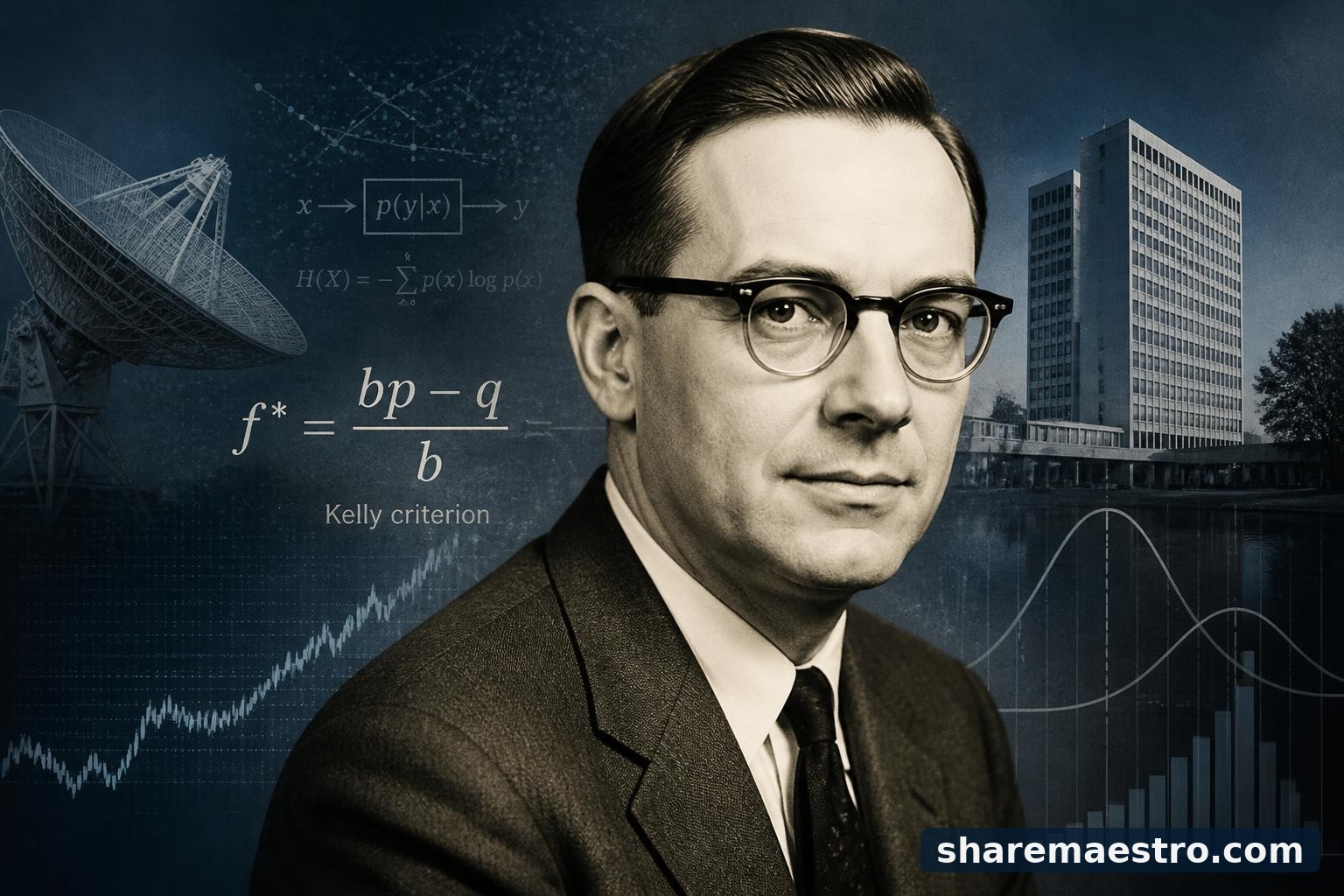
This Sharemaestro profile examines John L. Kelly Jr., the Bell Labs scientist whose growth-optimal betting rule connected Claude Shannon's information theory to capital allocation. The article traces Kelly's path from physics and speech synthesis to the 1956 paper that became the Kelly criterion, then follows the idea through Ed Thorp, portfolio theory, criticism from Paul Samuelson, and modern risk-aware variants. Its central argument is that Kelly's legacy is not a formula for easy riches but a disciplined, unforgiving way to think about edge, compounding, leverage, estimation error, and ruin.
- Kelly's 1956 paper reframed information rate as a capital-growth problem, showing that side information could have a precise economic value when repeated bets, reinvestment, and variable position sizes were possible.
- The Kelly criterion maximizes expected logarithmic wealth, which makes it a growth-optimal sizing rule for repeated favorable bets, not a stand-alone method for finding those bets.
- Ed Thorp carried Kelly's idea from blackjack to sports betting and securities markets, helping turn an obscure Bell System Technical Journal article into a core concept in quantitative investing.
- Kelly's strongest insight is also its danger: full Kelly can demand large bets, deep drawdowns, leverage, and extreme confidence in probability estimates that are rarely known in financial markets.
- Modern Kelly practice often means fractional sizing, robust optimization, drawdown constraints, and humility about model error rather than literal use of the full theoretical prescription.
Performance and evidence
Performance markers
Visual Evidence
Charts and timelines
Risk
Timeline
Philosophy
Performance
The scientist behind the wager
The most influential money-management paper in modern finance did not begin on Wall Street. It began at Bell Telephone Laboratories, in the postwar research machine at Murray Hill, New Jersey, where physicists, engineers, and mathematicians were turning communication into a mathematical science. John Larry Kelly Jr. was part of that world, a Texas-born physicist with a taste for hard problems and an instinct for turning abstraction into machinery. He was not a portfolio manager, not a broker, not a trader in the public record. Yet his name now sits beside one of the most argued formulas in betting and investing.
Kelly's 1956 article, published under the deliberately opaque title "A New Interpretation of Information Rate," asked a question that was almost embarrassingly practical for a Bell Labs journal: if a gambler receives information before the rest of the market, how fast can his bankroll grow? The answer was not to bet everything, and it was not to bet timidly. The answer was to maximize the expected logarithm of wealth, a rule that would later be called the Kelly criterion. In one stroke, information acquired a price in compounded capital.
That is why Kelly matters. He supplied finance with a language for position sizing when an investor believes there is an edge. He did not solve security selection, forecasting, or human fear. He did something narrower and more durable: he showed that the amount risked is as central to long-term success as the correctness of the prediction. The idea would migrate from horse-race imagery to blackjack, sports betting, hedge funds, portfolio optimization, and machine-learning-era risk models. It remains powerful because it is precise. It remains dangerous for the same reason.
From Corsicana to Murray Hill
Kelly was born in Corsicana, Texas, in 1923 and came of age during the war years. Accounts of his life describe four years as a Naval Air Force flyer, undergraduate and graduate work at the University of Texas at Austin, and a 1953 PhD rooted not in finance but in the physics of elastic materials. That background matters because Kelly's later financial fame can make him look like a gambling theorist who happened to work in science. The chronology runs the other way. He was first a physicist trained to measure, model, and compute.
The published record from 1953 places Kelly alongside D. S. Hughes in Physical Review on "Second-Order Elastic Deformation of Solids." The paper studied velocities of elastic waves in stressed solids and reported results for polystyrene, iron, and Pyrex glass. A footnote listed Kelly as then being at Murray Hill Laboratories of Bell Telephone Company. It is a revealing marker of transition: the young physicist had moved into the corporate research environment that would define his short career.
Bell Labs was unusually fertile ground for Kelly's mind. Claude Shannon's 1948 paper had recast communication as a problem of signals, noise, probability, and entropy. Kelly entered a laboratory culture in which the same mathematics could touch telephony, television, computers, coding, speech, and prediction. His later work on a block diagram compiler and speech synthesis shows the breadth of that environment. Finance was not his field. It was one possible application of a deeper question: how does useful information change the attainable rate of growth in a system?
A quiz-show delay becomes a theory of capital
The origin story has the odd texture of mid-century media. In William Poundstone's account, Kelly was intrigued by reports tied to "The $64,000 Question," the television quiz show that aired live in the East and later on the West Coast. The delay created a simple information asymmetry. A person who learned results by telephone before the West Coast broadcast could, in principle, wager with knowledge not yet reflected by others. For most people, this was a scam anecdote. For Kelly, it was a communication channel with economic content.
The intellectual step was to separate having an edge from sizing the edge. A gambler with a private wire should not automatically bet everything on each tip because any error, delay, or bad information could wipe him out. He should not bet a token amount either because that wastes valuable information. The correct policy had to recognize compounding, survival, and repetition. It had to treat bankroll as the engine of future opportunity, not merely as a stake for the next wager.
Kelly's paper made that insight formal. If the input symbols to a communication channel stand for the outcomes of a chance event, and if bets are available at odds tied to those probabilities, the bettor's knowledge can make capital grow exponentially. In the fair-odds case, Kelly showed that the maximum exponential rate of growth equals the information transmission rate. A technical idea from communication engineering had become a proposition about wealth: better information is valuable because it raises the sustainable compound growth rate.
The private wire and the first rule of compounding
Kelly's most famous device was the gambler with a private wire. In the simplest case, the channel transmits outcomes before they become public. In a noiseless binary example, the bettor knows the winner with certainty and can double capital each time at even-money odds. Kelly described the growth rate as G, the limiting logarithmic increase in capital per bet. With perfect binary information, G equals one when logarithms are taken to base two. The example is stylized, but it clarified the central point: repeated correct information compounds.
The interesting case was not perfect information. It was noisy information, where tips are more often right than wrong but not infallible. Kelly observed that betting the whole bankroll may maximize expected capital in a narrow arithmetic sense, yet it leaves the gambler likely to be broke over an indefinite sequence. That contrast is the heart of the paper. A strategy can look attractive in expected dollars and still be fatal to the bettor who must survive long enough for probabilities to assert themselves.
The logarithm solved the problem because it turns compounded wealth into an additive sequence. Repeated proportional bets multiply capital; logarithms add the results; the law of large numbers then links the chosen fraction to a long-run growth rate. This was not a casual preference for conservative utility. Kelly argued that the logarithm was the relevant object because of reinvestment and repetition. In finance, where investors often speak loosely about expected return, that distinction is still bracing. The path of wealth matters, not just the average payoff.
The formula is simple; the assumptions are not
In its popular form, the Kelly formula is often summarized as edge divided by odds. For an even-money coin with a 60 percent chance of winning, the full Kelly fraction is 20 percent of bankroll. Bet less and long-run growth is lower. Bet more and the path becomes more volatile, then eventually self-defeating. This simplicity explains the rule's appeal. It feels like a clean answer to a messy human question: once you believe the bet is favorable, how much is too much?
But the clean answer depends on a demanding setup. The bettor must have a positive edge, a reasonably specified probability distribution, known payoffs, the ability to scale the wager, and a sequence of comparable opportunities. Kelly himself noted that the model requires reinvestment of profits and control over the amount invested or bet in different categories. These requirements are ordinary in toy examples and extraordinary in financial markets. A stock does not announce its true probability distribution. A credit trade does not reveal its tail dependence before stress arrives.
The rule is also indifferent to stories that investors cherish. It does not care whether the opportunity is exciting, whether the last trade worked, or whether a manager wants to recover a drawdown. It asks for probabilities, payoffs, and capital. If the edge is zero or negative, the answer is not to bet. If the edge is positive but thin, the answer may be small even when the trade is emotionally compelling. Kelly's discipline is severe because it converts conviction into a number, then punishes overconfidence through compounding.
Why Kelly was not just another gambler's system
Betting systems have a long history of promising control over chance. Martingales, progressions, and doubling schemes exploit psychology more than mathematics. Kelly's approach is different because it begins by accepting uncertainty. It does not claim that losses can be escaped. It says losses must be sized so that the favorable arithmetic of the whole sequence can survive. That is why the criterion became intellectually respectable in a way that casino folklore never could.
The original paper also resisted a narrow gambling interpretation. Kelly was explicit that the model, though drawn from wagering, might apply to economic situations. The essential requirements were reinvestment and the ability to vary the amount committed among categories. This is why investors later recognized themselves in his gambler. A portfolio manager with signals, assets, leverage limits, and recurring opportunities faces a structurally similar problem, even if the payoffs are harder to specify than a horse race or coin toss.
There is a further twist. In one part of the paper, when odds are not fair and there is no track take, Kelly showed that deviations from fair odds can help the gambler. In market language, mispricing is only valuable if the investor has a better probability estimate than the price implies. The formula therefore links two tasks that are often separated: forecasting and sizing. A good forecast without disciplined sizing can still end in ruin; disciplined sizing without a true edge has nothing to compound.
Shannon's shadow and Bell Labs style
Kelly's achievement is hard to understand without Shannon's shadow. Shannon's 1948 work had treated communication as an engineering problem stripped of semantic meaning. The issue was not what a message meant but how a message selected from possible messages could be transmitted through noise. That conceptual move created the vocabulary of entropy, information, and channel capacity. Kelly's wager was a new interpretation of that apparatus, not a departure from it.
The Bell Labs setting also explains the paper's unusual mixture of practicality and abstraction. Kelly was surrounded by problems where theory had to meet apparatus: television signals, coding, speech, computing, and simulation. His 1961 work with Carol Lochbaum and V. A. Vyssotsky on a block diagram compiler described BLODI, a program designed to let engineers express circuit-like systems in a language close to their diagrams. It was another instance of translation, taking an expert's representation of a system and making it executable.
That practical bent extended into speech synthesis. Kelly and colleagues were involved in the work that produced a computer-sung version of "Daisy Bell," later famous for its cultural echo in 2001: A Space Odyssey. These projects can seem remote from the Kelly criterion, but they show the same intellectual signature. Kelly took signals seriously. He cared about what could be transmitted, modeled, simulated, and acted upon. In finance, the signal was an edge and the action was position size.
Ed Thorp carries the paper to the tables
For years, Kelly's paper attracted little attention outside technical circles. Its practical afterlife began when Edward O. Thorp, then a mathematician working on blackjack, encountered the idea through the Shannon orbit. Thorp later wrote that he initiated the practical application of the Kelly criterion by using it for card counting in blackjack. This was the migration point. A Bell Labs theorem about information rate became a betting discipline at casino tables, where probabilities, payoffs, and repeated trials were unusually measurable.
Thorp's importance was not merely that he used the formula. He showed what kind of operator it required. Card counting could create a positive expectation, but that edge fluctuated with the deck composition and could be small relative to bankroll volatility. Kelly sizing gave the counter a way to press advantage without treating every favorable hand as a license to overbet. In this sense, the criterion became an operational bridge between statistical edge and bankroll survival.
Thorp later extended the discussion to sports betting and securities markets. In his 1997 paper on blackjack, sports betting, and the stock market, he framed the common problem as finding favorable bets and then deciding how much to stake. He also described the criterion as maximizing expected logarithmic utility, known in other settings as the geometric-mean maximizing portfolio strategy, the growth-optimal strategy, or the capital growth criterion. Kelly's name endured, but the idea traveled under many aliases.
From table stakes to portfolio stakes
The move from blackjack to markets changed the difficulty of the problem. In a casino game, the payoffs are specified and the edge, while hard-earned, can often be estimated from rules and card composition. In securities markets, the payoff distribution is unstable, the opportunity set changes, and the act of trading can move prices or reveal information. Kelly's framework still applies as a way of thinking, but the inputs become contested. This is where many naive uses of the formula fail.
Thorp's securities-market application made the idea credible for traders who were already thinking in repeated bets. Arbitrage, convertible hedging, warrant pricing, statistical spreads, and option-like situations can resemble gambling more than long-only stock picking because they break returns into many measured exposures. Thorp's account of using the Kelly approach in markets over decades helped give the rule an institutional audience. It suggested that position sizing was not a back-office afterthought but part of the alpha engine.
Portfolio theory then absorbed Kelly under broader names. Growth-optimal portfolios, log utility, capital growth theory, and geometric mean maximization all point toward the same mathematical center. The 2011 volume edited by Leonard MacLean, Thorp, and William Ziemba gathered early ideas, classic papers, asset allocation applications, utility foundations, and evidence on investors' use of Kelly-type strategies. By then, Kelly's once-obscure article had become a reference point for both gamblers and financial economists.
The record: proof, practice, and what cannot be claimed
Kelly himself did not leave a fund record. There is no Kelly partnership, no audited investment vehicle, no annual letters compounding at a celebrated rate. The record of his influence must therefore be judged differently. On the theoretical side, his paper established a precise equivalence between information transmission and maximum exponential capital growth in the fair-odds case. On the practical side, later users, most famously Thorp, demonstrated that the rule could guide real wagering and trading when the edge could be measured well enough.
The mathematical record strengthened after Kelly. Leo Breiman's work on optimal gambling systems for favorable games helped formalize the long-run claims associated with growth-optimal strategies. The later literature drew distinctions among expected wealth, expected log wealth, finite-horizon utility, and asymptotic dominance. These distinctions matter because Kelly is often oversold in casual finance writing. It does not promise the highest wealth in every finite sample. It says something subtler about long-run growth under repeated favorable conditions.
Thorp's 1997 summary supplied one striking practical data point: he wrote of applying the approach in securities markets where it had helped him make a thirty-year total of $80 billion worth of bets. That is not the same as a return record, but it illustrates scale, repetition, and institutional relevance. The most honest assessment is that Kelly's criterion has an unusually strong theoretical record and a persuasive lineage of sophisticated practitioners. It does not have a simple scoreboard attached to Kelly himself.
The hidden cost: drawdowns are not a footnote
The Kelly criterion's greatest public-relations problem is that it can be right and still feel intolerable. Full Kelly maximizes long-run logarithmic growth under its assumptions, but the route can include sharp interim losses. MacLean, Thorp, and Ziemba summarized the trade-off plainly: the main advantage is maximizing the limiting exponential growth rate of wealth, while the main disadvantage is that suggested wagers may be very large and risky in the short term. That is not a small caveat. It is the lived experience of the rule.
This feature distinguishes Kelly risk from conventional volatility talk. A strategy can have the best long-run growth rate and still suffer drawdowns that cause investors, clients, lenders, or regulators to force a change before the long run arrives. The mathematics assumes the bettor can continue. Real capital often has terms, fear, margin calls, redemption rights, committees, and career risk. A theoretically optimal bet that cannot be held is not operationally optimal.
This is why fractional Kelly became the practical compromise. Instead of betting the full formula, investors scale the position down, often to one-half, one-quarter, or another fraction. The cost is lower expected long-run growth; the benefit is less violent compounding on the downside and some protection against estimation error. Fractional Kelly is not a refutation of Kelly. It is an admission that real investors live with incomplete information, finite patience, and institutional constraints that the pure model does not fully price.
The sharpest criticism: utility, time, and overconfidence
The most serious criticism of Kelly does not come from people who misunderstand it. It comes from economists who understand that maximizing expected log wealth is only one preference among many. Paul Samuelson famously resisted the notion that long horizons automatically make log maximization the right objective for all investors. His 1979 paper, pointedly titled "Why we should not make mean log of wealth big though years to act are long," became a compact warning against treating asymptotic growth as a universal welfare standard.
The issue is not whether the Kelly mathematics works in its domain. It is whether an actual investor's objective is the same as the formula's objective. An endowment with spending needs, a retiree with irreversible consumption risk, a bank with capital requirements, and a hedge-fund manager with drawdown clauses may all rationally reject full growth maximization. They might prefer lower terminal wealth in many scenarios if it reduces the probability of unacceptable loss along the way. In that sense, Kelly is a sizing rule, not a moral law.
There is also the problem of false precision. The formula responds aggressively to estimated edge. If the estimated edge is overstated, the resulting bet is too large. MacLean, Thorp, and Ziemba emphasized that errors in expected returns can dominate errors in variances and covariances in asset allocation problems, with a 20:2:1 rule of thumb often used to summarize relative importance. Kelly therefore magnifies the hardest part of investing: knowing the mean. A wrong probability estimate can turn mathematical discipline into leveraged error.
Kelly versus mean-variance finance
Kelly sits uneasily beside the mean-variance tradition associated with modern portfolio theory. Mean-variance optimization asks investors to trade expected return against variance, often over a single period or within a simplified return distribution. Kelly asks which allocation maximizes expected log wealth through compounding. Under some assumptions, the two can resemble each other. Under others, they diverge sharply. The philosophical difference is that Kelly is obsessed with time, reinvestment, and the multiplicative path of capital.
This difference explains why the criterion appeals to traders and systematic investors. A trader repeatedly deploying capital faces a sequence, not a single terminal lottery. The amount lost today changes the amount that can be risked tomorrow. Log wealth captures that dependence. It also penalizes ruin severely because the logarithm of zero wealth is fatal to the objective. Kelly is aggressive, but not reckless in the simplistic sense. It refuses bets that endanger the compounding machine beyond the justified edge.
At the same time, mean-variance tools remain useful precisely because investors do not always want the growth-optimal portfolio. They may care about benchmark-relative risk, tracking error, liabilities, liquidity, accounting outcomes, or regulatory capital. Kelly's continuing value is to expose what those frameworks sometimes hide: sizing mistakes have nonlinear consequences. Overbetting a good idea can be worse than underbetting it. In the Kelly world, risk is not merely dispersion around return. It is the possibility that capital is impaired enough to lose future optionality.
The modern turn: robust Kelly and model uncertainty
Modern quantitative finance has not abandoned Kelly. It has tried to civilize it. The most important shift is from assuming a known probability distribution to asking what happens when the distribution is uncertain. Sun and Boyd's work on distributionally robust Kelly gambling begins from that premise: classic Kelly chooses bets to maximize expected log growth under a known distribution, but practical allocation rarely has such certainty. Their robust version chooses the allocation that maximizes worst-case expected log growth across a set of plausible distributions.
That modern formulation is deeply faithful to Kelly's original spirit. The original paper priced information. Robust Kelly prices ignorance. It recognizes that the costliest risk may not be ordinary variance but being confidently wrong about the probabilities. In financial markets, this is not a technical nuisance. It is routine. Regimes change, liquidity disappears, correlations converge, and historical samples flatter strategies that have merely harvested hidden tail risk.
The lesson for investors is not that every allocation problem should be solved with a robust Kelly optimizer. It is that any serious use of Kelly must include a view about uncertainty in the inputs. The formula's elegance can seduce users into treating estimates as facts. The modern literature pushes in the opposite direction, toward constraints, probability sets, drawdown awareness, and stress testing. Kelly remains a powerful compass, but it needs a map that marks cliffs.
Influence without a trading desk
Kelly's influence is unusual because it passed through people and disciplines rather than through an institution he built. He died in 1965 at only 41, by then described as head of Bell Labs' information coding and programming department. A longer life might have taken him further into computing, speech, coding, or economic applications. Instead, the financial legacy developed through others: Shannon's intellectual circle, Thorp's casino and market practice, Breiman's proofs, Samuelson's critique, and the capital-growth literature that followed.
That lineage has made the Kelly criterion a kind of password among sophisticated risk takers. To know it is to know that expected value is not enough. A wager can be favorable and still too large. A strategy can be profitable and still destroy itself through sizing. A manager can have alpha and still fail because the drawdown path breaks confidence or financing. These are now common ideas in professional risk management, but Kelly supplied one of their cleanest mathematical forms.
The criterion also influenced how investors talk about edge. It makes the price of conviction explicit. A forecast with a small edge deserves a small allocation unless the payoff structure is unusually favorable. A large allocation demands not only expected return but confidence in the distribution and tolerance for the path. That is why Kelly's most important contribution may be cultural as much as mathematical. It replaced vague boldness with a scale.
What remains useful, and what remains dangerous
The useful Kelly is a discipline of proportionality. It tells investors to size positions according to edge, odds, and bankroll; to distinguish a good idea from a good-sized idea; to avoid negative-expectation bets; and to remember that compounding rewards survival. In a market culture that often treats conviction as a virtue by itself, Kelly insists on calibration. The question is not how strongly one feels. The question is how much capital the evidence can carry.
The dangerous Kelly is a lever for overconfidence. In markets, probability estimates are noisy, payoffs are fat-tailed, correlations are unstable, and liquidity can vanish when it is most needed. Full Kelly can recommend positions that are mathematically justified only if the inputs are right and the investor can tolerate the path. Those are large conditions. The rule can become especially hazardous for traders who back-fit probabilities from short records, assume independence where there is clustering, or ignore financing constraints.
John Kelly's profile therefore ends with a paradox. He gave finance a formula, but his real legacy is a warning against formula worship. The criterion is most valuable when it forces humility: How strong is the edge? How reliable is the probability estimate? What happens after a run of losses? Can the capital base survive? In that sense, Kelly did not make markets easy. He made the central risk question unavoidable.
Disclosure
Educational financial journalism and market research only. Not financial, investment, trading, tax, or legal advice.