In brief
This profile examines John W. Meriwether's career from Salomon Brothers bond arbitrage to the founding and collapse of Long-Term Capital Management, with emphasis on his strategy, risk framework, performance record, failures, criticism, later funds, and lasting influence on modern relative-value investing.
- Meriwether matters because he helped professionalize fixed-income arbitrage, joining trading instinct with academic finance and quantitative portfolio construction.
- Long-Term Capital Management generated exceptional early returns, including 43 percent in 1995 and 41 percent in 1996, before losing more than half its equity in 1998.
- The fund's problem was not simply that its models were wrong; it was that leverage, liquidity, counterparty behavior, and crowded trades made being temporarily wrong fatal.
- The 1998 rescue was privately financed by major banks and securities firms, but it was facilitated by the Federal Reserve because officials feared a disorderly liquidation could impair credit markets.
- Meriwether's legacy remains double-edged: his career clarified the power of relative value, but also made LTCM a permanent case study in leverage, model risk, and market structure.
Performance and evidence
Performance markers
Visual Evidence
Charts and timelines
Risk
Timeline
Philosophy
Performance
A calm trader at the center of a frantic market
In the third week of September 1998, the drama around John Meriwether no longer belonged only to his investors. It had moved from the quiet offices of Long-Term Capital Management in Greenwich, Connecticut, into the center of the global credit system. The fund that had been marketed as a highly disciplined arbitrage operation was bleeding capital, counterparties were tightening collateral terms, and the New York Federal Reserve was trying to determine whether the failure of one hedge fund could become a market event.
The paradox was pure Meriwether. Few Wall Street figures had done more to make trading look cerebral. At Salomon Brothers, he built a bond-arbitrage culture that prized mathematical talent, patience, and the nerve to scale small discrepancies. At LTCM, he gathered elite traders, senior policymakers, and two future Nobel laureates into a firm that seemed to embody the merger of practice and theory. Yet the trades that looked diversified on paper began behaving like one immense bet on liquidity returning to normal.
Meriwether's importance lies in that contradiction. He was not a promoter of crude speculation, and LTCM was not a boiler-room accident. It was a sophisticated firm run by sophisticated people using tools that remain central to modern finance. Its collapse matters because the strategy worked before it failed, and because its failure exposed a truth that still governs markets: relative value is only as durable as the financing, liquidity, and human tolerance that keep it alive.
Why Meriwether matters
Meriwether belongs in financial history because he helped turn bond arbitrage from an instinctive trader's craft into an institutional machine. The old Wall Street bond trader relied on feel, client flow, and balance-sheet access. Meriwether's circle added models, probability, derivatives, academic talent, and a belief that small pricing errors could be harvested systematically if the portfolio was hedged, diversified, and large enough.
That change was not cosmetic. Fixed-income markets became more complex after interest-rate volatility rose, derivatives expanded, and global bond markets deepened. A trader who could compare swaps, Treasuries, mortgage securities, futures, options, and sovereign debt across markets had a genuine edge. Meriwether recognized that the edge was not one brilliant call, but a repeatable method for identifying relationships that had temporarily deviated from history.
His record also became a warning to every market participant who confuses precision with safety. The President's Working Group later treated LTCM as a case about excessive leverage, transparency, and market discipline. The GAO emphasized that creditors and counterparties did not fully grasp the size and systemic implications of LTCM's positions until days before collapse. Philippe Jorion's academic postmortem sharpened the point further: LTCM's risk system underestimated danger because history, concentration, and model optimization reinforced one another.
The Salomon school of bond arbitrage
Meriwether's professional identity was formed at Salomon Brothers, the Wall Street firm that made fixed income glamorous before fixed income was supposed to be glamorous. MarketScreener records that he earned a B.S. from Northwestern University in 1969 and an M.B.A. from the University of Chicago Graduate School of Business in 1973, then built his career at Salomon, where he became vice chairman in 1988 with responsibility for fixed-income trading, fixed-income arbitrage, and foreign exchange trading.
Salomon in the 1980s was a perfect laboratory for Meriwether's style. Bond markets were expanding, interest rates were volatile, and trading desks could deploy capital in ways that traditional investment banks could not. Meriwether's bond arbitrage group searched for small discrepancies among related instruments, then used financing and hedges to enlarge the return on equity. In Roger Lowenstein's later account, described by its publisher, Meriwether assembled one of the brainiest bond-arbitrage teams on Wall Street.
The managerial insight was as important as the math. Meriwether hired and protected people who could think in spreads, convexity, financing terms, and probability distributions. His leadership style was quiet rather than theatrical, but it produced intense loyalty. This combination of elite recruitment and balance-sheet confidence became the model for LTCM. Greenwich was not a rejection of Salomon's trading culture; it was Salomon's arbitrage desk remade as a private partnership.
The scandal that interrupted the legend
Meriwether left Salomon in 1991 after the firm's Treasury-auction scandal, an episode that stained the culture from which his later venture emerged. The SEC's December 1992 News Digest announced administrative proceedings and a settlement involving John Gutfreund, Thomas Strauss, and John W. Meriwether. The matter concerned their failure to supervise Paul W. Mozer, a former Salomon managing director, in connection with false bids submitted in auctions of U.S. Treasury securities.
The scandal did not make Meriwether a market outcast. It made him a more complicated figure. His authority at Salomon had rested on judgment, restraint, and the discipline of the calculated gamble. The Treasury-auction matter raised a different question: whether a culture built around aggressive traders and internal trust could recognize governance risk early enough. It foreshadowed a later problem at LTCM, where confidence in talent and reputation would again shape how outsiders assessed risk.
By the early 1990s, Meriwether had both a tarnish and a franchise. He had lost the Salomon platform, but he had not lost the network, the traders, or the intellectual architecture. MarketScreener's profile notes that he formed Long-Term Capital Management in the early 1990s and later co-founded JWM Partners. The next act would be built on the proposition that the Salomon arbitrage method could earn institutional money without the constraints of a public securities firm.
The Greenwich fund built around intellectual capital
Long-Term Capital Management was founded in early 1994, and from the beginning it was presented as more than another hedge fund. Its principals carried unusual reputational weight. The roster included Meriwether's trading veterans and academic figures associated with the highest achievements in modern finance. Myron Scholes and Robert C. Merton, who would share the 1997 Economic Sciences Prize for a new method to determine the value of derivatives, gave LTCM an intellectual aura few trading firms could match.
That aura had commercial value. Investors and counterparties saw a firm that combined Meriwether's trading record, Salomon-trained arbitrageurs, option-pricing expertise, and former official-sector credibility. LTCM was not simply buying cheap securities and selling expensive ones. It was offering access to an engineered portfolio, one that claimed to identify temporary mispricings and hedge broad market direction. The firm appeared to convert academic finance into a return stream.
The structure reinforced the mystique. The President's Working Group described LTCM as a Delaware management partnership operating a Cayman fund vehicle, Long-Term Capital Portfolio. Federal Reserve History later summarized the pitch as market neutral, seeking to profit from temporary price differences among similar securities rather than from broad market direction. That promise was essential. Investors were not buying a macro call; they were buying Meriwether's belief that dislocations could be measured, financed, and waited out.
The convergence creed
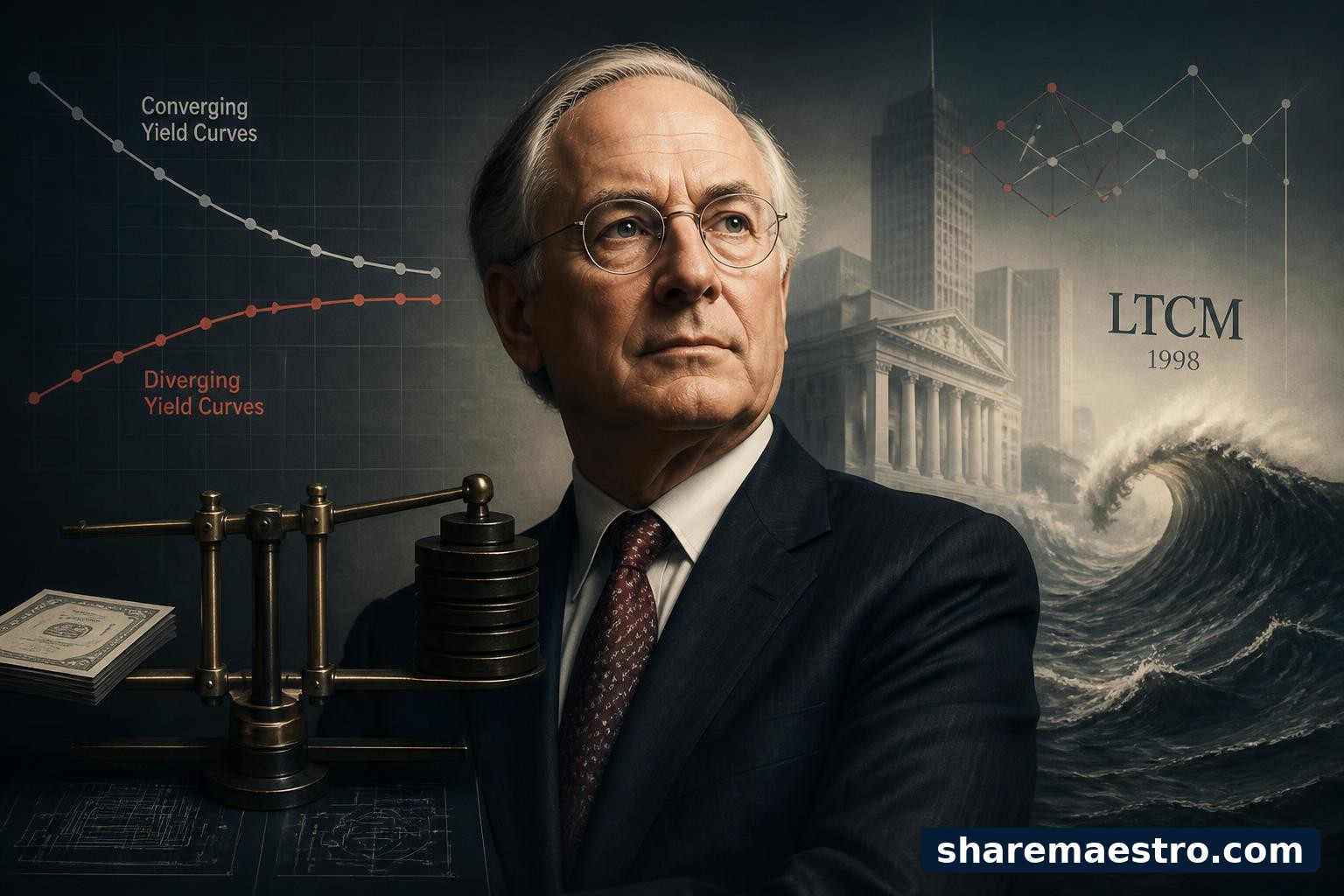
The heart of Meriwether's method was convergence. In its cleanest form, the trade bought an undervalued instrument and sold short a closely related overvalued instrument. If the spread narrowed, the portfolio made money regardless of whether interest rates rose or fell. In practice, the method ranged from classic Treasury on-the-run versus off-the-run trades to corporate bond relative value, swap spreads, mortgage securities, equity volatility, and model-dependent hedges.
The appeal was obvious. A conventional investor had to be right about direction. A relative-value trader could be right about relationships. If two securities were close substitutes, the trader did not need to know the absolute future level of rates. The trader needed to know that an abnormal spread was likely to normalize. That distinction made the strategy feel conservative, even when the financing behind it made the overall portfolio fragile.
The GAO later divided LTCM's approach into convergence trades, relative-value trades, conditional convergence trades, and directional trades. That classification matters because it shows how the word arbitrage stretched under pressure. Some positions had a clear convergence date or structural link. Others depended on a pricing model, a distant expectation, or a volatility assumption. As LTCM grew, the portfolio moved along a spectrum from near-arbitrage toward trades that needed time, liquidity, and stable correlations to prove right.
Portfolio construction at industrial scale
LTCM's portfolio was not a handful of clever trades. It was an industrial-scale balance sheet. The President's Working Group reported that roughly 80 percent of the fund's balance-sheet positions were in government bonds of G-7 countries, but the firm was also active in mortgage-backed securities, corporate bonds, emerging-market bonds, equity markets, futures, swaps, forwards, and options. The breadth was supposed to make the portfolio diversified.
The scale was extraordinary. By late August 1998, LTCM reportedly had more than 60,000 trades on its books, including long securities positions of more than $50 billion and short positions of similar size. Its gross notional futures contracts exceeded $500 billion, swaps exceeded $750 billion, and options plus other over-the-counter derivatives exceeded $150 billion. On August 31, 1998, the balance sheet included more than $125 billion in assets.
This was the machine's central bargain. The trades themselves often offered small expected returns per dollar of assets, so the fund used leverage to turn small spreads into attractive returns on equity. The GAO noted that LTCM's documents told investors it expected to use borrowed funds extensively and that gains and losses would move faster than without borrowings. The method demanded not only correct valuation, but durable financing through adverse marks.
The record that made skepticism difficult
Before the collapse, the numbers were not imaginary. Federal Reserve History reports that LTCM produced net returns of 20 percent in 1994, 43 percent in 1995, 41 percent in 1996, and 17 percent in 1997. The President's Working Group gave a similar summary, noting net returns of approximately 40 percent in 1995 and 1996 and slightly less than 20 percent in 1997. The decline in 1997 looked like moderation, not failure.
Those returns bought Meriwether credibility with investors and banks. They also created a subtle trap. A profitable leveraged arbitrage firm can appear less risky over time because its winning history becomes part of the credit decision. Counterparties compete for its business, financing terms improve, and internal confidence rises. The better the record, the easier it becomes for the market to treat the firm's model as proof rather than as a conditional estimate.
The 1997 return was especially important because it coincided with shrinking opportunities. As the strategy attracted competitors and markets became more efficient, spreads narrowed. Meriwether's own system had helped reduce the anomalies it sought to exploit. The performance record remained enviable, but the prospective return on incremental capital was falling. In that setting, returning capital could look responsible. It could also raise leverage if positions were not reduced in parallel.
The capital return that increased fragility
At the end of 1997, LTCM returned approximately $2.7 billion to investors, cutting its capital base by about 36 percent to $4.8 billion. The crucial detail is what did not happen. The President's Working Group found that the fund apparently did not reduce the scale of its investment positions. The balance-sheet leverage increased because equity fell, not because assets rose.
Federal Reserve Chairman Alan Greenspan later framed this as a strategic turn. LTCM had helped make markets more efficient, reducing the supply of above-normal opportunities. In response, the fund returned capital but also reached for return by using more leverage and taking more risk. The decision was not a single reckless trade. It was an adjustment to a business model whose original opportunity set was becoming crowded.
By early 1998, the margin of safety was thinner than the marketing story suggested. A convergence strategy can survive spread widening if its investors, lenders, and counterparties allow time to work. A highly leveraged convergence strategy has less control over time. Mark-to-market losses force collateral calls, counterparties revise terms, and the portfolio manager may have to sell precisely when spreads are widest. The capital return made LTCM less able to endure the event its models considered remote.
Russia, liquidity, and the failure of diversification
The trigger came from outside the elegant map of relative value. On August 17, 1998, Russia devalued the ruble and declared a debt moratorium, accelerating a global flight to safety. Investors moved toward the most liquid government securities and away from credit, emerging markets, less liquid bonds, and volatility exposure. LTCM had expected spreads to converge. Instead, in many places, they widened together.
The President's Working Group described the result with unusual clarity. Risk spreads and liquidity premiums rose sharply around the world. Losses in individual markets greatly exceeded what conventional risk models, estimated during stable periods, suggested were likely. Simultaneous shocks revealed that global trading portfolios were less diversified than assumed. Liquidity fell just when reducing exposure became most urgent.
The numbers deteriorated quickly. LTCM had $4.1 billion in capital on July 31, 1998, down about 15 percent for the year. In August alone it lost $1.8 billion, taking the year's equity loss to more than 50 percent and reducing capital to $2.3 billion. Federal Reserve History states that the fund lost 44 percent of its value in August. McDonough testified that the September 2 investor letter acknowledged 52 percent year-to-date losses through August 31.
The rescue that still shapes the bailout debate
By September 1998, LTCM's problem had become a problem of market plumbing. Bear Stearns, its clearing agent, required additional collateral for settlement exposures. Repo and derivatives counterparties pressed for collateral using daily margining processes. The fund's ability to meet cash-flow obligations was in doubt, and officials feared that a default would force counterparties to liquidate or re-hedge positions into already fragile markets.
On September 23, 1998, fourteen banks and securities firms agreed to recapitalize LTCM. Federal Reserve History says the group invested $3.6 billion to prevent imminent collapse, with the Fed facilitating but not lending its own money. McDonough emphasized in testimony that no public money was spent or committed. The consortium received 90 percent of the fund's ownership, and the original equity holders took severe losses.
The distinction matters. LTCM was not rescued because officials wished to protect Meriwether's investors from losing money. They were protected only in a limited and painful sense. The public concern was disorderly liquidation: hundreds of billions in positions being closed in stressed markets, spreading losses to firms with no direct LTCM exposure and raising the cost of credit. The episode helped create the modern vocabulary of fire sales, crowded exits, and nonbank systemic risk.
The critique: models, crowding, and misplaced trust
The most durable criticism of LTCM is not that it used models. Modern finance cannot function without models. The deeper criticism is that the models were asked to do too much. Jorion argued that LTCM underestimated risk because it relied on short-term history and concentrated exposures. Using the same covariance structure to measure risk and optimize positions could make the portfolio gravitate toward trades that looked safe precisely because the recent data had been kind to them.
The GAO added a governance and market-discipline critique. Some creditors and counterparties failed to apply prudent standards in dealing with LTCM. Regulators cited a halo effect, meaning that the credentials of the principals influenced credit decisions. Competition for profitable hedge-fund business, favorable economic conditions, and incomplete information weakened the discipline that was supposed to restrain leverage.
Crowding tied these flaws together. A trade that is cheap because nobody owns it is different from a trade that is cheap because many leveraged players already own it and cannot add more. LTCM's positions were geographically dispersed, but its risk was not as diverse as advertised. When spreads widened, similar strategies failed across markets. The result was not merely a bad forecast. It was a portfolio whose exits, financing, and assumptions all moved against it at once.
Meriwether after LTCM
Meriwether did not disappear after LTCM. MarketScreener records that he co-founded JWM Partners in 1999. The continuity was striking. The manager associated with the most famous hedge-fund failure of the 1990s was still able to raise money because investors understood that the method had produced real profits before the collapse. They also understood, or believed, that the next version would use less leverage and better controls.
The second act never carried the same systemic menace, but it echoed the same theme. City A.M. reported in July 2009 that JWM Partners was closing its main Relative Value Opportunity II fund after losing 44 percent over the previous two years, as bond spreads widened and investor redemption pressure mounted. The article said the fund had once managed $2.7 billion for roughly two dozen clients, but had reported $481 million in client assets by the end of April 2009.
That later chapter is essential to judging Meriwether fairly. He was not a one-trade figure, and he was not simply a cautionary villain. He remained committed to relative value after the most public humiliation imaginable. But the recurrence of stress in a later fixed-income strategy reinforced the central lesson of his career. In leveraged arbitrage, better risk controls may reduce the chance of ruin, but they cannot repeal the basic structure of the trade.
How the method changed markets
Meriwether's influence can be seen in the professionalization of relative-value investing. The modern fixed-income arbitrage desk, the multi-strategy hedge fund, and the bank counterparty-risk function all carry traces of the world he helped create. Spreads are now monitored in finer detail, derivatives are integral to hedging, and quantitative research is embedded in trading organizations rather than treated as an academic curiosity.
The Black-Scholes-Merton tradition also became part of this story, although not always in the simplified way popular accounts suggest. Merton and Scholes were not awarded the Nobel Prize because LTCM existed; they were honored for foundational work in derivatives valuation. LTCM's significance was that it placed that intellectual tradition inside a leveraged trading partnership, making the relationship between theory and market practice visible to a mass audience.
Regulators and counterparties changed as well. The President's Working Group called for stronger transparency, better private-sector risk management, more risk-sensitive capital treatment, and attention to bankruptcy and offshore structures. The GAO emphasized that market discipline alone may not account for contagion risk because each firm protects itself, not the system. In that sense, Meriwether changed markets partly by building a machine so impressive that its breakdown became a regulatory education.
What remains useful, and what remains dangerous
The useful part of Meriwether's legacy is the insistence that markets are relational. A bond is not only a yield; it is a financing instrument, a hedge, a liquidity claim, and a spread against alternatives. Relative value remains one of finance's most important disciplines because it forces investors to ask what exactly they are being paid for: credit, liquidity, optionality, balance-sheet use, or temporary disorder.
The dangerous part is the temptation to treat historical convergence as a promise. A spread can be wrong for longer than a levered investor can finance the position. A hedge can work in normal states and fail in liquidation states. A diversified portfolio can hide a single common exposure to liquidity. A counterparty can be generous during calm markets and exacting when every point of collateral matters.
Meriwether's career endures because it resists easy moralizing. He was neither a mere gambler nor a riskless scientist. He was a builder of arbitrage systems who showed that intelligence, discipline, and data can create extraordinary returns, then fail under conditions that the system itself helped obscure. For today's markets, the lesson is not to reject models or relative value. It is to remember that the final risk model is the market's willingness to finance you when your model says you are right but your marks say you are losing.
Disclosure
Educational financial journalism and market research only. Not financial, investment, trading, tax, or legal advice.