In brief
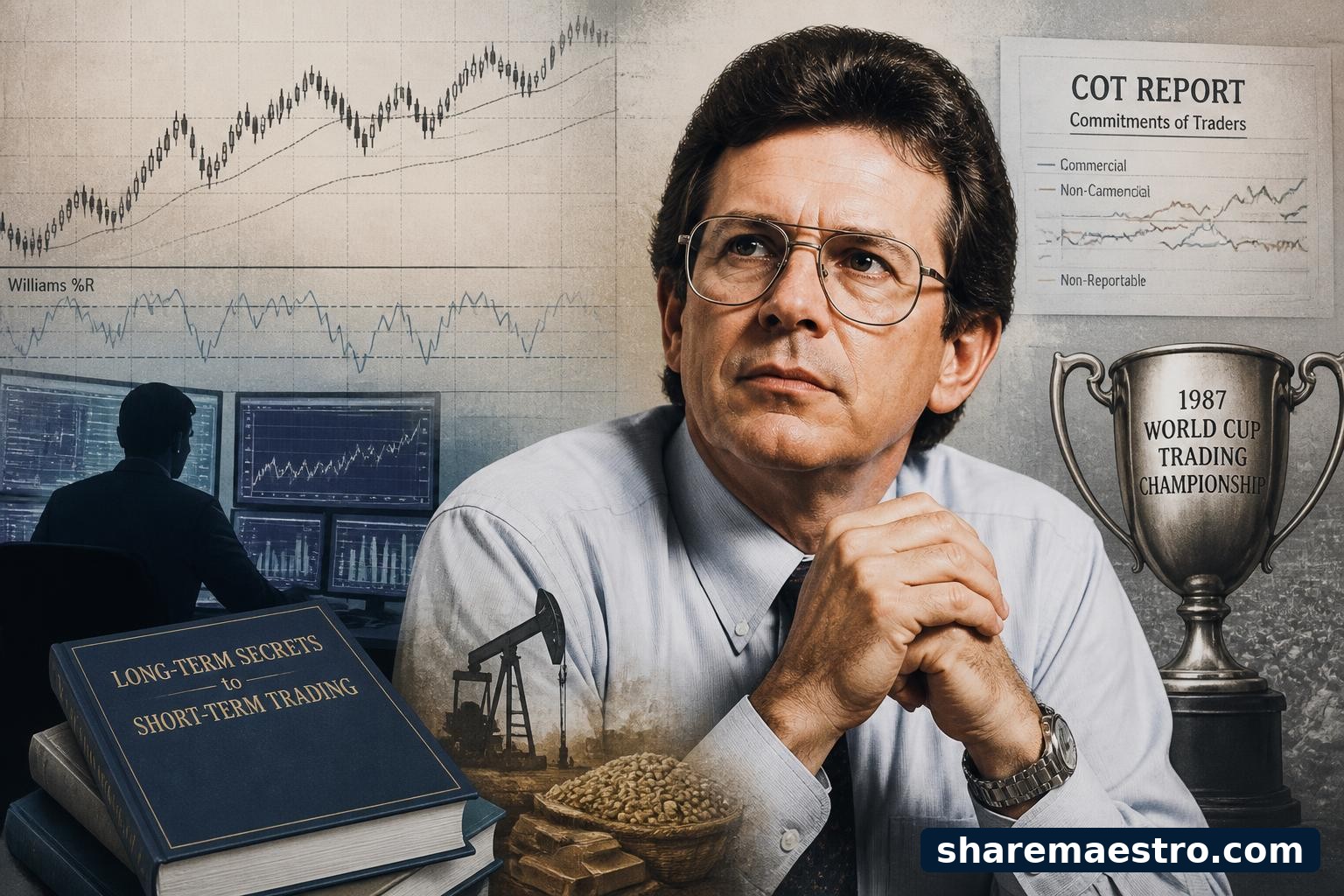
This Sharemaestro profile examines Larry Williams, the American trader, author, indicator designer, and trading educator best known for Williams %R, COT-based futures research, Long-Term Secrets to Short-Term Trading, and his 11,376 percent 1987 World Cup Trading Championship result. It traces how a journalism-trained market operator built a career from price-and-time pattern work, commercial hedger positioning, volatility breakouts, and a relentless appetite for testing. It also weighs the limits of contest performance, the hazards of futures leverage, the mixed evidence around technical trading rules, and the personal controversy of his tax-protest episode.
- Williams matters because he helped translate short-term futures speculation into a teachable public craft built around indicators, timing, COT data, and money management.
- His 1987 World Cup Trading Championship return of 11,376 percent remains the central number in his legend, but it should be read as a concentrated contest result, not as proof of a stable investor-like compound record.
- Williams %R and the Ultimate Oscillator endured because they compress market action into clear questions: where did price close within its recent range, and how strong is buying pressure across multiple horizons.
- His COT work reframed publicly reported futures positioning as an input for traders trying to understand commercial hedgers, large speculators, and the public.
- The durable lesson from Williams is not that traders can copy his results, but that short-term speculation requires a defined edge, position sizing, skepticism about easy signals, and respect for leverage.
Performance and evidence
Performance markers
Visual Evidence
Charts and timelines
Risk
Timeline
Philosophy
Performance
The year a trading contest became a legend
In the mythology of modern futures trading, Larry Williams stands at a peculiar intersection: part technical analyst, part commodities speculator, part educator, part cautionary tale. His name travels farther than many institutional money managers because his best-known number is simple enough to survive every retelling. The official World Cup Trading Championship historical standings list Larry Williams as the 1987 winner with a return of 11,376 percent, a figure so outsized that it made the contest itself part of his identity.
The timing mattered. The year 1987 was not a quiet laboratory for a private backtest. It was the year of equity-index violence, interest-rate drama, and the October stock-market crash. A trader who could survive that public arena while pressing futures positions became an irresistible story, especially for an industry built on the promise that a small amount of margin can control a large amount of financial exposure.
Williams did not become important only because he won. He became important because he turned the win into a durable body of teaching, writing, indicators, market letters, and seminars. The contest created the headline, but his longer career created the audience. The tension between those two things, the spectacular record and the repeatable lesson, is the proper way to read him.
Why Larry Williams matters
Williams belongs in market history because he popularized a practical form of short-term speculation at the point where retail access, charting software, and futures education were beginning to converge. He was never just a screen trader with a private account. He wrote, lectured, sold education, designed indicators, and pressed the idea that markets could be approached through recurring conditions rather than pure instinct.
That matters because much of today’s trading culture is descended from people like him. Modern traders take for granted that a platform will include a momentum oscillator, a volatility study, a COT chart, and a menu of backtested scans. Williams worked in an earlier period, when market data were harder to gather, computing power was scarce, and technical research often arrived through newsletters, books, and hand-kept records.
His influence is therefore not limited to one formula. Williams helped define the trader-educator as a market figure, someone who could be judged by performance claims, intellectual tools, and the public usefulness of a method. That role invites scrutiny. It also explains why his career remains interesting long after the original competition account closed.
From journalism to market research
Williams’ self-presentation has always had a reporter’s cadence. On his own educational site, he connects his writing life to a journalism degree from the University of Oregon, and he describes a trading apprenticeship that began with confusion, books, and failure before a more coherent market approach emerged. That background matters because he built a career by converting observation into usable narrative.
The journalism connection should not be overstated. Markets do not reward prose. Yet the habits are recognizable: collect facts, classify actors, ask who benefits, compare today with yesterday, and look for the missing condition that explains movement. Williams’ later fascination with commercial traders in the COT reports fits that cast of mind. He did not merely ask whether a chart looked bullish. He asked who was positioned, why they might be positioned that way, and what price might do when pressure resolved.
He has said that the early path was not instant mastery. His official trading education material presents the arc as a long sequence from fundamentals to technical structure to short-term swings. That is a useful corrective to the simplified public image. The popular story begins with the million-dollar run. The working story begins with years of market study.
The invention that made his name appear on every chart
Williams %R is the most portable artifact of his career. The indicator measures where the latest close sits relative to the highest high and lowest low of a chosen lookback period. StockCharts describes it as a momentum indicator that is effectively the inverse of the Fast Stochastic Oscillator, scaled from 0 to minus 100, with readings near 0 traditionally treated as overbought and readings near minus 100 as oversold.
The importance of %R is not that it predicts the future by itself. Its importance is that it gives a trader a clean way to see closing pressure. A close near the top of the recent range communicates something different from a close near the bottom. Williams’ own account of the indicator’s origin places it in the mid-1960s, a period when retail charting was primitive by modern standards and any systematic compression of price action could carry practical value.
The danger is equally clear. Overbought does not have to mean sell, and oversold does not have to mean buy. Strong trends can keep closing near range extremes for longer than a contrarian trader can stay solvent. The mature use of %R is less about treating it as a magic reversal light and more about asking whether price action confirms or conflicts with the broader condition.
A trader built from price, time, and conditions
Williams’ mature method is often described as short-term market timing, but that phrase can flatten what he tried to teach. In Long-Term Secrets to Short-Term Trading, the organizing subjects include volatility breakouts, price patterns, cycles, exits, and the business of speculation. The point is not simply to trade fast. The point is to locate a condition that might produce movement, then use timing tools to enter without letting the position become an open-ended opinion.
This is why Williams has often sounded less like a pure chartist than many of his followers. His own educational material criticizes traders who begin with day trading before understanding what moves markets. He treats day trading as difficult, physically and mentally demanding, and late in the educational sequence rather than the first stop for beginners. That is not the message usually attached to trading fame, but it is one of his more sober themes.
The distinction matters. A pattern without a market reason can become decoration. A reason without an entry can become a thesis that bleeds money. Williams’ trading work sits between those errors. He wanted observable conditions, but he also wanted the discipline of price action, exits, and money management.
The COT idea and the search for better-informed money
Williams’ COT work is one of the more serious parts of his legacy. The Commodity Futures Trading Commission’s Commitments of Traders reports break futures positioning into categories that allow the public to see how major groups are positioned. The current CFTC reporting environment includes legacy reports, disaggregated reports, financial futures reports, and supplemental agricultural reports, each offering a different view of reported open interest.
The attraction for Williams was obvious. Futures markets are not abstract betting pools. They include producers, processors, merchants, users, dealers, managed money, and other reportable traders. CFTC explanatory notes define producer, merchant, processor, and user participants as entities primarily engaged in the physical commodity business that use futures to manage or hedge risk. That makes them different from a purely speculative trader, even when their positions can still be early, hedged, or wrong.
In Trade Stocks & Commodities with the Insiders, Williams made a broad case for studying these groups, especially commercial interests. The title is provocative, but the substance rests on public data rather than illegal inside information. The useful insight is that trader categories can reveal stress, imbalance, or crowding. The risk is that a label such as commercial or managed money can seduce traders into assuming knowledge that the report itself does not prove.
The World Cup result and what it can prove
The 1987 World Cup Trading Championship result is the number that made Williams a legend: first place, 11,376 percent. The historical standings also show how extraordinary that figure was in context. Ralph Casazzone won in 1985 with 1,283 percent, an astonishing result by any normal standard. David Kline won in 1988 with 148 percent. Michelle Williams, Larry Williams’ daughter, won in 1997 with 1,001 percent. Williams’ 1987 number towers over them all.
That does not make it an institutional track record. A trading contest rewards percentage gain over a defined period, and the incentives differ from managing outside capital through a full cycle. Concentrated futures speculation can produce spectacular gains because leverage magnifies correct timing. The same structure can punish error with equal force. A competition result can show skill, nerve, and execution under pressure, but it cannot by itself establish a repeatable, risk-adjusted process suitable for every account.
The fairest interpretation is narrower and stronger. Williams publicly produced one of the most famous live futures contest results in the record of that competition. It demonstrated the upside power of short-term futures timing in the hands of a trader willing to press an edge. It also became a permanent warning that return figures without drawdown, sizing, margin, and full account context are incomplete.
What the contest tells us about leverage
Futures leverage is central to the Williams story. It is impossible to understand an 11,376 percent contest return without understanding that futures contracts allow a trader to control large notional exposure with a smaller margin deposit. That structure is neither good nor bad by itself. It is a tool. In the hands of a disciplined trader, leverage can convert a short-lived opportunity into a meaningful account gain. In the hands of an undisciplined trader, it can compress years of mistakes into days.
World Cup Trading Championships’ own public disclosure warns that futures and forex involve significant risk of loss, that past performance is not necessarily indicative of future results, and that a championship account may not represent all accounts controlled by a competitor. It also states that entrants may trade more than one account. Those disclosures are not trivia. They frame the proper use of contest performance as evidence.
Williams’ record is therefore best read as a high-voltage demonstration. It is evidence that he could trade aggressively and successfully in that defined arena. It is not evidence that followers should pursue the same percentage gains, the same concentration, or the same tolerance for swings. The lesson is about the power and danger of sizing, not the romance of a trophy.
The process beneath the showmanship
Williams’ trading vocabulary can sound theatrical, but the process underneath is more structured than the legend suggests. In his educational material, he describes a sequence that starts with understanding the longer-term forces behind markets, moves to technical structure, and only then focuses on short-term swings. That hierarchy is important because it places trade entry below market context.
His published work also emphasizes that short-term traders need more than opinions. Long-Term Secrets to Short-Term Trading covers volatility breakouts, profit patterns, exits, cycles, and money management. Those categories reveal the architecture of the method: find a condition, wait for movement, define the entry, know the exit, and size in a way that does not let one idea destroy the account.
The Williams method is not a single black box. It is a family of tools. There are range-based indicators such as %R, multi-period momentum tools such as the Ultimate Oscillator, COT positioning concepts, seasonal and cyclical thinking, and money-management rules. That breadth is both strength and weakness. It gives the trader multiple lenses, but it also creates room for discretion, overfitting, and after-the-fact storytelling.
Money management, the unglamorous center
The most valuable part of Williams’ teaching may be his insistence that trading is a money-management problem as much as a forecasting problem. His Wiley material treats money management as central to speculative survival, and his educational site repeatedly warns that futures trading is risky. That stance is less glamorous than a winning entry signal, but it is more durable.
This is where contest lore can mislead. A trader who wants to win a competition may accept risk that a professional fiduciary would reject. A trader running personal capital may tolerate volatility that a client would not. A trader selling education may use a headline number that is true but incomplete. Money management is the bridge between those worlds, because it asks how much of the account should be exposed when the trader is inevitably wrong.
Williams’ public career shows both sides of the issue. His fame came from pressing size in a spectacular year. His longevity came from teaching that the size, not merely the signal, determines whether the trader survives. That is the paradox at the center of his reputation: the man celebrated for an extreme return also became a messenger about the danger of extreme trading.
The Ultimate Oscillator and the search for fewer false signals
Williams did not stop with %R. StockCharts credits him with developing the Ultimate Oscillator in 1976 and notes that it was featured in Technical Analysis of Stocks & Commodities in 1985. The indicator was designed to capture momentum across three timeframes, using buying pressure and true range to reduce the false divergences that can plague single-period oscillators.
The design reveals a persistent Williams theme: short-term data need context. A very fast oscillator can react quickly, but it may also produce noise. A slower measure can filter noise, but it may arrive late. The Ultimate Oscillator combines several horizons in a weighted formula, attempting to keep the short-term signal while acknowledging the longer-term rhythm of price action.
The broader point is not that one oscillator solves momentum. It is that Williams repeatedly tried to convert trader intuition into measurable structure. Where is price closing? Is buying pressure expanding? Are multiple timeframes aligned or in conflict? These questions remain useful even when the exact indicator settings are debated.
Teaching a dangerous craft
Williams’ second career is inseparable from education. His official site presents Larry Williams University as a home for his courses, books, articles, webinars, and market commentary. It also stresses that he has been an educator for almost as long as he has been a trader. That dual role is common now, but Williams helped define it before online trading education became a crowded business.
The best version of the trader-educator model is apprenticeship at scale. A skilled practitioner explains how he thinks, where he has failed, and what conditions matter. The worst version is performance marketing dressed as instruction. Williams has lived close enough to both perceptions that serious readers should distinguish between his durable ideas and the promotional aura around his record.
His own site includes warnings about imposters and people claiming relationships with him, which reflects a newer problem in trading education. A famous name becomes a credential that others borrow. The more valuable Williams’ brand became, the more necessary it became to ask who is speaking, what is being sold, and whether the underlying method is being presented with suitable risk warnings.
The criticism: indicators, data mining, and the limits of technical proof
The obvious criticism of Williams is the obvious criticism of technical trading itself: if indicators worked simply and permanently, markets would arbitrage them away or traders would crowd them into failure. Williams’ indicators are clear and widely available, which means their mere presence on a chart cannot be a proprietary edge. The edge, if there is one, must come from context, testing, execution, and risk control.
Academic work on technical analysis offers a mixed picture. Park and Irwin’s review found many modern studies reporting positive results for technical trading strategies, but it also highlighted serious testing problems, including data snooping, ex post selection of rules, transaction costs, and risk estimation. That is exactly the zone in which popular trading systems often overpromise. A rule that looks excellent after many trials on historical data may be a discovery of the past rather than a guide to the future.
This critique does not erase Williams’ contribution. It defines the boundary around it. His tools are better understood as ways to ask disciplined questions of price and positioning, not as self-validating proof. A trader who uses %R, COT, or volatility breakouts without out-of-sample testing and strict sizing has adopted the vocabulary of Williams without adopting the skepticism that made the vocabulary useful.
The COT method, useful and dangerous
COT analysis has a special appeal because it feels more fundamental than a price oscillator. Instead of looking only at candles, the trader can see how reportable groups are positioned. That makes Williams’ COT work more robust in concept than a pure chart pattern. It asks whether the people closest to physical supply and demand are behaving differently from the speculative crowd.
Yet COT data are not a telescope into certainty. The CFTC explains that classifications depend on trader information and predominant activity, and that a trader’s classification can change as business activity evolves. A producer may hedge, speculate, or do both. A swap dealer may be laying off exposure from many counterparties. Managed money can be trend following, discretionary, hedged, or spread-based. The category is useful, but it is not a confession.
Williams’ mature COT idea is strongest when treated as an extreme-reading tool, a context filter, or a way to identify crowding. It is weakest when treated as a simple instruction to follow commercials and fade everyone else. The report shows positioning. It does not show timing, motive with precision, or the path prices must take before the next major move.
The tax-protest detour
No serious profile of Williams should omit the tax episode, because it complicates the image of a disciplined market operator. NPR reported the story as one of a trader who embraced a tax-protest argument, traded letters with the IRS, was arrested, and ultimately pleaded guilty to three misdemeanors. The report says he paid a fine after the criminal case resolved.
The episode does not belong in the same analytical bucket as his indicators or trading record. It was not a futures strategy. It was a personal legal and judgment failure with public consequences. It matters here because finance reputations depend not only on insight but also on trust, judgment, disclosure, and the willingness to accept rules one may dislike.
Williams’ own words in the NPR account acknowledge that the tax-protest argument was wrong. That matters, but it does not erase the episode. For a figure whose career involves teaching others how to manage risk and discipline, the contradiction is obvious. Markets punish bad assumptions. Legal systems do too.
What his method changed for ordinary traders
Williams helped democratize a trader’s research toolkit. Before every platform carried oscillators and before COT data could be downloaded and charted quickly, he pushed the idea that ordinary traders could build repeatable tools from price ranges, momentum, open interest, and public positioning data. That was a major shift in retail market education.
He also broadened the definition of technical analysis. In the laziest usage, technical analysis means drawing lines on a chart and announcing a forecast. Williams’ better work is more empirical. It asks what happens after certain conditions occur, whether the close carries information, whether volatility expansion follows compression, and whether different trader groups are stretched. Those questions can be tested, refined, rejected, or incorporated into a risk process.
His influence can be seen in the persistence of his tools. Williams %R appears across charting packages and educational libraries. The Ultimate Oscillator remains part of the standard technical-analysis menu. COT analysis is now a routine part of many futures discussions. The trader using those tools may never study Williams directly, but the path runs through him.
Disclosure
Educational financial journalism and market research only. Not financial, investment, trading, tax, or legal advice.