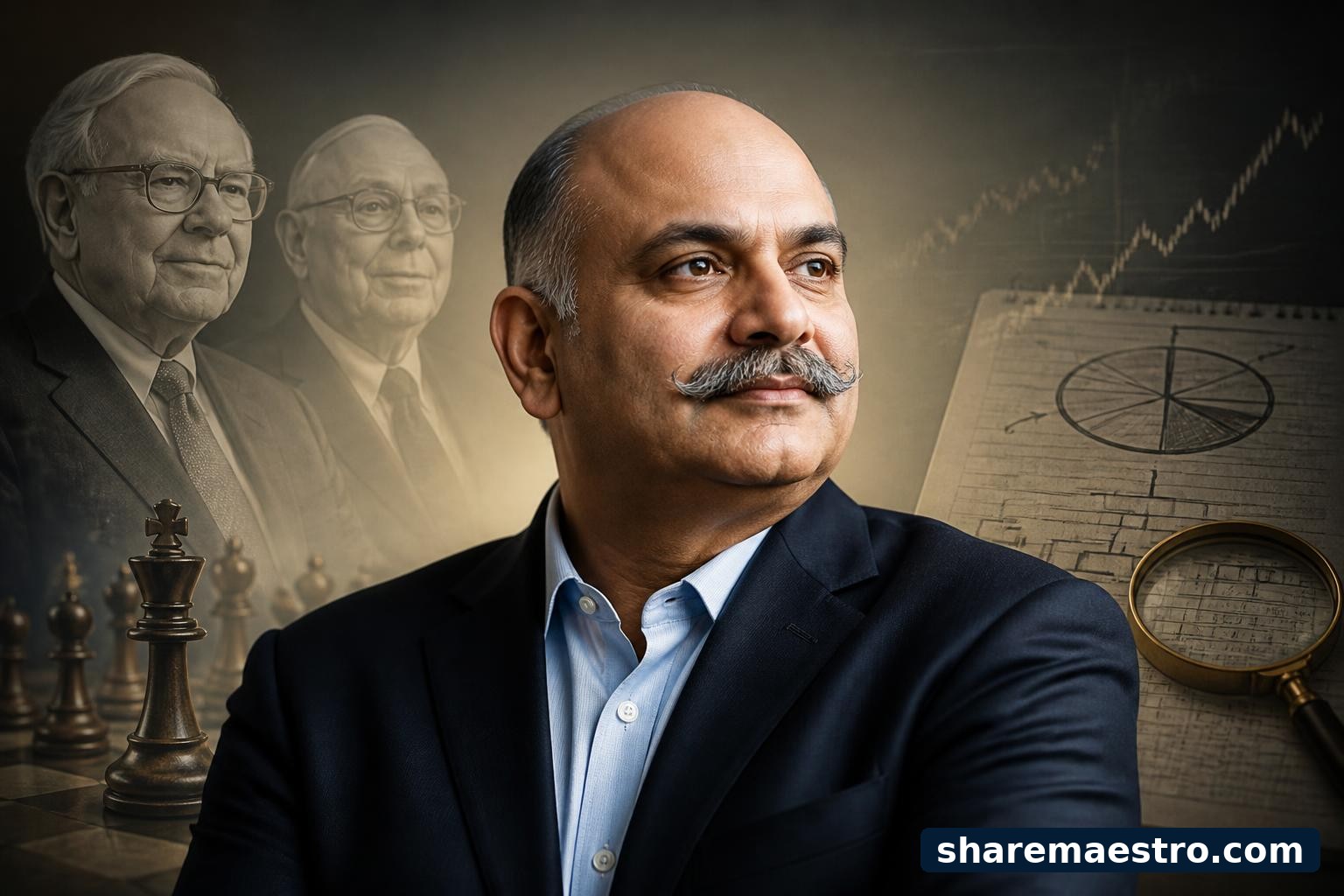
In brief
Mohnish Pabrai matters because he converted imitation into a serious investing method. His Pabrai Investment Funds were built as a modern echo of the Buffett partnerships, with performance-based fees, a few large positions, and a search for mispriced businesses around the world. His Dhandho framework helped popularize low-risk, high-uncertainty investing for a generation of value investors. The same habits that made his approach teachable also expose its limits: concentration, key-person dependence, opaque private fund holdings, difficult selling decisions, and long periods of underperformance against a roaring S&P 500.
- Pabrai’s distinctive contribution is not a new theory of finance but a disciplined embrace of cloning, meaning the systematic study and adaptation of proven ideas from Buffett, Munger, Graham, entrepreneurs, and other investors.
- Pabrai Funds’ private partnership structure deliberately echoes Buffett’s early partnership model, including no management fee, a 6% hurdle, high-water marks, and a concentrated long-only value portfolio.
- The Dhandho framework reframes value investing as asymmetric capital allocation: a few large bets in simple, understandable businesses where downside is limited and uncertainty creates mispricing.
- Pabrai’s record includes powerful early compounding and later recoveries, but also a financial crisis drawdown, a severe 2018 to 2020 air pocket, and public-fund underperformance through 2025.
- His continuing relevance lies in the tension between two lessons: great ideas can be copied with humility, and concentrated investing can become unforgiving when judgment, timing, or selling discipline falters.
Performance and evidence
Performance markers
Visual Evidence
Charts and timelines
Risk
Timeline
Philosophy
Performance
The copyist who made originality optional
Mohnish Pabrai’s most provocative idea is not a stock pick, a valuation formula, or a market forecast. It is the proposition that in investing, originality is overrated. He built a public identity around studying Warren Buffett and Charlie Munger, copying what could be copied, discarding what did not fit, and converting the resulting habits into a compact doctrine he called Dhandho. In a profession that rewards mystique, he turned imitation into a badge of seriousness.
That stance would be easy to dismiss if Pabrai were only a lecturer or author. He is not. He is the managing partner of Pabrai Investment Funds, the portfolio manager of the Pabrai Wagons ETF, the CEO of Dhandho Funds and Dhandho Holdings, and, as of June 30, 2026, the manager of about $1.2 billion across private partnership and exchange-traded fund assets through Dhandho Funds and Dalal Street. He has made himself both practitioner and explainer.
Pabrai matters because he gave small and professional value investors a repeatable language for concentrated investing: few bets, big bets, infrequent bets; margin of safety; simple businesses; low risk coupled with high uncertainty; and a willingness to stand apart from index-shaped portfolios. His career also supplies a cautionary counterweight. The same concentration that makes a great idea count can make a mistake dominate the record.
From engineer to Buffett partnership student
Pabrai’s biography begins closer to operating companies than to trading desks. He earned a computer engineering degree from Clemson University in 1986, worked at Tellabs from 1986 to 1991, and moved from research and development into international business assignments. That early exposure matters because his later investing style often reads like an engineer’s attempt to simplify a noisy system into decision rules, constraints, and feedback loops.
In 1990, he founded TransTech, an IT consulting and systems integration company, from his home. The business was financed with $30,000 from his 401(k) account and roughly $70,000 of credit card debt. It grew to a revenue run rate of more than $20 million with more than 160 people, was recognized as an Inc. 500 company in 1996, and was sold to Kurt Salmon Associates in 2000.
The investing turn came before the sale. Pabrai began applying the Buffett model to his own portfolio in 1995 and started Pabrai Funds as a hobby in 1999. By September 2000, he had made the funds his full-time vocation. The origin story is important because it explains why his investing voice is entrepreneurial rather than academic: capital is to be allocated as a business owner would allocate it, not as a benchmark-aware committee might.
Dhandho as a theory of asymmetric effort
The Dhandho Investor, published by Wiley in 2007, is the book that made Pabrai’s method portable. The subtitle is direct: The Low-Risk Value Method to High Returns. Its chapters move through Patel motel operators, simple businesses, distressed industries, durable moats, arbitrage, margin of safety, low-risk high-uncertainty situations, and copycats rather than innovators. The book did not invent value investing. It repackaged old ideas into a vivid operating manual.
The core insight is behavioral as much as financial. Markets dislike uncertainty, often treating uncertainty as if it were the same thing as risk. Pabrai’s Dhandho framework separates the two. A business can be temporarily clouded, misunderstood, cyclical, or unfashionable without being permanently impaired. If the downside is constrained and the market price already reflects a grim scenario, the uncertainty can become the investor’s friend.
That is why Pabrai’s language appeals beyond hedge funds. It gives investors a way to think about capital allocation as a series of wagers with uneven payoffs. The phrase most associated with the book, heads I win, tails I do not lose much, captures the ideal. The more difficult part, as his own record later showed, is that the tail can still be painful when the position is large, the cycle is slow, or the business quality was overestimated.
Cloning as work, not laziness
Pabrai’s most misunderstood word is cloning. In casual use, it sounds like copying a 13F filing or buying a famous investor’s holdings after a quarterly disclosure. In Pabrai’s vocabulary, it is closer to pattern recognition. He studies investors, entrepreneurs, and capital allocators who have already solved a problem, then asks whether the solution can be adapted without the original owner’s advantages.
That distinction is crucial. Blind copying imports someone else’s context, cost basis, liquidity, tax situation, and temperament. Pabrai’s stronger formulation is that investors should not waste time inventing if a superior model is already available. His private partnership structure copies Buffett’s 1950s partnership economics. His circle-of-competence filter descends from Buffett and Munger. His insistence on simple businesses and margin of safety comes through Graham and Buffett.
This is why Pabrai’s influence is larger than his asset base. He legitimized the idea that investing progress can come from studying the best available models with almost shameless humility. The danger is that cloning can become a shortcut for investors who borrow conclusions without borrowing the work. Pabrai’s own method demands reading, valuation, business judgment, and patience. The label is simple; the practice is not.
A fee structure built as an argument
The architecture of Pabrai Funds is part of the philosophy. The private funds charge no conventional management fee. The first 6% of annual returns goes to investors, and returns above that hurdle are split with three quarters to investors and one quarter to Dalal Street. Fees are subject to high-water marks, so a fund has to recover prior losses and exceed the relevant threshold before incentive fees resume.
The partnership rules reinforce the point. Pabrai Funds are long-only, unleveraged, and focused, investing in publicly traded equities on any exchange worldwide and bonds. The funds do not use margin borrowing, short stocks, or futures and options. The portfolio is deliberately concentrated, with the rules stating that typically 80% of assets are invested in under a dozen securities and that the funds have never held more than 20 distinct securities when fully invested.
This structure gives Pabrai credibility when he criticizes asset-gathering incentives. If he earns little during weak periods, the pain is shared. But it also raises the bar for the strategy. A concentrated fund with performance fees and a Buffett-inspired heritage cannot claim victory simply by surviving. Its reason for existing, according to the firm’s own objective, is to outperform the major indices over the long haul.
The process begins with exclusion
Pabrai’s stated process starts by eliminating most of the investable universe. Before rigorous analysis, he asks whether he understands the business and whether it lies within his circle of competence. If the answer is no, the security is skipped. That first filter is deceptively severe. It rejects the Wall Street habit of always having a view and replaces it with the investor’s right to do nothing.
The next question is business quality. Pabrai’s materials describe the search for great businesses selling below intrinsic value and special situations that exploit market inefficiencies. The objective is not statistical cheapness alone. He wants understandable businesses, durable economics, honest and competent management, and a price that makes the prospective return attractive enough to justify concentration.
The final step is sizing. In a diversified portfolio, a 2% position can be a research note with capital attached. In Pabrai’s world, a 10% position is closer to a business decision. The upside of that discipline is that the portfolio can be transformed by one or two correct judgments. The downside is that mistakes cannot hide. A thesis that moves from cheap to impaired can reshape the whole fund.
From American bargains to global anomalies
Pabrai’s opportunity set has become more global over time. The private-fund rules allow investments in public equities on exchanges worldwide, and the Pabrai Wagons ETF gives the public version of the strategy wide geographic latitude. The ETF may invest up to 100% of assets in foreign issuers, emerging markets, and even frontier markets, and it may hold a significant cash position when the adviser thinks that is appropriate.
The visible U.S. 13F record shows a concentrated domestic slice rather than the full global picture. Dalal Street’s filing for the quarter ended March 31, 2026 listed three reportable entries with a total value of $422,885,142. Because 13F filings omit many foreign securities and other instruments, the filing should not be treated as the entire Pabrai portfolio. It does, however, confirm the continuing taste for concentration.
This global turn fits the Dhandho frame. Pabrai is not trying to own a representative sample of world equities. He is trying to find anomalies: businesses with attractive reinvestment prospects, capable owner-operators, unusual assets, or temporary neglect. In that sense, geography is secondary. The real map is a search for mispricing that survives deeper examination.
The record: brilliant stretches, brutal intervals
Pabrai’s performance record resists a single sentence. In the 2020 annual meeting transcript, he described the first eight years of PIF2 as a period with no down years, with returns averaging more than 29% a year while the S&P 500 was essentially flat. He also described strong performance from 2009 to 2018, with annual returns in the mid-20% range across funds after the financial crisis.
The weak periods are just as important. During the 2007 to 2009 financial crisis, PIF2 was down close to 65%, compared with roughly 36% to 37% for the S&P 500. From 2018 to 2020, the funds hit another severe air pocket, with the 2024 annual meeting transcript describing a roughly 50% drawdown and about 30% annualized declines while the S&P 500 was modestly positive.
The lesson is not that Pabrai failed or triumphed in a simple way. It is that his strategy produces lumpy outcomes. Concentration, cyclicality, and non-index exposures create the possibility of major outperformance and major embarrassment. Pabrai’s own long-term framing is that investors must judge the record over long horizons. The harder question is whether all partners can emotionally and financially remain through the troughs.
The selling problem hiding inside value investing
Pabrai’s most interesting self-criticism concerns selling. In 2020, he laid out a painful ledger: Moutai, Ferrari, Rain Industries, and Fiat Chrysler. The issue was not that all were failures. Some were highly profitable. The problem was that he sold certain compounders too early and held other positions too long, leaving large sums on the table relative to what could have been achieved by different decisions.
The distinction strikes at the center of modern value investing. Buying cheap is conceptually clean. Holding a business that has become optically expensive but remains exceptional is harder. Pabrai’s later formulation is that compounders deserve more leash. That evolution brings him closer to the Buffett who moved from cigar butts toward great businesses, but it also complicates the Dhandho preference for obvious asymmetry at purchase.
Selling is where checklists meet temperament. A spreadsheet can estimate intrinsic value, but it cannot fully answer when a superb business deserves to run, when a cyclical winner has overshot, or when a management change has truly altered the thesis. Pabrai’s willingness to discuss those errors is one reason his teaching has bite. The mistakes are not abstract. They came from real capital.
Wagons brings the method into public view
The launch and conversion of Pabrai Wagons is a significant new chapter because it places a version of Pabrai’s approach inside a registered public vehicle. The predecessor mutual fund began operations on September 29, 2023. After a board-approved reorganization, it was converted into the Pabrai Wagons ETF, which began trading on February 9, 2026 and later traded on NYSE Arca under the ticker WAGN.
The ETF’s prospectus describes an actively managed fund seeking long-term capital appreciation. It normally invests at least 80% of net assets in equity securities, can own companies of any market capitalization, and can invest in both growth and value companies. It may also invest in special situations, foreign securities, emerging markets, frontier markets, and cash when conditions warrant.
The public wrapper changes the trade-offs. The ETF charges a 0.90% unitary management fee and publishes holdings information in a way private funds do not. It gives a broader audience access to Pabrai’s portfolio management but also exposes the strategy to daily market pricing, bid-ask spreads, ETF-specific risks, and short-period performance comparisons. The method is the same family tree, but the audience is less patient by design.
The public record starts with a benchmark problem
The Wagons record is young, but its early comparison is sobering. For the periods ended December 31, 2025, the predecessor fund’s Institutional Class returned 3.98% before taxes for one year and 10.20% annualized since its September 29, 2023 inception. The S&P 500 returned 17.88% for the same one-year period and 24.74% since that inception date, with no deduction for fees, expenses, or taxes.
Those numbers are not a verdict on a long-horizon investor. They are a reminder that public funds are judged in public time. Pabrai’s approach asks for years, often through awkward mark-to-market declines. ETF investors can enter and exit intraday. The friction between long-term concentrated ownership and daily liquidity is not unique to Wagons, but it is especially sharp when the manager’s brand is built on patience.
The prospectus itself flags the relevant risks: newer fund risk, management risk, key man risk, non-diversification risk, foreign securities risk, emerging and frontier markets risk, and the possibility of meaningful country or sector exposure. These are not boilerplate distractions. They are the formal version of what Pabrai’s history already teaches. The strategy cannot be evaluated without accepting its capacity for visible underperformance.
Risk management without the comfort of diversification
Pabrai often reduces risk by refusing leverage, avoiding shorts, avoiding derivatives in the private funds, and demanding a margin of safety. That is real risk control. It prevents certain forms of forced selling and balance-sheet fragility. Yet it does not eliminate the central risk of the strategy: a small number of judgments can dominate investor outcomes.
The ETF prospectus makes that plain. The fund is non-diversified, may invest a larger percentage of assets in fewer issuers, and may focus 25% or more of assets in one or more sectors. It may invest up to 100% of assets in emerging markets. It has India, Turkey, Eurozone, Asia, and other country or regional risks described in detail. The fund is also heavily dependent on Pabrai as a single individual.
This is the paradox of concentrated value investing. It may be intellectually cleaner than closet indexing, but it is not psychologically easier. Diversification can hide mediocrity; concentration exposes it. The investor gets a clearer link between thesis and result, but also fewer places to hide when a thesis breaks. Pabrai’s discipline reduces some risks while intensifying others.
The critique: guru risk, opacity, and the S&P 500
Pabrai attracts criticism for three reasons. First, his style is identified so closely with Buffett and Munger that skeptics question how much is original. That critique misses part of the point, since he explicitly treats cloning as a virtue, but it becomes sharper when copied principles produce results that lag simpler index exposure. A Buffett-inspired structure does not guarantee Buffett-like outcomes.
Second, private fund opacity limits outside evaluation. Pabrai Funds disclose holdings only to the extent required by law or audits, and the partnership rules explain why investment ideas are kept confidential. That is rational for a concentrated manager who does not want ideas appropriated. It is also frustrating for outsiders trying to separate skill, luck, factor exposure, and timing.
Third, the benchmark has become harder to beat. A concentrated portfolio that omits the dominant technology winners can look wrong for years, even if individual theses are sound. Pabrai has argued in annual meeting discussions that his portfolios can differ meaningfully from the S&P 500. That independence is the product. It is also the burden. If a manager rejects the benchmark, he must eventually justify the deviation with returns.
Dakshana extends the ROI mindset beyond markets
Pabrai’s philanthropy is not incidental to his investing identity. He is the founder and chairman of the Dakshana Foundation, which focuses on poverty alleviation through education, particularly intensive coaching for gifted but economically disadvantaged students in India seeking entrance to engineering and medical programs. The foundation’s public profile frames education as a durable weapon against poverty.
The same page describes Pabrai using a value investor’s concern with efficiency and return on investment to run Dakshana. It reports that since operations began in 2007, IITs in India had accepted 1,539 Dakshana Scholars out of 2,575, a success rate of 59.76%, and that the fully loaded cost per scholar was $3,066 in 2016. Those figures are old, but they reveal the operating philosophy.
The philanthropic work also explains part of Pabrai’s public appeal. He is not merely teaching investors to compound capital for its own sake. His broader narrative is to copy what works, compound patiently, and redirect wealth toward measurable human outcomes. That does not soften the investment critique, but it rounds out the portrait. The same mind that searches for mispriced securities searches for high-return interventions.
What remains useful, and what remains dangerous
Pabrai’s enduring usefulness lies in a small set of habits. Stay inside a circle of competence. Study better investors without ego. Do not pay for activity when patience is available. Demand asymmetry. Keep fees aligned. Accept that a few decisions may matter more than hundreds of marginal ones. These lessons remain valuable in markets dominated by products, screens, and constant commentary.
The dangerous part is the seduction of simplicity. Few bets, big bets, infrequent bets sounds elegant until one of the few bets is wrong. Cloning sounds humble until it becomes borrowed conviction. Holding compounders sounds obvious until valuation, management change, taxes, and opportunity cost collide. Pabrai’s record is useful precisely because it contains both the sermon and the scars.
His career is best understood not as a clean victory lap for value investing, but as a live case study in concentrated capital allocation. Pabrai made copying respectable by insisting that good ideas deserve to be reused. He also showed that even a well-copied model cannot outsource judgment. The investor still has to buy, size, hold, and sell. That is where the Dhandho promise meets the market’s harder arithmetic.
Disclosure
Educational financial journalism and market research only. Not financial, investment, trading, tax, or legal advice.